What you'll learn
- How climate change is already affecting physical systems such as ice, oceans, rainfall and ecosystems.
- How these physical changes create human consequences for health, food, water, homes and economies.
- Why impacts are uneven between global, national, regional and local scales.
- How to use named examples and data carefully in GCSE Geography answers.
1. Start point: climate change is a change in the background conditions
Weather is the day-to-day state of the atmosphere, such as today’s temperature, rainfall or wind. Climate is the average pattern of weather over a much longer period, usually 30 years or more.
Climate change matters because it shifts the “normal” conditions that people, ecosystems, farms, coasts and cities are adapted to.
Climate change and consequences
Climate change means a long-term shift in average weather conditions, usually measured over at least 30 years. A consequence is an effect that follows from that change, such as rising sea level, food insecurity or damage to infrastructure.
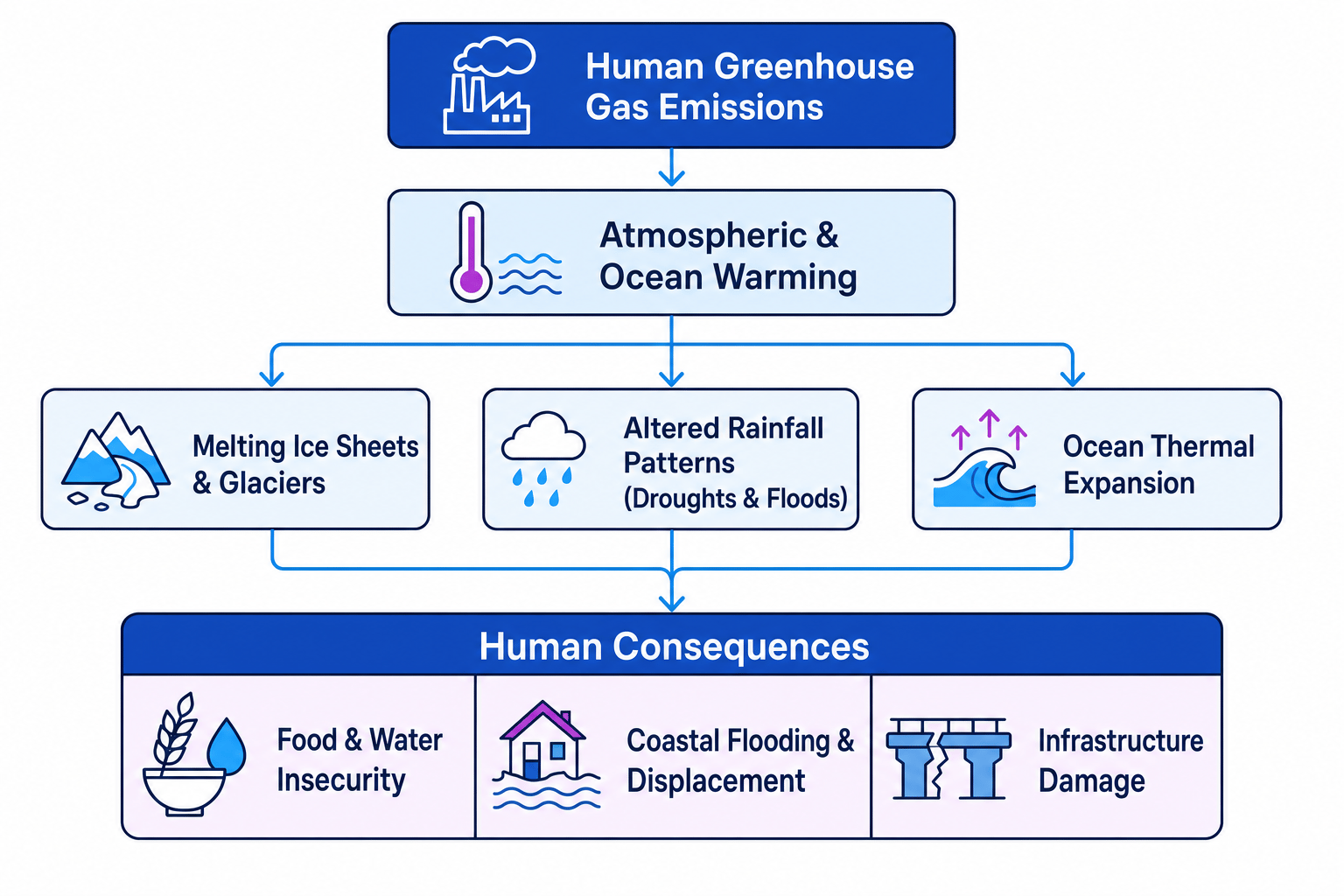
Current global climate change is mainly linked to human greenhouse gas emissions from burning fossil fuels, agriculture, industry and land-use change. The consequences are already being experienced across the planet, not just predicted for the future.
The diagram below summarises the main links: climate change alters physical systems first, then those changes affect people, places and economies.
The big picture
Climate change is a risk multiplier: it often makes existing hazards, inequalities and environmental pressures worse, rather than creating every problem from scratch.
2. Reading evidence: anomalies, trends and baselines
In Geography, you may be given a graph showing temperature change over time. These graphs often use anomalies rather than raw temperatures.
A baseline is a reference period used for comparison, such as 1961–1990 or 1991–2020. A temperature anomaly is the difference between the observed temperature and the baseline average.
temperature anomaly=observed temperature−baseline average\text{temperature anomaly} = \text{observed temperature} - \text{baseline average}temperature anomaly=observed temperature−baseline averageIf the anomaly is positive, conditions were warmer than the baseline. If it is negative, conditions were cooler.
Calculating a temperature anomaly
- Suppose a climate graph shows that the baseline average temperature for a country is 14.0 °C, while the observed temperature in one year is 15.2 °C.
- Subtract the baseline from the observed value: 15.2−14.0=+1.215.2 - 14.0 = +1.215.2−14.0=+1.2 °C.
- Interpret the result: the year was 1.2 °C warmer than the baseline, which is evidence of warmer conditions if it fits a longer-term trend.
Confusing weather with climate
Do not say “one hot day proves climate change”. A single hot day is weather. Stronger evidence comes from long-term trends, repeated records, and changes in the frequency or intensity of events such as heatwaves.
3. Physical consequences currently being experienced
Climate change affects the Earth system, meaning the connected parts of the planet: atmosphere, oceans, ice, land, living things and human activity.
Rising temperatures and heatwaves
Global average temperature has risen by about 1.2 °C since the late 19th century, although exact figures vary slightly depending on the dataset. Warming is not even: some regions, especially the Arctic, are warming faster than the global average.
A heatwave is a prolonged period of unusually hot weather for a particular place. Heatwaves can:
- increase heat stress and deaths, especially among older people and those with health conditions
- reduce crop yields if plants suffer water stress
- damage transport infrastructure, such as railway lines and roads
- increase demand for water and electricity
In the UK, the 2022 heatwave produced a record temperature of 40.3 °C at Coningsby, Lincolnshire. This shows that climate change consequences can be local and national, not just distant or “global”.
Changing rainfall: droughts and floods
A warmer atmosphere can hold more water vapour, so rainfall events can become heavier in some places. At the same time, shifting atmospheric circulation can make other places drier or make dry seasons longer.
This means climate change can increase both:
- drought risk, where water supply is too low for people, farming and ecosystems
- flood risk, where heavy rainfall, rivers or storm surges overwhelm natural and human drainage systems
Named examples include the Horn of Africa drought affecting Somalia, Ethiopia and Kenya in the early 2020s, and the 2022 Pakistan floods, where extreme monsoon rainfall combined with high exposure and vulnerability. Exact attribution is complex, but climate change can increase the likelihood or severity of heavy rainfall and drought conditions.
Calculating percentage increase in rainfall
- Imagine a town normally receives 80 mm of rain in a very wet week, but during an extreme event it receives 124 mm.
- Use the percentage change formula:
- Substitute the values:
- Interpret the result: rainfall was 55% higher than the comparison value, which helps explain why drains, rivers and flood defences may have been overwhelmed.
Melting ice and sea-level rise
The cryosphere is the frozen part of the Earth system, including glaciers, ice sheets, sea ice, snow and permafrost. Climate change is causing many glaciers to retreat and ice sheets in Greenland and Antarctica to lose mass.
Sea level rises mainly because:
- land ice melts and adds water to the oceans
- seawater expands as it warms, called thermal expansion
Sea-level rise increases the risk of coastal flooding, erosion and saltwater entering freshwater supplies. Low-lying countries and islands are especially exposed, including Bangladesh, the Maldives and some Pacific island states.
Explaining sea-level rise as a chain of consequences
- Start with the physical change: higher global temperatures cause land ice to melt and oceans to warm.
- Link this to the process: melting land ice adds water to the sea, while warmer seawater expands.
- Connect it to place: in a low-lying delta such as Bangladesh, even small rises in sea level can worsen storm-surge flooding and saltwater intrusion.
- Add the human consequence: farmland, homes and drinking water supplies may be damaged, increasing displacement and economic losses.
Ocean warming and ecosystem change
Warmer oceans can damage marine ecosystems. Coral bleaching happens when corals are stressed by warm water and expel the algae living in their tissues. If stress continues, corals may die.
The Great Barrier Reef in Australia has experienced repeated mass bleaching events in the 21st century. This affects biodiversity, tourism, fishing and coastal protection.
On land, species may shift towards cooler areas, such as higher altitudes or closer to the poles. Some species cannot move fast enough, especially if habitats are fragmented by roads, cities or farmland.
Use physical and human links together
A strong answer rarely stops at “ice melts” or “corals bleach”. Add the next link: Who or what is affected? For example, coral bleaching can reduce fish habitats, which can affect fishing communities and tourism income.
4. Human consequences: impacts depend on exposure and vulnerability
The same climate hazard does not affect all places equally. A severe flood in one country may cause fewer deaths than a smaller flood somewhere else if buildings, warning systems, healthcare and emergency planning are stronger.
Exposure and vulnerability
Exposure means people, property or ecosystems are located where a hazard can affect them. Vulnerability means how likely they are to be harmed, depending on factors such as income, housing quality, health, age and access to support.
Human consequences include:
| Consequence | How climate change can contribute | Located example |
|---|---|---|
| Food insecurity | Heat, drought or flooding can reduce crop yields and kill livestock. | Horn of Africa drought affecting pastoralist communities. |
| Water stress | Drought, glacier retreat and saltwater intrusion can reduce reliable freshwater supplies. | Coastal Bangladesh faces salinity problems in some areas. |
| Health risks | Heat stress, smoke from wildfires, poor air quality and disease spread can increase illness. | European heatwaves have caused excess deaths, especially among older people. |
| Damaged infrastructure | Floods, storms, heat and coastal erosion can damage homes, roads, railways and power systems. | UK heat in 2022 disrupted rail travel and increased fire risk. |
| Displacement | People may be forced to move temporarily or permanently after floods, droughts or coastal erosion. | Pakistan’s 2022 floods displaced millions within the country. |
Comparing vulnerability between places
- Identify the hazard in both places: for example, extreme heat affecting a city in the UK and a rapidly growing city in a lower-income country.
- Compare exposure: both may have many people living in built-up areas, where concrete and tarmac store heat.
- Compare vulnerability: poorer households may have less access to cooling, healthcare, insurance or safe housing.
- Explain the outcome: the physical hazard may be similar, but the human consequences can be worse where vulnerability is higher and adaptive capacity is lower.
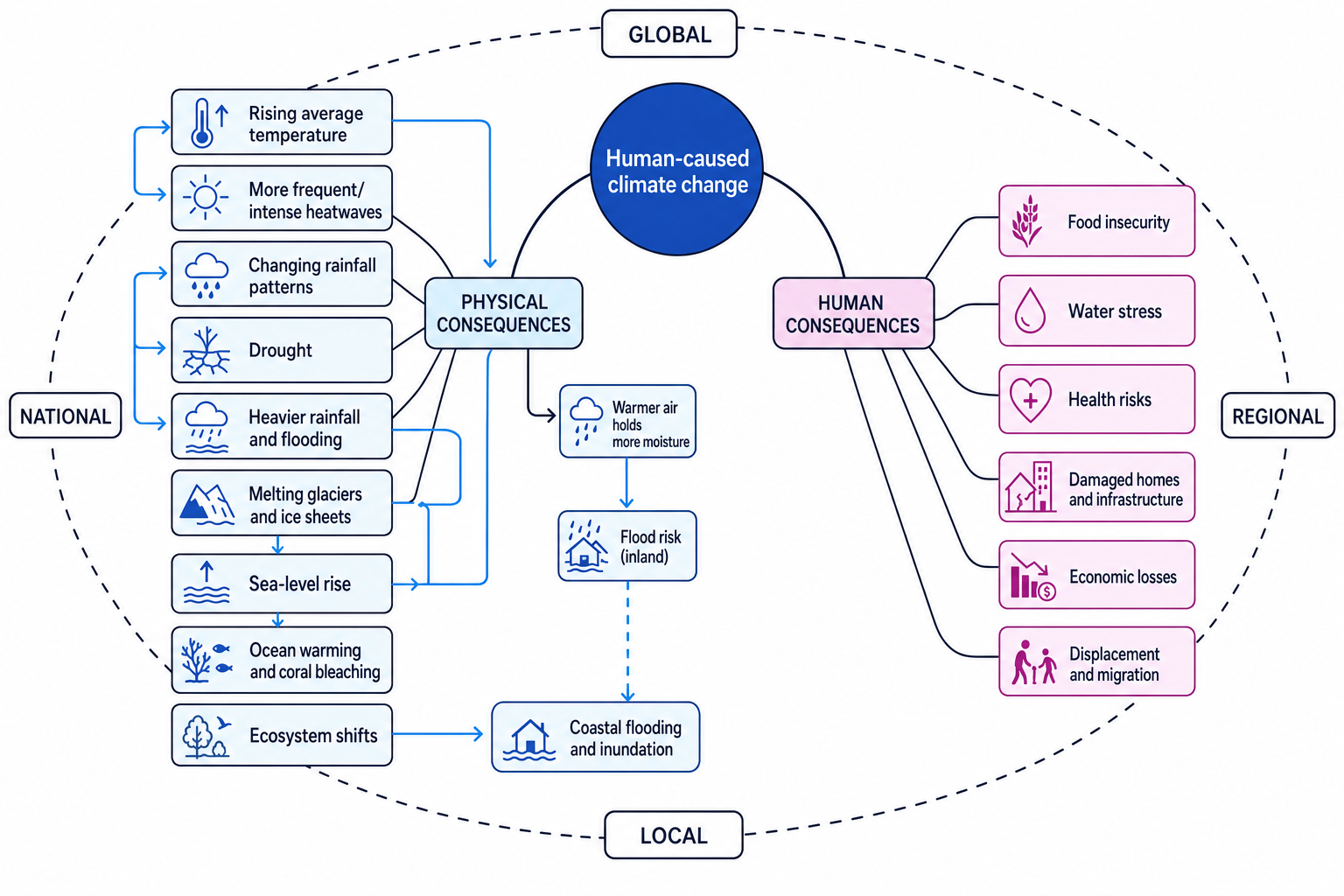
5. Consequences happen at different scales
Climate change is global, but its consequences are experienced at many scales.
At the global scale, rising temperatures, sea-level rise and ocean warming affect Earth systems as a whole. Global food prices can also be affected if harvests fail in major exporting regions.
At the regional scale, impacts vary. The Arctic faces rapid warming, sea-ice loss and permafrost thaw. The Mediterranean faces greater heat and wildfire risk. The Sahel region of Africa is vulnerable to rainfall variability, drought and pressure on farming.
At the national scale, governments must manage costs to healthcare, infrastructure, farming, water supply and disaster response. For example, Pakistan has had to respond to major flood damage, while the UK is adapting to hotter summers, flood risk and coastal erosion.
At the local scale, impacts are felt in homes, streets, schools, farms and ecosystems. A coastal village may face erosion; an urban neighbourhood may face heat stress; a farmer may face crop failure after drought.
Uneven impacts
The countries and communities most affected by climate change are not always those that have produced the most greenhouse gas emissions. This makes climate change an environmental, economic and social issue.
Avoid overclaiming
Climate change does not automatically “cause” every flood, drought, storm or wildfire. A better phrase is that it can increase the likelihood, intensity or impacts of some events, while local factors such as land use, drainage and poverty also matter.
In the exam
- Use a clear chain: climate change → physical process → human or environmental consequence → named place.
- Include scale where possible, such as global sea-level rise, regional Arctic warming, national flood impacts in Pakistan, or local UK heatwave disruption.
- Be precise with language: write “increases the risk of” or “can make more intense” rather than claiming every event is caused only by climate change.
Check yourself
- Can you explain two physical consequences of climate change and link each one to a human impact?
- Why might the same flood hazard cause different levels of damage in two countries?
- Can you name one global, one regional, one national and one local example of a climate change consequence?