What you'll learn
- Where temperate deciduous woodlands are found and what makes them distinctive.
- How climate, soil, water, plants, animals and humans are interdependent.
- Why biodiversity is moderate, and how plants and animals adapt to seasonal change.
- How woodlands provide goods and services, what threatens them, and how they can be managed sustainably.
Starting point: what is a deciduous woodland?
Deciduous woodland
An ecosystem is a community of living organisms interacting with non-living conditions. A biome is a very large ecosystem type. A deciduous woodland is a temperate biome dominated by broad-leaved trees that lose their leaves in autumn or winter.
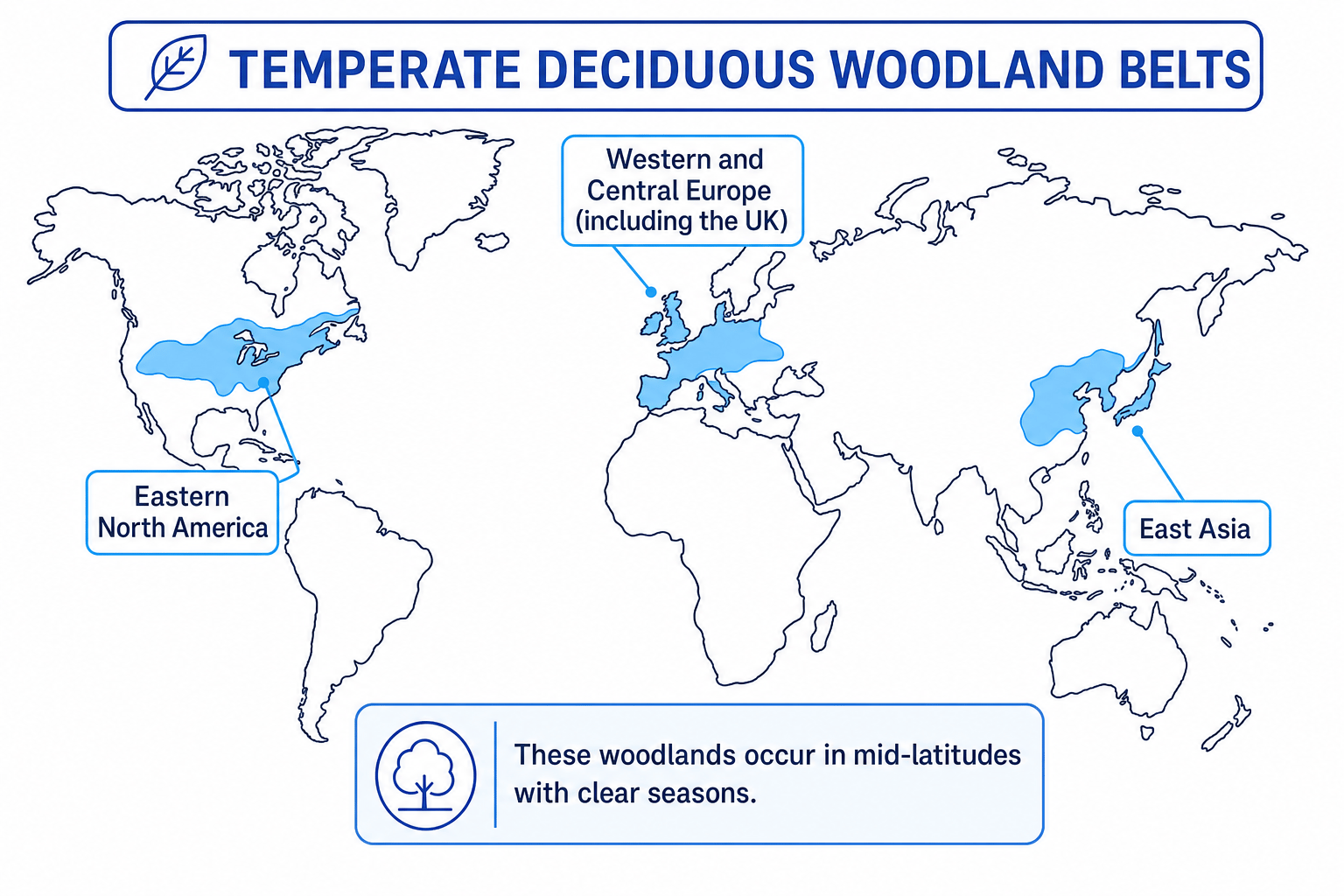
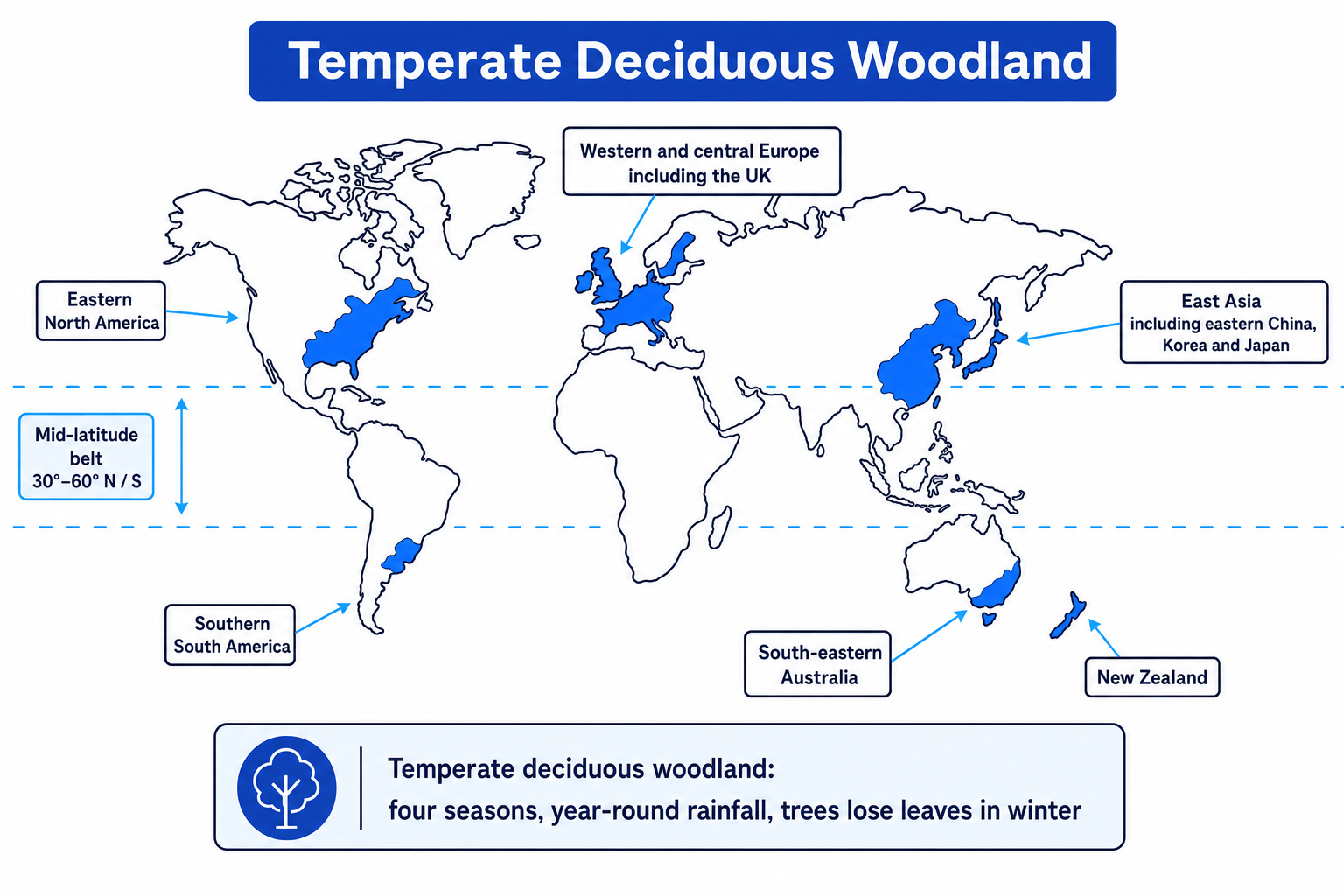
Temperate means moderate: not usually extremely hot or cold, with clear seasonal changes. Deciduous woodlands are mainly found in the mid-latitudes, especially eastern North America, western and central Europe including the UK, and East Asia.
Classifying a woodland climate
A climate graph shows January at about 4°C, July at about 18°C, and rainfall in every month, totalling roughly 750 mm a year.
- Compare the temperatures: the year is seasonal, with cool winters and warm summers, so it fits a temperate biome rather than a tropical biome.
- Check rainfall: rain falls all year, so it is not a desert climate and there is enough water for trees.
- Link climate to vegetation: warm, wet summers support broad leaves, while cool winters favour trees that shed leaves to reduce stress.
Abiotic and biotic characteristics
Abiotic and biotic factors
Abiotic factors are non-living parts of an ecosystem, such as climate, soil and water. Biotic factors are living parts, such as plants, animals, fungi, bacteria and humans.
Climate
Deciduous woodlands have four seasons. Rainfall is usually moderate and spread through the year. Summer warmth gives a growing season, while winter cold reduces plant growth.
Soil
Soils are often brown earth soils: fertile temperate soils with plenty of humus, which is dark organic matter from decomposed leaves. Leaf litter helps recycle nutrients back into the soil.
Water
Trees affect the water cycle. The canopy catches some rainfall before it reaches the ground; this is interception. Roots help water soak into the soil and reduce rapid surface runoff.
Plants and animals
Plants are layered: tall canopy trees such as oak, beech and ash; shrubs such as holly and hazel; a field layer of grasses, ferns and spring flowers; and mosses, fungi and decomposers near the ground.
Animals include deer, foxes, badgers, squirrels, insects and birds. Decomposers are organisms, such as fungi and bacteria, that break down dead material.
Humans
Humans are living organisms, but in geography they are often considered separately because they strongly alter ecosystems through farming, forestry, recreation, road building and conservation.
Interdependence and food webs
Everything is connected
Interdependence means parts of an ecosystem rely on each other. A change in one part, such as rainfall or deer numbers, can affect plants, soils, animals and people.
A food web is a diagram showing feeding relationships. Arrows show the transfer of energy and nutrients from the organism being eaten to the consumer, for example: oak acorn → squirrel → fox.
Interdependence in deciduous woodland includes:
- Climate and water affect tree growth.
- Trees add leaf litter, which improves soil fertility.
- Fertile soil supports more plant growth.
- Plants provide food and habitats for animals.
- Animals pollinate plants, spread seeds, graze saplings and add waste to the soil.
- Humans can protect woodland, but can also compact soil, remove trees or fragment habitats.
The nutrient cycle: Gersmehl model
Nutrient cycle
The nutrient cycle is the movement of nutrients between living material, dead organic matter and soil. A Gersmehl model shows this using stores and arrows.
The three main stores are biomass — nutrients in living plants and animals, litter — dead leaves, branches and organisms, and soil — nutrients available for roots. In deciduous woodland, all three stores are fairly important because leaf fall is seasonal and decomposition is reasonably quick.
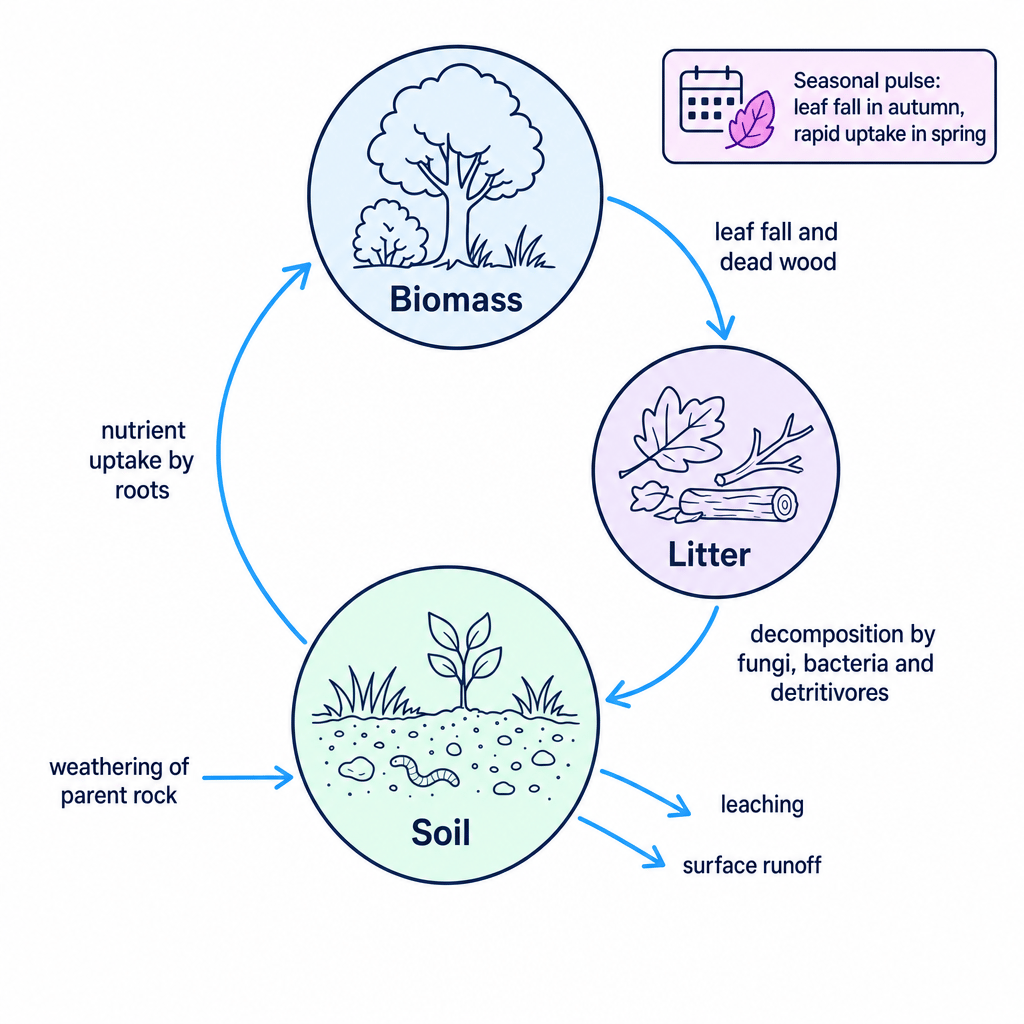
Leaching is when nutrients are washed down through soil by rainwater. Weathering is the breakdown of rock, which can slowly add minerals to the soil.
Tracing nutrients after autumn leaf fall
- In autumn, trees drop leaves, so nutrients move from the biomass store to the litter store.
- Fungi, bacteria and detritivores such as earthworms break down the litter, moving nutrients into the soil store.
- In spring, roots take up nutrients from the soil, increasing the biomass store as new leaves grow.
Reading Gersmehl diagrams
Do not confuse store size with transfer speed. In a Gersmehl model, circle size shows how many nutrients are stored, while arrow size shows how quickly nutrients move.
Biodiversity and adaptations
Biodiversity
Biodiversity means the variety of living organisms in an area, including different species, habitats and genetic variation.
Deciduous woodlands have moderate biodiversity. They are richer than deserts or tundra because they have enough rainfall, fertile soils and layered habitats. They are less biodiverse than tropical rainforests because winter cold limits year-round growth and food supply.
Plant adaptations
- Broad, flat leaves have a large surface area to capture sunlight during the growing season.
- Leaves are often thin, helping photosynthesis in spring and summer.
- Trees shed leaves in winter to reduce water loss and avoid frost damage.
- Buds may have protective scales, ready for rapid growth in spring.
- Deep and spreading roots help trees reach water and stay stable.
Animal adaptations
- Migration is seasonal movement; some birds leave in winter when food is scarce.
- Hibernation is a long inactive period; dormice and some bats conserve energy in winter.
- Food storage helps animals survive seasonal shortages; squirrels and jays store nuts and acorns.
Winter water stress
Deciduous trees do not lose leaves because they are “dead” in winter. They lose leaves to conserve water and reduce damage when cold or frozen soil makes water harder to absorb.
Goods, services and threats
Goods and services
Goods are physical products people take from ecosystems, such as timber and fuelwood. Services are benefits ecosystems provide, such as recreation, conservation value, carbon storage and water regulation.
Deciduous woodlands provide:
- Timber for construction, furniture and fencing.
- Fuel through firewood and wood pellets.
- Conservation by protecting habitats, species and genetic diversity.
- Recreation such as walking, cycling, education and tourism.
- Extra services including carbon storage, flood reduction, soil protection and improved wellbeing.
Climate change as a threat
Climate change means long-term change in climate patterns, especially linked to rising greenhouse gas concentrations. It can threaten woodland structure — the layers, ages and species present — and function — what the ecosystem does.
Possible impacts include:
- Hotter, drier summers causing drought stress and tree death.
- More storms damaging canopies and creating gaps.
- Pests and diseases spreading more easily.
- Earlier spring growth creating mismatches between flowers, insects and birds.
- Some species shifting northwards or to cooler sites, changing biodiversity.
Deforestation causes
Deforestation is the removal of forest or woodland, usually to use the land for something else.
Key causes include:
- Urbanisation and population growth: more demand for housing, roads, services and recreation space.
- Timber extraction: woodland cut for sale, income and employment.
- Agricultural change: larger fields, livestock grazing or crop expansion replacing woodland.
A GIS — Geographical Information System — is a digital mapping system with layers, such as forest cover, roads, slope, settlements and protected areas. It helps identify patterns of woodland loss.
Identifying a forest-loss pattern on GIS
- Overlay forest-loss data with roads and settlements to see whether clearance clusters near access routes or urban edges.
- Compare dates on the GIS layers to see whether woodland loss spreads over time or appears as one sudden clearance.
- Link the pattern to likely causes: edge loss may suggest urbanisation, road-linked strips may suggest timber extraction, and flatter cleared land may suggest agriculture.
Using population and resource graphs
When reading line graphs of future population projections, compare the different scenario lines and link rising population to higher demand for land, food, housing and timber. Do not claim population growth causes deforestation unless you explain the land-use link.
Located example: sustainable management in the New Forest, UK
Sustainable management
Sustainable management means using resources in a way that meets present needs while protecting the ecosystem for the future.
A useful located example is the New Forest, mainly in Hampshire in southern England, within the UK. Nationally, the UK has much less natural woodland than it once did, so ancient and semi-natural woodlands are especially valuable. Regionally, the New Forest is close to large populations in southern England, so recreation pressure is high.
Management approaches include:
- Zoning visitors: car parks, marked paths and cycle routes concentrate footfall and reduce trampling in sensitive habitats.
- Selective felling: only some trees are removed, helping maintain woodland structure and habitat variety.
- Coppicing: cutting trees near the base so they regrow, producing wood while creating varied habitats.
- Deadwood retention: leaving fallen wood for fungi, beetles and nesting species.
- Grazing management: commoners, meaning local people with traditional grazing rights, graze ponies and cattle, maintaining open wood pasture.
- Conservation protection: planning controls and protected-site status help limit damaging development.
- Education: signs, visitor centres and campaigns encourage responsible dog walking, litter control and fire prevention.
The key balance is between local jobs, recreation, timber, wildlife and long-term ecosystem health.
In the exam
- Use linked chains: abiotic change → biotic response → ecosystem impact → human consequence.
- For Gersmehl diagrams, describe both stores and transfers; do not just name the three circles.
- For management questions, include a located example, specific actions, and a judgement about how they reduce conflict or protect sustainability.
Check yourself
- Why is deciduous woodland biodiversity described as moderate rather than high?
- How does autumn leaf fall affect the nutrient cycle?
- How can GIS help identify the causes of woodland loss?