

What you'll learn
- Why the UK is sometimes described as having a “two-speed economy”.
- How greenfield development and brownfield regeneration create different costs and benefits.
- How to calculate and interpret net migration.
- Why different stakeholders have different values and attitudes towards migration.
Starting point: what is this topic really about?
This part of UK Challenges is about how the UK is changing. It links settlement — where people live and work — with population change and economic inequality.
A key idea is that UK challenges are not evenly spread. Some places have very high wages, investment and house prices, while others face lower pay, weaker transport links and fewer high-value jobs. At the same time, the UK needs more housing, but deciding where to build is controversial. Migration also changes the size, structure and needs of the population.
Settlement, population and economy
A settlement is a place where people live, from a village to a major city. Population means the number and characteristics of people in a place. The economy is the system of jobs, businesses, income, trade and services that produces wealth.
The UK’s “two-speed economy”
Two-speed economy
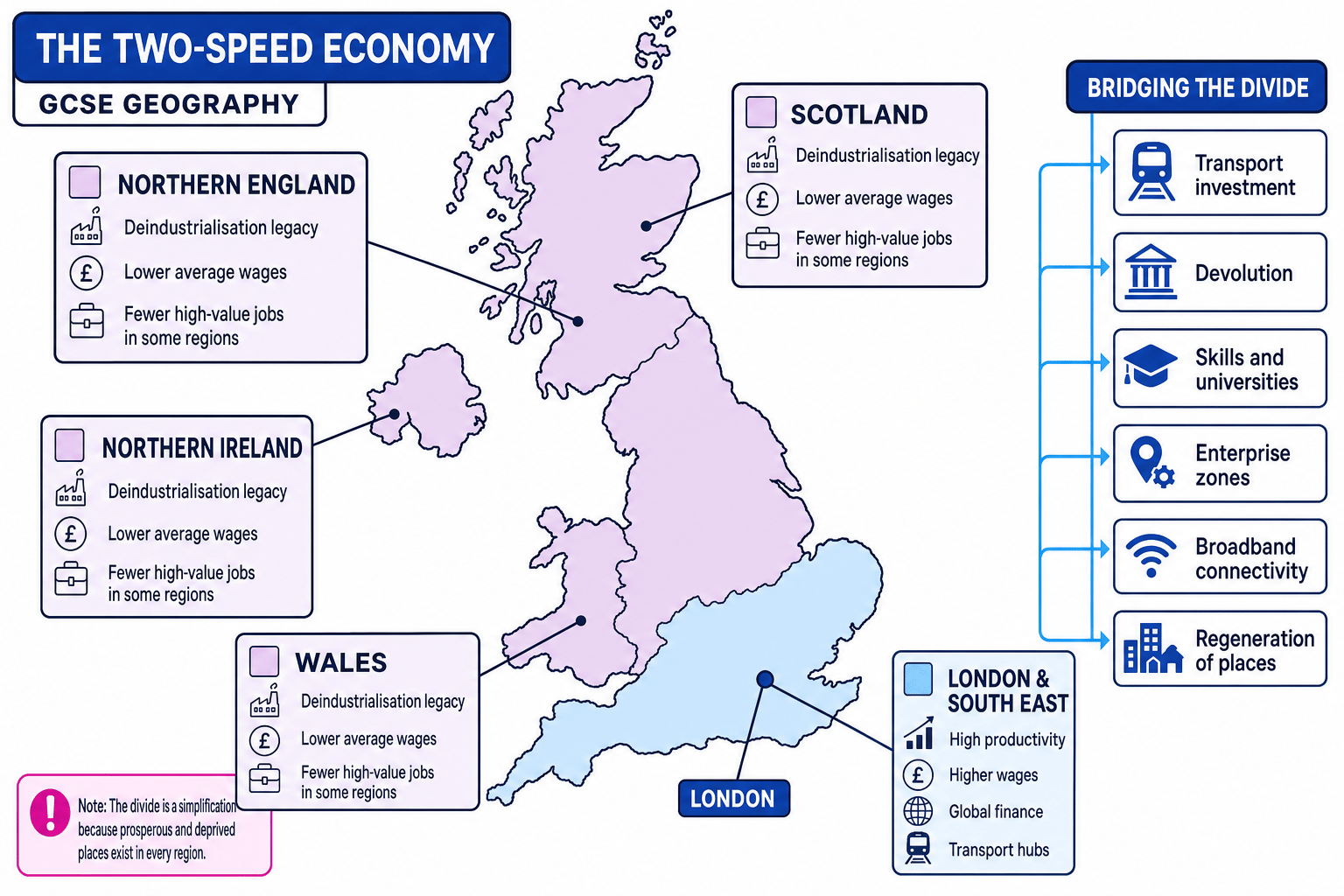
A two-speed economy is when different parts of a country grow at different rates. In the UK, London and the South East often grow faster and attract more investment than many other regions.
The phrase is a simplification, but it is useful. London and the South East have many advantages: global financial services, major airports, government institutions, universities, dense transport networks and high levels of private investment.
Other regions, including parts of northern England, Wales, Scotland and Northern Ireland, can have lower average wages and fewer high-value jobs. Some places still feel the effects of deindustrialisation, which means the decline of manufacturing industries such as coal, steel, textiles and shipbuilding.
The big idea
The UK’s economic challenge is not simply “rich south, poor north”. It is about uneven development between regions and within regions. Prosperous and deprived places exist in every part of the UK.
Why does the gap exist?
Several processes help explain the two-speed economy.
Agglomeration means businesses benefit from being close together. London has many banks, law firms, media companies, universities and transport links in one place, so skilled workers and companies are attracted there.
Productivity means the value of goods or services produced per worker or per hour. Regions with more high-skilled jobs and advanced industries usually have higher productivity.
Infrastructure means the basic systems that help a place function, such as roads, railways, broadband, energy supply, hospitals and schools. Better infrastructure can attract investment and make workers more mobile.
Worked skill: comparing regional growth
Calculating percentage change in pay
A resource says average weekly pay rose from £600 to £690 in Region A, and from £500 to £525 in Region B.
- Use the percentage change formula:
- For Region A, substitute the values:
- For Region B, substitute the values:
- Compare the results: Region A grew faster because pay increased by 15%, compared with 5% in Region B. This supports the idea of uneven economic growth.
Options for bridging the gap
To bridge the gap means to reduce regional inequality. No single policy can solve it, so governments usually need a mix of strategies.
Transport investment
Better rail, roads and buses can connect people to jobs and help businesses reach customers. Examples include investment linked to the Northern Powerhouse, TransPennine rail improvements and local transport upgrades in city regions such as Greater Manchester and the West Midlands.
However, transport schemes are expensive. They can also benefit already-successful places most if poorer communities are not well connected to the new routes.
Devolution
Devolution
Devolution means transferring some decision-making power from central government to regional or local authorities.
In England, some areas have elected metro mayors, such as Greater Manchester and the West Midlands. Devolution can allow local leaders to make decisions about transport, skills, housing and regeneration based on local needs.
Skills, education and universities
Improving education, apprenticeships and technical training can help workers access better-paid jobs. Universities can support innovation and attract high-value industries, especially when linked to science parks and local businesses.
Enterprise zones and investment incentives
An enterprise zone is an area where businesses may receive benefits such as tax relief, simplified planning or improved infrastructure. The aim is to attract investment and jobs to areas that need economic growth.
Thinking incentives always create new jobs
Some incentives move jobs from one place to another rather than creating genuinely new employment. In evaluation questions, ask whether a strategy creates long-term, skilled jobs for local people.
Regeneration
Regeneration means improving a place economically, socially and environmentally. It can include new housing, cleaned-up land, better public spaces, improved transport and support for businesses.
A strong answer usually evaluates whether regeneration benefits existing residents, or mainly attracts wealthier newcomers and raises house prices.
Greenfield development and brownfield regeneration
The UK has a housing challenge: many areas need more homes, especially where demand is high. But building new homes creates conflicts over land use.
Greenfield and brownfield sites
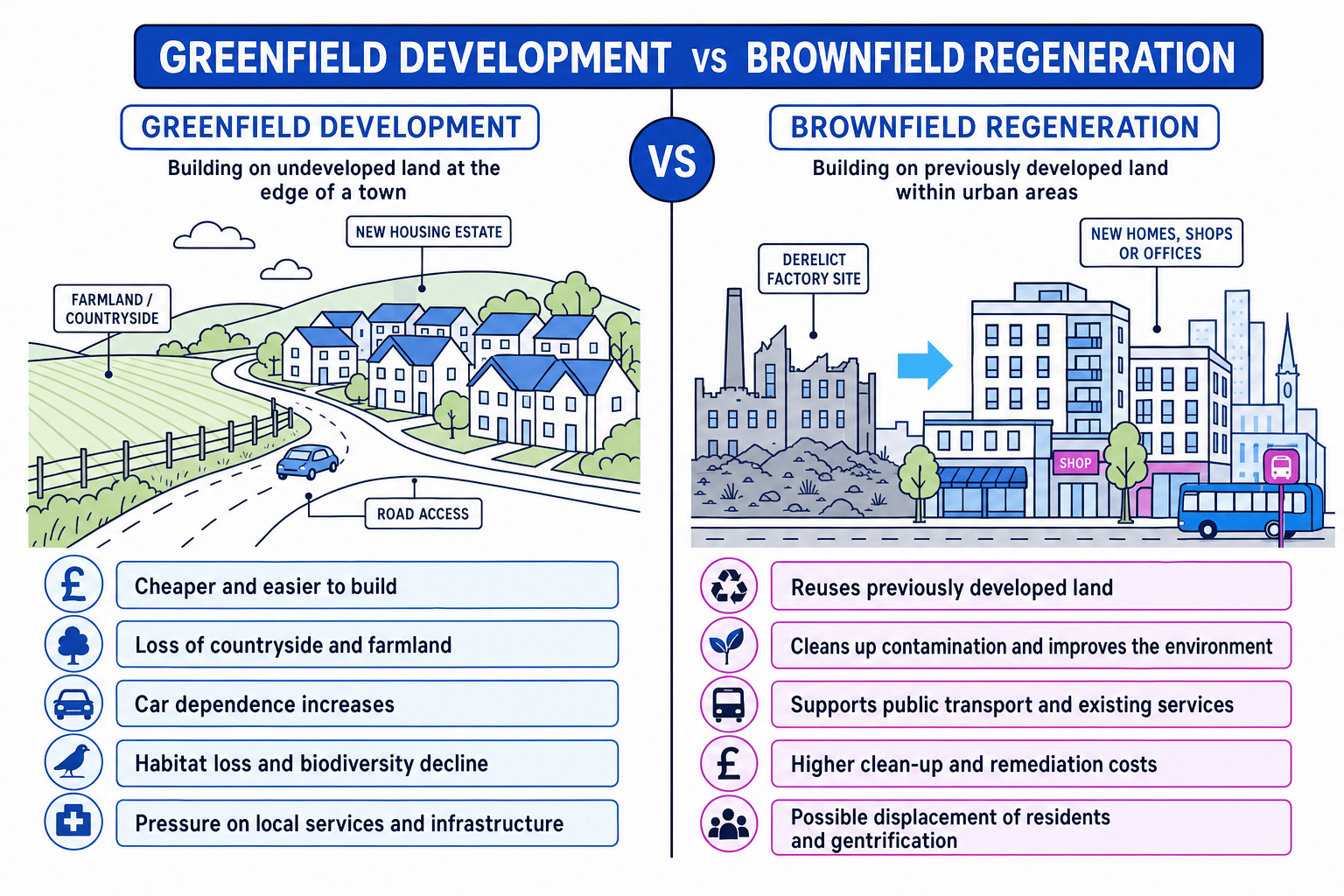
A greenfield site is land that has not previously been built on, often farmland or countryside near a settlement. A brownfield site is land that has been built on before and is now derelict, vacant or underused.
Greenfield development: benefits and costs
Greenfield land is often cheaper and easier to build on because there may be fewer existing buildings to demolish. It can allow larger housing estates, roads, schools and business parks to be planned together.
But it can also cause the loss of countryside, habitats and farmland. It may increase car use if the development is on the edge of a town with weak public transport. It can also put pressure on local services such as GP surgeries, schools and roads.
Brownfield regeneration: benefits and costs
Brownfield regeneration reuses land within existing urban areas. This can reduce pressure on the countryside and support public transport because the site is already near services and jobs.
However, brownfield land can be expensive to prepare. Old industrial sites may have contaminated land, meaning the soil or groundwater has been polluted by previous uses. Cleaning this up is called remediation.
A good UK example is Stratford in East London, where former industrial land was regenerated for the London 2012 Olympic and Paralympic Games. The area gained new housing, transport improvements, parkland and sports facilities, but some critics argue that rising rents and house prices made the area less affordable for some local residents.
Green belt is not the same as greenfield
The green belt is a planning policy designed to keep land around cities open and limit urban sprawl. Some greenfield sites are in the green belt, but not all greenfield land is green belt land.
Worked decision-making: choosing a development site
Comparing greenfield and brownfield options
A council needs 2,000 new homes. Site A is greenfield land on the edge of town. Site B is a derelict factory site near the town centre.
-
Compare the economic factors: Site A may be cheaper and quicker to build on, but Site B could attract investment into a run-down urban area.
-
Compare the social factors: Site A may provide larger family homes, but Site B is closer to jobs, shops, schools and public transport.
-
Compare the environmental factors: Site A would cause loss of countryside and possible habitat damage, while Site B reuses land but may need expensive remediation.
-
Make a balanced judgement: if sustainability is the priority, Site B may be stronger because it reuses urban land and reduces car dependence. If rapid housing supply is the priority, Site A may appear easier, but it has greater environmental costs.
UK net migration
Migration terms
Migration is the movement of people from one place to another. Immigration means people moving into a country. Emigration means people leaving a country. Net migration is the difference between immigration and emigration.
Net migration can be positive or negative. If more people enter than leave, net migration is positive. If more people leave than enter, net migration is negative.
The UK has usually had positive net migration in recent decades. Recent Office for National Statistics estimates have been high by historical standards, with net migration around the hundreds of thousands per year in the early 2020s. Exact figures are revised and depend on the year and definition used.
Calculating net migration
Calculating net migration and migration rate
A country has 1,200,000 immigrants and 500,000 emigrants in one year. Its population is 67,000,000.
- Use the net migration formula:
- Substitute the values:
-
Interpret the sign: net migration is positive, so the population increased by 700,000 due to migration.
-
To compare with other countries, calculate the rate per 1,000 people:
- This means net migration was about 10.4 people per 1,000 population.
How reliable are UK migration statistics?
Migration statistics are useful, but they are not perfect.
The UK uses sources such as census data, visa records, tax and employment data, health registrations and passenger data. The Office for National Statistics combines and revises these sources to estimate long-term international migration.
A long-term international migrant is usually someone who changes their country of usual residence for at least 12 months. This matters because short-term workers, tourists and some students may not count in the same way.
Migration data is often revised
Do not treat one migration figure as permanently exact. Estimates can change when better administrative data becomes available, or when people’s intentions change after arriving or leaving.
Reliability issues include:
- Emigration is harder to measure than immigration because people do not always formally record that they have left.
- Short-term migration may be missed or counted differently.
- Undocumented migration is difficult to measure accurately.
- Student migration can be complex because some students leave after study while others stay for work.
- Local-scale data is usually less reliable than national data because smaller numbers create more uncertainty.
- The Census is detailed, but it only happens every 10 years, so it can become out of date.
Stakeholder attitudes towards migration
Stakeholder
A stakeholder is a person, group or organisation affected by an issue, or able to influence decisions about it.
Different stakeholders have different values. A value is a belief about what matters most, such as economic growth, cultural diversity, public service capacity, border control, human rights or community stability. These values shape attitudes towards migration.
Different viewpoints
Migrants may value safety, better jobs, education, family reunion or freedom from conflict. Many send remittances, which are money transfers to family members in another country.
Employers may support migration because it can fill labour shortages, especially in sectors such as health and social care, construction, hospitality, agriculture, universities and technology.
Local residents may have mixed views. Some value cultural diversity, new businesses and a younger workforce. Others worry about pressure on housing, schools, GP appointments and local wages.
Local councils may welcome population growth because it can support services and local economies, but they may also face short-term pressure if funding, housing and infrastructure do not keep up.
National government must balance economic needs, public opinion, border management and humanitarian responsibilities, such as supporting refugees.
Regional governments may have different attitudes. For example, parts of Scotland have argued that migration can help respond to ageing populations and population decline in some areas.
Attitudes are not fixed
Do not assume every person in a stakeholder group thinks the same way. Attitudes vary by age, job, income, location, personal experience and media influence.
Applying stakeholder thinking
Explaining different attitudes to migration
A coastal town has an ageing population and shortages of care workers. New migrants arrive to work in social care and hospitality.
-
Identify the economic impact: employers may support migration because it helps fill job vacancies and keeps services running.
-
Identify the social impact: some residents may welcome new families because they support schools, shops and community life.
-
Identify the pressure point: other residents may worry if housing, GP appointments or school places are already under strain.
-
Link attitudes to values: positive attitudes may be based on economic growth and diversity, while negative attitudes may be based on concerns about service capacity and rapid change.
Writing one-sided migration answers
Migration has costs and benefits for different people and places. Strong answers avoid “migration is good” or “migration is bad” and instead explain who benefits, who may be pressured, and why.
In the exam
- Use precise terms: net migration, brownfield, greenfield, regeneration, devolution and stakeholder.
- For “assess” or “evaluate” questions, give both benefits and costs, then make a justified judgement.
- When using data, calculate change carefully and quote figures from the resource rather than making vague claims.
- For migration questions, separate reliability of statistics from attitudes towards migration — they are different issues.
Check yourself
- Why is the phrase “two-speed economy” useful but also a simplification?
- What are two benefits and two costs of brownfield regeneration?
- Why might employers, local residents and councils have different attitudes towards migration?
