What you'll learn
- How the UK’s population is likely to change over the next 50 years.
- Why population change affects demand for water, energy, food, housing and transport.
- How growing populations put pressure on UK ecosystems.
- How sustainable transport options can help the UK reduce environmental impacts.
The big picture: people, resources and sustainability
The UK challenge is not simply “more people use more stuff”. It is about how many people live in the UK, where they live, how they travel, what they consume, and how efficiently resources are managed.
Core terms
- A resource is something people use to meet needs, such as water, energy, food, land or raw materials.
- Resource consumption means the amount of resources used by people, households, businesses or a whole country.
- Environmental sustainability means meeting present needs without damaging ecosystems or reducing the ability of future generations to meet their needs.
- A population projection is an evidence-based estimate of future population, based on assumptions about births, deaths and migration.
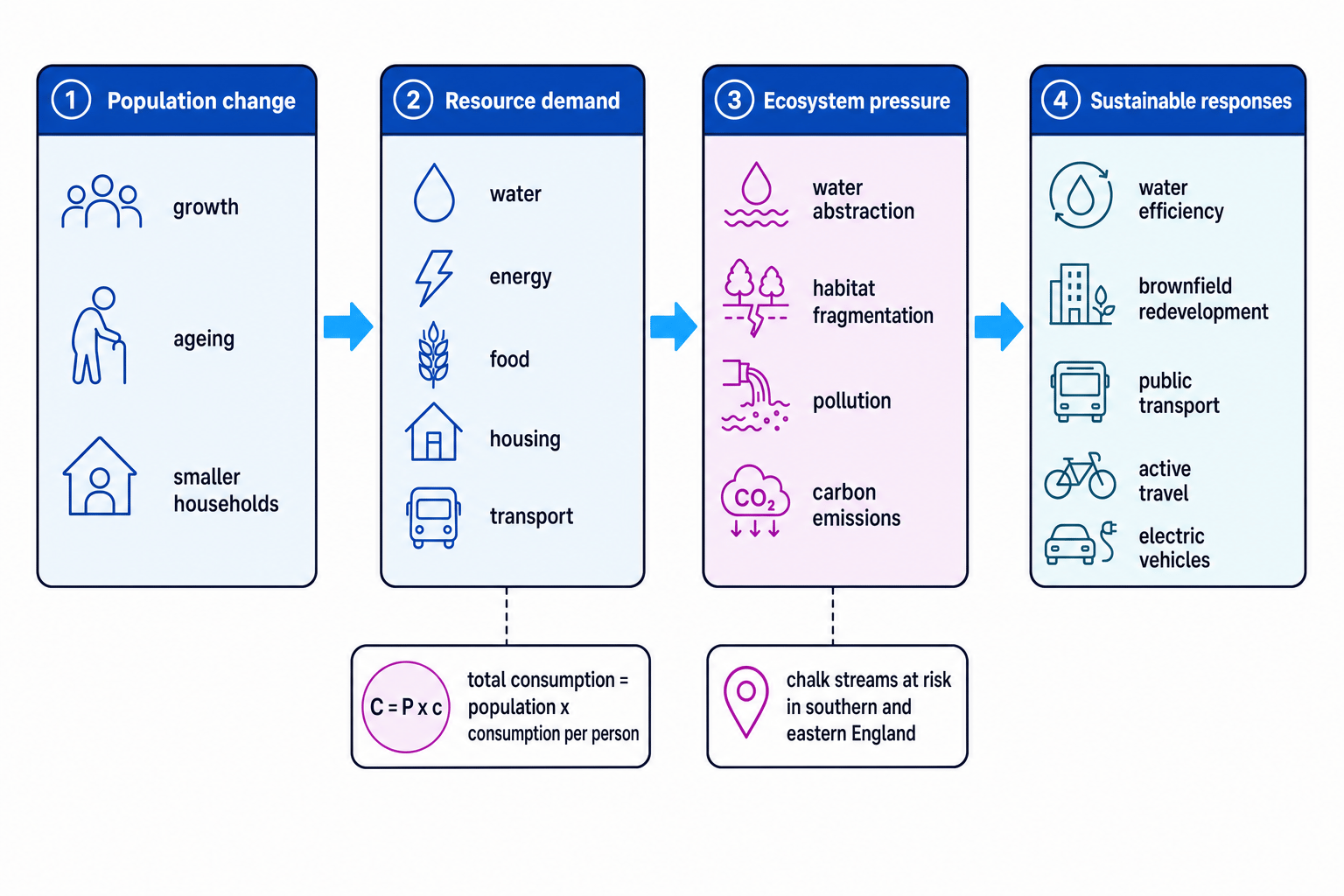
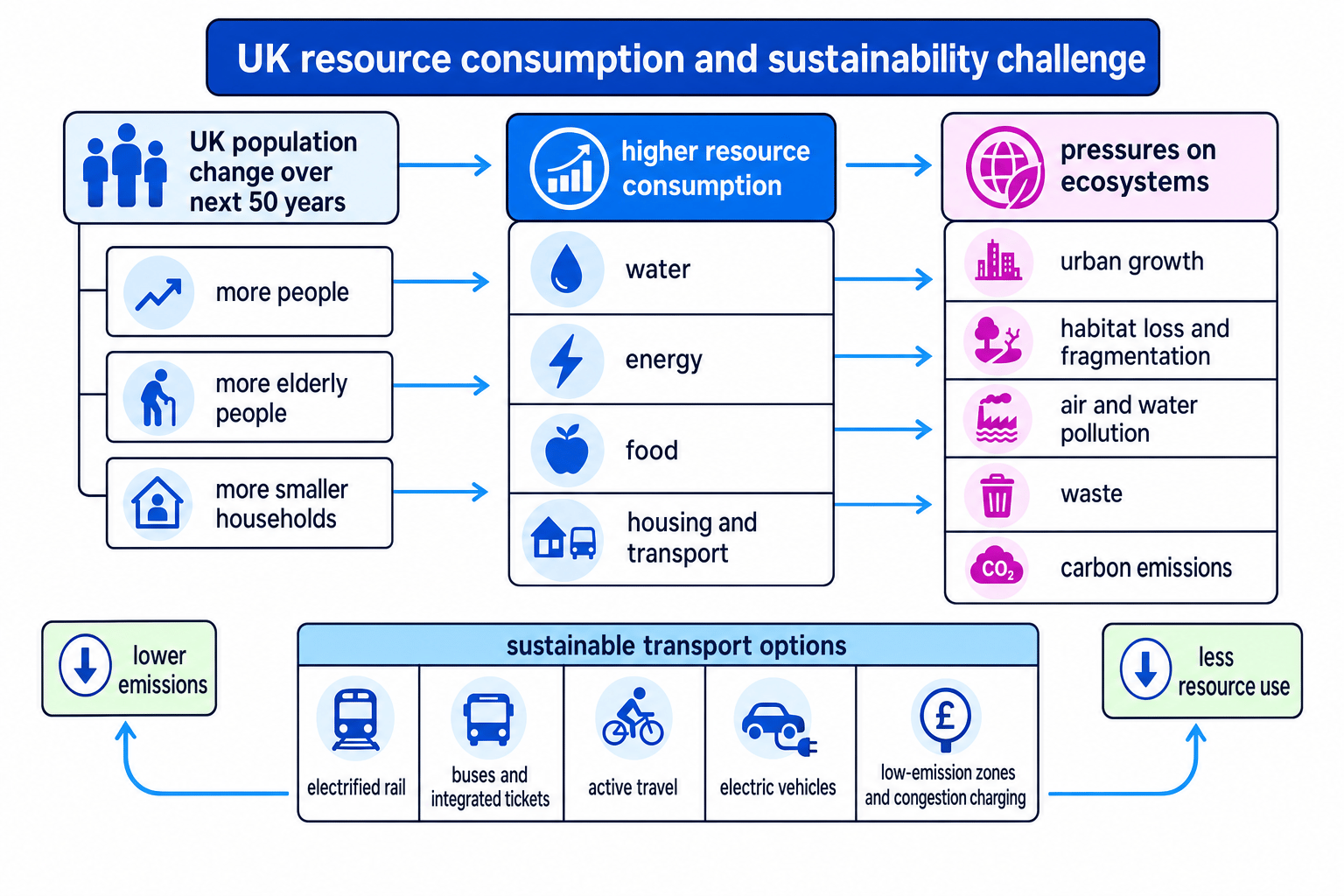
The challenge works like a chain: population change affects resource demand; resource demand can increase pressure on ecosystems; sustainable planning and transport can reduce some of these pressures.
1. How the UK population may change in the next 50 years
The UK population was about 68 million in the early 2020s. Most projections suggest it will continue to grow over the next 50 years, possibly reaching the mid-to-upper 70 millions, depending on future fertility, life expectancy and net migration.
Population change terms
- Fertility rate means the average number of children born per woman.
- Life expectancy means the average age a person is expected to live to.
- Net migration is the difference between the number of people entering a country and the number leaving it.
Key changes expected
More people overall
A larger population usually means higher total demand for:
- water for homes, farming, industry and energy production
- energy for heating, electricity and transport
- food from UK farming and imports
- housing and land for homes, roads, schools and hospitals
- waste services such as recycling, landfill and sewage treatment
An ageing population
The UK is also expected to have a larger proportion of older people. This can affect resource use because older populations may need more healthcare facilities, warmer homes in winter, accessible transport and local services.
More smaller households
Even if population growth is slow, the number of households can rise faster. A one-person household often uses more energy and water per person than a four-person household, because appliances, heating and rooms are not shared as efficiently.
Population is only part of consumption
A useful way to think about resource demand is C=P×cC = P \times cC=P×c, where CCC is total consumption, PPP is population, and ccc is consumption per person. Technology, efficiency and behaviour can reduce consumption per person.
Estimating extra domestic water demand
-
Compare two rounded population figures: if the UK rises from 68 million people to 76 million people, the extra population is ΔP=76,000,000−68,000,000=8,000,000\Delta P = 76{,}000{,}000 - 68{,}000{,}000 = 8{,}000{,}000ΔP=76,000,000−68,000,000=8,000,000 people.
-
Apply a typical average domestic water use of about 140 litres per person per day: extra demand=8,000,000×140=1,120,000,000\text{extra demand} = 8{,}000{,}000 \times 140 = 1{,}120{,}000{,}000extra demand=8,000,000×140=1,120,000,000 litres per day.
-
Convert litres to cubic metres: 1,120,000,000÷1,000=1,120,0001{,}120{,}000{,}000 \div 1{,}000 = 1{,}120{,}0001,120,000,000÷1,000=1,120,000 cubic metres per day.
-
Interpret the result: if water efficiency, leakage control and supply do not improve, population growth could add major pressure to reservoirs, rivers, aquifers and wastewater treatment.
Only discussing total population
In exam answers, do not stop at “the population is increasing”. Add how age structure, household size, regional growth and consumption per person affect resource demand.
2. Pressures of growing populations on UK ecosystems
Ecosystems and biodiversity
An ecosystem is a community of living things, such as plants and animals, interacting with each other and with the physical environment. Biodiversity means the variety of living organisms in an area.
UK ecosystems include rivers, woodlands, grasslands, heathlands, peatlands, coastlines, wetlands and urban green spaces. They provide ecosystem services, which are benefits people receive from nature, such as clean water, flood storage, carbon storage, pollination and recreation.
Main pressures from population growth
| Pressure | How population growth can increase it | UK examples |
|---|---|---|
| Urban growth | More homes, roads and services can use greenfield land and split habitats into smaller areas. | Urban fringes around London, Birmingham, Manchester and Bristol. |
| Water abstraction | More households and businesses increase demand for water taken from rivers and aquifers. | Chalk streams in southern and eastern England are vulnerable because they rely on groundwater. |
| Pollution | More traffic, sewage, waste and surface runoff can reduce air and water quality. | River systems near large towns and cities face pressure from runoff and wastewater. |
| Recreation pressure | More visitors can cause trampling, path erosion, litter and disturbance to wildlife. | National Parks, coastal paths, urban parks and lowland heathlands. |
| Climate emissions | Higher consumption and transport demand can increase greenhouse gas emissions. | Heatwaves and drought risk affect rivers, wetlands and urban ecosystems. |
A greenfield site is land that has not previously been built on, often farmland or semi-natural land. A brownfield site is land that has been built on before and may be reused, such as old industrial land.
Why this matters
When habitats are reduced or split up, species find it harder to feed, breed and move. This is called habitat fragmentation. Fragmented habitats are often less resilient to shocks such as drought, flooding or disease.
For example, southern England has many rare chalk streams. More homes can increase water demand, while paved surfaces increase polluted runoff. During dry summers, lower river flows can reduce oxygen levels and damage habitats for fish, plants and invertebrates.
Linking housing growth to river ecosystem pressure
-
Start with the population change: a growing town needs more housing, roads, schools and shops.
-
Link this to resource demand: more households increase water use, so more water may be abstracted from rivers or groundwater.
-
Link this to ecosystem impact: lower river flow can warm up faster, carry less dissolved oxygen and concentrate pollutants, which makes conditions harder for aquatic wildlife.
-
Add a sustainable response: water meters, leakage repairs, sustainable drainage systems and protecting river corridors can reduce the pressure.
Use a pressure-impact-response chain
For ecosystem questions, structure your answer as: population pressure → environmental impact → management response. This makes your explanation clearer and more geographical.
Assuming all growth has the same impact
Population growth in a dense city, a water-stressed region and a rural tourist area can create different pressures. Always connect the pressure to the specific ecosystem and location.
3. Sustainable transport options for the UK
Sustainable transport
Sustainable transport moves people and goods while reducing environmental damage, resource use and social inequality. It aims to cut emissions, improve air quality and keep places accessible.
Transport is a major part of the UK sustainability challenge because it uses energy, creates air pollution, emits greenhouse gases and requires land for roads, parking, railways and airports.
A key idea is modal shift, which means changing from a more damaging form of transport to a less damaging one, such as from private cars to buses, trains, cycling or walking.
Option 1: Rail improvement and electrification
Rail can move large numbers of people using less space than roads. Electrified rail can produce lower emissions than diesel trains, especially if electricity comes from renewable sources.
This helps with longer-distance commuting, intercity travel and freight. Moving freight from lorries to rail can reduce road congestion and emissions. However, rail projects are expensive, take years to build and may not serve rural areas well.
Option 2: Better buses, trams and integrated ticketing
Buses are flexible and can serve suburbs and smaller towns. Trams and light rail work well on busy urban corridors. Integrated ticketing means one payment system or ticket can be used across different transport modes.
Examples include London’s Oyster/contactless system, Manchester’s Bee Network, Nottingham’s tram system and park-and-ride schemes in cities such as York and Cambridge.
Option 3: Active travel
Active travel means walking, cycling or wheeling for everyday journeys. It is most effective for short trips to school, work, shops and public transport stops.
It reduces emissions, improves health and uses little road space. But it needs safe cycle lanes, good pavements, secure bike parking and routes that feel safe in the dark and in bad weather.
Option 4: Electric vehicles
Electric vehicles reduce exhaust emissions at the point of use, which can improve air quality in towns and cities. They are useful for journeys where walking, cycling or public transport are less practical.
However, they do not fully solve the transport problem. They still need road space, charging infrastructure, electricity, batteries and raw materials. They also do not remove congestion or tyre and brake particle pollution.
Option 5: Demand management
Demand management means reducing unnecessary car use or encouraging people to travel at different times or by different modes.
Examples include:
- congestion charging, such as in central London
- Ultra Low Emission Zones and Clean Air Zones
- workplace parking levies, such as Nottingham’s scheme
- road pricing, parking controls and lower speed zones
These can reduce traffic and pollution, but they work best when people have affordable alternatives.
Option 6: Planning places around public transport
Sustainable transport is not just about vehicles. It is also about where homes, jobs and services are located. Compact, mixed-use developments near stations and bus routes can reduce the need to drive.
Choosing a sustainable transport package
-
Identify the main problem: if a city-region has heavy commuter congestion and poor air quality, the issue is not only vehicle emissions but also too many car journeys on limited road space.
-
Match options to journey types: walking and cycling suit short trips, buses and trams suit urban corridors, rail suits longer commuting, and electric vehicles suit journeys that still need cars or vans.
-
Compare environmental effects: modal shift to public transport and active travel reduces congestion and emissions, while electric vehicles mainly reduce exhaust emissions.
-
Consider fairness: charges such as Clean Air Zones are more acceptable if revenue supports cheaper buses, safer cycling and better public transport access.
No single transport solution is enough
A sustainable UK transport strategy needs a mix of cleaner vehicles, better public transport, active travel, demand management and land-use planning.
In the exam
-
Use clear chains of reasoning: population change → resource demand → ecosystem pressure → sustainable response.
-
Include scale: national UK trends, regional differences such as water stress in southern/eastern England, and local examples such as London’s ULEZ or chalk stream pressures.
-
Evaluate transport options by considering environmental benefits, cost, fairness and whether people have realistic alternatives to car use.
Check yourself
- How could an ageing UK population change resource consumption over the next 50 years?
- Why might population growth put pressure on chalk stream ecosystems?
- Which sustainable transport option is best for reducing congestion, and which is best for reducing exhaust emissions?