What you'll learn
- How to use India as your compulsory case study of development in an emerging country.
- How India’s location, context and uneven development influence its progress.
- How economic, social, demographic, geopolitical and technological changes affect development.
- How to judge the positive and negative impacts of rapid development on people and the environment.
Your chosen country: India
For this topic, we will use India. India is an emerging country: it has rapid economic growth, increasing global influence and expanding industry and services, but it still has major inequalities in income, health, education and access to services.
India is a strong case study because it is huge in both population and area, has very diverse regions, and is changing quickly.
Development
Development means improvement in people’s standard of living and quality of life. Standard of living usually means material wealth, such as income, jobs and housing. Quality of life is broader: it includes health, education, safety, freedom, environment and wellbeing.
Measuring India’s development
Development can be measured in different ways.
A single development measure uses one indicator, such as Gross National Income per capita, meaning the average income per person in US dollars. A composite development measure combines several indicators. The most common is the Human Development Index (HDI), which uses income, education and life expectancy.
India can appear very powerful if you look at total GDP, because its economy is one of the largest in the world. But by income per person and HDI, it ranks much lower than high-income countries because its population is very large and development is uneven.
GDP is not the same as development
Do not write “India is developed because it has a large GDP.” A large total economy can still include widespread poverty, regional inequality and limited access to healthcare or education.
Comparing single and composite measures
- If you use total GDP, India looks highly powerful because it has a very large economy and a population of about 1.4 billion people.
- If you use GNI per capita, India looks less developed because national income is divided across a huge population.
- If you use HDI, you get a fuller picture because it also includes education and life expectancy, showing progress but also social gaps.
Location and global position
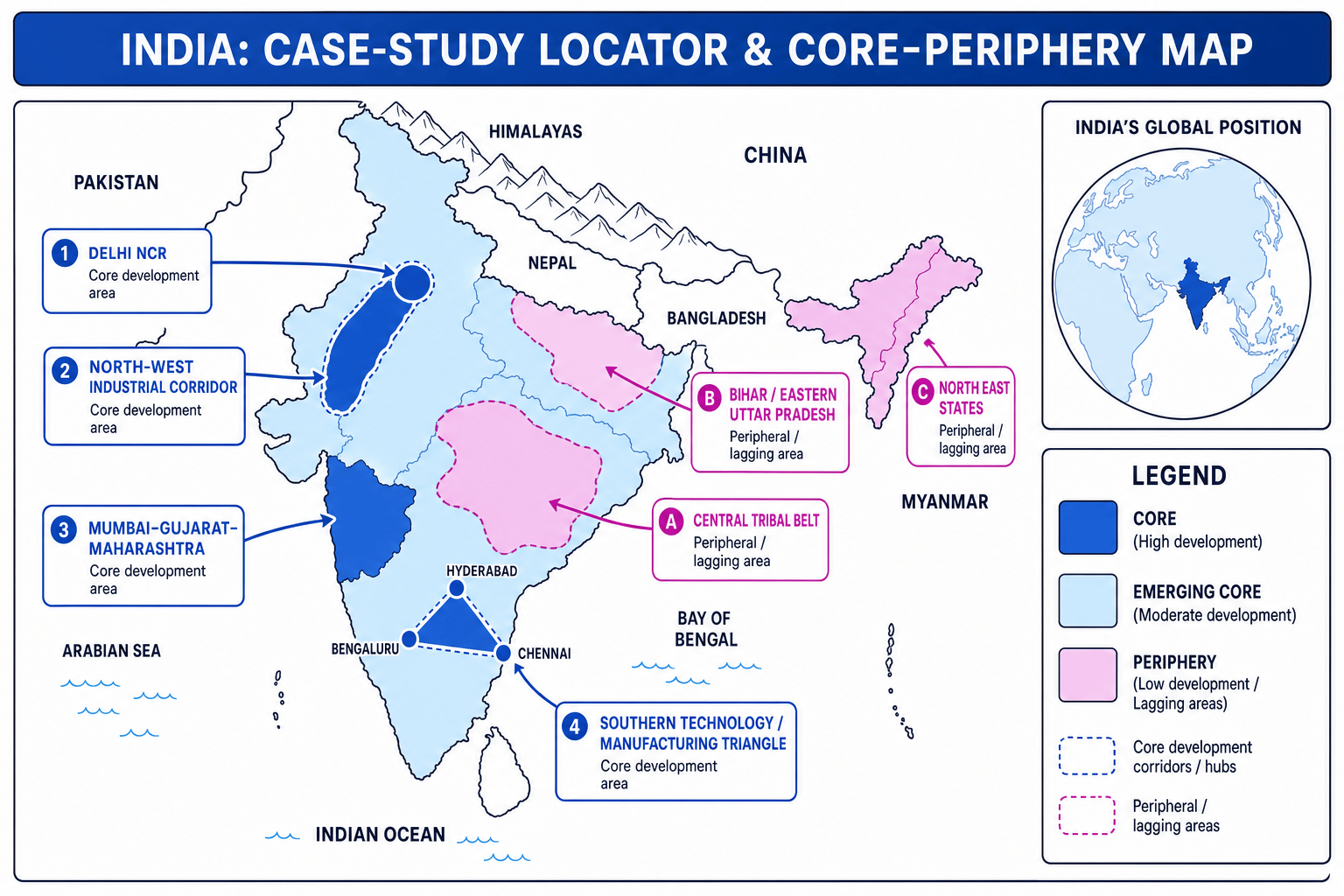
India is in South Asia, north of the Indian Ocean. It borders Pakistan, China, Nepal, Bhutan, Bangladesh and Myanmar. Its location gives it access to major sea routes between the Middle East, Africa and East Asia, which helps trade.
India is also globally important. It is a member of the G20 and BRICS, has nuclear weapons, a major space programme, a large diaspora and growing influence in technology, pharmaceuticals and services.
India’s wider context
Political context
India is the world’s largest democracy. It is a federal country, meaning power is shared between the national government and state governments. Since economic reforms in 1991, India has opened up more to trade and private investment.
Social and cultural context
India is extremely diverse. It has many languages, religions and ethnic groups. Hinduism is the largest religion, but India also has one of the world’s largest Muslim populations. Social inequalities can be linked to income, gender, caste, education, urban-rural differences and region.
Environmental context
India includes the Himalayas, the Indo-Gangetic Plain, deserts, tropical coasts, monsoon climates and the Deccan Plateau. This creates opportunities, such as farming and hydropower, but also risks, including floods, droughts, cyclones, water stress and heatwaves.
Uneven development: core and periphery
Core and periphery
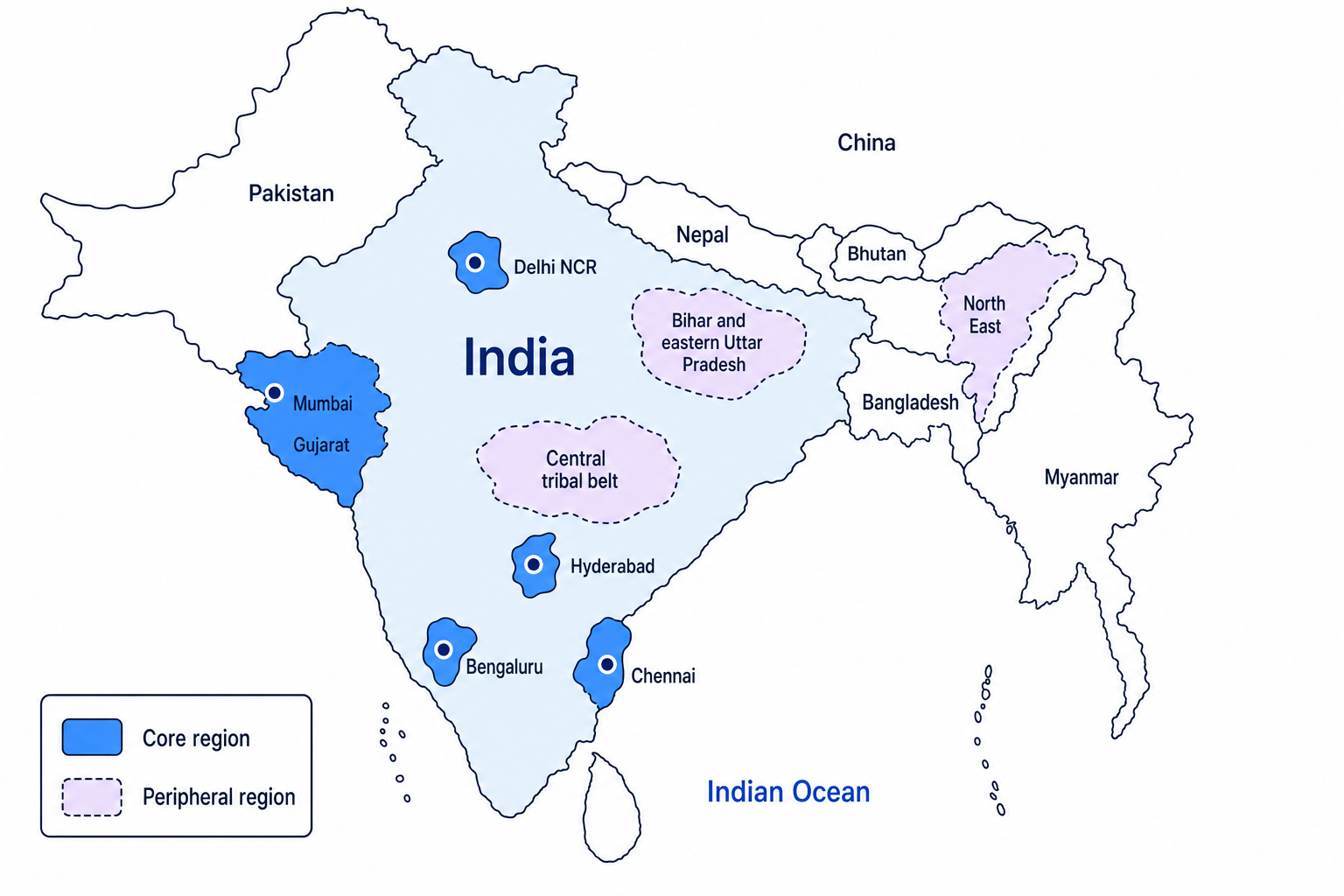
A core region is a more developed area with better jobs, infrastructure, investment and services. A periphery region is a less developed or more isolated area with fewer opportunities and often weaker infrastructure.
India’s development is not even.
Important core or fast-growing regions include:
- Mumbai, Maharashtra and Gujarat: finance, ports, manufacturing and trade.
- Delhi NCR: government, services, transport and industry.
- Bengaluru, Hyderabad and Chennai: technology, software, research and manufacturing.
More peripheral or lagging regions include parts of:
- Bihar and eastern Uttar Pradesh, where incomes and services are often lower.
- The North East states, where distance, terrain and weaker connections can restrict growth.
- Parts of the central tribal belt, where poverty, resource extraction and limited services can overlap.
Development varies because of physical geography, transport links, education levels, government policy, historic investment, access to global markets, conflict and the location of major cities.
A choropleth map is a map shaded by data value, such as literacy rate, poverty or GDP per person. Darker or lighter shading usually represents higher or lower values.
Reading choropleth maps
Always check the key, the units and the scale. Then look for clusters: for India, ask whether higher values are concentrated in western, southern or urbanised regions, and whether lower values appear in poorer rural or peripheral areas.
Calculating difference from the mean
- Suppose a resource gives India’s national mean development index as 65, a core region as 82 and a peripheral region as 54.
- Use the rule D=regional value−national meanD = \text{regional value} - \text{national mean}D=regional value−national mean.
- For the core region, D=82−65=+17D = 82 - 65 = +17D=82−65=+17, so it is 17 index points above the mean. For the peripheral region, D=54−65=−11D = 54 - 65 = -11D=54−65=−11, so it is 11 index points below the mean.
- This supports the idea of uneven development because one region is clearly above the national average while another is below it.
Economic change: sectors of the economy
Economic sectors
The primary sector extracts raw materials, such as farming and mining. The secondary sector manufactures goods. The tertiary sector provides services, such as banking, tourism and retail. The quaternary sector involves high-value knowledge work, such as research, software and data.
India has shifted from relying mainly on agriculture towards manufacturing, services and technology. Services now produce over half of India’s GDP, while agriculture produces a much smaller share but still employs many people. Exact figures vary by source and year.
Positive impacts
- Growth in IT, finance, pharmaceuticals and business services has created skilled jobs.
- Manufacturing has expanded in sectors such as vehicles, textiles, electronics and steel.
- Rising tax income can support roads, railways, schools, healthcare and sanitation.
- A growing middle class increases demand for housing, education, transport and consumer goods.
Negative impacts
- Many workers remain in low-paid informal jobs without secure contracts.
- Rural areas can be left behind if farming incomes remain low.
- Industrial growth can increase air pollution, water pollution and waste.
- Benefits are concentrated in major cities and connected regions.
Using sector data to profile economic change
- If a data source shows services make the largest contribution to GDP, identify India as a service-led emerging economy.
- If agriculture employs a much larger share of workers than its share of GDP, infer that many agricultural jobs are low productivity and low income.
- Link this to uneven development: high-value service jobs are more common in cities such as Bengaluru, Hyderabad, Mumbai and Delhi, while poorer rural regions may depend more on farming.
Trade, aid and investment
Trade, aid and investment
International trade is the exchange of goods and services between countries. Aid is money, resources or expertise given to support development. Public investment is spending by government, while private investment comes from businesses, including transnational corporations, which operate in more than one country.
India is heavily involved in global trade. It exports services such as IT and business processing, as well as pharmaceuticals, textiles, refined petroleum products and jewellery. It imports large amounts of crude oil, gas, electronics, machinery and gold. Major trade partners include the USA, EU countries, the UAE, China and other Asian economies.
India has received aid and development loans, for example from international organisations such as the World Bank and Asian Development Bank. However, India is also a donor, giving aid, loans and technical support to neighbouring countries and parts of Africa.
A proportional flow-line map shows movement using arrows whose width represents the size of the flow. It is useful for visualising India’s exports, imports, migration or aid links.
Reading flow-line maps
Use the arrow direction for where the flow goes, the arrow width for how large it is, and the label for what is being moved. Do not assume a thick trade arrow is automatically “good” — it may show imports of expensive fuel.
Since 1991, India has encouraged more foreign direct investment, meaning overseas companies invest in factories, offices or services inside India. Private investment by Indian firms and TNCs has grown, especially in technology, cars, telecoms and retail. However, public investment is still vital for railways, roads, electricity, schools, hospitals, sanitation and digital infrastructure.
TNC investment is not aid
A TNC invests to make profit. Aid is intended to support development. Both can help development, but they work in different ways and can have different winners and losers.
Population structure and life expectancy
A population structure shows how a population is divided by age and sex. It is often shown using a population pyramid.
Over the last 30 years, India’s population has changed significantly:
- Life expectancy has risen from around the early 60s in the 1990s to around 70 before COVID-19, though exact estimates vary.
- Fertility has fallen from over 3 births per woman to around replacement level or below in many states.
- India still has a large working-age population, creating a possible demographic dividend, where a high share of workers can support economic growth.
- Some states, especially in the south, are beginning to age faster than poorer northern states.
Interpreting a population pyramid
- If the base of the pyramid becomes narrower over time, infer that birth rates are falling.
- If the middle age groups are wide, infer that India has many working-age people, which can support growth if jobs and skills are available.
- If the top of the pyramid widens, infer that more people are living longer, increasing demand for healthcare and pensions.
Changing social factors
India has made major social progress, but problems remain.
Education has improved, with rising literacy and more children attending school. Higher education has helped India’s IT, engineering, medical and research sectors. However, education quality varies between states, between rural and urban areas, and between rich and poor households.
India’s middle class has grown as more people work in services, government, skilled manufacturing and professional jobs. This increases spending and can drive economic growth.
At the same time, inequality has increased. Wealth is concentrated among richer households and in successful urban regions. Some groups, including poorer rural communities, women, informal workers, lower-caste groups and tribal communities, may benefit less from rapid development.
Geopolitics and development
Geopolitics
Geopolitics means the way relationships between countries, power, territory, security and resources affect development.
India’s foreign policy is often described as strategic autonomy: it tries to work with different powers without being fully tied to one alliance. It has strong links with the USA, EU, Japan, Russia, Gulf states and African countries.
These relationships can support development through trade, technology transfer, energy supplies, defence cooperation and investment. For example, links with Gulf states matter for oil imports and remittances from Indian workers abroad.
However, geopolitics can also slow development. India spends heavily on defence because of tensions with Pakistan and China. Territorial disputes include Kashmir with Pakistan and border areas with China. Conflict risk can divert money from social spending and create uncertainty for investors.
India is not part of a NATO-style military pact, but it is involved in defence partnerships and strategic groupings such as the Quad with the USA, Japan and Australia.
Technology and connectivity
Connectivity means how well people and places are linked by transport, communications and digital networks.
Technology supports India’s development in many ways:
- Mobile phones and cheap data connect people to banking, education, markets and government services.
- Digital payment systems such as UPI allow quick cashless transactions.
- Aadhaar, India’s digital identity system, helps deliver welfare payments and services, although privacy and exclusion concerns exist.
- Satellites support weather forecasting, disaster management, farming and communications.
- IT hubs such as Bengaluru, Hyderabad, Pune and Gurgaon link India to global service markets.
But the benefits are uneven. Urban, richer, male and educated groups often have better digital access than poorer rural communities, women and older people. This is the digital divide.
Impacts of rapid development
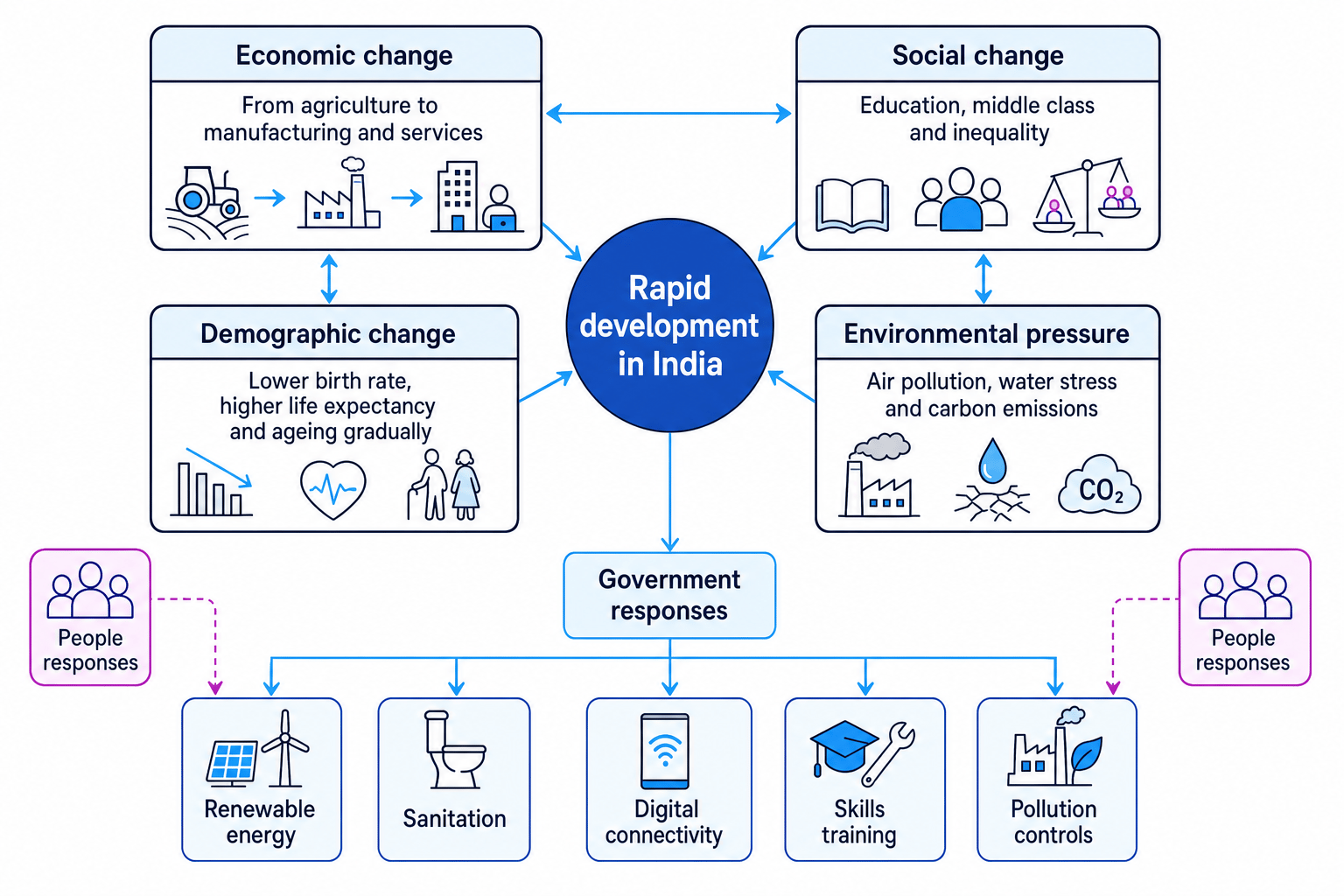
Rapid development affects people and the environment in connected ways. The diagram below summarises the main links between economic, social, demographic and environmental change.
Positive impacts
- More jobs in services, construction, manufacturing and technology.
- Rising incomes for many households and growth of the middle class.
- Improved education, healthcare, transport, electricity and sanitation in many areas.
- Stronger global status through the G20, BRICS, space exploration, pharmaceuticals and digital services.
Negative impacts
- Urban growth can create overcrowding, informal settlements and pressure on water and waste systems.
- Air pollution is severe in many cities, especially during winter in northern India.
- Industrialisation and coal use increase carbon emissions.
- Water stress affects cities, farms and industries.
- Inequality can widen between core and peripheral regions.
Managing rapid development
India’s government and people are trying to manage development to improve quality of life and global status.
Government responses include:
- Digital India to improve online services and digital infrastructure.
- Make in India to encourage manufacturing and investment.
- Skill India to improve training for young workers.
- Swachh Bharat Mission to improve sanitation and reduce open defecation.
- Renewable energy expansion, especially solar power, supported by India’s role in the International Solar Alliance.
- Metro systems, rail upgrades and road schemes to improve transport in cities and between regions.
People and communities also respond through self-help groups, local water conservation, education charities, clean-energy adoption, recycling initiatives and campaigns for better services.
The big judgement
India’s development has been rapid and globally significant, but it is uneven. The strongest answers explain both sides: growth has improved opportunities and global power, while inequality and environmental pressure remain serious barriers.
In the exam
- Use India by name and write at more than one scale: national, regional and local.
- Link processes together: for example, trade and TNC investment can create jobs, but also increase regional inequality and pollution.
- Use data carefully: say “about” for changing figures, include units, and distinguish percentage points from percentage change.
- For evaluation questions, judge who benefits, who loses, and whether impacts are short-term or long-term.
Check yourself
- Why can India rank highly by total GDP but lower by HDI or GNI per capita?
- What are two reasons development is faster in India’s core regions than in some peripheral regions?
- How can technology both reduce and increase inequality in India?