

What you'll learn
- What “development” means, beyond just money.
- How development is measured using GDP per capita, HDI, inequality and corruption indices.
- Why development varies globally and within countries, including the UK.
- How aid, agreements, top-down projects and bottom-up projects try to reduce uneven development.
Development: the big idea
Development
Development means improvement in people’s lives over time, including their wealth, health, education, freedoms, safety and access to basic needs.
A narrow definition of development uses economic criteria — measures linked to money, production and jobs. For example, a country with a high average income may be described as economically developed.
A broader definition also includes social measures — things linked to people’s wellbeing, such as life expectancy, literacy, education and access to healthcare — and political measures, such as corruption, human rights, democracy and stability.
Development is more than income
A country can become richer without everyone’s quality of life improving equally, so geographers use several indicators together.
What contributes to human development?
Human development
Human development is the improvement of people’s opportunities and choices, especially the ability to live a long, healthy, educated and secure life.
Different factors can help or limit human development:
| Factor | What it means | Example link to development |
|---|---|---|
| Economic | Income, jobs, investment, trade and industry | More tax income can fund schools, roads and hospitals. |
| Social | Education, healthcare, gender equality and housing | Better education can increase skilled employment. |
| Technological | Access to transport, electricity, internet, machinery and mobile phones | Mobile banking in Kenya has helped some people access finance. |
| Cultural | Beliefs, traditions, languages and community norms | Cultural attitudes may affect education, gender roles and healthcare use. |
| Food security | Reliable access to enough safe, nutritious food | Food insecurity can reduce health and school attendance. |
| Water security | Reliable access to enough safe water | Water insecurity increases disease risk and reduces time for work or school. |
Blaming culture too simply
Do not write that a country is “poor because of its culture”. Culture is complex, and development is usually shaped by many linked factors, including history, trade, government, technology and the physical environment.
Measuring development
GDP per capita
GDP per capita
Gross Domestic Product, or GDP, is the total value of goods and services produced in a country in one year. GDP per capita means GDP per person.
GDP per capita is useful because it allows countries with different population sizes to be compared.
GDP per capita=total GDPpopulation\text{GDP per capita}=\frac{\text{total GDP}}{\text{population}}GDP per capita=populationtotal GDPCalculating GDP per capita
A country has a GDP of US$180 billion and a population of 45 million.
- Convert the GDP into millions so it matches the population scale: US180billionisUS180 billion is US180billionisUS180,000 million.
- Divide total GDP by population: 180,000÷45=4,000180{,}000 \div 45 = 4{,}000180,000÷45=4,000.
- Interpret the answer: GDP per capita is about US$4,000, but this is only an average and does not show whether wealth is shared fairly.
HDI, inequality and corruption
Human Development Index
The Human Development Index, or HDI, is a combined development measure from 0 to 1. It includes health, education and income. A value closer to 1 suggests higher human development.
Other indicators help reveal what GDP can hide:
- Inequality means wealth, opportunities or services are not shared evenly. It can be measured using the Gini coefficient, income share of the richest groups, or regional differences.
- Political corruption means public power is used for private gain. A corruption index, such as the Corruption Perceptions Index, estimates how corrupt a country’s public sector is perceived to be.
Interpreting mixed development indicators
Country A has GDP per capita of US12,000,HDIof0.68andhighinequality.CountryBhasGDPpercapitaofUS12,000, HDI of 0.68 and high inequality. Country B has GDP per capita of US12,000,HDIof0.68andhighinequality.CountryBhasGDPpercapitaofUS8,000, HDI of 0.78 and lower inequality.
- Compare income first: Country A looks wealthier on GDP per capita because US12,000ishigherthanUS12,000 is higher than US12,000ishigherthanUS8,000.
- Compare broader human development: Country B has the higher HDI, so its health, education and income combination is stronger overall.
- Use inequality to qualify the judgement: Country A’s high inequality suggests the average income may hide poorer living conditions for many people.
Treating one indicator as the full answer
GDP per capita is useful, but it does not show inequality, informal work, political freedom, corruption, environmental quality or whether people can access services.
The global pattern of development
Uneven development
Uneven development means development levels vary between places and within places. Spatial variation means differences from one location to another.
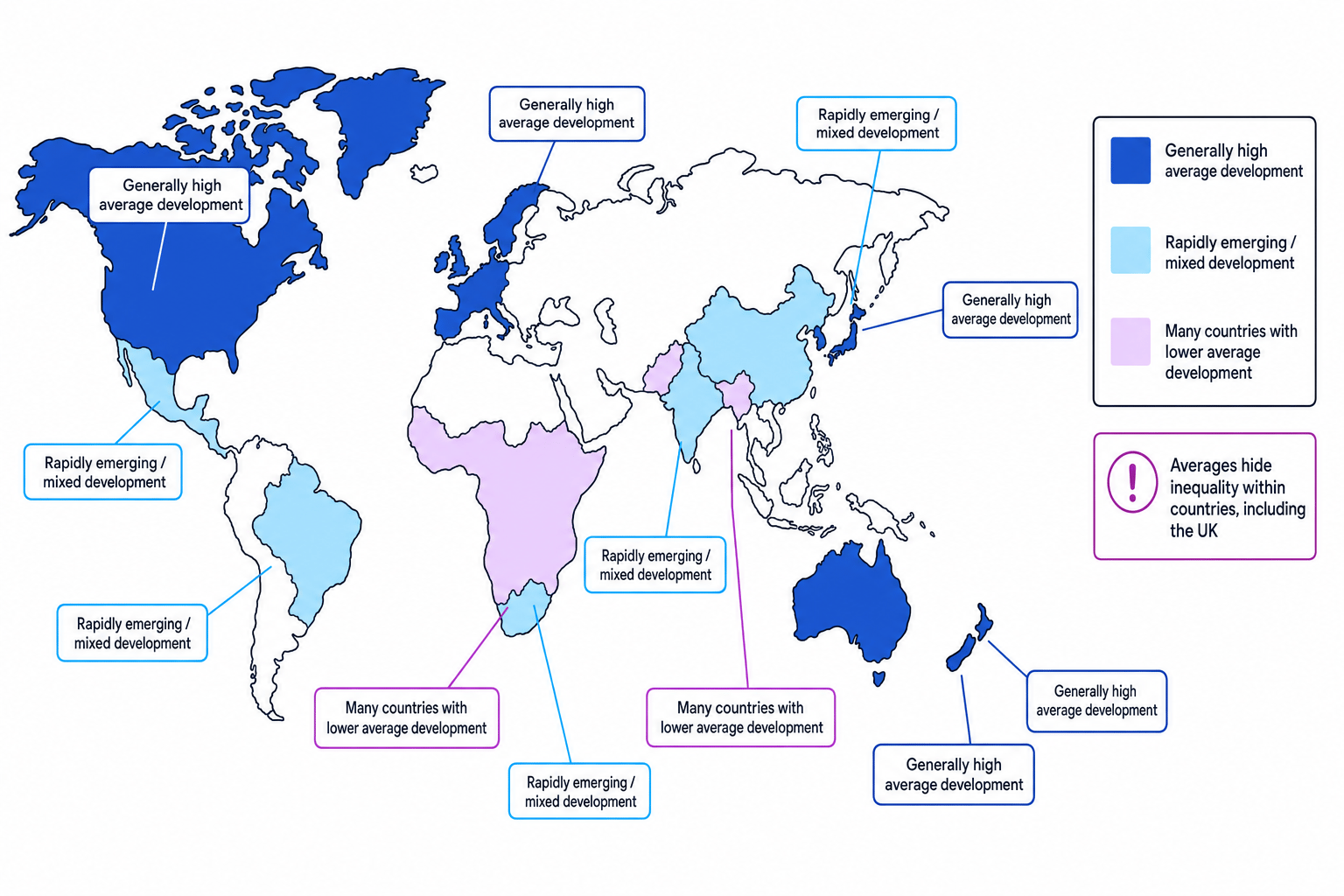
The broad global pattern is that many high-income, high-HDI countries are in North America, Europe, Japan, South Korea, Australia and New Zealand. Many lower average development levels are found in parts of Sub-Saharan Africa and South Asia. Large emerging economies, such as China, India, Brazil and Mexico, often show rapid growth but major internal inequality.
This map is simplified, but it helps you describe the pattern at a global scale.
Between and within countries
Development varies between countries, such as Norway often ranking near the top of HDI tables while Niger often ranks much lower. Exact rankings change each year, so focus on the pattern rather than memorising one number.
Development also varies within countries. In the UK, London and the South East generally have higher average incomes and stronger access to high-paid services jobs than many post-industrial areas, such as parts of South Wales, North East England and former coalfield communities. In China, coastal provinces and cities such as Shanghai and Guangdong are generally more developed than some inland western regions.
Describing the global pattern
- Start with the overall distribution: high average development is concentrated in North America, Western Europe and parts of East Asia and Oceania.
- Add contrast: lower average development is common in parts of Sub-Saharan Africa and South Asia, while emerging economies show mixed development.
- Change scale: mention that national averages hide regional and local inequalities, such as London compared with some post-industrial UK regions.
Use scale in your answers
Strong geography answers move between global, national, regional and local scales instead of describing countries as if everyone there has the same life.
Why development varies
Physical factors
Physical factors are natural features of the environment. Climate, relief, water supply, disease risk, natural hazards, resources and whether a country is landlocked can affect development. For example, landlocked countries may face higher trade costs, while areas with reliable water and fertile soils may support farming more easily.
Physical factors are not destiny. Good governance, technology and trade links can reduce disadvantages.
Historic factors
Historic factors are past events and processes that still affect places today. Colonialism, slavery, conflict, border creation and unequal trade relationships shaped many economies. For example, the Democratic Republic of the Congo has huge mineral wealth, but colonial exploitation, conflict and weak governance have limited wider human development.
Within the UK, the Industrial Revolution created strong manufacturing regions. Later deindustrialisation — the decline of traditional industries such as coal, steel and shipbuilding — contributed to job losses and lower incomes in some regions.
Economic factors
Economic factors include investment, trade, debt, employment structure, infrastructure and links to global markets. Countries that rely heavily on exporting one raw material may be vulnerable if global prices fall. Countries with varied industries, ports, technology and skilled workers may attract more investment.
In the UK, London benefits from finance, government decision-making, universities, transport links and global business connections. Some rural and former industrial areas have weaker transport links or fewer high-paid jobs, which can reduce opportunities.
Causes link together
Uneven development is rarely caused by one factor. Physical, historical and economic factors usually interact over time.
Consequences for quality of life
Quality of life
Quality of life means people’s overall wellbeing, including health, safety, education, housing, income, environment and personal freedom.
Uneven development affects everyday life in many ways:
| Aspect | How uneven development can affect it |
|---|---|
| Housing | Rapid urban growth can create informal settlements with overcrowding and poor sanitation, such as parts of Lagos or Nairobi. |
| Health | Poorer areas may have fewer doctors, hospitals, vaccinations and safe water, increasing disease risk. |
| Education | Families may struggle to pay school costs, or children may miss school to work or collect water. |
| Employment | More people may work in low-paid informal jobs without contracts, safety or pensions. |
| Technology | The digital divide limits access to online learning, banking, job adverts and information. |
| Food and water security | Drought, conflict, poverty and weak infrastructure can reduce access to reliable food and safe water. |
Uneven development can also create migration pressures. Some people move from rural to urban areas, or from lower-income countries to higher-income countries, to seek work, safety, education or healthcare.
Strategies to reduce uneven development
International aid
International aid is money, resources, expertise or emergency support given by one country, organisation or charity to another country or community.
Aid can be short-term emergency aid, such as food and shelter after an earthquake, or long-term development aid, such as funding schools, clinics, wells and training. It can save lives and build capacity, but it may create dependency, be tied to donor interests, or be affected by corruption.
Inter-governmental agreement
An inter-governmental agreement is a deal between governments to work together, for example through trade rules, debt relief, climate finance or the United Nations Sustainable Development Goals.
These agreements can tackle problems that cross borders, but progress may be slow and countries may disagree over costs and responsibilities.
Top-down and bottom-up development
A top-down project is led by a government or transnational corporation, meaning a company operating in several countries. A bottom-up project is led by local communities and usually works at a smaller scale.
Top-down projects include dams, ports, mines, motorways and industrial zones. They can create jobs and infrastructure quickly, but may cause debt, displacement or environmental damage if local people are ignored.
Bottom-up projects include community wells, local clinics, small-scale irrigation, microfinance and training schemes. They are often cheaper and better matched to local needs, but may have limited funding and may not transform a whole national economy.
Choosing a development strategy
A rural village has unsafe drinking water, low incomes and long journeys to the nearest town.
- Identify the main barrier: the immediate issue is local water security, not national-scale electricity or export growth.
- Match the strategy to the scale: a bottom-up project such as a community-managed borehole or rainwater harvesting system could directly improve health and save time.
- Evaluate the limitation: the project may improve quality of life locally, but it still needs maintenance, training and wider investment to create long-term employment.
In the exam
- Define development broadly: include economic, social and political measures, not just GDP.
- Use more than one indicator when judging development, and explain what each one hides or reveals.
- Always use scale: global pattern, country-level differences, and inequalities within countries such as the UK.
- For strategies, give both advantages and limitations, then decide which is more suitable for the place and problem.
Check yourself
- Why might GDP per capita give a misleading picture of development?
- How can development vary within a high-income country such as the UK?
- What is one advantage and one limitation of a bottom-up development project?
