In your AQA GCSE English Literature Paper 2 exam, you will be asked to compare a poem printed on the exam paper with another poem of your choice from the Worlds and Lives anthology cluster. To score highly, you cannot simply look at the poems in isolation; you must understand how they converse with one another through shared themes.
What you'll learn
- How to identify and group poems from the Worlds and Lives cluster into three core thematic pairings.
- How to transition smoothly from one poem to another using comparative analytical vocabulary.
- How to structure a comparative body paragraph that satisfies both AO1 (comparison and response) and AO2 (writer's methods).
Understanding the Comparative Task
To excel in comparing poetry, you need to move beyond simple "spot-the-difference" exercises. The examiner wants to see a conceptual exploration of how two different writers navigate similar aspects of human experience.
Thematic Pairing
A thematic pairing is a pair of poems that share a core subject or conceptual focus (such as the impact of industrialisation or the search for identity) but explore it through different lenses, contexts, or poetic methods.
Comparative Thesis
A comparative thesis is a concise, argument-driven statement at the beginning of your essay that establishes the main conceptual similarity and differences between the two poems in response to the exam question.
When comparing, always structure your analysis around the writers' intentions. Ask yourself:
- What are the poets saying about the world they live in?
- How do they use language, form, and structure to convey this?
- Why did they write these poems? How do their different historical, social, or geographical contexts explain their differing perspectives?
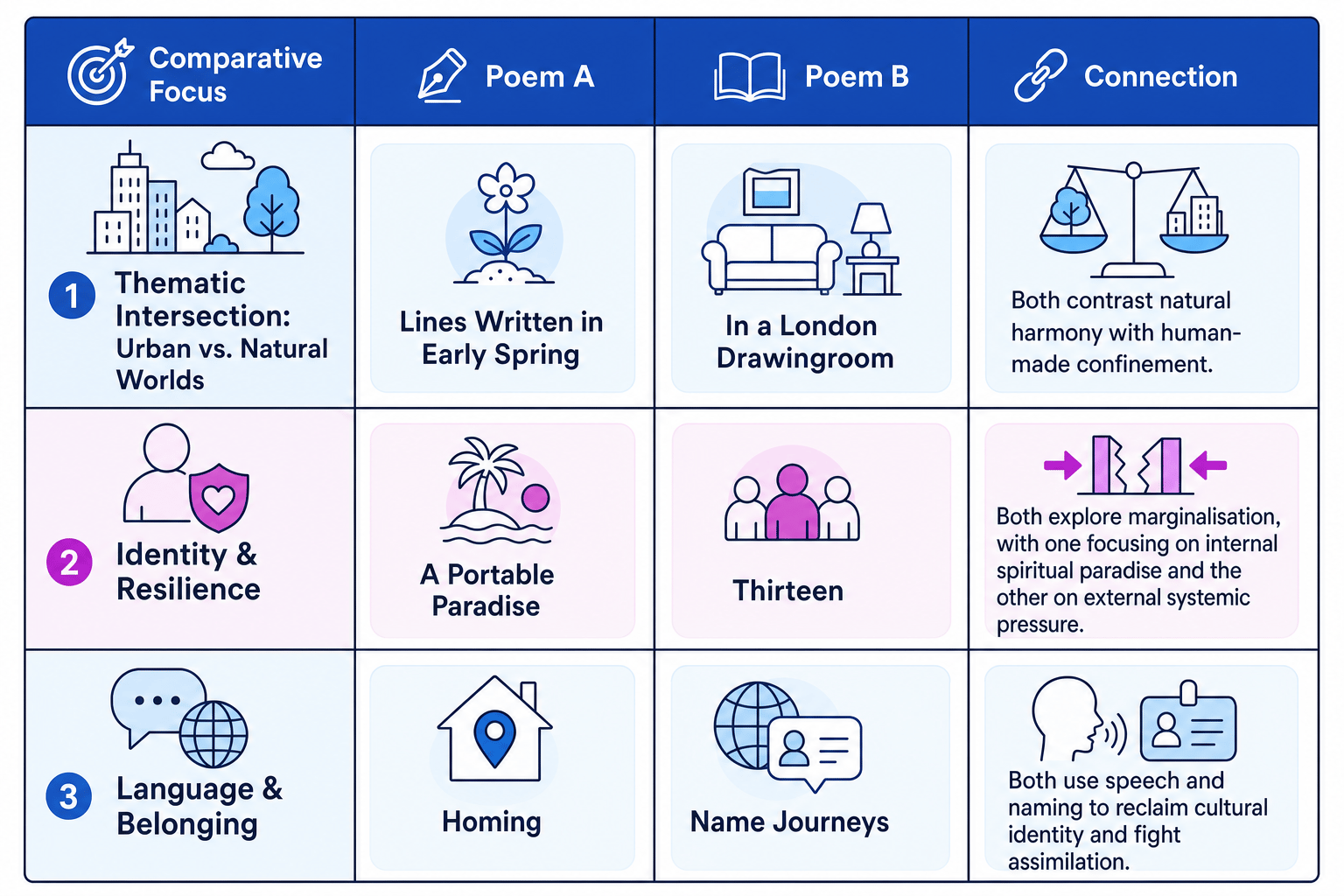
Pairing 1: The Urban World vs. The Natural World
This pairing explores how humanity interacts with its surroundings, contrasting the harmony of the natural world with the claustrophobia and artificiality of urban environments.
'Lines Written in Early Spring' (William Wordsworth) vs. 'In a London Drawingroom' (George Eliot)
- The Conceptual Connection: Both poets react to the rise of industrialisation, but they approach the division between the natural and human-made worlds from opposite geographical starting points.
- Wordsworth's Perspective: Writing at the dawn of the Romantic movement, Wordsworth uses pastoral imagery to present nature as a harmonious, divine force where "every flower / Enjoys the air it breathes." He laments the contrast between nature's "holy plan" and human society, posing the melancholy question: "Have I not reason to lament / What man has made of man?"
- Eliot's Perspective: Writing in the Victorian era of rapid urban sprawl, Eliot presents the city as a sterile, suffocating cage. Nature is completely obscured; the sky is described as "one sheet of red-hot clay," and the houses "wall in the earth" like prison barriers. Instead of Wordsworth's organic variety, Eliot's urban landscape is defined by "monotony," where even the people are reduced to uniform, indistinguishable shapes.
Nature as a Moral Compass
In these poems, nature is not just scenery; it is a moral standard. Wordsworth uses nature to highlight how far humanity has fallen from its spiritual roots, while Eliot uses the absence of nature to show how urban life strips humans of their individuality and vitality.
Pairing 2: Identity, Systemic Power, and Resilience
This pairing focuses on how marginalized individuals navigate worlds that seek to suppress, control, or label them.
'A Portable Paradise' (Roger Robinson) vs. 'Thirteen' (Caleb Femi)
- The Conceptual Connection: Both poems explore the experience of Black identity and the pressures of hostile environments, but they offer contrasting solutions—one internal and spiritual, the other external and highly realistic.
- Robinson's Perspective: Robinson uses a lyrical, metaphorical style to explore how one can survive systemic hostility and hardship. His "paradise" is a metaphor for cultural pride, memory, and personal hope that must be kept secret and protected: "keep it warm and close to your heart / inside your pocket." It is a quiet, resilient survival mechanism passed down through generations.
- Femi's Perspective: Femi offers a raw, physical account of systemic prejudice in contemporary London. Written from the perspective of a thirteen-year-old boy, the poem exposes how institutional powers (like the police) view young Black boys through a "predator's eye." Femi exposes the immediate, unavoidable trauma of being marked as a "threat" before even reaching adulthood.
Ignoring the Nuance of Tone
Do not simply write that both poems are "sad." Robinson's tone is warm, instructional, and hopeful (a "portable paradise" is a tool of defiance), whereas Femi's tone is tense, urgent, and direct, capturing the immediate physical vulnerability of youth under institutional surveillance.
Pairing 3: Language, Voice, and Belonging
This pairing investigates how we express who we are, and how language, accents, and names act as battlegrounds for cultural survival and assimilation.
'Homing' (Liz Berry) vs. 'Name Journeys' (Raman Mundair)
- The Conceptual Connection: Both poets explore language as the ultimate vessel of identity, demonstrating how society attempts to suppress non-standard speech, and how reclaiming one's voice is an act of empowerment.
- Berry's Perspective: Berry celebrates the Black Country dialect, using organic, animalistic metaphors to depict words as "birds" that have been caged by societal expectations but are now "released" to fly back to where they belong. Reclaiming her regional accent is presented as an act of joy and self-assertion against those who mock it.
- Mundair's Perspective: Mundair addresses the pain of cultural migration and the anglicisation of her name. She describes how English speakers "bruised" and "flattened" her birth name, stripping it of its heritage. Reclaiming her original name is a profound act of healing and decolonisation—a refusal to let her identity be erased by the "weight of English."
Worked Example: Structuring a Comparative Paragraph
Structuring a comparative paragraph
Walk through this model process to draft a comparative body paragraph addressing this question: Compare how Wordsworth in 'Lines Written in Early Spring' and Eliot in 'In a London Drawingroom' present the relationship between humanity and their environment.
- Draft a conceptual comparative topic sentence: Begin by stating how both poets present the environment as a force that shapes human well-being, but contrast their physical settings. Drafting: "While Wordsworth presents the natural world as a harmonious, divine sanctuary that exposes the tragic self-destruction of human society, Eliot depicts the urban environment as an oppressive, artificial cage that actively drains humanity of its spiritual freedom."
- Analyze the first poem (Wordsworth) with precise methods: Introduce your evidence and analyze how the poet's choices affect the reader. Drafting: "Wordsworth establishes nature's spiritual purity through the personification of 'fair works' to which 'Nature link / The human soul.' The verb 'link' implies a pre-existing, sacred bond between humanity and the earth. However, this harmony makes the speaker's observation of society more painful, leading him to mourn 'What man has made of man.' The repetition of 'man' emphasizes a self-inflicted cycle of misery, isolating human suffering from the joyful, breathing world around them."
- Create a transition to the second poem (Eliot): Use a transitional phrase that directly compares the methods and themes of both poems. Drafting: "In stark contrast, Eliot's Victorian London offers no such spiritual escape; instead of being 'linked' to a wider, breathing world, humanity is physically and psychologically confined."
- Analyze the second poem (Eliot) using corresponding methods: Provide evidence of urban confinement, keeping your terms precise. Drafting: "Eliot uses the metaphor of the city as a closed space, noting that the 'houses opposite / Wall in the earth.' Here, the active verb 'wall' highlights how human construction actively suffocates the natural world, severing the very connection Wordsworth laments losing. Furthermore, Eliot describe the sky as 'one sheet of red-hot clay,' using industrial, oppressive imagery to suggest that even the heavens have been replaced by factory materials, leaving no room for natural beauty or individual thought."
- Synthesize both points with context (AO3): End the paragraph by linking the differing representations to the historical contexts of the writers. Drafting: "Ultimately, while Wordsworth writes from an early Romantic perspective to warn readers that turning away from nature leads to spiritual decay, Eliot's late-Victorian perspective reflects the grim reality of that warning realized, showing a world where industrialisation has successfully imprisoned the human spirit."
Use Transition Words Wisely
Elevate your comparison by avoiding repetitive transitions like "On the other hand." Instead, use analytical transitions that highlight the exact nature of the relationship:
- For similarities: "Correspondingly," "In a parallel fashion," "Echoing this idea," "Mirroring Wordsworth's use of..."
- For differences: "Conversely," "In stark contrast," "Where Robinson seeks..., Femi highlights..."
In the exam
- Read the prompt and the printed poem first: Spend two minutes identifying the core theme of the printed poem (e.g., identity, nature, power) and highlight two or three key methods used by the poet.
- Select your comparison poem deliberately: Choose a poem from your memory that offers a clear conceptual contrast or a strong structural parallel. Do not just pick the poem you know best; pick the one that makes the most compelling argument when paired with the printed text.
- Write a balanced introduction: Start with a thesis statement that outlines both poems, introducing them as two distinct voices responding to the same central theme.
- Adopt an integrated structure: Avoid writing one long block on Poem A and then one long block on Poem B. Instead, write two or three comparative paragraphs (using the structure in the worked example) where you weave back and forth between both texts.
Check yourself
- Which poem would you pair with Boey Kim Cheng's 'The Planners' to compare how humans reshape their physical landscapes? Why?
- What is the difference between how Roger Robinson ('A Portable Paradise') and Caleb Femi ('Thirteen') present the experience of young Black men in modern society?
- How does the use of dialect in Liz Berry's 'Homing' compare to the exploration of language and name-erasure in Raman Mundair's 'Name Journeys'?
