Welcome to your comprehensive study companion for the Worlds and Lives poetry cluster (AQA GCSE English Literature, Specification 8702). In this section, we will delve into the deep connections between the "worlds" we inhabit—whether physical, social, or emotional—and the "lives" of those who navigate them.
To achieve the highest marks, you must avoid simply listing poetic devices. Instead, you need to understand how poets use language, form, and structure to convey their unique perspectives on human existence, nature, and society.
The Core Theme of Worlds and Lives
The poems in this cluster investigate the friction between different environments (natural vs. industrial/urban) and the individuals living within them. High-scoring essays always link these spatial landscapes to the internal, psychological states of the speakers.
1. Lines Written in Early Spring (William Wordsworth)
Written in 1798 during the dawn of the Romantic movement, William Wordsworth’s poem is a profound meditation on the beauty of nature and the tragic self-destruction of humanity.
Theme: Nature's Harmony vs. Human Discord
Wordsworth presents the natural world as a beautifully interconnected, sentient space where every living thing is filled with joy. This pristine external "world" contrasts sharply with the "lives" of humans, who have distanced themselves from this natural order to their own detriment.
Romanticism
A literary and artistic movement of the late 18th and early 19th centuries that reacted against the scientific rationalism of the Enlightenment and the physical grime of the Industrial Revolution. Romantics championed the sublime power of nature, raw emotion, and the value of individual experience.
Key Quotations and Analysis
- "I heard a thousand blended notes, / While in a grove I sate reclined,"
- Method: Auditory imagery and relaxed syntax.
- Effect: The "blended notes" establish immediate harmony, suggesting that nature speaks in a unified, beautiful language. The speaker's passive posture ("sate reclined") shows him receptive to nature’s spiritual lessons.
- "To her fair works did Nature link / The human soul that through me ran;"
- Method: Personification of Nature ("her").
- Effect: Wordsworth capitalizes "Nature," elevating it to a divine force. He suggests that humanity is naturally designed to be spiritually bound to the environment, casting our modern isolation from nature as a tragedy.
- "Have I not reason to lament / What man has made of man?"
- Method: Rhetorical question and repetitive phrasing.
- Effect: The speaker experiences deep grief ("lament"). The simple, devastating final line condemns the industrialised, war-torn human world, pointing out that humanity is responsible for its own misery.
Form and Structure
- Quatrains and ABAB Rhyme Scheme: The poem is written in steady four-line stanzas with an alternating rhyme scheme. This simple, song-like form mirrors the steady, predictable, and peaceful rhythm of the natural world.
- The Meter (Iambic Tetrameter with Trimeter variations): While the first three lines of each stanza generally have eight syllables, the final line often shrinks to six. This structural compression draws the reader’s focus to the final, often melancholy thoughts about mankind.
2. In a London Drawingroom (George Eliot)
George Eliot’s Victorian poem presents a starkly different "world" from Wordsworth’s. Writing during the peak of British industrialization, Eliot exposes the oppressive, claustrophobic reality of modern urban life.
Theme: Urban Monotony and Confinement
Unlike the expansive, joyful natural world of Early Spring, Eliot's London is a sterile, man-made prison. Humanity has paved over nature, leading to emotional detachment and spiritual decay.
Key Quotations and Analysis
- "The sky is sad, and the o'erhanging sky / Looks far and cold"
- Method: Pathetic fallacy and repetition.
- Effect: By projecting sadness and coldness onto the sky, Eliot illustrates how the industrial city has alienated humanity from any source of divine warmth or comfort.
- "A world of stone / The street-walls slope adown in stone"
- Method: Repetition and cold, mineral imagery.
- Effect: The repetition of "stone" emphasizes the unrelenting density of the urban landscape. It is solid, artificial, and utterly devoid of life or growth.
- "And all these uniform grey streets on streets / Like map-work"
- Method: Simile and monochrome color imagery.
- Effect: The simile "Like map-work" highlights the sterile, calculated geometry of the city. The word "uniform" suggests a crushing loss of individuality; every street, and by extension every life, looks identical.
Pathetic Fallacy
A literary device where human emotions are attributed to inanimate aspects of nature (for example, a "sad sky" or "angry clouds"). In industrial poetry, it is frequently used to show how a damaged environment reflects the emotional desolation of its human inhabitants.
3. Thirteen (Caleb Femi)
Caleb Femi’s contemporary poem brings us into a modern urban world, exploring how systemic structures and social environments shape—and often restrict—the lives of young Black boys.
Theme: Vulnerability, Institutional Prejudice, and Identity
The poem tracks a defining moment in a boy’s life when his innocent childhood "world" clashes with the hostile, suspicious gaze of adult society. Femi addresses how external authorities construct a damaging identity for young people based on superficial, structural prejudices.
Key Quotations and Analysis
- "Thirteen, you’ll be told you fit the description"
- Method: Direct address (second-person pronoun "you") and passive voice.
- Effect: The use of "you" immediately pulls the reader into the vulnerable position of the protagonist, creating a visceral sense of empathy. The phrase "fit the description" introduces the theme of institutional profiling, highlighting how society pre-determines the guilt of marginalized youths.
- "the uniform of the police / is a dominant blue"
- Method: Color symbolism and institutional imagery.
- Effect: The "dominant blue" represents authority, power, and state control. It visually contrasts with the vulnerable, un-uniformed child, emphasizing the unequal power dynamic between the state and the individual.
- "a corner you cannot see around"
- Method: Metaphor.
- Effect: The "corner" symbolizes the uncertain, treacherous future that young people of color must navigate, where danger and prejudice lurk out of sight.
Form and Structure
- Free Verse: The poem does not follow a strict rhyme scheme or metrical pattern. This lack of formal constraint reflects the unpredictable, chaotic nature of modern urban life and the raw, conversational honesty of the speaker’s voice.
- Enjambment: Lines spill over into one another without punctuation, mirroring the breathless anxiety of a tense interaction with authority.
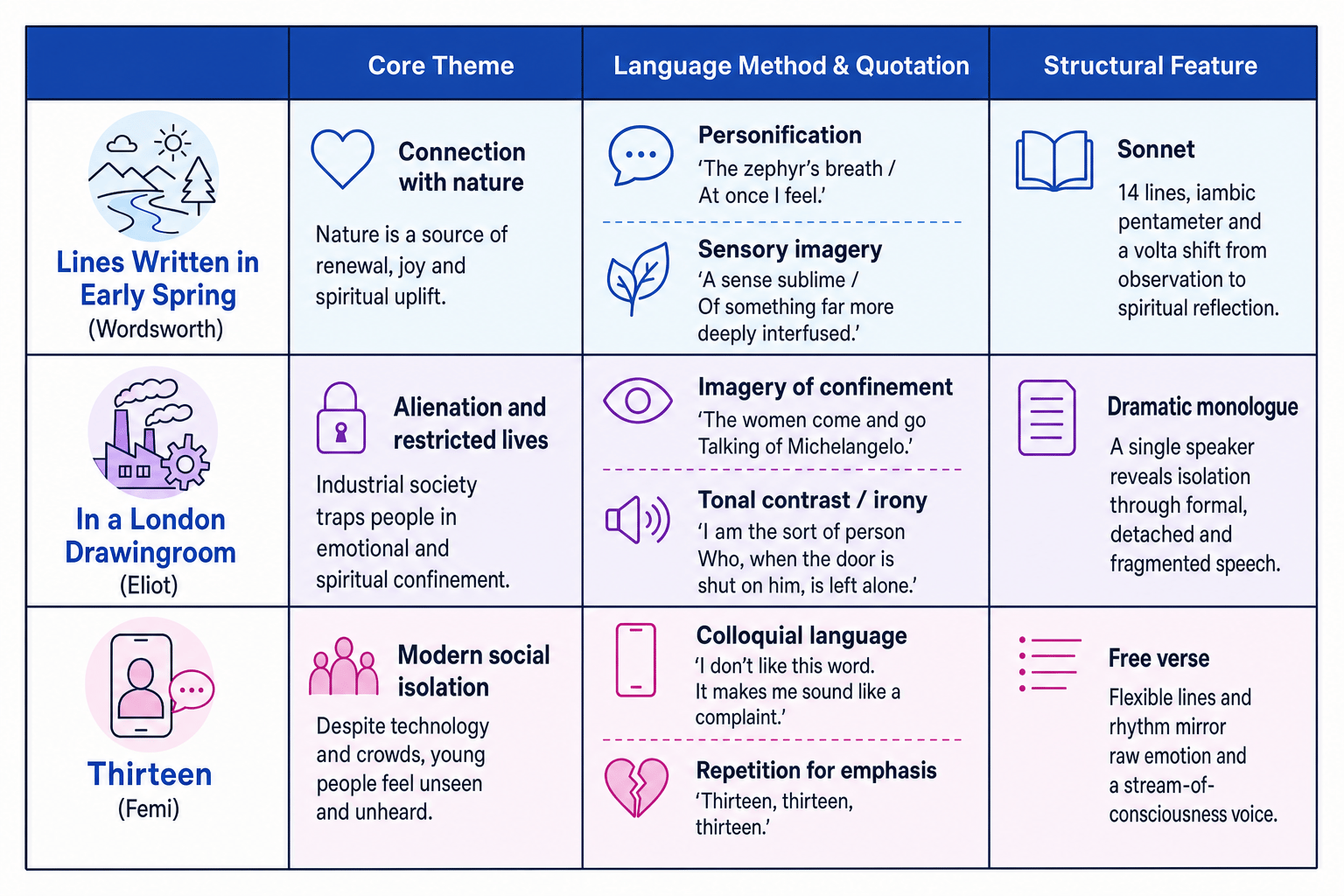
Comparative Visual Guide
The relationship between these different environments and human responses is central to your Paper 2 exam. The diagram below illustrates how you can map these connections structurally:
Comparing Across Eras
When writing your essay, look for structural parallels. For instance, notice how both George Eliot and Caleb Femi use the urban setting of London to explore restriction, though Eliot focuses on physical/spiritual monotony, while Femi focuses on social/racial profiling.
Worked Example: Analyzing a Passage Step-by-Step
In the exam, you must show a deep, multi-layered understanding of how a poet uses language and structure to convey meaning (AO2) while linking this to the broader context (AO3). Let's walk through an exemplar analysis of this quotation from George Eliot's In a London Drawingroom:
"And all these uniform grey streets on streets / Like map-work..."
Analyzing a quotation from In a London Drawingroom
- State your main thesis point (AO1): Identify how the quote reveals the relationship between the environment and the individual.
- Drafting: Eliot demonstrates how the industrialization of London strips the environment of organic beauty, creating an oppressive, artificial world that confines the human spirit.
- Embed your quotation and identify the primary method (AO2): Choose a precise technique and weave the quote smoothly into your prose.
- Drafting: The speaker describes the urban sprawl through the monochrome imagery of "uniform grey streets on streets," which she captures via the mathematical simile "Like map-work."
- Analyse the specific word choices and structural effects (AO2): Look at connotations and repetition.
- Drafting: The repetition of "streets on streets" creates an exhausting, claustrophobic rhythm, mimicking the endless replication of brick and stone. Furthermore, the adjective "uniform" implies a crushing lack of individuality, suggesting that the inhabitants of these streets are subjected to the same dull, mechanical existence.
- Synthesize your analysis with historical context (AO3): Explain why the writer wrote this at the time.
- Drafting: This sterile depiction reflects the anxieties of the mid-Victorian era, where rapid urbanization and the rise of factory labor detached citizens from the agrarian, seasonal rhythms of nature, transforming people into mere cogs within a mechanized, mapped-out empire.
Feature-Spotting
Avoid simply identifying a device without explaining its impact. For example, writing: "Eliot uses a simile in 'Like map-work'." earns very few marks. You must explain why that simile is used: "Eliot uses the simile 'Like map-work' to suggest that the human world has been over-planned, structured, and stripped of the spontaneous chaos of natural growth."
In the exam
- Plan your comparison: Spend 5 minutes planning before writing. Identify one core theme that links the named poem in the question to your chosen comparative poem (e.g., "The oppression of urban environments" in In a London Drawingroom and Thirteen).
- Integrate AO3 naturally: Do not dump a history paragraph at the start of your essay. Instead, weave historical context into your analysis of language (just like Step 4 of the worked example above).
- Track the structural shifts: Always analyze how a poem moves from the first stanza to the last. Does the speaker's tone shift from hope to despair? Identifying this dynamic arc shows examiners that you understand the poem as a whole work of art, not just a collection of quotes.
- Use comparative discourse markers: Words like conversely, similarly, whereas, in a parallel fashion, and on the other hand are vital for keeping your essay balanced and cohesive.
Check yourself
- How does Wordsworth's use of regular iambic meter in Lines Written in Early Spring contrast with Caleb Femi's use of free verse in Thirteen? What does this tell us about their respective "worlds"?
- What is the symbolic significance of "stone" in George Eliot's In a London Drawingroom?
- Why does Femi write Thirteen using the second-person pronoun "you" rather than "I"?
