Welcome to your ultimate guide on comparing poems within the Worlds and Lives anthology cluster for AQA GCSE English Literature (Specification 8702).
Comparing poetry can feel intimidating at first, but once you understand how to look for thematic links and structural patterns, it becomes a highly rewarding puzzle. In the exam, you will be given one poem from the cluster printed on the exam paper, and you will need to choose another poem from the "Worlds and Lives" collection to compare it with.
What you'll learn:
- How to decode comparison exam questions and construct a cohesive comparative thesis statement.
- How to pair poems dynamically across key themes like place, social division, and identity.
- How to integrate language, form, and context into balanced, side-by-side analytical paragraphs.
1. The Core Philosophy of Poetry Comparison
To get top marks in Paper 2, Section B, you must do more than write two separate essays glued together. You need to explore how two poets use different paths to reach a similar (or deliberately contrasting) destination.
Before we look at the poems, let's establish our core terminology:
Comparative Synthesis
Comparative synthesis is the skill of bringing two separate texts together to form a single, unified argument. Instead of discussing Poem A and then Poem B in isolation, you analyze them in tandem, exploring how they speak to each other.
Juxtaposition
Juxtaposition is the act of placing two contrasting ideas, characters, or poetic methods close together to highlight their differences and create a deeper meaning.
The Golden Rule of Comparison
In the exam, you are assessed on your ability to weave similarities and differences together throughout your entire essay. The best responses use comparison as a tool to unpack the writers' intentions and the social contexts that shaped their "worlds."
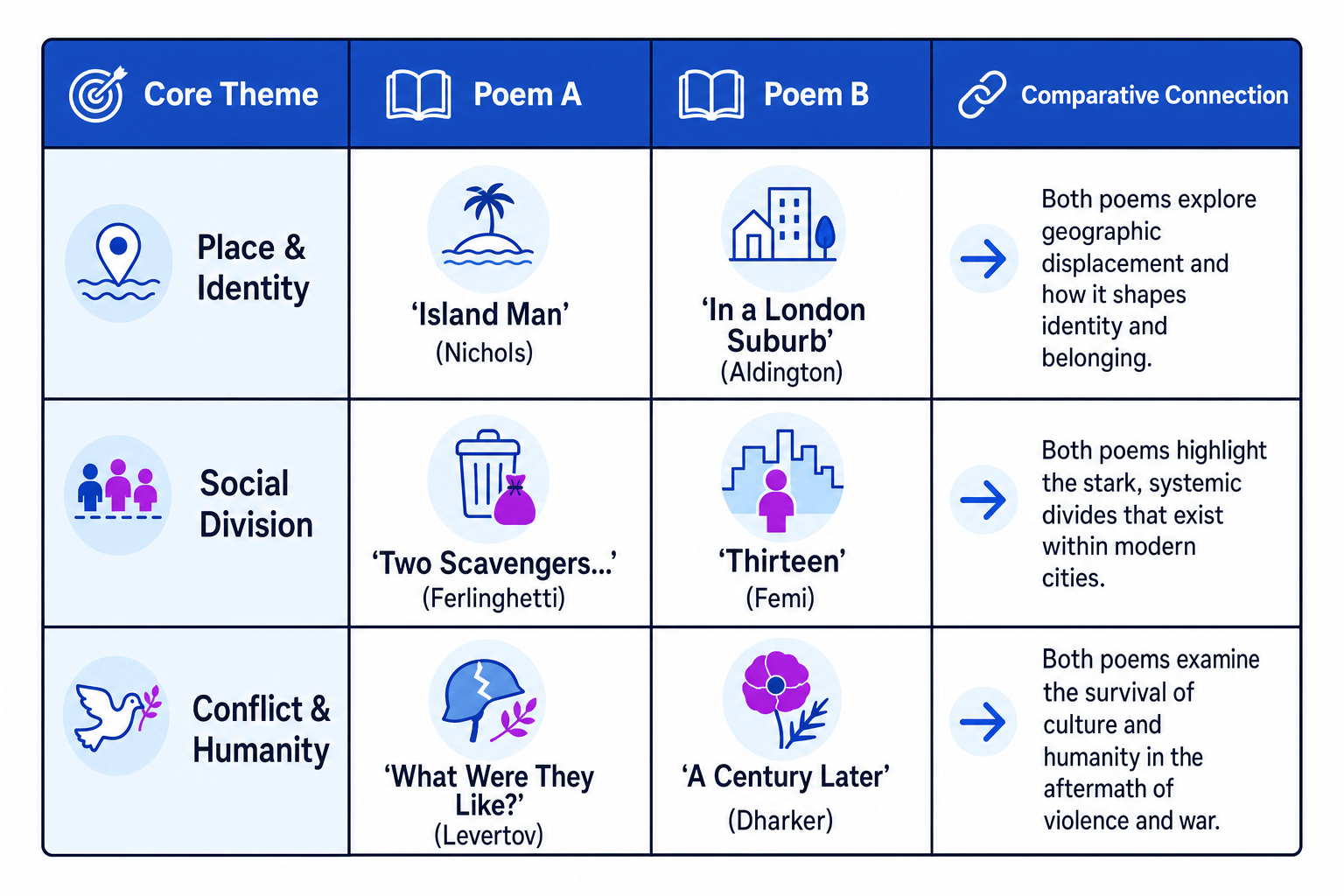
To structure your comparison effectively, you need a thematic map of the "Worlds and Lives" cluster. The diagram below illustrates how different poems can be paired to create sophisticated comparative arguments.
2. Linking Key Themes in 'Worlds and Lives'
The "Worlds and Lives" cluster centers on how our physical, cultural, and political environments ("worlds") shape our personal experiences, struggles, and memories ("lives").
When comparing, you should focus your paragraphs on three main pillars:
- AO1: Conceptual Ideas: What messages are the poets sending about human existence?
- AO2: Poetic Methods: How do the poets use form (such as free verse or sonnets), structure, and imagery to convey these messages?
- AO3: Contextual Influences: What real-world experiences, historical events, or cultural backgrounds influenced these poets?
Let's look at how we can group these poems conceptually.
Place and Displacement
Many poems in this cluster investigate how leaving or living in a specific landscape impacts who we are.
- In 'Island Man', Grace Nichols uses a fluid, punctuation-free structure to capture her protagonist's agonizing split identity between his vibrant Caribbean past and his dull, urban London reality.
- In 'In a London Suburb', Richard Aldington also explores feeling alienated by a modern city, portraying the London landscape as a suffocating cage of "grey" and "yellow fog" that isolates him from nature and emotional warmth.
Social Inequality and Power
Other poems focus on the invisible boundaries that split modern societies.
- Lawrence Ferlinghetti's 'Two Scavengers in a Truck, Two Beautiful People in a Stone White Plaza' uses a visual, staggered layout to represent the "small gulf" of class inequality that divides garbage collectors from wealthy commuters in San Francisco.
- Caleb Femi's 'Thirteen' exposes a different kind of division—the systemic profiling of a young Black boy in London, where authority figures treat him with suspicion, showing how prejudice shapes a child's "world."
The 'Device Spotting' Trap
Do not simply write lists of poetic devices like "Both poets use metaphors." AQA examiners penalize "feature-spotting." Instead, frame your comparison around meaning: "Both poets use metaphors of division to expose the economic and racial divides in modern cities." Always connect the method directly to the writer's underlying message.
3. Constructing a Comparative Paragraph
To compare successfully, your paragraphs must follow a balanced, comparative structure. Rather than writing a block on Poem A followed by a block on Poem B, you should use comparative transitions to move fluidly between the two texts within each paragraph.
Use this simple structural checklist for your analytical body paragraphs:
- Comparative Point: State a shared or contrasting idea found in both poems.
- Analysis of Poem A: Introduce a precise quotation, identify the poetic method (language or structure), and analyze its effect on the reader.
- Comparative Transition: Use a transition phrase (e.g., Similarly, In contrast, Crucially, however) to pivot to the second text.
- Analysis of Poem B: Analyze a corresponding quotation, identifying its method and effect.
- Synthesis (Context & Intent): Explain why the poets used these different approaches, linking their choices to their contexts (AO3).
4. Step-by-Step Comparative Walkthrough
Let's put this technique into action. We will compare how Grace Nichols in 'Island Man' and Richard Aldington in 'In a London Suburb' present the feeling of displacement.
Comparing the presentation of place and identity
-
Formulate a comparative thesis statement
Begin by establishing a clear, conceptual thesis that directly addresses how both poems explore the psychological impact of their environments.
Drafting the thesis: While both Nichols and Aldington present the grey urban landscape of London as a source of alienation and emotional stagnation, Nichols depicts this through the lens of cultural displacement and nostalgic longing for a lost homeland, whereas Aldington focuses on the personal, psychological isolation of modern suburban life.
-
Analyze Poem A (Island Man) focusing on language and form
Select a precise quotation from 'Island Man' that highlights the struggle of displacement. Analyze the imagery and structural choices.
Analysis: Nichols depicts the island man's daily struggle to wake up to London's reality. The "sound of blue surf" in his mind is violently replaced by the "grey metallic soar" of London traffic. The color contrast between "blue" and "grey" highlights the loss of vibrancy in his new world. Furthermore, Nichols uses the metaphor of a "metallic soar" to transform ordinary traffic into an aggressive, unnatural beast. Structurally, the lack of punctuation throughout the poem reflects the dreamlike blurring of his dual identities, illustrating how displacement leaves his mind suspended between two worlds.
-
Incorporate a comparative transition and analyze Poem B (In a London Suburb)
Pivot to 'In a London Suburb' using a transition word that highlights a key difference or similarity, then analyze its methods.
Analysis: Similarly, Aldington uses dreary color imagery to present London as an emotionally draining space, describing the "cold wet land" and "yellow fog" that surrounds him. However, while Nichols' protagonist longs for a physical island, Aldington's speaker suffers from a more existential, social isolation. Aldington uses the simile "thoughts of you are like bright flowers" to show that beauty and warmth exist only in his internal memories of a loved one, juxtaposed against the hostile, "ugly" external reality of the suburbs.
-
Synthesize the comparison by linking to the writers' intentions and contexts
Conclude the paragraph by explaining how their unique historical and social contexts influenced their representations of place.
Synthesis: This divergence in their sense of displacement stems from their distinct contexts. Writing as a Guyanese immigrant arriving in Britain in the late twentieth century, Nichols captures the collective Windrush generation experience of cultural dislocation and the effort to preserve Caribbean heritage. Conversely, Aldington, writing in the early twentieth century amidst the rapid, soulless expansion of industrial London, uses his speaker's alienation to critique the spiritual emptiness and lack of natural beauty in modern suburban developments.
Using Comparative Transition Phrases
To make your comparative synthesis seamless, memorize a bank of transitional phrases:
- To show similarity: In a parallel manner, Echoing this sentiment, Both poets utilize... to...
- To show contrast: Conversely, Whereas Poem A..., Poem B..., This contrasts sharply with...
In the exam
- Spend 5 minutes planning: Before writing, highlight the key words in the prompt. Jot down 3 core thematic connections between the printed poem and your chosen poem.
- Write a comparative thesis: Start with an introductory paragraph that outlines your main argument for both poems. Never write an introduction that only mentions the printed poem.
- Aim for 3 detailed comparative paragraphs: Use the side-by-side synthesis method shown in the worked example above to ensure you are continually comparing throughout your response.
- Equal weighting is key: Do not write 80% of your essay on the printed poem and only 20% on your chosen poem. Aim for an even split (approx. 50/50) to demonstrate deep knowledge of the entire anthology.
- Vary your focus: Ensure you analyze at least one structural/formal method (such as stanzas, enjambment, caesura, or rhythm) alongside your language analysis to satisfy the AO2 criteria.
Check yourself
- Which poem from the 'Worlds and Lives' cluster would you pair with Denise Levertov's 'What Were They Like?' to explore the devastating effects of war and conflict on culture?
- How does the use of free verse in 'Island Man' differ from the structured, traditional stanzas used in 'In a London Suburb' to reflect the speakers' internal emotional states?
- What are the key contextual differences between Caleb Femi's 'Thirteen' and William Wordsworth's 'Lines Written in Early Spring' regarding how society interacts with its surroundings?
