Welcome to your study guide for the Worlds and Lives poetry cluster (AQA GCSE English Literature, Specification 8702). This collection of 15 poems spans different eras, cultures, and continents. While the poems might seem very different at first glance, they are all deeply connected by how they explore human experiences, the places we inhabit, and the forces that shape who we are.
What you'll learn:
- The core thematic pillars that unite the 15 poems in the "Worlds and Lives" cluster.
- How to strategically pair poems to answer any comparative exam question.
- How to construct a high-scoring comparative thesis statement.
Understanding the "Worlds and Lives" Cluster
Before you start memorising lines or writing essays, you need to understand what this cluster is actually asking you to investigate. The title itself gives you the clues:
- "Worlds" refers to the spaces we inhabit—both physical landscapes (like cities, islands, and woods) and the social, cultural, or historical environments that surround us.
- "Lives" refers to individual human experiences—how we grow up, navigate transitions, struggle against constraints, and discover our own identities.
To succeed in your GCSE, you must look at how these two concepts interact. How does a specific world shape an individual life?
Comparative Synthesis
Comparative synthesis is the act of combining analysis of two different texts into a single, cohesive argument. Rather than writing two separate essays, you draw direct links between the choices made by both writers to show how they explore similar or contrasting ideas.
The Four Thematic Pillars
To make the 15 poems manageable, you can group them into four thematic pillars. Every poem in the cluster fits into at least one of these categories, and many cross over.
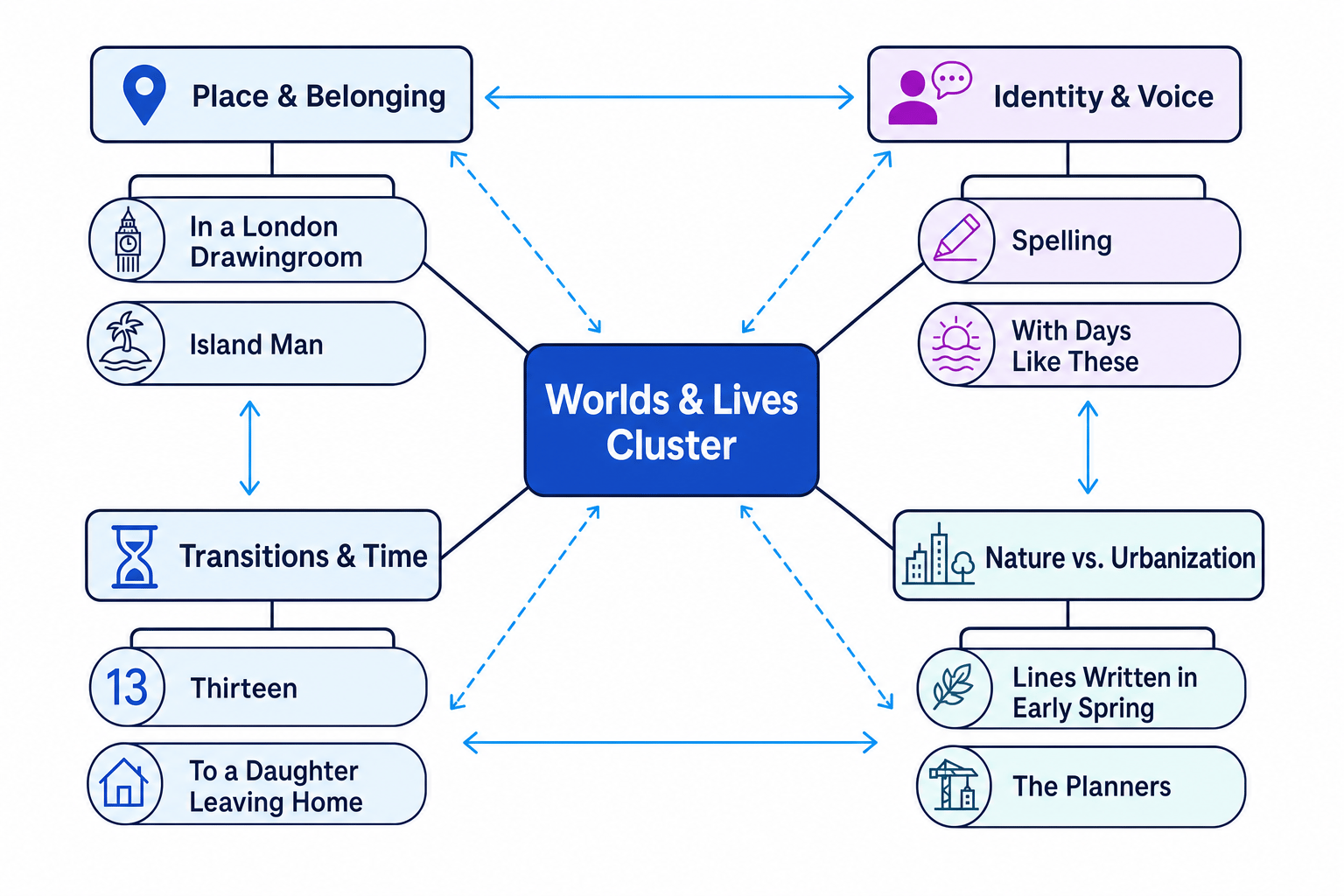
1. Place and Belonging
These poems explore physical environments and how they impact a person's sense of home, alienation, or comfort.
- Key Poems: In a London Drawingroom (George Eliot), Island Man (Grace Nichols), In Romney Marsh (John Davidson).
- Core Idea: Physical spaces can feel like a prison or a sanctuary. For instance, Eliot's London is a stifling, industrial landscape where "all hurry on," whereas Nichols' Island Man experiences a painful mental division between his vibrant Caribbean past and the dull "London grey" of his present.
2. Identity, Heritage, and Voice
These poems examine how language, culture, history, and personal background define who we are.
- Key Poems: Spelling (Margaret Atwood), With Days Like These (Raymond Antrobus), Names (Teresa Mei Chuc).
- Core Idea: Finding your voice and naming your experience is a form of power. Atwood explores how words and "spelling" are linked to female history and survival, while Antrobus uses the perspective of a deaf speaker to examine communication and exclusion in a hearing world.
3. Transitions, Youth, and Growing Up
These poems focus on the passage of time, the loss of innocence, and the emotional shifts of growing older.
- Key Poems: Thirteen (Caleb Femi), To a Daughter Leaving Home (Linda Pastan), An Easy Passage (Julia Copus).
- Core Idea: Growing up involves a delicate balance of vulnerability and freedom. Copus uses the physical metaphor of a girl negotiating a rooftop to represent the transition from childhood to adulthood, while Femi's Thirteen presents a starker, more vulnerable transition marked by systemic prejudice.
4. Humanity and the Natural vs. Built World
These poems contrast the beauty and wisdom of nature with the destructive or clinical tendencies of human civilization.
- Key Poems: Lines Written in Early Spring (William Wordsworth), The Darkling Thrush (Thomas Hardy), The Planners (Boey Kim Cheng).
- Core Idea: Humans often damage their own lives by cutting themselves off from nature or trying to over-control their environments. Wordsworth laments "what man has made of man" in the midst of a harmonious natural scene, while Cheng uses the metaphor of clinical architecture in The Planners to show how modern development erases history and soul.
The Power of Pairing
You do not need to compare every poem to every other poem. Instead, master 4 or 5 key poems that span different themes. This ensures you always have a highly adaptable "partner poem" ready for the exam, no matter which poem AQA prints on the paper.
How the Exam Works
In the exam, you will be given one printed poem from the cluster. You will be asked to compare how a specific theme (such as the power of place, family relationships, or growing up) is presented in this printed poem and one other poem of your choice from the "Worlds and Lives" cluster.
This is a closed-book exam. You must recall key quotes, methods, and ideas for your second poem from memory.
The 'Half-and-Half' Essay
Many students write about the printed poem for three paragraphs, and then write about their chosen poem for another three paragraphs. This is not a true comparison. To achieve high marks, you must use an integrated structure, comparing both poems side-by-side in every paragraph.
Worked Example: Structuring a Comparative Argument
Let’s walk through how to unpack a question, select a companion poem, and build a unified argument.
Selecting a Comparative Poem and Constructing a Thesis
The Prompt: Compare how poets present the relationship between people and their environments in 'In a London Drawingroom' and one other poem from the 'Worlds and Lives' cluster.
- Deconstruct the prompt: Identify the core theme. Here, it is "the relationship between people and their environments." This means we must look at how an environment affects a person's thoughts, feelings, or freedom. In Eliot’s poem, the urban environment is bleak, monotonous, and restrictive ("No skies / O'erarch the city lot").
- Select the companion poem: Choose a poem that offers a clear point of comparison. Lines Written in Early Spring by William Wordsworth is an ideal choice. While Eliot presents a bleak, industrial, man-made city that isolates people, Wordsworth presents a beautiful, natural world that highlights the tragic self-isolation of humanity ("And much it grieved my heart to think / What man has made of man"). This creates a sharp contrast between urban artificiality and natural purity.
- Identify paired textual evidence and methods:
- Eliot (Metaphor/Form): Uses the monotonous image of "a world of many worlds" where "all hurry on" to work, showing how industrial environments turn humans into mechanical, disconnected units. The single-stanza, highly structured form mirrors the physical confinement of the city.
- Wordsworth (Personification/Contrast): Personifies nature as a source of harmony ("to her fair works did Nature link / The human soul"), contrasting it with human misery to show how modern societies reject natural joy. His regular, musical ABAB rhyme scheme evokes natural ease.
- Draft a comparative thesis statement: Combine these ideas into a single, cohesive argument that answers the prompt.
"While both Eliot and Wordsworth explore how physical environments profoundly shape human consciousness, they do so through contrasting landscapes. Eliot uses the bleak, oppressive monotony of industrial London to suggest that modern city environments alienate individuals from nature and themselves. Conversely, Wordsworth utilizes the vibrant harmony of the natural world to highlight humanity’s tragic self-isolation, arguing that human suffering stems from our rejection of the natural peace around us."
Quote Short, Quote Often
Because the exam is closed-book, do not try to memorise long stanzas. Memorise highly precise, 2-to-5-word phrases (e.g., "London grey", "spaces are ruled", "monotonous play"). These are easier to integrate seamlessly into your own analytical sentences.
Analysing Methods in Poetry (AO2)
When comparing your poems, remember that you are not just comparing what the poets say, but how they say it. This is your Assessment Objective 2 (AO2).
Always link the writer's technique directly to their intended effect:
- Form: Is the poem written in a single block of text (like In a London Drawingroom), showing restriction? Or does it use free verse with enjambment (like Island Man or An Easy Passage), reflecting freedom, fluidity, or the natural flow of thought?
- Imagery: Look out for semantic fields (groups of words sharing a common theme). For example, does the poet use mechanical, sterile vocabulary (The Planners) or organic, sensory language (Lines Written in Early Spring)?
- Structure: Look at caesura (pauses in the middle of lines) and enjambment (lines running over). Do these pauses represent hesitation, disruption, or physical boundaries?
In the exam
To secure a high grade on your poetry comparison essay, use this four-step strategy under timed conditions:
- Spend 5 minutes planning: Do not just start writing. Read the printed poem, highlight 3 key quotes, choose your companion poem, and write a brief thesis statement.
- Start with a synthesised thesis: Your opening paragraph must name both poems and set up a clear, conceptual argument that directly answers the question prompt.
- Use the "PEEL-C" paragraph structure: Focus each paragraph on a shared conceptual point. Analyze a quote from Poem A (including its method and effect), and then transition directly into a comparison with a quote from Poem B using comparative connectives (e.g., similarly, in stark contrast, whereas).
- Integrate context (AO3) naturally: Avoid dropping in random historical facts. Only mention context if it directly explains why the poet wrote what they did (e.g., Wordsworth’s Romantic ideals guiding his love of nature, or Antrobus's personal experience of deafness shaping his presentation of language).
Check yourself
Before moving on to individual poem analyses, make sure you can answer these foundational questions:
- Can you name the four thematic pillars of the "Worlds and Lives" cluster and identify at least two poems that belong to each?
- What is the main difference between a "half-and-half" essay structure and an integrated comparative structure?
- Why is it highly effective to compare a poem about an urban environment (like In a London Drawingroom or The Planners) with a poem about a natural environment (like Lines Written in Early Spring)?
