To truly understand The Tempest, we have to travel back to 1611. This was the late Jacobean era (the reign of King James I). The Tempest is widely considered one of Shakespeare’s final plays, written at a time when England was expanding its horizons across the Atlantic, grappling with the boundaries of royal power, and deeply fascinated by the supernatural.
In your GCSE exam, context is assessed under AO3. This does not mean you should simply dump random historical facts into your essay. Instead, you must show how the ideas, events, and beliefs of the Jacobean era directly influenced Shakespeare's choices, and how a contemporary audience would have reacted compared to a modern reader.
What you'll learn
- How the shipwreck of the Sea Venture and the early British Empire shaped the presentation of the island, Prospero, and Caliban.
- The impact of Jacobean beliefs about magic, witchcraft, and the Great Chain of Being on Prospero's powers.
- How the political environment of King James I’s court influenced the play's themes of power, usurpation, and reconciliation.
- The way the play functions as metatheatre—reflecting Shakespeare's own farewell to the stage.
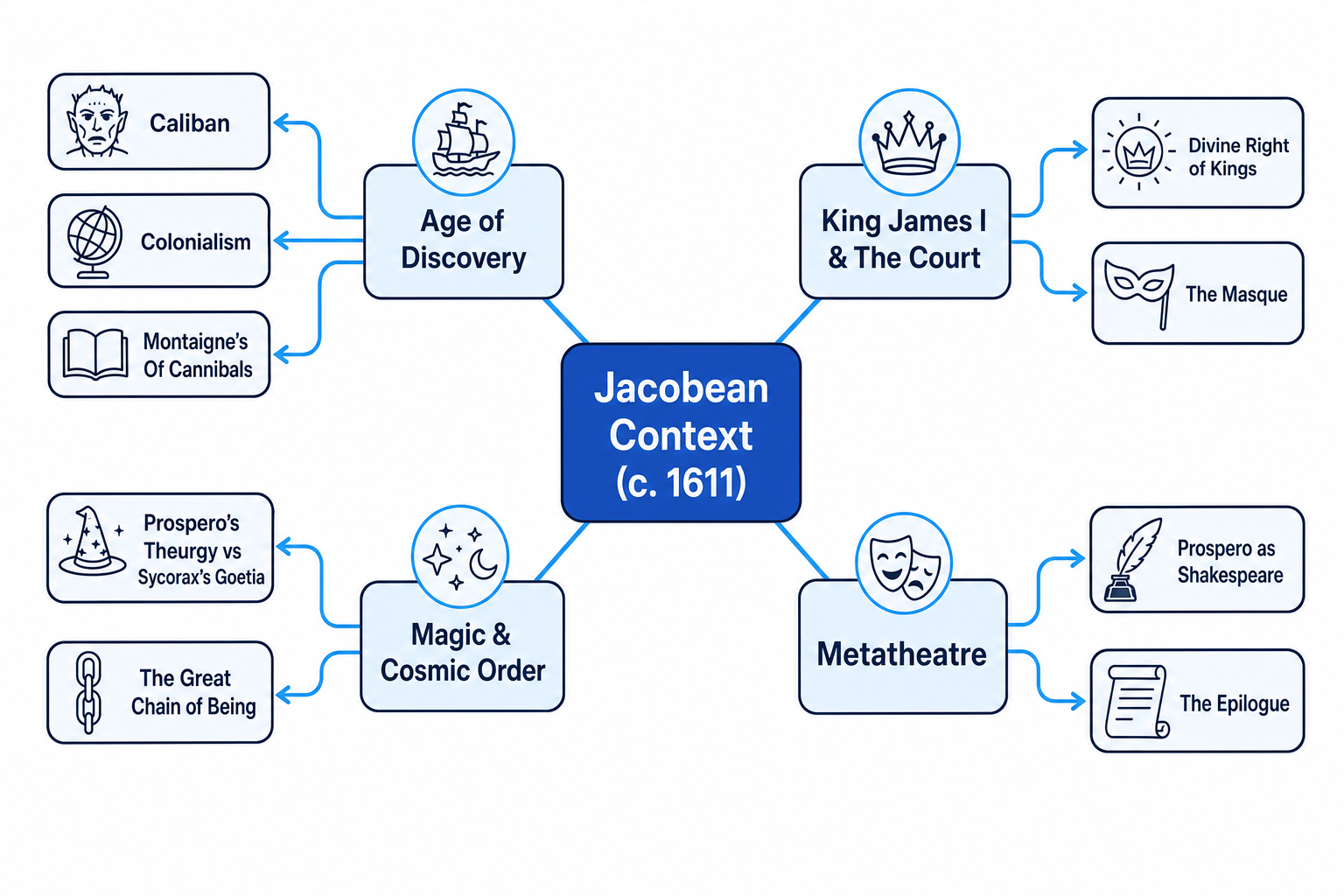
1. The Age of Discovery and Colonisation
In the early 17th century, European nations were actively exploring and claiming lands in the Americas. In 1609, an English ship called the Sea Venture, headed for the colony of Virginia, was wrecked in a storm off the coast of Bermuda. The crew survived on the uninhabited island for nine months before building new boats and sailing on. Reports of this miracle survival reached London in 1610 and directly inspired Shakespeare's opening shipwreck.
Colonialism
Colonialism is the policy or practice of acquiring full or partial political control over another country or territory, occupying it with settlers, and exploiting it economically.
In The Tempest, the island acts as a colonial space. Prospero arrives as an outsider, takes control of the land, and enslaves the native inhabitants, Caliban and Ariel.
The "Noble Savage" and Michel de Montaigne
A major philosophical influence on the play was the essay Of Cannibals (translated into English in 1603) by the French philosopher Michel de Montaigne. Montaigne argued that indigenous people living in "primitive" societies were actually more harmonious, pure, and "noble" than civilized, corrupt Europeans.
Shakespeare engages with this idea in two ways:
- Gonzalo’s Utopia (Act 2, Scene 1): Gonzalo describes how he would govern the island if he were king, using ideas lifted almost word-for-word from Montaigne’s essay (imagining a society with no sovereignty, no wealth, and no forced labor).
- The Character of Caliban: Caliban's name is an anagram of "cannibal" (which itself was a term associated with Carib Indians). Shakespeare does not make Caliban a simple monster. Instead, he gives him some of the most beautiful, poetic language in the play ("Be not afeard; the isle is full of noises...", Act 3, Scene 2), forcing the audience to sympathize with his loss of sovereignty.
The Colonial Conflict
While a Jacobean audience might have viewed Caliban as naturally subordinate and uncivilized, Shakespeare presents a highly complex portrait. By giving Caliban poetic depth and a legitimate grievance ("This island's mine, by Sycorax my mother"), Shakespeare critiques the brutal realities of European colonialism.
2. Magic, Science, and the Great Chain of Being
The supernatural was not a fantasy concept for Jacobeans; it was a deeply understood aspect of their reality.
The Great Chain of Being
The Great Chain of Being was a strict hierarchical structure of all matter and life, believed to have been decreed by God. It descended from God at the top, down to angels, humans, animals, plants, and finally rocks.
Any attempt to break this order—such as a subject overthrowing a king, or a human trying to wield supernatural power above their natural station—was seen as a sin against God that would result in cosmic chaos (symbolized by the tempest itself).
Prospero’s Magic: Theurgy vs. Goetia
To understand Prospero's art, we must distinguish between two types of magic recognized in the Renaissance:
- Theurgy (High/White Magic): This was viewed as a divine science. It relied on scholarship, mathematics, and the alignment of human will with God and nature. Prospero is a theurgist. He wears robes, uses books, and commands spirits to restore moral order.
- Goetia (Low/Black Magic): This involved making pacts with devils and using dark, earthly forces for malevolent ends. Sycorax, Caliban’s mother, represents this. She was a witch from Algiers who "could control the moon."
Confusing Prospero's Magic with Evil Witchcraft
Do not assume Prospero's magic is presented as evil. In the Jacobean era, there was a clear distinction between dark witchcraft (like that of Sycorax or the witches in Macbeth) and scholarly magic (theurgy). However, because magic still skirted the edge of divine boundary-crossing, Prospero must ultimately "abjure" (give up) his magic at the end of the play to return to his proper place in the human hierarchy.
3. King James I and Jacobean Court Politics
The Tempest was performed at court before King James I in 1611, and again in 1613 to celebrate the wedding of his daughter, Princess Elizabeth. This context heavily shaped several aspects of the play.
The Divine Right of Kings
King James I was a firm believer in the Divine Right of Kings—the political and religious doctrine that a monarch's authority comes directly from God, and therefore the king is not subject to any earthly authority.
When Antonio usurps Prospero's dukedom in Milan, he violates this divine law. The tempest and Prospero's subsequent magical trials are designed to force the usurpers (Antonio and Sebastian) to repent, thereby restoring the correct political hierarchy.
The Wise Ruler
James I saw himself as a highly intellectual, academic king (he wrote books on demonology and kingship). However, Shakespeare offers a gentle warning through Prospero:
- In Milan, Prospero neglected his state duties because he was too wrapped up in his "secret studies."
- This neglect created the power vacuum that allowed his brother to overthrow him.
- The play suggests that a good ruler must balance intellectual pursuit with active, practical governance.
The Court Masque
In Act 4, Prospero conjures a masque—a lavish courtly performance featuring Roman goddesses (Iris, Ceres, and Juno) to celebrate the betrothal of Miranda and Ferdinand.
Masque
A masque was an extravagant form of courtly entertainment popular in the 16th and 17th centuries, involving music, dance, elaborate costumes, and allegorical spectacles designed to praise the reigning monarch.
By including a masque in The Tempest, Shakespeare was appealing directly to King James's love for these expensive spectacles, while also highlighting Prospero’s god-like control over the characters on his island.
4. Metatheatre: Shakespeare's Farewell
Many scholars view The Tempest as autobiographical. Written around 1611, it was one of the last plays Shakespeare wrote entirely by himself before retiring to Stratford-upon-Avon.
Metatheatre
Metatheatre refers to aspects of a play that draw attention to its own nature as drama or theatre, reminding the audience they are watching a play.
Prospero acts as a playwright or director on the island. He controls the actors (the shipwrecked nobles), creates special effects (the tempest, the disappearing banquet), and commands his stage manager (Ariel).
When Prospero delivers his famous soliloquy in Act 4, Scene 1, he states:
"Our revels now are ended. These our actors, As I foretold you, were all spirits and Are melted into air, into thin air..."
This is widely interpreted as Shakespeare himself speaking directly to his audience, preparing to "drown his book" (stop writing) and retire from the magical world of the London theatre.
Integrating Context (AO3) with Language Analysis (AO2)
Let's look at how to write a high-level paragraph that successfully integrates context to analyze a character's motivations, avoiding the trap of a "context dump."
Question: Explore how Shakespeare presents the relationship between Prospero and Caliban.
-
Step 1: Point Start with an analytical claim that directly answers the question, highlighting the power dynamics and the colonial subtext.
Example: "Shakespeare presents the relationship between Prospero and Caliban as a tense, deeply unequal struggle for ownership of the island, reflecting contemporary Jacobean anxieties surrounding colonialism and the treatment of indigenous peoples."
-
Step 2: Evidence and Language Analysis (AO2) Introduce a specific, short quotation and analyze the literary methods used.
Example: "This power struggle is made explicit when Caliban asserts his original sovereignty, declaring, 'This island’s mine, by Sycorax my mother / Which thou tak’st from me.' Caliban's use of the possessive pronoun 'mine' directly contrasts with his accusation of theft ('tak'st from me'). By phrasing Caliban's claim in regular blank verse, Shakespeare gives his grievance a dignity and poetic weight that challenges Prospero's absolute authority."
-
Step 3: Contextual Integration (AO3) Explain why this matters by linking the literary effect to Jacobean history and ideas (such as Montaigne's essay).
Example: "Through Caliban's poetic claim to the land, Shakespeare engages directly with Michel de Montaigne’s essay Of Cannibals, which challenged the Eurocentric assumption that native populations were subhuman. Rather than presenting Caliban as a crude caricature of a 'savage,' Shakespeare utilizes the colonial setting to force his Jacobean audience to confront the moral ambiguity of English transatlantic expansion. This complicates the relationship, transforming Caliban from a mere servant into a dispossessed ruler defending his natural right."
In the exam
- Never "bolt on" context: Do not write a paragraph of pure history. Every time you mention a historical fact (like King James's interest in magic or the Sea Venture), immediately link it back to a specific quote, character, or dramatic choice made by Shakespeare.
- Focus on the writer's intent: Use phrases like "Shakespeare utilizes the contemporary fear of..." or "Through this, Shakespeare appeals to the Jacobean belief in..." to show you understand that the play is a constructed piece of art.
- Contrast audiences: Show how a modern audience might interpret a scene differently than a Jacobean audience. For example, a modern audience often views Caliban as a victim of colonial oppression, whereas a Jacobean audience may have viewed his rebellion as a dangerous violation of the Great Chain of Being.
Check yourself
- Why did the shipwreck of the Sea Venture capture the imagination of the public in Jacobean London, and how does this relate to the setting of The Tempest?
- What is the difference between Theurgy and Goetia, and why is this distinction vital for understanding Prospero’s magic?
- How does Gonzalo’s utopian speech in Act 2, Scene 1 reflect the ideas of Michel de Montaigne's essay Of Cannibals?
