Dennis Kelly’s DNA is a contemporary play first performed in 2007 at the National Theatre. It tells the chilling story of a group of teenagers who accidentally "kill" one of their peers, Adam, and subsequently construct a web of lies to cover up their crime.
To score highly on the AQA GCSE English Literature paper (specifically targeting AO3: Context), you must understand that "context" is not just a list of historical facts to be dropped into your essay. Instead, it is the relationship between the play's ideas and the social, cultural, and political environments in which Kelly wrote it.
What you'll learn
- How the early 2000s UK media panic over "feral youth" influenced the play.
- How Kelly uses concepts of evolutionary biology and animal behaviour to question human morality.
- How to link philosophical concepts, such as utilitarianism and nihilism, directly to the characters' choices.
- How to write about context in a fluid, analytical way that elevates your essay structure.
1. The Social Context: The "Hoodie Panic" of the 2000s
In the early 2000s, British media and politicians were preoccupied with what they called "anti-social behaviour" among teenagers. This era saw the introduction of ASBOs (Anti-Social Behaviour Orders) and a widespread moral panic about youth gang culture.
Moral Panic
A moral panic is a widespread, exaggerated public fear that a particular group or subculture (in this case, teenagers in hoodies) poses a direct threat to the values, safety, and interests of society as a whole.
During this period, shopping centres banned hooded sweatshirts, and the media frequently demonised adolescents as "feral," aggressive, and lawless.
Kelly's Subversion of the Stereotype
Rather than simply reproducing this stereotype, Kelly subverts it. The characters in DNA are not street-gang members fighting over territory or drugs; they are ordinary school pupils who find themselves in an extraordinary, terrifying situation.
- Intelligence and Articulacy: Characters like Phil, Leah, and Richard are highly articulate and philosophical. They discuss the cosmos, evolutionary science, and empathy.
- Anxiety over Aggression: The group is driven by intense fear, panic, and a desperate desire to conform, rather than a raw desire for violence.
- The Absent Adults: Throughout the entire play, there are no parents, teachers, or police officers on stage. The adult world is entirely absent, forcing the teenagers to govern themselves—with disastrous results.
The Absent Adult World
By removing adults from the stage, Kelly creates a miniature society. The teenagers are forced to construct their own moral laws from scratch, showing how easily human beings default to authoritarianism and cruelty when the stabilizing structures of civilised society are removed.
2. The Scientific Context: Evolutionary Biology and "The Selfish Gene"
The title of the play, DNA (Deoxyribonucleic acid), is a direct reference to genetics and evolutionary biology. Kelly was heavily influenced by the ideas of evolutionary psychologists and writers like Richard Dawkins, whose landmark 1976 book The Selfish Gene argued that genes act selfishly to ensure their own survival, often dictating human behaviour in ways we do not realise.
Genetic Determinism
Genetic determinism is the belief that human behaviour, personality, and choices are entirely dictated by our genetic code (our DNA), rather than by personal choice, free will, or upbringing (nurture).
If human beings are genetically determined to survive at all costs, then morality, empathy, and altruism might just be fragile, artificial concepts.
Chimpanzees vs. Bonobos
In Act 2, Scene 1, Leah delivers a famous monologue where she compares human behaviour to that of our closest evolutionary relatives: chimpanzees and bonobos.
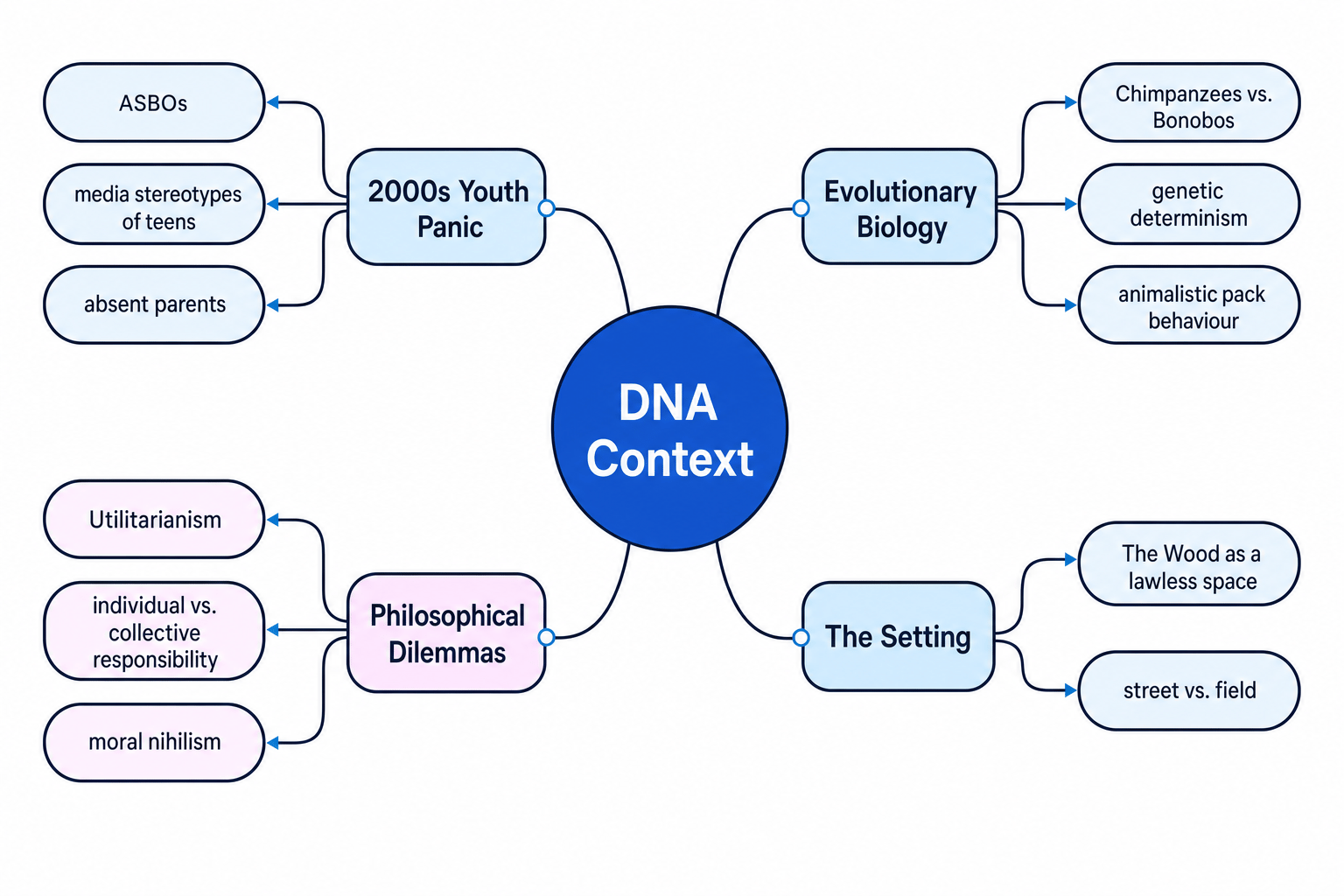
- Chimpanzees: Highly violent, territorial, and hierarchical. They form aggressive coalitions to murder outsiders and establish dominant alphas.
- Bonobos: Peaceful, matriarchal, and cooperative. They resolve conflict through social bonding rather than violence.
Kelly uses this biological comparison to ask a vital question: Which primate's DNA do we inherit? When the pressure is on, the group quickly abandons bonobo-like empathy and defaults to chimpanzee-like pack brutality to protect themselves.
Look at the Group dynamic
When writing about the group's hierarchy, use terms like "ape-like pack mentality" or "primal hierarchy." Phil acts as the silent, dominant alpha male who uses violence and psychological manipulation to keep the submissive betas (like Brian and Danny) in line.
3. Philosophical Context: Utilitarianism vs. Deontology
The core conflict of the play is a moral dilemma: Is it acceptable to sacrifice one person to ensure the happiness and safety of the group? This is a classic battle between two competing ethical frameworks.
Utilitarianism
Utilitarianism is a moral philosophy which argues that the most ethical action is the one that produces "the greatest good for the greatest number of people."
Phil is the ultimate utilitarian. When he decides that Adam must be killed (for a second, permanent time) because Adam's return would ruin all their lives, he is making a cold, mathematical calculation. In Phil's eyes:
- Letting Adam live = 8 people go to prison (maximum suffering).
- Killing Adam = 1 person dies, 8 people stay free (minimum suffering for the majority).
Deontology (Duty-Based Ethics)
Conversely, deontology is the ethical framework which argues that certain actions are inherently wrong, regardless of their consequences. Under this view, murder is always wrong, even if it saves others. Leah represents this deontological stance; she instinctively knows that what they are doing is evil, screaming at Phil, "It's not fair, it's not right!"
Don't simplify Leah's character
While Leah represents the moral conscience of the play, remember that she is ultimately complicit. She never goes to the police. Kelly uses her to show how easily individual morality (deontology) is crushed by the terrifying weight of collective self-interest (utilitarianism).
How to Integrate Context: A Worked Example
In your exam, you should never write a "standalone" paragraph about the 2000s or chimpanzees. You must weave context (AO3) directly into your language and structural analysis (AO2) and your overall thesis (AO1).
Integrating context into text analysis
Analyze how Kelly uses the character of Phil to explore ideas of power and human nature in DNA.
-
Identify a precise textual method and quote: Focus on the moment Phil asserts his dominance over the group using declarative language and food imagery: "Phil eats his waffle... 'I'm in charge. Everyone is happier.'"
-
Link the textual method directly to a contextual concept: Connect Phil's silent consumption and blunt commands to the primal hierarchy of evolutionary biology (the chimpanzee alpha) and the cold logic of utilitarian philosophy.
-
Draft the integrated analytical paragraph: "Kelly uses Phil’s silent, physical consumption of food to establish him as the undisputed alpha male of the group, reflecting the primal chimpanzee behaviour Leah describes elsewhere. When Phil finally speaks, he uses absolute declaratives: 'I'm in charge. Everyone is happier.' The noun 'everyone' highlights Phil's ruthless utilitarian philosophy; he believes individual suffering (such as the sacrifice of Adam) is entirely justified if it preserves the collective stability of the group. Rather than depicting teenagers as mindlessly violent, Kelly contextualises their cruelty as a deeply rationalized, evolutionary drive for survival, suggesting that human morality is merely a thin veneer over our primal DNA."
Context Dumping
Avoid "context dumping"—writing a paragraph of pure history or sociology (e.g., "In 2007, ASBOs were popular...") without connecting it to a specific line of the text. If you can delete the contextual fact and your analysis of the play still makes perfect sense, your context is not integrated.
In the exam
- Anchor everything in the text first: Start your paragraph with a point about a character, theme, or structure (AO1), support it with a precise quotation, and analyze the writer's methods (AO2). Only then bring in the context (AO3) to explain why Kelly made these choices.
- Use precise terminology: Do not just say "Kelly shows how teens act like animals." Instead, write: "Kelly explores genetic determinism and primal pack mentality through the group's regression into chimpanzee-like territorial violence."
- Adopt a conceptual focus: Frame your essay around Kelly's wider moral and philosophical intentions. Ask yourself: What is Kelly trying to warn the audience about? (e.g., the fragility of morality, the dangers of group conformity, or the coldness of pure utilitarianism).
Check yourself
- Can you explain the difference between chimpanzee and bonobo behaviour as outlined by Leah, and how this relates to the characters' actions?
- Why did Dennis Kelly choose to leave adult characters completely out of the play? How does this choice connect to the socio-political context of the early 2000s?
- How does Phil's treatment of Brian illustrate the dark side of a utilitarian "greatest good for the greatest number" mindset?
