In the GCSE English Literature exam, you will not just be asked to describe what happens to the characters in The Tempest. Instead, you must explore why Shakespeare wrote the play and what messages he wanted to convey to his Jacobean audience. This means looking closely at the play's main ideas, or themes.
What you'll learn
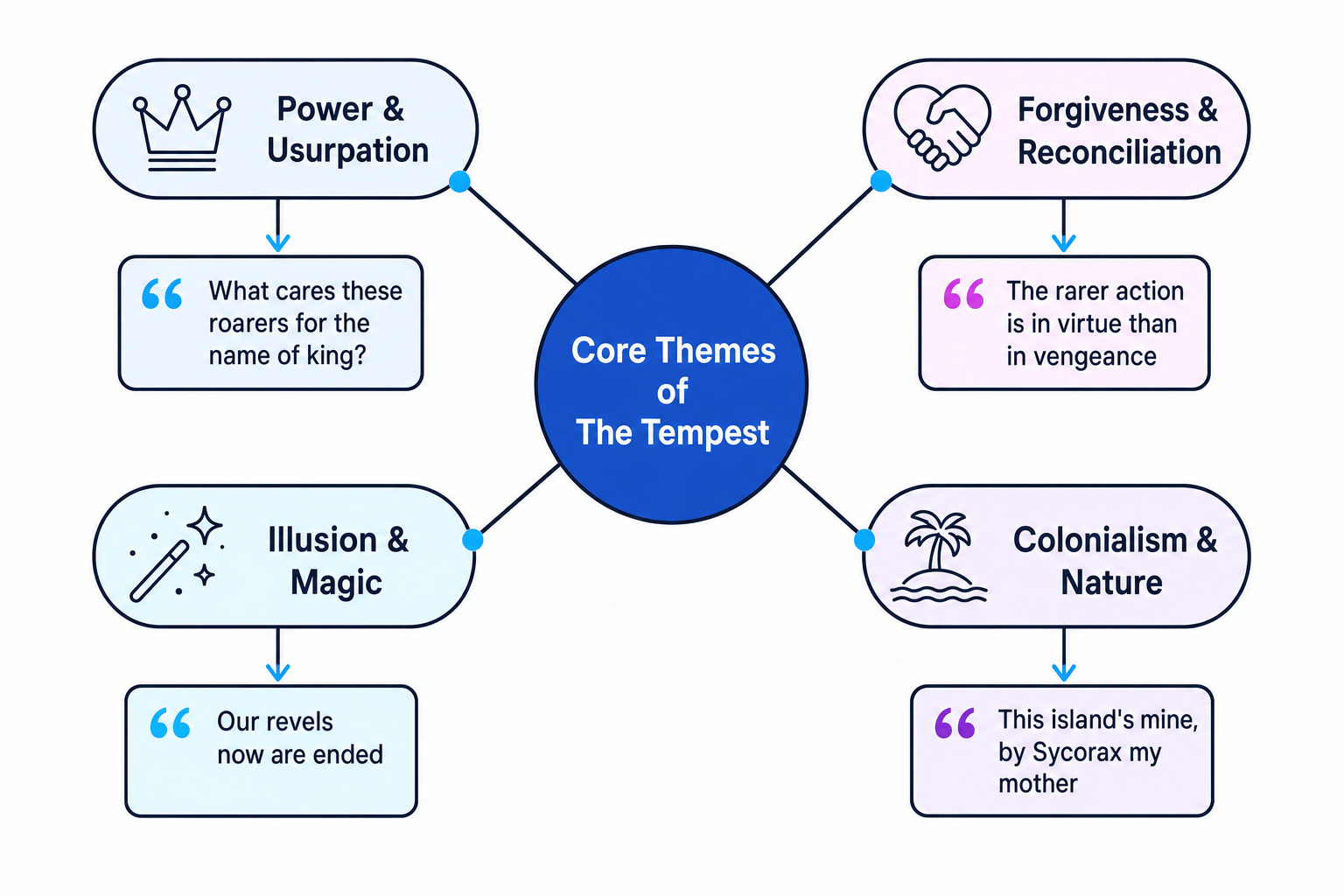
- How power, control, and usurpation drive the conflict on the island.
- Why Prospero's journey from vengeance to forgiveness forms the moral heart of the play.
- How Shakespeare uses magic and illusion to comment on the nature of theatre and reality.
- The ways in which the play reflects Jacobean ideas about colonialism, nature, and nurture.
1. Power, Control, and Usurpation
At its core, The Tempest is a play about who has the right to rule. It begins with a violent disruption of the social hierarchy and continues to explore different power struggles throughout.
Usurpation
Usurpation is the act of illegally taking someone else's power, throne, or position by force.
The Disruption of Natural Authority
In Act 1, Scene 1, Shakespeare immediately challenges the idea of earthly power. During the storm, the Boatswain shouts:
"What cares these roarers for the name of king?"
In this moment, the tempest (a force of nature) respects no social hierarchy. The King of Naples, Alonso, has no power over the waves. This structural opening alerts the audience that the usual rules of power and status do not apply on this isolated island.
The Cycles of Usurpation
Power in The Tempest is rarely secure; it is constantly being challenged and stolen:
- Antonio usurped Prospero: Twelve years before the play begins, Antonio stole Prospero's title as Duke of Milan, with the help of Alonso.
- Prospero usurped Caliban: Upon arriving on the island, Prospero took control from Caliban, who claims, "This island's mine, by Sycorax my mother".
- Sebastian and Antonio plot to usurp Alonso: Even when shipwrecked, Antonio tempts Sebastian to murder Alonso to steal the crown of Naples.
- Caliban, Stephano, and Trinculo plot to usurp Prospero: The comedic subplot mirrors the serious main plot, as the low-status characters scheme to murder Prospero and rule the island.
By mirroring these power struggles across different social classes, Shakespeare suggests that the desire for power is a corrupting, universal human trait.
2. Forgiveness, Reconciliation, and Redemption
While the play is driven by betrayal and the desire for revenge, its ultimate resolution rests on forgiveness. This shift is crucial for understanding Shakespeare's message about human nature.
Vengeance vs. Virtue
The emotional climax of the play is not a physical battle, but Prospero's internal decision to abandon his plans for revenge in favour of mercy.
The Turning Point
Prospero has spent twelve years planning his revenge. He uses his magic to torture his enemies with illusions and terrors. However, in Act 5, Scene 1, the spirit Ariel tells Prospero that his enemies are so miserable that if Prospero saw them, his "affections would become tender."
Prospero, moved by a spirit's capacity for empathy, makes a monumental decision:
"The rarer action is / In virtue than in vengeance."
Here, Shakespeare uses alliteration ("virtue" and "vengeance") to contrast these two paths. "Rarer" in Jacobean English meant both more unusual and more noble. To forgive is a higher, more civilized human act than to seek revenge.
Remember the Genre
The Tempest is one of Shakespeare's late plays, often classified as a Romance or a Tragi-comedy. These plays typically begin with tragedy (betrayal, loss, exile) but end in reconciliation, harmony, and restoration, often symbolized by the marriage of the younger generation (Miranda and Ferdinand).
3. Illusion, Magic, and Metatheatre
Magic is the engine of the play, but Shakespeare uses it as a metaphor for something much closer to home: the theatre itself.
Metatheatre
Metatheatre describes aspects of a play that draw attention to the fact that it is a play, making the audience aware of the theatrical medium itself.
Prospero as the Playwright
Prospero uses his "Art" (his magic) to control the other characters, stage illusions (like the banquet and the wedding masque), and manipulate the plot. In this sense, Prospero acts like a playwright or a theatre director.
When Prospero decides to give up his magic, he famously says:
"Our revels now are ended. These our actors, / As I foretold you, were all spirits and / Are melted into air, into thin air"
In this famous speech (Act 4, Scene 1), Shakespeare uses the character of Prospero to address the audience directly. The "revels" refer both to the magical masque Prospero has just staged and to the theatrical performance of The Tempest itself. By comparing human life to a brief, insubstantial dream, Shakespeare emphasizes the fragile nature of both reality and art.
Confusing Jacobean attitudes to magic
Do not assume all magic was viewed as evil by Shakespeare's audience. While King James I wrote a book condemning witchcraft (Daemonologie), Prospero’s magic is presented as theurgy (high, intellectual, scholarly magic) rather than black magic. Prospero studies books to achieve his power, unlike Caliban’s mother, Sycorax, who practiced dark magic. However, Prospero must still give it up ("I'll drown my book") to return to the natural, Christian social order of Milan.
4. Colonialism and the 'New World' (Nature vs. Nurture)
Written in 1611, The Tempest reflects the anxieties and excitement of the Age of Discovery, when European ships were exploring and colonizing the Americas.
The Colonial Dynamic
Prospero's relationship with Caliban directly mirrors the European colonization of indigenous peoples:
- Prospero initially treats Caliban kindly, teaching him language.
- Caliban shows Prospero the resources of the island ("all the qualities o' th' isle").
- Prospero then enslaves Caliban, claiming he is biologically incapable of civilization.
Shakespeare uses Caliban to explore the Jacobean debate of Nature versus Nurture (whether a person's character is formed by their genetics/nature or their upbringing/nurture). Prospero bitterly describes Caliban as:
"A devil, a born devil, on whose nature / Nurture can never stick"
Prospero believes Caliban is naturally evil and cannot be educated. However, Shakespeare gives Caliban some of the most beautiful, poetic language in the play (such as the "Be not afeard; the isle is full of noises" speech in Act 3, Scene 2). This structural choice challenges the colonial view, prompting the audience to feel empathy for Caliban and question whether the "civilized" Europeans are actually the corrupt ones.
Worked Example
Analyzing Prospero’s shift to forgiveness
Walk through how to write a high-scoring analytical paragraph on how Shakespeare presents the theme of forgiveness in Act 5, Scene 1.
-
Step 1: Make a clear point (AO1) linked to the writer's intent. State how Shakespeare uses Prospero's shift to convey a moral message.
Draft: Shakespeare presents forgiveness as the ultimate form of moral growth, demonstrating that true nobility lies in mercy rather than revenge.
-
Step 2: Embed a precise quotation and identify literary methods (AO2). Introduce the quote smoothly within your sentence and name the key techniques (e.g., juxtaposition, alliteration).
Draft: This is evident when Prospero resolves his conflict by stating, "The rarer action is / In virtue than in vengeance." Shakespeare employs alliteration with the soft 'v' sounds of "virtue" and "vengeance," juxtaposing these two opposing moral paths.
-
Step 3: Analyze the specific word choices and their effects on the reader (AO2). Examine the connotations of key words.
Draft: The comparative adjective "rarer" is highly significant; in the Jacobean era, it denoted both something uncommon and something of exceptional value or purity. By declaring virtue to be the "rarer" path, Prospero recognizes that while revenge is a common, instinctual human response, choosing to forgive is a noble, divine act that elevates humanity.
-
Step 4: Link to context and the play's wider structure (AO3/AO1). Explain how this fits into the historical context of the play and its genre.
Draft: This pivotal shift reflects the Christian humanist values of Shakespeare’s Jacobean audience, who would have viewed mercy as a royal attribute. Structurally, this transformation resolves the tension of the play, steering The Tempest away from the destructive path of a revenge tragedy and toward the harmonious resolution characteristic of Shakespearean romance.
In the exam
- Focus on the big ideas (AO3): Don't just list what the characters do. Ask yourself why Shakespeare wrote this play in 1611. How do the themes of power or colonialism reflect Jacobean concerns?
- Track structural shifts: The best essays show how a theme develops. For example, show how the theme of power moves from physical rebellion in Act 1 to spiritual surrender and abdication in Act 5.
- Analyze language, form, and structure together (AO2): Look at how the themes are expressed. Does a character speak in prose or blank verse? (e.g., Caliban speaks in prose when drunk with Stephano, but blank verse when describing the beauty of the island, showing his complex nature).
- Link different plots: Show how Shakespeare mirrors themes across different groups of characters (e.g., Antonio usurping Prospero is mirrored by Stephano and Trinculo plotting to kill Prospero). This shows you understand the form of the play.
Check yourself
- Why is the opening storm in Act 1, Scene 1 structurally important for the theme of power?
- What does the contrast between Prospero's "Art" and Sycorax's magic tell us about Jacobean attitudes toward the supernatural?
- How does Caliban's use of blank verse (poetry) challenge Prospero's view that he is a "born devil"?
