For your AQA GCSE English Literature Paper 1 exam, you are expected to write a closed-book essay. This means you do not have the text in front of you. To succeed, you need a bank of highly versatile, short, and memorable "micro-quotations" that you can recall under pressure and analyse in deep detail.
Evaluating a few key words deeply (AO2) and linking them to Victorian context (AO3) is far more effective than memorising long chunks of text.
What you'll learn
- How to select and memorise highly versatile "micro-quotations"
- How to decode the structural and linguistic methods Stevenson uses
- How to link language analysis directly to Victorian anxieties about science, evolution, and social reputation
1. Duality and the Divided Self
The core thematic conflict of the novella is the division of the human psyche between good and evil. Stevenson uses Dr Jekyll to show how Victorian society forced men to split their personalities to maintain a respectable facade.
Dualism
Dualism is the concept that human nature is split into two opposing, incompatible forces: the moral, civilised self (represented by Jekyll) and the primitive, instinctual self (represented by Hyde).
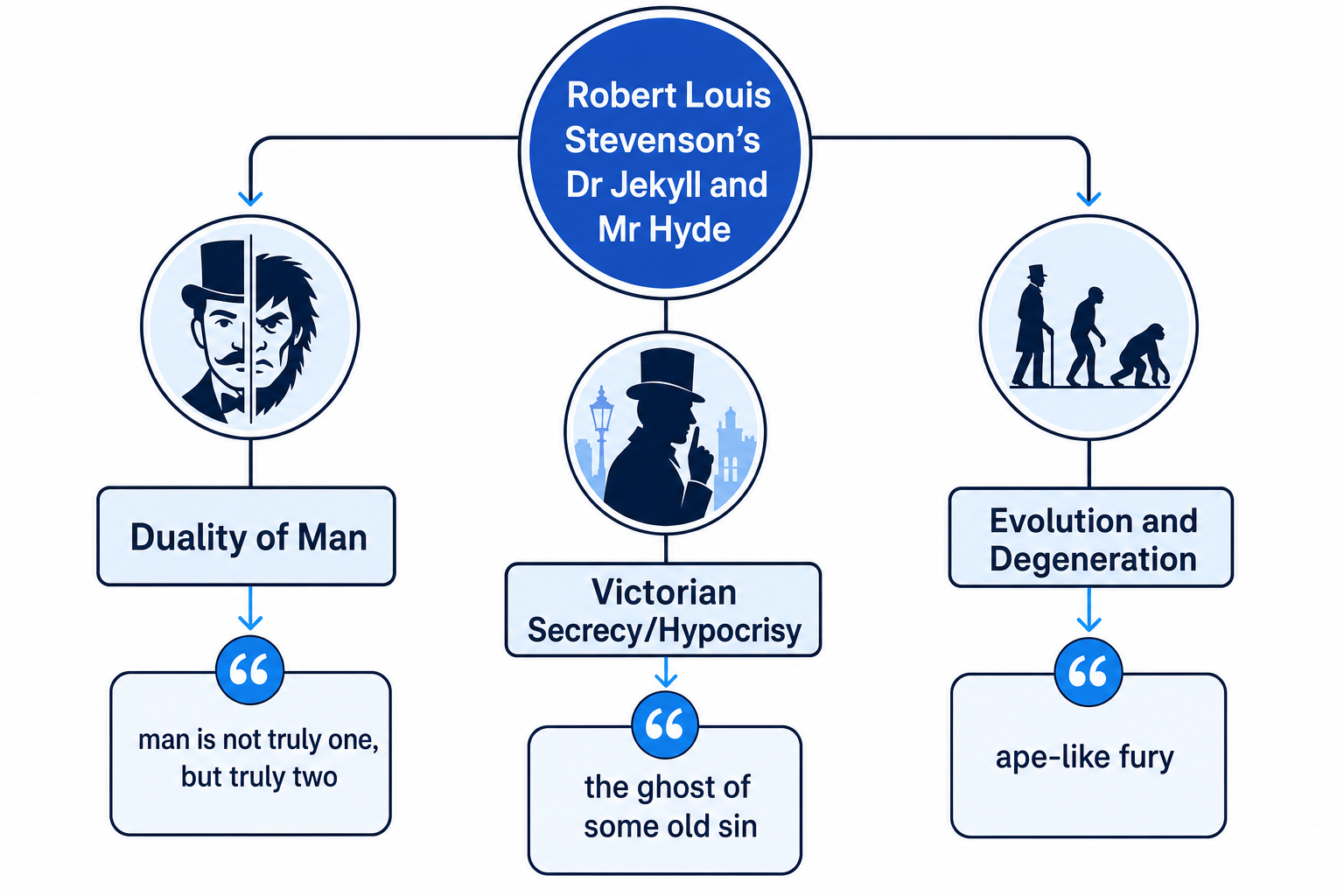
"Man is not truly one, but truly two"
(Dr Jekyll, Chapter 10: "Henry Jekyll's Full Statement of the Case")
This is the central thesis of the entire novella.
- The Method: Stevenson uses the structural parallel of the adverb "truly" to contrast "one" and "two". The repetition emphasizes Jekyll's scientific conviction.
- The Analysis: The word "truly" suggests an absolute, undeniable reality. By declaring man is split, Jekyll attempts to excuse his own moral failures. The numerical contrast between "one" and "two" challenges the traditional Christian view of a single, unified soul.
- The Context: This reflects Victorian psychological theories of the "double life" and the rising interest in the subconscious mind.
"I felt younger, lighter, happier in body"
(Dr Jekyll, Chapter 10)
Jekyll describes his first physical transformation into Hyde.
- The Method: A triadic structure (rule of three) using comparative adjectives ("younger, lighter, happier").
- The Analysis: The comparative adjectives show that releasing his repressed, evil desires feels liberating, not horrifying. It reveals that Jekyll’s goodness was a painful burden imposed by Victorian social expectations. The word "lighter" suggests he has cast off the heavy weight of social morality.
Duality is a universal struggle
Do not treat Jekyll as pure good and Hyde as pure evil. Jekyll created Hyde because he wanted to indulge in sinful pleasures without losing his respectable social status. Hyde is the physical manifestation of Jekyll's repressed desires.
2. Evolution, Atavism, and Degeneration
During the late 19th century, Charles Darwin’s theory of evolution terrified Victorians. They feared that if humans had evolved from apes, they could also degenerate (slide backward) into primitive beasts. Stevenson channels this fear directly through the character of Mr Hyde.
Atavism
Atavism is the evolutionary throwback or regression to a primitive, ancestral state. In Victorian literature, atavistic characters are often depicted as violent, ape-like, and lacking moral control.
Degeneration
Degeneration is the theory that a civilised society or individual can morally and physically decay, reverting to a lower, less developed state of existence.
"Like a damned Juggernaut"
(Mr Enfield, Chapter 1: "Story of the Door")
This is our very first introduction to Hyde's physical presence, describing him trampling a young girl.
- The Method: A powerful simile combined with religious imagery ("damned").
- The Analysis: A "Juggernaut" is a massive, unstoppable Hindu temple car that crushed devotees under its wheels. By comparing Hyde to this object, Enfield depicts him as an inhuman, supernatural force of destruction. The adjective "damned" foreshadows Hyde’s spiritual damnation and links him to the devil.
- The Context: Victorians were deeply religious. Describing a character as spiritually "damned" from the outset immediately marks them as an existential threat to Christian society.
"Ape-like fury"
(The Maid / Narrator, Chapter 4: "The Carew Murder Case")
The maid witnesses Hyde brutally murdering the MP Sir Danvers Carew.
- The Method: Zoomorphism (giving animalistic qualities to a human).
- The Analysis: The noun "ape" strips Hyde of his humanity, reducing him to a wild beast. The noun "fury" suggests a wild, uncontrolled rage that is entirely disproportionate to any provocation.
- The Context: Published in 1886, just 15 years after Darwin’s The Descent of Man, this description directly tapped into Victorian anxieties about the beast within us all.
Confusing 'zoomorphism' with 'personification'
Personification gives human qualities to non-human things (e.g., the wind whispered). Zoomorphism gives animal qualities to humans (e.g., his ape-like fury). Make sure you use the correct term to secure high AO2 marks.
3. Victorian Secrecy and Hypocrisy
In Victorian London, reputation was everything. Gentlemen would go to extreme lengths to hide their sins, creating a culture of intense secrecy, locked doors, and foggy streets.
"The ghost of some old sin, the cancer of some concealed disgrace"
(Mr Utterson, Chapter 2: "Search for Mr Hyde")
Utterson believes Jekyll is being blackmailed by Hyde for sins committed in his youth.
- The Method: Metaphors ("ghost" and "cancer").
- The Analysis: The metaphor "ghost" suggests that past sins cannot be easily laid to rest; they haunt the present. The metaphor "cancer" is highly visceral—it implies that secrets are a deadly, degenerative disease eating away at Jekyll’s respectable life from the inside out.
- The Context: This perfectly captures the anxiety of the Victorian elite. A single scandal could utterly destroy a gentleman's standing in society, leading to a culture of concealment and hypocrisy.
Use the setting as a metaphor
Stevenson uses the London setting to mirror this secrecy. The "fog" that constantly rolls through the streets acts as a physical barrier that hides sinful behaviour, symbolizing the moral blindness of Victorian society.
Worked Example
Deconstructing Hyde's primitive regression
Read the following extract and consider how Stevenson presents Hyde's violent nature. Let's walk through how to build a top-tier paragraph analysing the phrase: "with ape-like fury, he was trampling his victim under foot".
-
Identify the core method and extract the micro-quote: Select the specific device and narrow down the quote to its absolute essence.
- Application: The writer uses zoomorphism in the noun phrase "ape-like fury" to describe Hyde's brutal attack on Sir Danvers Carew.
-
Analyse the connotations of specific words: Unpack the exact words used and explain how they construct Hyde's character.
- Application: The adjective "ape-like" carries strong animalistic connotations of wild, untamed aggression. It strips Hyde of human reason, morality, and empathy. The noun "fury" reinforces this, suggesting an uncontrollable, volcanic release of energy that contrasts sharply with the quiet, orderly Victorian society.
-
Link to structural progression and reader effect: Explain how this fits into the wider novella and how the Victorian reader would react.
- Application: This shocking burst of animalistic violence occurs in Chapter 4, shattering the peaceful, moonlit night. For a contemporary Victorian reader, this depiction of a regression to an animal state would provoke deep-seated anxiety about moral and physical degeneration.
-
Contextualise the analysis (AO3): Connect the linguistic choices to the historical background.
- Application: This zoomorphic description reflects late-Victorian anxieties surrounding Charles Darwin's On the Origin of Species (1859). The idea that humans evolved from primates led to the terrifying fear of atavism—the belief that the savage, primitive beast still lurked just beneath the civilised surface of Victorian gentlemen.
In the exam
- Memorise 'micro-quotes': Do not try to learn whole sentences. Memorise 2-3 word fragments like "ape-like fury", "damned Juggernaut", or "polar twins". They are easier to remember and force you to focus on close-word analysis.
- Track the character arc: When discussing a quote, mention where it occurs in the novella. A quote from Chapter 1 (Enfield’s external view of Hyde) serves a different narrative purpose than a quote from Chapter 10 (Jekyll’s internal confession).
- Always link to the 'Why': Never just name a method (e.g., "Stevenson uses a simile"). Explain why he used it to affect the reader, and how it reflects Victorian anxieties about science, religion, or reputation.
Check yourself
- Can you explain the difference between atavism and duality, using a specific quote for each?
- Why is the word "cancer" in Chapter 2 such a powerful metaphor for Victorian secrets?
- What does the transition from Jekyll's feeling of being "younger, lighter, happier" to his eventual dread of Hyde tell us about Stevenson's message on indulging our dark desires?
