In the study of The Strange Case of Dr Jekyll and Mr Hyde, understanding the structural skeleton of the novella is just as important as knowing the plot. Robert Louis Stevenson does not tell this story in a straightforward, chronological way. Instead, he constructs a complex mystery that relies on shifting perspectives, hidden documents, and sudden changes in tone across key chapters.
By mastering these pivotal chapters, you will be able to write sophisticated, high-scoring essays that analyse form and structure alongside language and context.
What you'll learn
- How Stevenson uses structural shifts in narrative perspective to build suspense.
- The thematic and gothic significance of key milestone chapters (Chapters 1, 4, 8, 9, and 10).
- How to analyse a late-stage extract to unpack Jekyll's psychological collapse.
The Structural Blueprint of the Novella
To appreciate why specific chapters matter so much, we first need to understand the overarching structure of the text. Stevenson uses a framed narrative that transitions from a standard third-person limited perspective to a series of first-person epistolary accounts.
Epistolary Form
A literary form where a story is told through documents, letters, diaries, or written confessions rather than standard chronological narration.
For the first eight chapters, we follow Mr Utterson. We see only what he sees, making us feel like detectives trying to solve a bizarre case. Then, in the final two chapters, the narrative structure completely shifts. We are handed two written testimonies—first from Dr Lanyon, and then from Dr Jekyll himself—which retrospectively explain the supernatural and psychological truth behind the mystery.
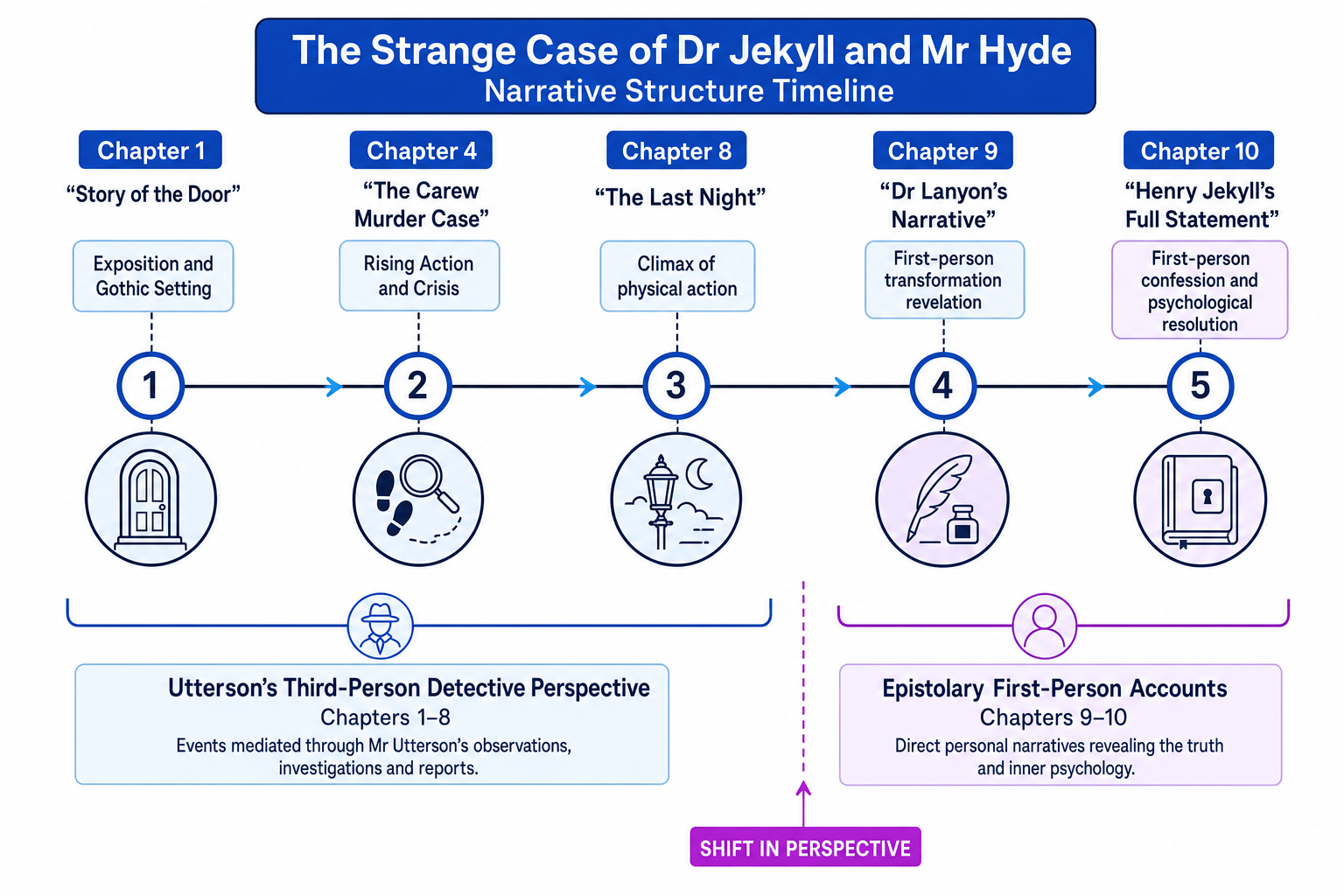
The Epistolary Shift
The shift from Utterson's third-person perspective to first-person letters in Chapters 9 and 10 mimics the peeling back of Jekyll's respectable Victorian facade. It forces the reader to move from observing Hyde's external horrors to experiencing Jekyll's internal psychological torment directly.
The Five Key Chapters
While every chapter plays a part, five specific chapters carry the weight of Stevenson's thematic and structural intentions.
Chapter 1: "Story of the Door"
This chapter serves as the exposition. It introduces the key characters of Utterson and Enfield, and establishes the atmospheric, gothic setting of London's dark, winding streets.
- Thematic Focus: Duality and reputation.
- Key Symbol: The "blistered and distained" door of the laboratory, which stands in stark contrast to the "freshly painted shutters" and prosperous look of the main street. This immediately introduces the motif of the double, or dual nature, of Victorian society.
- Key Quote: Enfield describes Hyde trampling a young girl: "The man trampled calmly over the child's body and left her screaming on the ground." The juxtaposition of the adverb "calmly" with the violent verb "trampled" establishes Hyde's cold, unnatural lack of empathy.
Chapter 4: "The Carew Murder Case"
This chapter represents a major escalation in the rising action. By having Hyde murder a highly respected Member of Parliament, Sir Danvers Carew, Stevenson transitions Hyde from a localized, private menace to a public, national threat.
- Thematic Focus: Atavism and Victorian anxieties about evolution and moral degeneration.
- Key Symbol: The fog that blankets London ("A great chocolate-coloured pall lowered over heaven"), which symbolises the moral blindness and hypocrisy of Victorian society, where crimes are hidden from view.
- Key Quote: "And next moment, with ape-like fury, he was trampling his victim under foot and hailing down a storm of blows..." The zoomorphic metaphor "ape-like fury" directly taps into late-Victorian fears of evolutionary regression (atavism), suggesting that a beastly, primitive nature lurks beneath even the most civilized men.
The 'Door' as a structural anchor
Notice how doors keep appearing. In Chapter 1, we see the blistered door. In Chapter 8, Utterson breaks the cabinet door down. In Chapter 10, Jekyll locks himself behind closed doors. Use the motif of the "door" to link these chapters together in structural essay paragraphs.
Chapter 8: "The Last Night"
This is the physical climax of Utterson’s investigation. The tension peaks on a wild, windy night as Utterson and Poole finally break into Jekyll’s private cabinet, only to find the twitching body of Hyde, dressed in Jekyll's oversized clothes.
- Thematic Focus: The breakdown of social order and rationality.
- Key Symbol: The key to the cabinet, which has been crushed underfoot—representing how Jekyll's control over his dual nature has been utterly shattered.
- Key Quote: Poole describes hearing Hyde crying inside the room: "A dismal screech, as of mere animal terror, rang from the cabinet." The simile "as of mere animal terror" highlights that Hyde, representing Jekyll's unchecked primitive desires, has completely overwhelmed Jekyll's rational, human side.
Chapter 9: "Dr Lanyon's Narrative"
This chapter acts as the primary revelation of the supernatural truth. Written by Dr Lanyon before his death, it provides a first-person, eyewitness account of Hyde drinking the potion and transforming back into Dr Jekyll.
- Thematic Focus: The limits of rational science versus the terrors of transcendental science.
- Key Symbol: The chemical ingredients and the transforming vial, representing the dangerous overreaching of human ambition (a classic gothic trope reminiscent of Mary Shelley's Frankenstein).
- Key Quote: Lanyon's reaction to the transformation: "My life is shaken to its roots; sleep has left me; the deadliest terror sits by me at all hours of the day and night." The organic metaphor "shaken to its roots" shows that witnessing Jekyll's transgression has physically destroyed Lanyon’s rigid, rationalist Victorian worldview.
Chapter 10: "Henry Jekyll's Full Statement of the Case"
The final chapter is entirely epistolary. It is a retrospective confession written by Jekyll before he loses his identity to Hyde permanently. It provides the psychological resolution, shifting our perspective of Jekyll from a victim of a monster to a complex, tragic figure who brought about his own doom.
- Thematic Focus: The inescapable duality of mankind and the agony of psychological repression.
- Key Quote: "I stood already committed to a profound duplicity of life." The word "duplicity" means both double-dealing and holding two opposing states of being, highlighting that Jekyll's downfall was caused by his inability to reconcile his respectable public persona with his private desires.
Confusing the chronological order
Chronologically, the events of Chapter 9 and Chapter 10 happen before Utterson and Poole break down the door in Chapter 8. Stevenson deliberately rearranges this timeline, placing the explanations at the very end to maximize dramatic tension and force the reader to experience the mystery just as Utterson did. Always clarify this structural choice in your exam responses.
Putting It Into Practice
When analyzing a key chapter, you must connect the specific language of the extract to its structural placement in the novella and the broader Victorian context. Let’s look at how to construct an analytical response using a passage from Chapter 10.
Analysing Jekyll's confession in Chapter 10
Task: Analyse how Stevenson presents the conflict within Dr Jekyll in Chapter 10.
Extract focus:
"I was no more myself when I laid aside restraint and plunged in shame, than when I laboured, in the eye of day, at the furtherance of knowledge or the relief of sorrow and suffering. And it fell out with me, and I stand back from the painful conclusion, that man is not truly one, but truly two."
-
Analyse the language and key methods in the extract. Identify the contrast Stevenson sets up between Jekyll's two lives. The verb phrase "plunged in shame" suggests a deliberate, desperate immersion into sin, contrasting sharply with the noble verbs "laboured", "furtherance", and "relief" associated with his daytime activities. The metaphor "in the eye of day" highlights the intense social surveillance of Victorian London, where respectability had to be publicly performed.
-
Evaluate how this reflects the Victorian context. Link these linguistic choices to the societal pressure of the late 19th century. Victorian gentlemen were expected to maintain a flawless reputation of moral purity. However, this rigid moral code forced many to lead hidden double lives. Jekyll's assertion that "man is not truly one, but truly two" acts as Stevenson's critique of this extreme societal repression, showing how it inevitably splits the psyche.
-
Assess the structural impact of placing this passage at the very end of the novella. Explain why this revelation is held back until Chapter 10. By delaying Jekyll's confession until the final chapter, Stevenson keeps the reader in suspense, mirroring the Victorian habit of hiding unpleasant truths. When the truth is finally revealed in Jekyll's own voice, it shifts the genre from a detective thriller into a deep psychological tragedy, leaving the reader to reflect on the dark capacity for evil within all of humanity.
In the exam
- Name the narrative perspective: Always state which perspective we are reading when looking at an extract (e.g., Utterson's third-person search in Chapters 1–8, Lanyon's horrified letter in Chapter 9, or Jekyll's desperate confession in Chapter 10).
- Track the dramatic arc: Briefly state where the extract sits in the wider narrative structure (e.g., "This extract occurs in the rising action of Chapter 4, immediately after the brutal murder of Carew...").
- Use structural terms accurately: Don't just analyze individual words. Comment on structural features like epistolary form, delayed revelation, foreshadowing, juxtaposition, and chronological order to show the examiner you understand how the text has been crafted.
Check yourself
- Why does Stevenson choose to tell the story of Carew's murder (Chapter 4) from the perspective of a maid looking out of a window, rather than having Utterson witness it directly?
- In what ways does the physical setting in Chapter 8 ("The Last Night") mirror the mental state of Poole and Utterson as they prepare to break down the door?
- How does the change in tone from Lanyon's academic rationality in Chapter 9 to Jekyll's emotional desperation in Chapter 10 alter our final impression of Dr Jekyll?
