When Robert Louis Stevenson wrote The Strange Case of Dr Jekyll and Mr Hyde in 1886, he was working within a well-established literary tradition: the Gothic. However, instead of setting his story in a drafty medieval castle in Southern Europe, he did something far more terrifying for his Victorian readers. He brought the monsters to the familiar, foggy streets of contemporary London.
By twisting traditional Gothic tropes to fit the anxieties of the late-Victorian era, Stevenson created a masterpiece of psychological terror. To score highly in your GCSE exam, you must go beyond simply spotting these "Gothic ingredients"—you need to explain how and why Stevenson uses them to manipulate the reader’s emotions and reflect the anxieties of his society.
What you'll learn
By the end of these study notes, you will understand:
- How Stevenson transitioned traditional Gothic conventions into the Urban Gothic.
- The structural and symbolic function of the Doppelgänger and liminality.
- How to analyse Stevenson's use of pathetic fallacy and atavistic imagery to evoke dread.
- How to write high-level, context-linked analysis of Gothic methods for your AO2 and AO3 marks.
1. Traditional Gothic vs. The Urban Gothic
To understand Stevenson's techniques, we must first look at where they came from. Traditional Gothic literature of the late 18th century relied on remote settings, supernatural occurrences, and clear-cut battles between good and evil.
Urban Gothic
The Urban Gothic is a subgenre of Gothic fiction that transplants traditional elements of terror, decay, and suspense from remote, medieval settings into the crowded, labyrinthine streets of a modern, industrial city.
By shifting the setting to London, Stevenson forced his readers to confront a disturbing truth: the potential for monstrous depravity exists right in the heart of modern civilisation and respectable society.
Key Methods of the Urban Gothic in the Text:
- The Labyrinthine City: London is depicted as a confusing maze of dark streets and alleys. This physical labyrinth mirrors the psychological maze of Jekyll's mind and the legal mystery Utterson is trying to solve.
- The Contrast of Light and Shadow: Stevenson constantly plays with light. Street lamps flicker in the dark, and gas lamps struggle against an oppressive gloom, symbolising the fragile nature of human reason and morality trying to hold back the dark, primal instincts of humanity.
2. The Doppelgänger and the Metaphor of the House
One of the most powerful Gothic devices Stevenson uses is the double.
Doppelgänger
A Doppelgänger (literally meaning "double-goer" in German) is a non-biologically related lookalike or a double of a living person, often representing their darker, repressed alter ego in Gothic literature.
In this novella, Edward Hyde is Henry Jekyll’s physical and moral double. This is not just a supernatural trick; it is an exploration of Victorian hypocrisy. Victorians were expected to maintain an untarnished public reputation of virtue and sobriety while suppressing their primal, sinful desires.
The Gothic House as a Psychological Map
Stevenson masterfully uses the physical layout of Jekyll’s house as a visual metaphor for this duality. The house has two parts, representing the two sides of the human psyche:
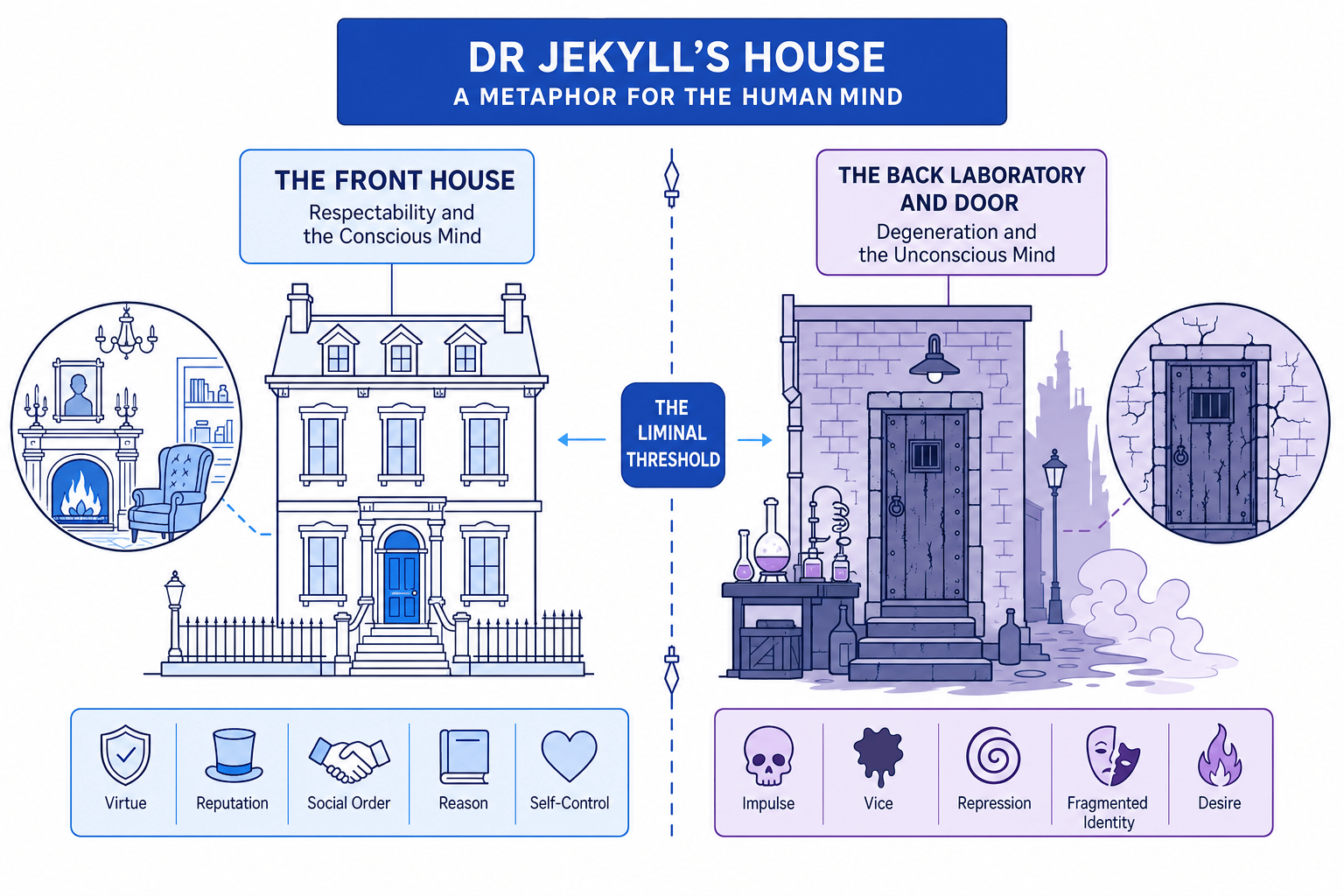
The Setting is the Mind
The front of Jekyll's house represents his respectable, social self (the Ego). The laboratory at the back—decayed, secretive, and windowless—represents his dark, repressed desires (the Id) where Hyde is given free rein.
The Iceberg of the Victorian Psyche
Think of Jekyll’s house as a Victorian gentleman's mind. The front door is the polite face presented to dinner guests. The dirty, blistered back door is the dark, subconscious cellar where shameful secrets are hidden away.
3. Liminality and Pathetic Fallacy
Gothic writers rely heavily on creating atmospheres of uncertainty. To do this, Stevenson uses liminality and pathetic fallacy.
Liminality
Liminality (from the Latin word limen, meaning "threshold") refers to a state of transition, being on the boundary between two different states, places, or identities.
In Jekyll and Hyde, liminality is everywhere:
- Twilight and Dawn: Many key events happen during the transition between night and day.
- Doors and Windows: Windows are barriers that fail to keep secrets in; doors are thresholds between the respectable public world and the hidden, violent world of Hyde.
- The Fog: The famous London fog is a physical manifestation of liminality. It acts as a shifting curtain that continuously veils and unveils the truth.
Pathetic Fallacy: The "Chocolate-Coloured Pall"
Stevenson uses the weather to mirror the moral corruption and confusion of the characters. When Utterson travels to Hyde’s quarters in Soho in Chapter 4, the fog is described with intense, Gothic language:
"A great chocolate-coloured pall lowered over heaven, but the wind was continually charging and routing these embattled vapours..."
The noun "pall" refers to a heavy cloth draped over a coffin, immediately associating London with death and decay. The active, military verbs "charging" and "routing" suggest a violent, cosmic battle between light and dark, good and evil, reflecting the internal psychological war raging within Dr Jekyll.
4. Atavism and Scientific Gothic
During the late 19th century, the British public was gripped by the scientific theories of Charles Darwin (on evolution) and Cesare Lombroso (on criminology). Lombroso argued that criminals were "evolutionary throwbacks" who had failed to evolve properly. This fear of regressing into a beast-like state is known as atavism.
Stevenson infuses his Gothic descriptions of Hyde with atavistic imagery to evoke deep-seated Victorian fears of degeneration.
How Hyde is Animalised:
- He is described as moving with "ape-like fury" when murdering Sir Danvers Carew.
- He shrinks back with a "hissing intake of the breath", evoking the image of a serpent (which also carries biblical connotations of Satan and the fall of man).
- Utterson notes that Hyde seems "troglodytic" (primitive, caveman-like).
By blending science with Gothic horror, Stevenson created a new kind of terror: the fear that humanity is not the pinnacle of creation, but merely a thin layer of civilisation painted over a violent, animalistic core.
Worked Example: Analysing a Gothic Passage
Analysing the Gothic setting of the laboratory door
Read the following description of the door Hyde uses, from Chapter 1:
"It was two storeys high; showed no window, nothing but a door on the lower storey and a blind forehead of discoloured wall on the upper; and bore in every feature, the marks of prolonged and sordid negligence."
Walk through how to analyse this passage to explain how Stevenson uses Gothic methods to foreshadow the character of Hyde.
-
Identify the core Gothic method: Identify the use of personification and architectural decay to create a sinister atmosphere. The key phrase here is the "blind forehead" of the wall and its "sordid negligence."
-
Analyse the language and structural choices (AO2): The adjective "blind" suggests a lack of perception, secrecy, and a refusal to see or be seen. The architectural feature of a windowless upper floor ("blind forehead") personifies the building as a faceless, unreadable entity, which directly mirrors how characters cannot look at Hyde without feeling a sense of unnameable deformity. The noun "negligence" and adjective "sordid" evoke decay and moral filth, contrasting sharply with the clean, wealthy street around it.
-
Connect the text to context and reader impact (AO3 & AO1): Explain how this setting functions as a physical projection of Hyde's character before we even meet him. For a Victorian reader, this "sordid" anomaly in a respectable neighborhood represents the hidden moral rot within Victorian society. It suggests that behind the polished veneer of respectability lies a dark, uninspected decay.
Device Spotting
Do not just write: "Stevenson uses pathetic fallacy when he writes 'the fog rolled over the city'." This is called "device spotting" and will limit you to lower marks. You must always explain the effect of the device. Why the fog? To show how the truth is obscured, and to represent Jekyll’s attempts to hide his sins from God and society.
The Critical Vocabulary Boost
To impress the examiner, replace basic words like "scary" or "weird" with precise Gothic critical terms:
- Instead of "spooky atmosphere", use "an atmosphere of oppressive dread".
- Instead of "Hyde represents the bad side", write "Hyde is the physical externalisation of Jekyll's repressed id".
- Instead of "the weather is dark", write "the pathetic fallacy serves to heighten the sense of moral obscurity".
In the exam
When answering a question on setting, character, or mystery in Dr Jekyll and Mr Hyde, use these three steps to weave in Gothic methods smoothly:
- Establish the Gothic Frame: Start your paragraph by identifying the specific Gothic convention Stevenson is playing with (e.g., the double, the urban labyrinth, or atavistic degeneration).
- Embed Precise, Micro-Quotations: Avoid long block quotes. Instead, weave short, high-impact Gothic words directly into your sentences (e.g., Jekyll's laboratory is "windowless", while Hyde has "ape-like fury").
- Link Method directly to Victorian Context (AO3): Never analyze a Gothic method in a vacuum. Always explain why this would terrify a 19th-century reader (e.g., explain that Hyde's animalistic violence tapped into deep-seated Victorian anxieties surrounding Darwinian evolution and the fear of human regression).
Check yourself
Before your next practice essay, make sure you can answer these questions:
- What is the difference between traditional 18th-century Gothic settings and Stevenson’s "Urban Gothic"?
- How does the physical structure of Jekyll’s house represent the Freudian concept of the human mind (Ego and Id)?
- Why was the concept of "atavism" so terrifying to late-Victorian readers, and which Gothic descriptions of Hyde exploit this fear?
