When you sit down to write an essay on The Strange Case of Dr Jekyll and Mr Hyde, it is incredibly tempting to dive straight into writing. However, without a roadmap, your essay can quickly dissolve into a passive summary of the plot.
In your AQA GCSE English Literature exam, you are assessed on your ability to maintain a focused, personal response (argumentative structure) and to analyze how Robert Louis Stevenson uses language and structure to convey his ideas. Spending five minutes crafting a precise essay plan is the single most effective way to secure high marks.
What you'll learn:
- How to write a compelling, thesis-driven introduction.
- How to structure a balanced response using both the provided extract and the wider novel.
- How to weave language analysis and Victorian context seamlessly into your planning.
Why Planning is Your Secret Weapon
To score highly, your essay must read like a cohesive argument, not a list of unrelated observations. The examiners want to see a clear thread running through your entire response. This thread starts with your thesis statement and is carried through your paragraphs via topic sentences.
Thesis Statement
A thesis statement is a one- or two-sentence summary of your central argument. It directly answers the exam prompt and outlines the writer's deeper thematic purpose, rather than just stating a plot fact.
Topic Sentence
A topic sentence is the opening sentence of a body paragraph. It acts as a mini-thesis for that paragraph, stating the main point you will prove. It should focus on a concept or a writer's method, never just a plot event.
When you plan, you are deciding on your thesis and your topic sentences before you write. This prevents you from writing a chronological plot summary (e.g., "First Hyde does this, then Jekyll does that") and forces you to write a thematic analysis (e.g., "Stevenson uses Hyde to expose the hypocrisy of Victorian morality").
The 3-Part Essay Architecture
The AQA exam requires you to write about the printed extract and the novel as a whole. A brilliant way to structure this is the Extract-Wider-Wider format. This ensures you satisfy both parts of the question while maintaining a clear, chronological, or conceptual progression.
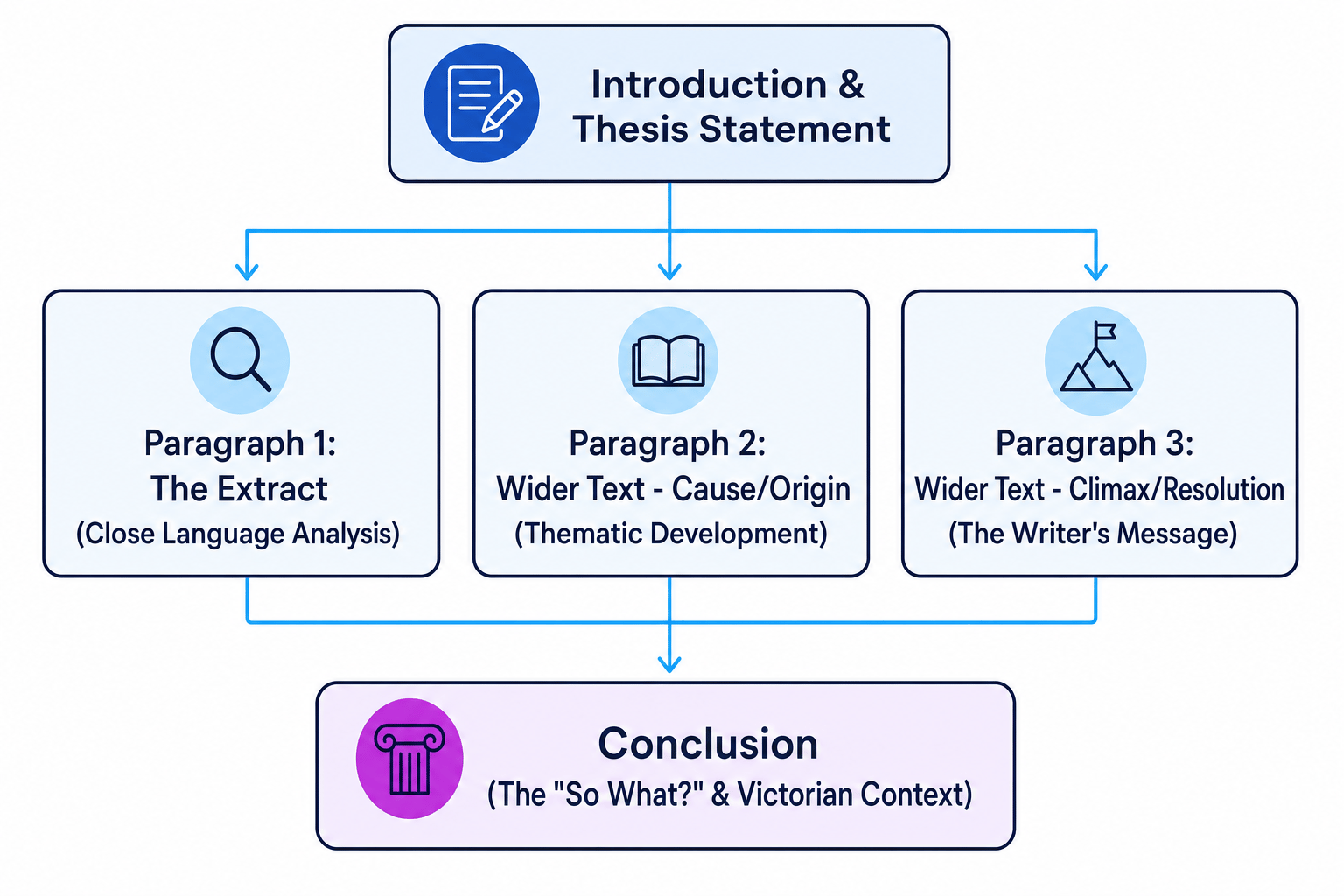
- Introduction & Thesis: Define your overall argument. State what Stevenson is using the character or theme to teach his Victorian audience.
- Paragraph 1 (The Extract): Perform a deep-dive language analysis of the provided passage. Identify specific literary devices (such as metaphor, semantic fields, or pathetic fallacy) and explain their structural significance to the wider novel.
- Paragraph 2 (Wider Text - Causes & Origins): Move to another part of the novella (typically earlier or midway) to show how this theme or character trait develops.
- Paragraph 3 (Wider Text - Climax & Resolution): Analyze the end of the novella (often Chapter 10, "Henry Jekyll's Full Statement of the Case") to show the consequences or ultimate resolution of the theme.
- Conclusion: Summarize your argument by answering the "So what?" question. Why did Stevenson write this story? How does it reflect the anxieties of late-Victorian society?
Avoid the 'Extract-Only' Trap
Students who only write about the extract can never achieve more than a basic pass. Your plan must deliberately map out connections to the rest of the novel to ensure you show a comprehensive understanding of the text's structural arc.
Deconstructing the Prompt
Before you write down a single quotation, you must deconstruct the question. Every AQA prompt contains a key conceptual anchor. Your job is to locate this anchor and ask yourself: What is Stevenson's underlying message about this concept?
For example, look at this prompt:
Starting with this extract, explore how Stevenson presents the relationship between Jekyll and Hyde.
- The Subject: The relationship between Jekyll and Hyde.
- The Conceptual Anchor: How does this relationship symbolize the internal conflict of the human psyche and the hypocrisy of Victorian society?
Planning an essay on the presentation of secrecy
In this worked example, we will walk through the exact steps to build a high-scoring essay plan based on the prompt: "Explore how Stevenson presents the theme of secrecy in the novel."
-
Formulate your central thesis statement. Instead of writing "Stevenson shows that the characters have a lot of secrets," look for the author's social purpose. Write a thesis that targets the heart of Victorian society: Stevenson presents secrecy not merely as a plot device, but as a destructive symptom of Victorian hypocrisy. By forcing his middle-class gentlemen to hide their natural, darker desires behind a veneer of respectability, Stevenson argues that societal repression inevitably breeds psychological monstrosity.
-
Deconstruct the extract and select evidence (assuming the extract is Chapter 1: Enfield's story of the door). Identify a specific quote from the extract that highlights secrecy.
- Evidence: Enfield describes the door as having "no bell or knocker" and being "blistered and distained."
- Methods: Visual imagery, symbolic setting.
- Analysis: The lack of a knocker symbolizes a deliberate rejection of social interaction and a desire to shield transactions from the public gaze. The "blistered" texture reflects the hidden decay beneath London's polished surface.
-
Select a wider-text point mapping the development of secrecy. Look at how secrecy shifts from a social habit to a physical and psychological illness. Go to Chapter 5 ("Incident of the Letter") or Chapter 7 ("Incident at the Window").
- Focus: Jekyll's self-imposed confinement.
- Evidence: Jekyll sits "like some disconsolate prisoner" behind the half-shut window, before thrusting it down with a look of "abject terror and despair."
- Methods: Simile, dramatic action, visceral imagery.
- Analysis: Secrecy has physically imprisoned Jekyll. The window acts as a physical barrier between his public persona and his hidden, monstrous reality. His "terror" reveals the psychological toll of maintaining a double life.
-
Select a final wider-text point demonstrating the climax/resolution of secrecy. Look at Chapter 10 ("Henry Jekyll's Full Statement of the Case") to find the ultimate consequence of this secrecy.
- Focus: Jekyll's confession of his double life.
- Evidence: Jekyll admits he "concealed [his] pleasures" and lived a life of "profound duplicity."
- Methods: First-person narrative perspective, emotive adjectives ("profound").
- Analysis: Stevenson reveals that Jekyll's downfall was not his desires themselves, but the societal pressure to conceal them. The "duplicity" is what split his psyche, showing that enforced secrecy is the true villain of the novel.
-
Weave Victorian context (AO3) into the conclusion. Connect the points to the social anxieties of 1886.
- Context: The Victorian "Double Life" and the Gentlemen's Code of Conduct. London was split physically into the respectable West End and the impoverished, criminal East End.
- Synthesis: Stevenson uses the motif of secrecy to critique the Victorian middle-class obsession with reputation. He warns his contemporary readers that hiding humanity’s dual nature under a mask of moral purity will ultimately result in a violent, uncontrollable outbreak of the primitive self (reflecting evolutionary fears of degeneration).
Integrating Context (AO3) Without "Information Dumping"
A common mistake in GCSE essays is "context dumping"—writing a paragraph about Charles Darwin, Cesare Lombroso, or Victorian smog that has absolutely nothing to do with the literary analysis.
Your essay plan should treat context as the catalyst for Stevenson’s writing. Use the formula: Method + Meaning + Contextual Link.
Contextual Anchors for Jekyll & Hyde
- Darwinism and Degeneration: Use this when analyzing Hyde's physical description ("ape-like," "troglodytic"). It reflects Victorian fears that humans could genetically slip backward down the evolutionary ladder.
- The Victorian Compromise: Use this when analyzing Utterson or Jekyll’s reputation. It refers to the unspoken social agreement to ignore respectable gentlemen's private vices as long as public appearances were maintained.
- Deacon Brodie: The real-life inspiration for Jekyll—a respectable Edinburgh cabinet maker by day and a thief by night. Use this to illustrate the theme of duality.
The Biography Trap
Do not write long paragraphs about Robert Louis Stevenson’s life, his strict religious upbringing, or his illnesses unless it directly explains a specific choice he made in the text. Focus on the societal anxieties of his readers instead.
In the exam
- Spend 5 minutes planning: Write your thesis statement at the top of your planning sheet immediately. Do not skip this step under time pressure.
- Draft three clear topic sentences: Ensure each one acts as a conceptual step forward in your argument rather than a description of plot.
- Select 2 precise quotations per paragraph: Choose short, high-yield quotes (e.g., "trampled calmly," "damned Juggernaut," "ape-like fury") that allow for deep, word-level analysis of methods (AO2).
- Link every paragraph back to your thesis: Use transitional phrases like "This reinforces Stevenson’s warning that..." or "Consequently, this demonstrates..." to keep your essay tightly focused.
Check yourself
- Can you write a thesis statement for an essay on how Utterson represents Victorian repression?
- Does your essay plan contain three distinct body paragraphs that show a clear progression through the novella (Beginning, Middle, End)?
- Have you selected at least four short, memorable quotations from the wider novel that you can write down from memory?
