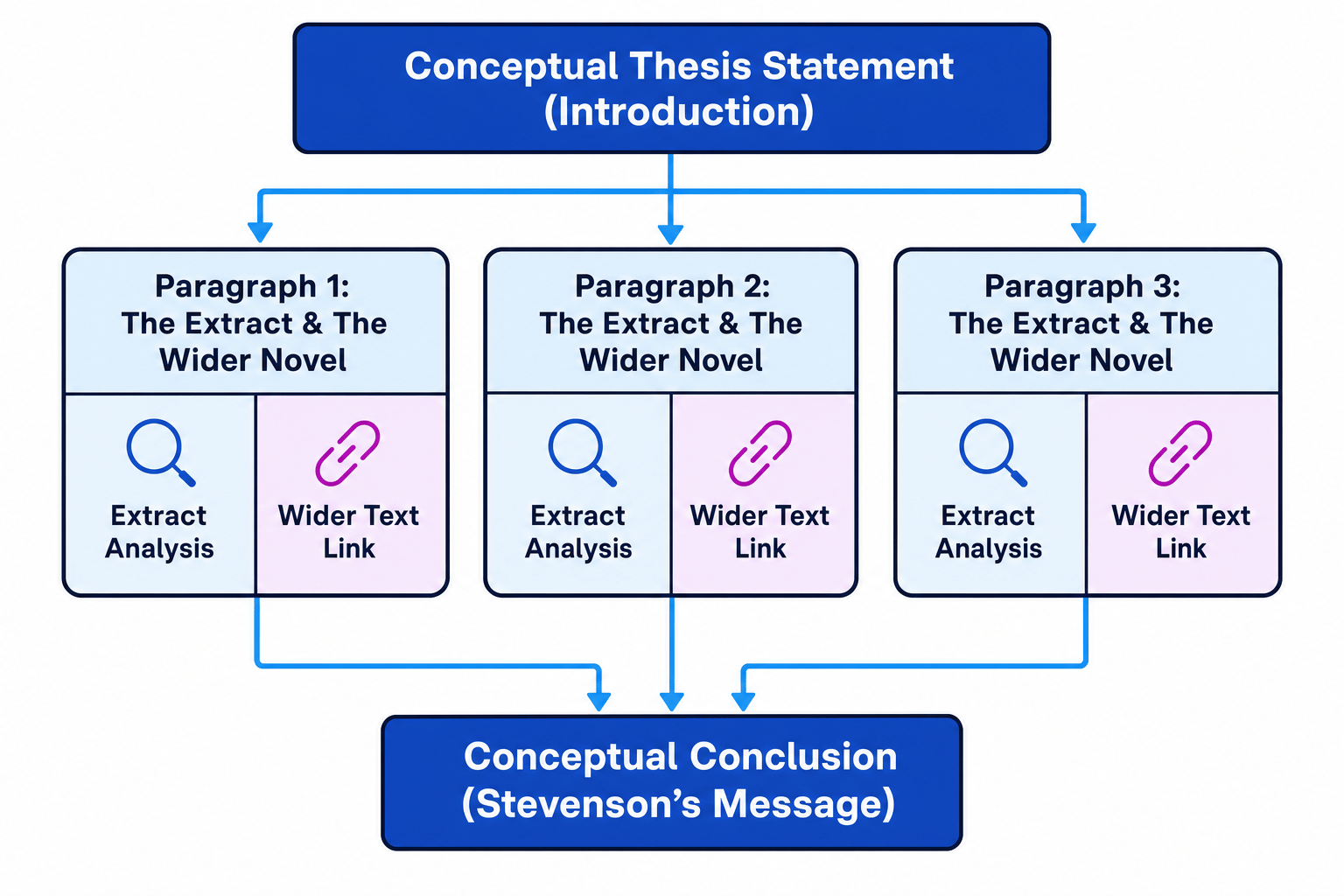
Mastering the "Extract-to-Whole" Transition
The biggest pitfall for most students is writing two separate essays: one about the printed extract and one about the rest of the book.
To score in the higher bands, you must integrate the two seamlessly. The extract is your microcosm—a tiny lens through which you can examine the massive, overarching themes of the whole novel.
The Golden Rule of the Extract
Never treat the extract in isolation. Every time you analyse a word or technique in the extract, immediately ask yourself: How does this reflect, foreshadow, or contrast with the wider novel's depiction of this theme or character?
Chronological vs. Thematic Journeys
Instead of organising your essay by "Extract" and then "Wider Novel," organise your essay by ideas or the chronological journey of the characters.
For instance, if the question is about the presentation of Hyde's violence, your three paragraphs might look like this:
- Paragraph 1: Hyde’s initial, sudden violence (referencing the trampling of the girl in Chapter 1, and any similar animalistic descriptions in the extract).
- Paragraph 2: The escalation to brutal, unchecked murder (referencing the Carew Murder Case in Chapter 4, close-reading the extract’s language of "ape-like fury").
- Paragraph 3: The internalised violence of Hyde destroying Jekyll from within (referencing Jekyll’s confession in Chapter 10, showing how repressed desires inevitably turn destructive).
Constructing a Level 6 Paragraph
When you write an analytical paragraph, you should aim for a fluid, natural structure rather than a rigid "PEE" (Point, Evidence, Explanation) formula. A high-scoring structure is PETAL:
- Point: A conceptual topic sentence tied to the question.
- Evidence: A short, embedded quotation from the extract or wider novel.
- Technique: Naming the literary device or linguistic method used.
- Analysis: Deconstructing the specific connotations of the words and their impact on the reader.
- Link: Connecting your analysis back to Victorian context and Stevenson’s broader moral message.
Let's look at how to build this step-by-step.
Developing an analytical paragraph on Jekyll's duality
Suppose you receive an exam question asking: "Explore how Stevenson presents the conflict between good and evil in Dr Jekyll and Mr Hyde."
The printed extract is from Chapter 10 ("Henry Jekyll's Full Statement of the Case"), where Jekyll describes his discovery that "man is not truly one, but truly two."
Here is how you construct a high-level analytical paragraph:
-
Formulate a conceptual topic sentence.
Start by identifying why Stevenson presents this conflict, rather than just stating that it exists.
Draft: "Stevenson presents the conflict between good and evil not as an external battle, but as an inescapable internal division within the Victorian psyche, forced upon individuals by strict societal expectations."
-
Embed a precise quote from the extract and identify the writer's methods.
Select a high-yield quote and pinpoint the specific linguistic features. From Chapter 10, we can use Jekyll's realization that his two sides are "polar twins" that are "continuously struggling."
Draft: "In the extract, Jekyll reflects on his dual nature, describing his good and evil sides as 'polar twins' that are 'continuously struggling' in the 'agonised womb' of his consciousness. Stevenson uses the oxymoronic metaphor 'polar twins' to highlight that while these forces are diametrically opposed ('polar'), they are also fundamentally inseparable and born of the same source ('twins')."
-
Analyse the deep connotations of the language (AO2).
Zoom in on specific words to explore their psychological and physical implications.
Draft: "The noun 'womb' has visceral, biological connotations of creation and birth, implying that duality is not a learned behavior but an innate, organic part of human existence. The adjective 'agonised' underscores the immense mental torture this division causes, suggesting that the pressure to suppress one's darker impulses leads to profound psychological decay."
-
Link the analysis to the wider novel and Victorian context (AO3).
Connect this specific quote to the historical reality of Victorian London and the novel as a whole.
Draft: "This internal battle reflects the broader anxieties of late-Victorian society, which was obsessed with maintaining a polished, moral outward appearance (reputability) while secretly indulging in vice behind closed doors. This conflict is dramatised throughout the novel by the physical layout of Jekyll’s house: the handsome, welcoming front door represents his public-facing, socially acceptable persona, while the blistered, sinister laboratory door—associated with Hyde—represents the hidden, primitive desires that Victorian gentlemen went to great lengths to repress."
Pitfalls to Avoid
The 'Feature-Spotting' Trap
Many students identify literary techniques (e.g., "Stevenson uses a simile here") but fail to explain how or why that technique creates meaning. Naming a device gets you very few marks on its own. If you identify a metaphor, you must explain what that metaphor suggests about the character's mind or Stevenson's wider message.
Embedding Quotations
Never introduce a quote with "The quote says..." or "In this quote, Stevenson writes...". Instead, embed the quote naturally into the flow of your own sentence.
Weak: Jekyll says his evil side is very strong. "My devil had been long caged, it came out roaring."
Excellent: Jekyll’s attempt to repress his desires ultimately fails, as his long-suppressed 'devil' eventually 'came out roaring', with the animalistic verb 'roaring' demonstrating the sheer, uncontrollable power of unchecked vice.
Model Essay Paragraphs: A Comparative Study
Let's look at the difference between a mid-level (Grade 5) paragraph and a top-level (Grade 9) paragraph on the presentation of Mr. Hyde.
Question: How does Stevenson present Mr Hyde as a frightening and unnatural figure?
The Mid-Level Response (Grade 5)
Stevenson presents Hyde as very frightening. In Chapter 4, when Hyde murders Sir Danvers Carew, the maid says he attacked him with "ape-like fury". The word "ape-like" is a simile that shows Hyde is like a monkey, which would have scared Victorian readers because they were afraid of evolution. He also "trampled" his victim, which is a very violent action. This shows Hyde has no feelings and is purely evil. This would make the reader feel shocked because Sir Danvers Carew was a nice old man.
Why this is only a Grade 5:
- AO1: Good knowledge of the plot and correct quotation, but the argument is quite simple and narrative-focused.
- AO2: Identifies the technique ("ape-like fury" is actually a metaphor/noun phrase, not a simile) but the analysis is surface-level ("shows he is like a monkey").
- AO3: Context (evolution) is mentioned but feels "bolted on" rather than integrated into the literary analysis.
The Top-Level Response (Grade 9)
Stevenson presents Hyde as a terrifyingly unnatural figure by portraying him as a regression of human evolution, representing the primitive beast that lurks beneath the veneer of Victorian civilisation. During the assault on Carew, Stevenson characterises Hyde's violence as an explosive release of repressed energy, noting that he attacked with "ape-like fury." The animalistic adjective "ape-like" directly evokes Darwinian anxieties of devolution—the terrifying Victorian fear that humanity could slide backward down the evolutionary ladder if moral vigilance was relaxed. Furthermore, the noun "fury" suggests an unguided, elemental force of destruction rather than rational human anger. This primal regression is juxtaposed with the "incredibly sweet" and civilised presentation of Carew, demonstrating how fragile the structures of polite Victorian society are when confronted with the raw, unchecked id. By depicting Hyde's violence as frantic, auditory, and chaotic—such as when the bones are described as "audibly shattered"—Stevenson forces his audience to confront the physical horror of their own hidden, instinctual natures.
Why this is a Grade 9:
- AO1: Highly conceptual, answering the question by focusing on the "primitive beast" and "veneer of civilization."
- AO2: Precise vocabulary (e.g., animalistic adjective, juxtaposed, auditory depiction). The analysis zooms in on specific words and explores their psychological weight.
- AO3: Context is seamlessly woven in. The mention of "Darwinian anxieties" and "devolution" directly explains why the language ("ape-like") would have profoundly disturbed a Victorian reader.
In the exam
When you open your exam paper, use this step-by-step strategy to maximise your marks:
- Spend 5 minutes planning: Do not start writing immediately. Highlight the key words in the prompt, read the extract carefully, and jot down 3 main ideas that trace a journey across the novel.
- Draft your thesis first: Write a powerful 2–3 sentence introduction that answers the question conceptually. Explain why Stevenson chose to explore this theme.
- Keep quotes short: Memorise "micro-quotes" of 1–3 words (e.g., "Satan's signature," "ape-like fury," "distinguished for religion"). They are much easier to embed and analyse in detail.
- Use structural transition words: Connect your paragraphs using comparative signposts like "Similarly," "Conversely," "Stevenson escalates this theme when," or "While the extract presents..." to prove your essay is a unified argument.
Check yourself
Before you sit your practice exams, make sure you can answer these questions:
- Can you explain the difference between a plot summary and a conceptualised thesis statement?
- Why is it vital to link the "micro-analysis" of the extract to the "macro-analysis" of the whole novel?
- Which specific Victorian anxieties (e.g., physiological Darwinism, evangelical hypocrisy, urban gothic) directly match the themes in your chosen model essay?
