To secure top marks in your GCSE English Literature exam, you must understand that Robert Louis Stevenson did not write The Strange Case of Dr Jekyll and Mr Hyde in a vacuum. The terrifying power of the novella lies in how it directly tapped into the deepest fears, anxieties, and hypocrisies of late-Victorian society.
Evaluating this relationship between the text and the world in which it was written is assessed under AO3 (Context). The secret to scoring highly in AO3 is integration: you should never drop random history facts into your essay. Instead, you must show how Stevenson uses his characters and settings to comment on Victorian social anxieties.
What you'll learn
- How the Victorian demand for respectability forced gentlemen to lead hypocritical double lives.
- Why Charles Darwin's theories of evolution triggered a deep panic about human degeneration and atavism.
- How Stevenson used the Urban Gothic genre and London's divided geography to reflect the duality of the human mind.
- How to seamlessly weave historical context into your language analysis to build high-scoring, analytical arguments.
1. Victorian Respectability and the "Double Life"
In late 19th-century Britain, middle- and upper-class society was obsessed with outward appearances, reputation, and moral purity.
Respectability
Respectability was the strict social code of the Victorian era that demanded absolute emotional restraint, Christian devotion, charity, and public decorum, particularly from upper-class men.
To maintain their high social standing, wealthy men were expected to suppress their natural desires, appetites, and vices. Showing weakness, anger, or sexual desire in public could ruin a man's reputation, which was his most valuable asset.
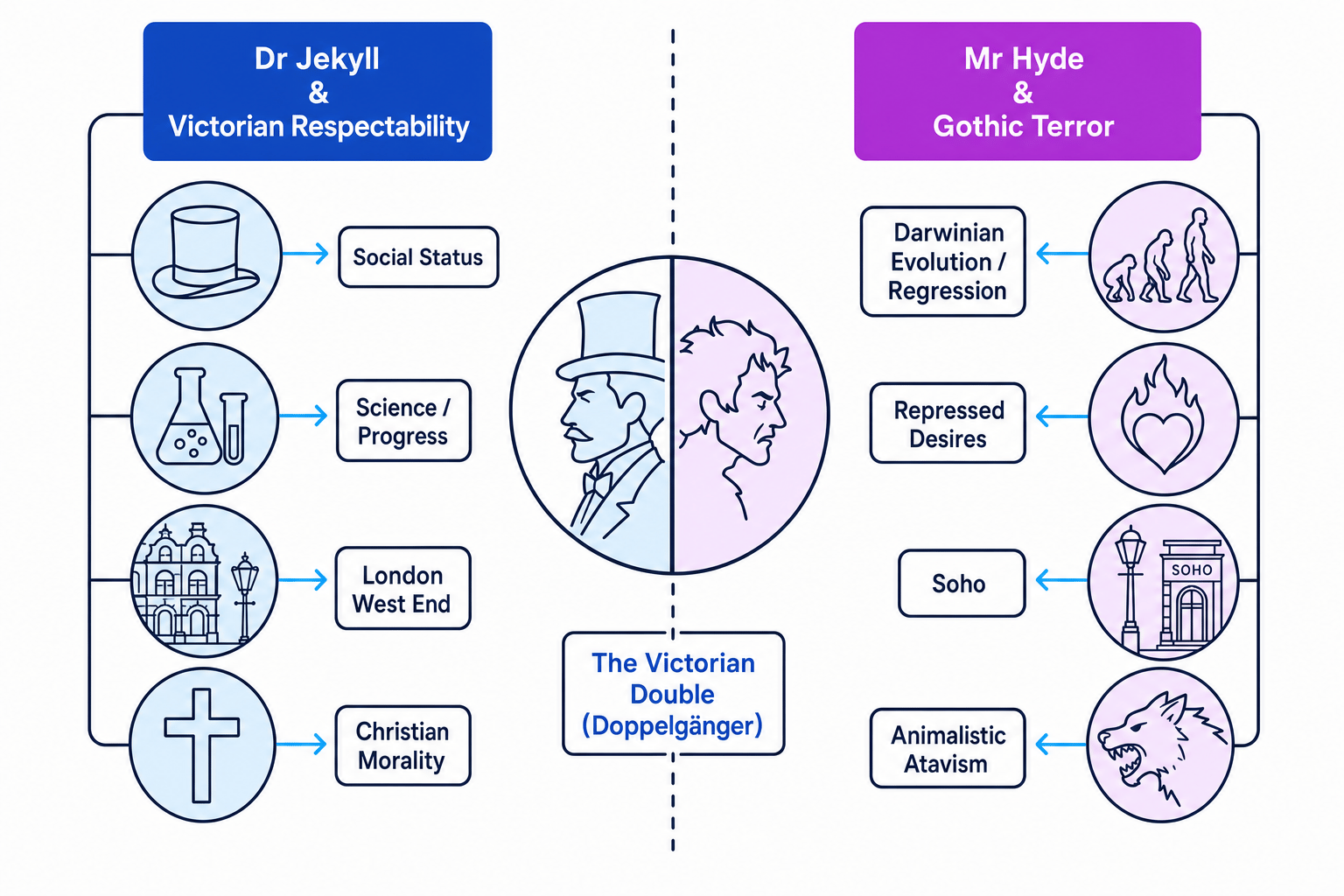
This intense social pressure created a culture of extreme hypocrisy. Many gentlemen led "double lives": presenting a polished, virtuous facade to high society during the day, while secretly indulging in sinful, illicit pleasures in the less respectable districts of London by night.
Stevenson exposes this psychological strain through Dr Jekyll. Jekyll is not a monster because he has dark desires; he is a monster because he tries to split those desires entirely from his respectable self to preserve his reputation:
"I concealed my pleasures... I stood already committed to a profound duplicity of life." (Chapter 10)
The facade of respectability
The tragedy of Dr Jekyll is not that he wanted to do bad things, but that Victorian society made it impossible for him to admit his human flaws. His attempt to isolate his "bad" side to protect his "respectable" side is what ultimately destroys him.
2. Scientific Anxiety, Evolution, and Atavism
The late Victorian period was a time of rapid scientific discovery, which deeply unsettled traditional religious beliefs. The most disruptive of these ideas was Charles Darwin’s theory of evolution, published in On the Origin of Species (1859).
While Darwin argued that humans evolved from primates over millions of years, Victorian readers did not find this comforting. Instead, it triggered a terrifying new fear: if humans could evolve forward from animals, could they also degenerate backward into beasts?
Atavism
Atavism (or evolutionary regression) is the reappearance of ancestral, primitive characteristics in a modern organism. Victorians feared that criminals and the "undeserving poor" were throwbacks to an earlier, more savage stage of human evolution.
Stevenson directly maps this evolutionary anxiety onto the physical description of Mr Hyde. Hyde is repeatedly described as animalistic, primitive, and unevolved:
- He attacks Carew with "ape-like fury" (Chapter 4).
- Utterson describes him as "troglodytic" (prehistoric/caveman-like) in Chapter 2.
- He is described as a "masked thing like a monkey" in Chapter 8.
By presenting Hyde as a physical throwback, Stevenson is reminding his Victorian audience that beneath their expensive suits, top hats, and polite manners, there lies a savage animal waiting to break free.
3. The Urban Gothic and London's Divided Geography
Traditionally, Gothic horror stories took place in wild, remote settings like crumbling castles in Transylvania or desolate European mountains. Stevenson revolutionized the genre by creating the Urban Gothic, bringing the terror home to the familiar, foggy streets of contemporary London.
To do this, Stevenson exploited the real social and geographical divisions of Victorian London:
The West End vs. the East End
The West End (where Jekyll, Utterson, and Lanyon live) was the wealthy heart of respectable society, characterized by grand, clean, gas-lit squares. The East End and areas like Soho (where Hyde has his house) were poverty-stricken, overcrowded, and associated with crime, disease, and immigration.
The Layout of Jekyll's House
Stevenson uses Jekyll’s house as a physical metaphor for the human mind and Victorian society:
- The Front Entrance: Located in a respectable square, it is elegant, clean, and welcomes polite visitors like Utterson. This represents Jekyll’s public, respectable persona.
- The Back Door (The Laboratory): Blistered, neglected, and opening onto a dingy, anonymous side street. It is through this back door that Mr Hyde slips in and out. This represents the hidden, repressed subconscious.
Jekyll's house as the brain
Think of Jekyll's house as a human skull. The elegant front door is the conscious face we show the world, smiling and polite. The decaying laboratory door at the back is the subconscious mind where we hide our darkest, most embarrassing thoughts and desires from public view.
4. Religious Guilt and Calvinism
Stevenson was raised in Edinburgh, Scotland, by a deeply religious Presbyterian nurse, Alison Cunningham, who filled his head with terrifying Calvinist stories of sin, hell, and eternal damnation.
Calvinism
Calvinism is a branch of Protestant Christianity that emphasizes the absolute sovereignty of God and the total depravity of human nature, teaching that humans are naturally sinful and prone to evil.
This religious upbringing left Stevenson with a lifelong preoccupation with the battle between good and evil inside every human soul. In the novella, Jekyll’s experiment is not just a scientific pursuit; it is a religious attempt to escape the guilt of sin. By separating his bad side (Hyde) from his good side, Jekyll hopes to indulge in sin without feeling the crushing weight of Christian guilt.
However, Stevenson's narrative acts as a moral warning: you cannot separate your sinful nature without destroying your humanity.
Treating Hyde as purely evil and Jekyll as purely good
Many students write that Jekyll represents "good" and Hyde represents "evil". This is inaccurate! Jekyll is never entirely good. Even before he takes the potion, he is hypocritical, selfish, and desperate to hide his vices. Hyde is Jekyll's repressed evil, but Jekyll is a complex mixture of both good and bad.
How to Integrate Context: A Worked Example
To achieve a Grade 7, 8, or 9, you must avoid the "history dump"—the bad habit of writing a paragraph of pure historical facts that doesn't look at Stevenson's language. Your context must be woven directly into your word-level analysis.
Let's look at how to build a top-tier paragraph analyzing the description of Hyde murdering Sir Danvers Carew.
Integrating Victorian evolutionary anxiety into quotation analysis
The Task: Analyze how Stevenson presents the character of Mr Hyde in the murder of Sir Danvers Carew, using context to deepen your analysis.
-
Step 1: Point and Evidence. State a clear analytical point and support it with a precise, short quotation showing how Hyde is presented.
Example: Stevenson presents Hyde as a terrifyingly primitive force of nature during his brutal attack on Carew, describing his actions as being fueled by "ape-like fury."
-
Step 2: Method and Close-Word Analysis. Identify the writer's literary technique and analyze the connotations of the specific words used.
Example: Stevenson uses the animalistic simile "ape-like" to dehumanize Hyde. The noun "ape" strips Hyde of human reason, morality, and empathy, suggesting his violence is instinctual and completely uncontrolled, while the noun "fury" highlights the chaotic, unprovoked energy of the assault.
-
Step 3: Link to Context (AO3). Explain why Stevenson chose these specific words by linking them to the anxieties of his Victorian readers.
Example: This zoomorphic description would have deeply unsettled a late-Victorian audience, who were haunted by Charles Darwin's recent theory of evolution. By linking Hyde to a primate, Stevenson taps into the cultural anxiety of atavism—the terrifying belief that civilized Victorians could easily degenerate back into savage beasts if they abandoned their moral restraint.
-
Step 4: Analyze the Writer's Purpose. Conclude by explaining the broader message Stevenson is sending to his readers through this characterization.
Example: Ultimately, Stevenson uses this evolutionary regression to warn his readers that the strict suppression demanded by Victorian respectability does not destroy man's primal instincts; instead, it causes them to ferment into an explosive, monstrous violence.
The 'Why' Question
Whenever you write about context, ask yourself: "Why did Stevenson want his readers to think about this specific Victorian fear at this exact moment in the story?" This keeps your focus on the author's craft rather than historical facts.
In the exam
- Never write a standalone paragraph about context. Always attach your historical context to a specific quotation and a specific literary method (AO2).
- Use precise historical vocabulary. Do not just write "back in the olden days." Use terms like late-Victorian respectability, evolutionary anxiety, atavistic degeneration, the Urban Gothic, and duplicity.
- Focus on the author's intent. Use active verbs to describe Stevenson's choices: Stevenson exposes..., Stevenson critiques..., Stevenson subverts..., Stevenson reflects.... This shows the examiner you understand the text is a constructed piece of art.
Check yourself
- Can you explain how the physical structure of Dr Jekyll’s house mirrors both his psychological state and Victorian social class divisions?
- Why would the word "troglodytic" have been particularly offensive and terrifying to an educated Victorian reader in 1886?
- What is the difference between writing a "history dump" and truly integrating AO3 into your essay?
