In the GCSE English Literature exam, you will not just be asked to describe what happens to Dr Jekyll or Mr Hyde. Instead, you must write about the ideas Robert Louis Stevenson explores through them. These ideas are the themes of the novel.
By understanding the themes, you learn why Stevenson wrote this terrifying story and what he was trying to teach his late-Victorian readers.
What you'll learn
- How Stevenson presents the duality of human nature as an inescapable conflict.
- Why the pressure of maintaining a respectable reputation leads to hypocrisy and secrecy.
- How the clash between orthodox science, transcendental science, and religion reflects Victorian fears of evolution and degeneration.
Laying the Foundations: Core Terms
Before we dive into the text, we need to establish a precise vocabulary. In the exam, using precise literary and historical terms will significantly boost your marks for AO2 (analysis of language, form, and structure) and AO3 (understanding context).
Duality
Duality is the conceptual state of having two separate, often opposing or contradictory parts or aspects. In this novel, it refers to the co-existence of good and evil within a single human soul.
The Victorian Compromise
The Victorian Compromise refers to the unwritten code of late-19th-century society where citizens maintained a strict, moral, and highly respectable public facade, while secretly indulging in sinful, immoral, or "unrespectable" private pleasures.
Let us look at how these terms form the backbone of Stevenson's gothic masterpiece.
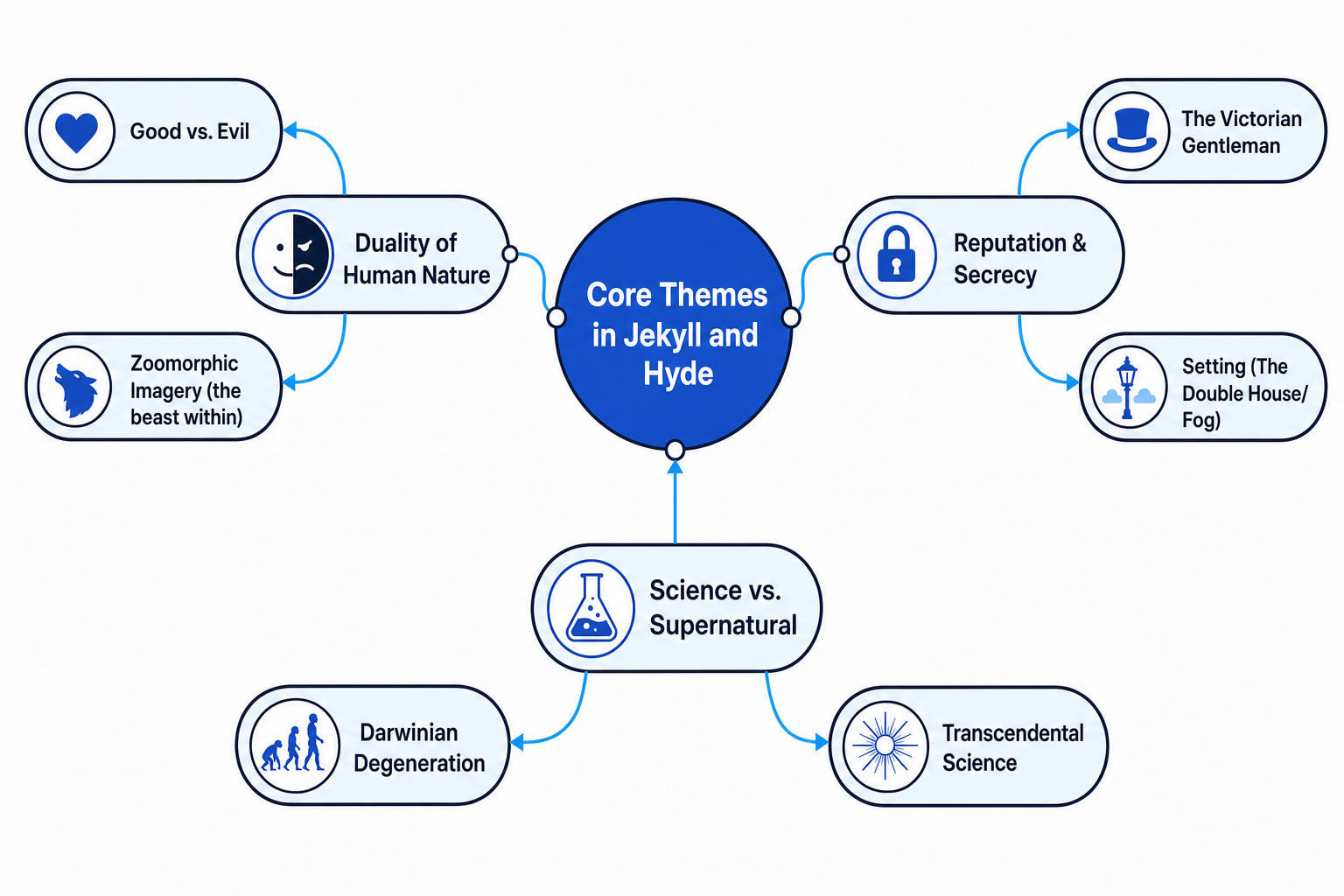
Theme 1: The Duality of Human Nature
The most prominent theme in the novel is the idea that human beings are split into dual halves. Jekyll is not simply a good man who is cursed by an evil monster; he is a man who actively tries to separate the two halves of his own personality.
The Good vs. The Evil
Jekyll himself concludes that "man is not truly one, but truly two." Stevenson does not present good and evil as external forces, but as internal components of every human being.
- Dr Jekyll represents the socially acceptable, moral, and intellectual side of humanity. However, he is not purely good; he feels the burden of his hidden desires.
- Mr Hyde represents the raw, unrestrained, primitive, and evil side of humanity. He is described as being smaller than Jekyll because Jekyll's evil side had been less developed and exercised throughout his life.
The "Beast Within" and Zoomorphic Imagery
To convey this dualism, Stevenson uses zoomorphic imagery (describing human behavior in animalistic terms) when characterizing Hyde. Hyde is described as possessing "ape-like fury" and moving with a "slank, quick, heavy tread" like a predator.
This animalistic description suggests that underneath our civilized, polished surfaces lies an untamed animal. This directly tapped into late-Victorian anxieties surrounding Charles Darwin's theory of evolution, which suggested humans had evolved from primitive beasts.
Confusing Hyde as an outsider
Many students write that Mr Hyde is a separate entity who "hijacks" Dr Jekyll. This is a mistake. Hyde is Jekyll. Hyde is simply Jekyll's repressed, evil desires given physical form. When Jekyll drinks the potion, he does not create a new person; he merely releases a part of himself.
Theme 2: Reputation, Secrecy, and the Victorian Gentleman
During the Victorian era, a gentleman’s reputation was his most valuable asset. If a man lost his reputation, he lost his social standing, his career, and his friends.
The Burden of Respectability
To preserve their reputations, gentlemen had to repress their natural desires. This repression led to intense secrecy and deep hypocrisy.
We see this clearly in the character of Mr Gabriel John Utterson. Utterson is a lawyer who is "strict with himself." Stevenson writes that Utterson:
"drank gin when he was alone, to mortify a taste for vintages"
Utterson loves fine wines but drinks cheap gin in private so he does not indulge his passions too much. This highlights the self-denial required to be a respected Victorian gentleman.
The "Gothic Double" in the Setting
Stevenson uses the setting of London to symbolize this theme of secrecy. The city itself has a dual nature, split between respectable streets and dark, decaying slums.
Jekyll’s house is a physical metaphor for this:
- The front facade of his house is elegant, clean, and respectable, reflecting Jekyll's public reputation.
- The back door (the laboratory door used by Hyde) is blistered, neglected, and opens into a dingy, shady alleyway.
This layout represents the split life of the Victorian gentleman: a clean, handsome front presented to the public, with a secret, decaying back door where their private sins can escape unnoticed.
Look for the Fog
Whenever Stevenson describes the dense London fog (pathetic fallacy), pay attention. The fog acts as a physical barrier that hides secrets. It "cuts off" characters from the truth, representing the moral blindness and secrecy of Victorian society.
Theme 3: Science, Evolution, and the Supernatural
In 1859, Charles Darwin published On the Origin of Species, shaking the foundations of religious belief. People began to fear that if humans evolved from primitive animals, they could also degenerate (slide backward down the evolutionary ladder) into beasts.
Transcendental Science vs. Orthodox Science
The conflict between different scientific beliefs is dramatized through the falling out of Dr Jekyll and Dr Lanyon.
- Dr Lanyon represents orthodox, rational science. He deals only with the physical world and dismisses Jekyll’s work as "unscientific balderdash."
- Dr Jekyll practices transcendental science (science that crosses boundaries into the spiritual, supernatural, and psychological). Jekyll uses chemistry to split the human soul.
       [Orthodox Science]                         [Transcendental Science]
        (Dr Hastie Lanyon)                         (Dr Henry Jekyll)
   Rational, physical, bounded.               Spiritual, psychological, risky.
"I have gone too far... to see this."        "I was the first that ever did so."
When Lanyon witnesses Hyde drink the potion and transform back into Jekyll, his rational world collapses. He cannot cope with the supernatural reality of Jekyll's discovery, and he dies of shock. Through this, Stevenson warns that human science, if unchecked by moral and religious boundaries, can be destructive.
Analyzing Themes in Your Essays
When writing about themes in the AQA exam, you must follow a structured approach that links the writer's methods (AO2) directly to their ideas and context (AO3).
Let us walk through a practical example of how to build an analytical paragraph focusing on the theme of Duality.
Analyzing Jekyll's regression
Analyze how Stevenson presents the conflict of duality in Chapter 10 of the novel.
- Formulate a clear thematic thesis statement (Point): Drafting: Stevenson presents duality not as a peaceful balance, but as a violent, internal conflict between a man's civilized mind and his primitive, animalistic desires.
- Integrate a precise, memorable quotation (Evidence): Drafting: After refraining from taking the potion for several months, Jekyll notes that his repressed evil side was desperate to break free, writing: "My devil had been long caged, he came out roaring."
- Identify the writer's methods and literary devices (Method): Drafting: Stevenson uses the metaphor of a "devil" to represent Jekyll's hidden evil (Hyde), and pairs this with the zoomorphic verb "roaring" to highlight Hyde's wild, untamed nature.
- Analyze the deeper language implications and reader effects (Analysis): Drafting: The noun "devil" has strong religious connotations, implying that Hyde is an embodiment of pure sin and damnation. By describing this devil as "long caged," Stevenson suggests that attempting to repress human nature only makes our dark desires more volatile. The verb "roaring" evokes the image of a starved, predatory beast, warning the reader that suppressing our natural instincts will eventually cause them to break free with uncontrollable violence.
- Link the analysis back to Victorian context and the author's purpose (Link): Drafting: Through this, Stevenson critiques the hypocritical constraints of Victorian society. He suggests that the strict moral codes of the era, which forced gentlemen to cage their natural desires, ultimately created monsters like Hyde by denying human beings their natural duality.
In the exam
- Focus on the writer as a creator: Never write about Jekyll or Hyde as if they are real people. Always frame your sentences around Stevenson's intentions (e.g., "Stevenson uses Hyde to criticize..." or "Through Jekyll's downfall, Stevenson warns...").
- Synthesize context (AO3) with language (AO2): Do not write a separate, isolated paragraph about Victorian history. Instead, weave historical context naturally into your language analysis (just like the "devil long caged" example above).
- Track the theme's trajectory: Show how a theme develops. For example, show how the theme of Secrecy starts with Utterson refusing to ask questions in Chapter 1, escalates with locked doors and letters in the middle chapters, and culminate in the final, shocking revelation in Chapter 10.
Check yourself
- Why does Stevenson describe Hyde as "smaller" and "younger" than Jekyll in Chapter 10?
- In what ways does the setting of Dr Jekyll's house mirror his own internal duality?
- How does the character of Lanyon represent the limits of traditional Victorian science when confronted with the supernatural?
