When studying Robert Louis Stevenson's The Strange Case of Dr Jekyll and Mr Hyde, it is vital to remember that characters in 19th-century literature are not real people. Instead, they are literary constructs designed to explore and represent the intense social, scientific, and psychological anxieties of the late Victorian era.
What you'll learn
- How Stevenson uses characters as constructs to debate Victorian hypocrisy and repression.
- The symbolic functions of Dr Jekyll, Mr Hyde, Mr Utterson, and Dr Lanyon.
- How to analyse character-driven language and structure to secure top marks (AO2 and AO3).
Key Character Concepts
Before exploring the individual characters, you must understand the key concepts Stevenson uses to frame them.
Construct
A literary construct is a character created by an author specifically to represent an abstract idea, a social group, or a philosophical conflict, rather than simply to act as a realistic person.
Duality
Duality is the state of having two separate, often opposing, parts or aspects. In this novella, it refers to the belief that human nature is split between a civilized, good side and a primitive, evil side.
Doppelgänger
A doppelgänger is a literary archetype of a double, alter-ego, or a shadow-self of a character. Hyde is the physical doppelgänger of Jekyll, representing his repressed desires.
Atavism
Atavism is the recurrence of a trait or characteristic typical of an ancestral or primitive form. Influenced by Victorian Darwinian fears, atavism suggested that humans could biologically regress into ape-like beasts.
Dr Henry Jekyll: The Fractured Victorian Gentleman
Dr Henry Jekyll is a highly respected, wealthy physician. To the outer world, he is the epitome of Victorian propriety—charitable, religious, and cultured. However, he is secretly tormented by what he calls his "impatient activity of disposition" and his "undignified" secret pleasures.
Jekyll's Hubris
Jekyll’s fatal flaw is his hubris (excessive pride). Instead of accepting that human nature is a complex mixture of good and bad, he attempts to use science to sever them completely. He wants to free his good self to perform high-minded deeds without the distraction of sin, while letting his evil self indulge without consequences.
Jekyll's Mind:
[ Civilised, Moral Self ]  <--- (Tension / Repression) --->  [ Dark, Primitive Desires ]
                                                                       │
                                                       (Separated by Jekyll's potion)
                                                                       ▼
                                                             [ Mr Edward Hyde ]
Key Quotes for Jekyll
- "man is not truly one, but truly two" (Chapter 10): This is Jekyll’s central philosophical discovery. The repetition of "truly" emphasizes his absolute certainty.
- "my devil had been long caged, he came out roaring" (Chapter 10): The metaphor of the "devil" represents Jekyll's repressed desires, while the verb "roaring" suggests that repressing these desires only made them more powerful and animalistic when finally released.
Mr Edward Hyde: The Primal Shadow
Mr Edward Hyde is the physical manifestation of Dr Jekyll’s repressed evil. Because he represents the primitive, uninhibited side of humanity, he is physically smaller, younger, and hairy, suggesting he is an evolutionary throwback.
The Mirror of Victorian Anxiety
Hyde triggers an instinctive, physical revulsion in everyone who meets him. Characters repeatedly state that there is something "deformed" or "displeasing" about him, yet they cannot pinpoint exactly what it is. This inability to define his deformity reflects the Victorian terror of the unknown and the subconscious fear that savage, animalistic impulses lurk beneath every polite, civilized surface.
Hyde as the Id
From a psychological perspective, Hyde represents the Freudian Id—the part of the psyche containing basic, primal drives (aggression, pleasure, survival) unrestricted by social morality or the ego.
Key Quotes for Hyde
- "with ape-like fury, he was trampling his victim under foot" (Chapter 4): The animalistic simile "ape-like" directly taps into Victorian fears of evolutionary regression and atavism. The juxtaposition of "trampling" and "under foot" emphasizes his absolute lack of human empathy.
- "a mask of pain and dread" (Chapter 8): Even when Hyde is hidden, his presence inflicts psychological torment. He is a source of pure, unadulterated terror.
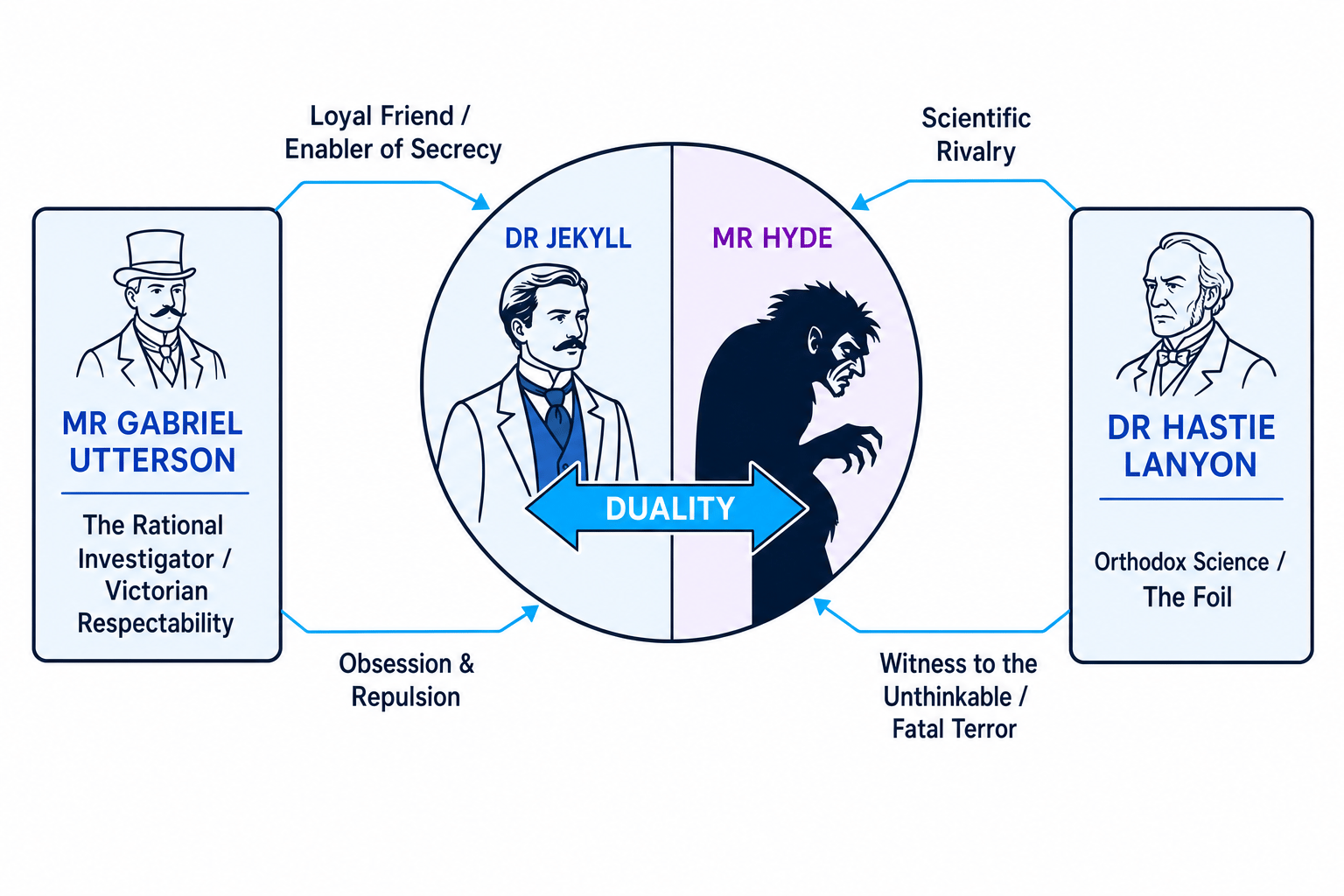
Mr Gabriel John Utterson: The Rational Victorian Investigator
Mr Utterson is the narrative anchor of the novella. As a lawyer, he is rational, cold, and meticulously cautious. Stevenson uses Utterson as a device to guide the reader through the mystery, slowing down the plot with his stubborn, logical denials of the supernatural.
The Enabler of Repression
Utterson represents the peak of Victorian gentlemanly conduct. He is "undemonstrative" and "cold", yet he is incredibly loyal to his friends. Crucially, Utterson values reputation above almost all else. He frequently seeks to cover up potential scandals (such as Jekyll's apparent blackmail by Hyde) rather than expose the truth. His refusal to accept the truth about Jekyll and Hyde is a direct critique of the Victorian middle class's wilful blindness to hypocrisy.
Confusing Utterson with the Narrator
Many students write that Utterson is the narrator of the novella. He is not. The novella is written in the third-person limited perspective, closely following Utterson's point of view for the first eight chapters, before shifting to first-person letters from Lanyon (Chapter 9) and Jekyll (Chapter 10). Always describe Utterson as the "central perspective" or "detective figure", not the narrator.
Key Quotes for Utterson
- "lean, long, dusty, dreary and yet somehow lovable" (Chapter 1): The syndetic list of dull, dry adjectives ("dusty, dreary") reflects his dry, repressed lifestyle, while "lovable" establishes his moral reliability.
- "If he be Mr. Hyde," he had thought, "I shall be Mr. Seek." (Chapter 2): This pun shows Utterson's dry, legalistic humor and introduces his role as the investigator who seeks the hidden truth.
Dr Hastie Lanyon: The Orthodox Scientific Foil
Dr Lanyon is Jekyll's former friend and scientific colleague. He represents traditional, orthodox, and rational science, whereas Jekyll represents transcendental, mystical, and dangerous science.
The Price of Absolute Rationalism
Lanyon serves as a structural foil (a character who contrasts with another to highlight particular qualities). When Lanyon witnesses Hyde drink the potion and transform back into Jekyll, his entire materialist worldview is shattered. He cannot survive the proof that the spiritual, supernatural, and monstrous exist. His subsequent physical decay and death represent the destruction of Victorian scientific certainty when confronted with the terrifying depths of the human psyche.
Key Quotes for Lanyon
- "Jekyll became too fanciful for me" (Chapter 2): Lanyon dismisses Jekyll’s advanced experiments as "scientific balderdash" (nonsense), demonstrating his rigid adherence to traditional scientific boundaries.
- "my life is shaken to its roots; sleep has left me" (Chapter 9): The organic metaphor "shaken to its roots" emphasizes how deeply the revelation of Jekyll's duality has destroyed Lanyon’s psychological and physical stability.
Worked Example: Analysing characterisation
In your exam, you must show how Stevenson uses language to construct these characters and convey deeper thematic meaning. Let's look at how to unpack a passage describing Hyde's physical effect on others.
Analysing Hyde's physical impact
Question: Explore how Stevenson presents the character of Mr Hyde in Chapter 1 through the reactions of other characters.
Quotation: "There is something wrong with his appearance; something displeasing, something downright detestable. I never saw a man I so disliked, and yet I scarce know why. He must be deformed somewhere; he gives a strong feeling of deformity, although I couldn’t specify the point." (Mr Enfield, Chapter 1)
-
Identify the writer's methods: Identify the use of indefinite pronouns ("something"), alliteration ("downright detestable"), and the abstract concept of "indescribable" deformity.
-
Analyse the language and its effect on the reader: The repetition of "something" reveals Enfield's inability to find the words to describe Hyde. It suggests that Hyde's evil defies human language and rational classification. The harsh, plosive alliteration of "downright detestable" conveys a strong sensory repulsion, indicating that Hyde's corrupt spirit is physically felt by those around him.
-
Link to context and thematic purpose (AO3): Connect this physical repulsion to Victorian anxieties about evolutionary degeneration (atavism). By making Hyde's deformity impossible to define, Stevenson suggests that the potential for evil is an intangible, hidden part of human nature itself, lurking beneath the surface of civilized Victorian society, waiting to be unleashed.
Integrating Context (AO3)
Never write "historical paragraphs" that are isolated from your character analysis. Instead, weave context directly into your sentences. For example: "Stevenson presents Hyde as 'ape-like', mirroring Victorian anxieties surrounding Charles Darwin's theory of evolution, which suggested humans could regress to a primitive state."
In the exam
- Focus on character as a construct: Refer to characters as tools used by Stevenson. Use phrases like "Stevenson uses Jekyll to expose..." or "Utterson acts as a proxy for the repressed Victorian reader..."
- Deconstruct the relationships: Do not write about characters in isolation. Compare them. Highlight how Lanyon's scientific orthodoxy contrasts with Jekyll's mysticism, or how Utterson's rational denial acts as a shield for Jekyll's hypocrisy.
- Trace character trajectories: Show how characters change across the novella. Lanyon moves from robust health and rational confidence to physical decay and death. Jekyll moves from a "large, well-made, smooth-faced man" to a weeping prisoner in his own cabinet.
Check yourself
- Why is Mr Utterson structurally necessary to the mystery genre of the novella?
- How does Stevenson use animalistic imagery to present Mr Hyde as an atavistic character?
- What are the key differences between the scientific philosophies of Dr Jekyll and Dr Lanyon?
