Understanding the plot of Robert Louis Stevenson’s The Strange Case of Dr Jekyll and Mr Hyde is about much more than memorising what happens. Because Stevenson structured the novel as a mystery, the order in which we learn information is crucial to how we experience the themes of duality, repression, and the Victorian double life.
This guide will break down the narrative arc, examine the chapter-by-chapter events, and show you how to analyse the novel's unique structure to secure top marks in your GCSE English Literature exam.
What you'll learn
- The Structural Blueprint: How Stevenson uses a multi-layered, non-linear narrative to build suspense.
- The Chapter-by-Chapter Journey: A chronological and thematic breakdown of the novel's ten chapters.
- The Shift in Perspective: Why the change from Mr Utterson’s detective-like hunt to Dr Jekyll’s confession is the ultimate structural device.
1. The Narrative Arc and Novel Structure
At first glance, Jekyll and Hyde reads like a traditional Victorian detective story. However, Stevenson plays with narrative form to mirror the psychological fragmentation of his characters.
To talk about the plot analytically, you must master three structural terms:
Epistolary Narrative
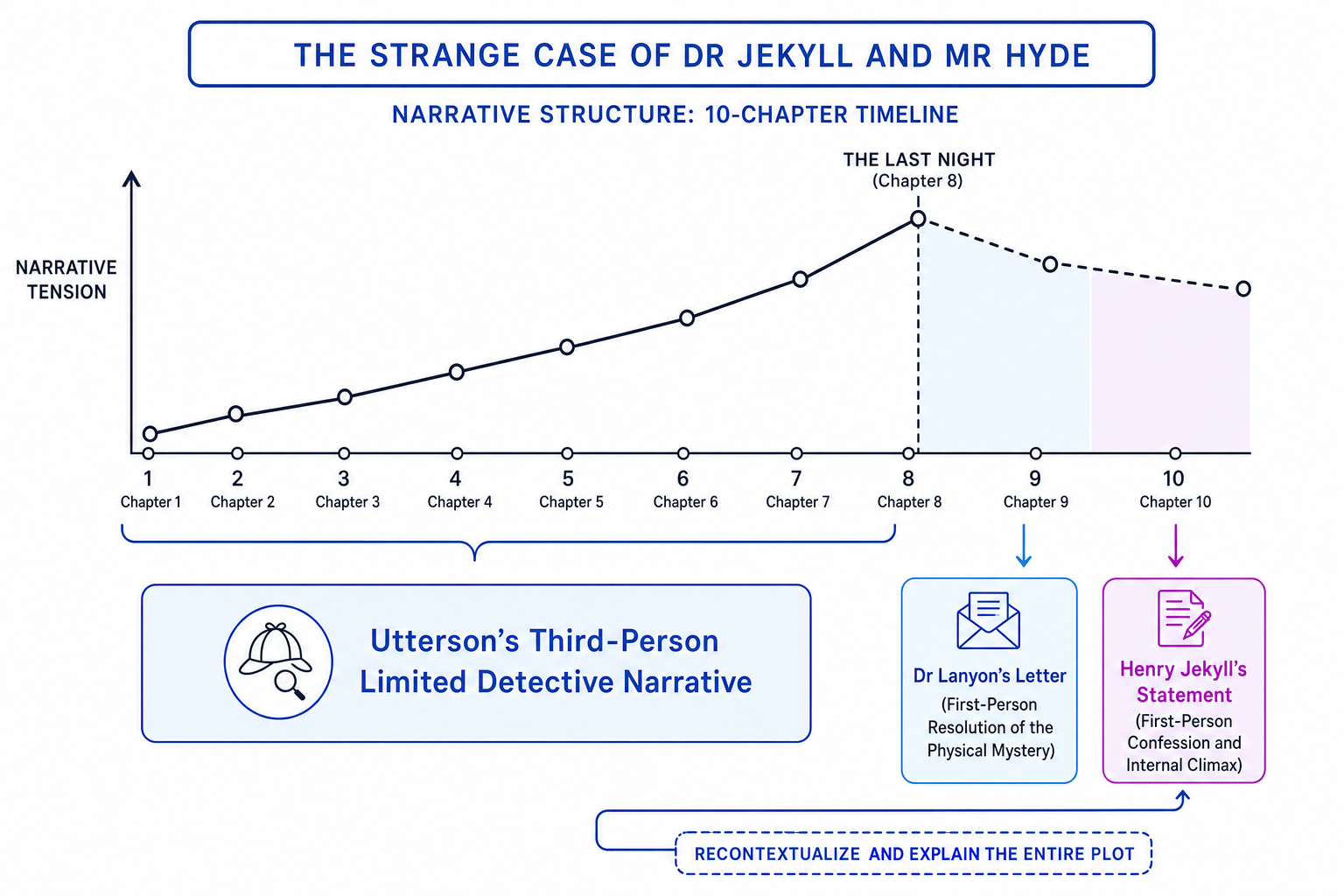
An epistolary narrative is a story told through documents, letters, or diary entries. Stevenson uses this in Chapter 9 (Lanyon’s letter) and Chapter 10 (Jekyll’s statement) to reveal truths that the third-person narrator cannot access.
Non-Linear Structure
A non-linear structure is a narrative that does not follow a straight chronological timeline. The final two chapters of the novella actually loop back in time to explain the events of the first eight chapters from different perspectives.
Third-Person Limited Perspective
A narrative perspective where the storyteller is outside the action but only has access to the thoughts, feelings, and observations of one single character (in this case, Mr Utterson).
By keeping the reader locked inside the perspective of the rational, upright lawyer Mr Utterson for the first eight chapters, Stevenson prevents us from knowing the truth. We are forced to solve the mystery along with Utterson, which increases the Gothic sense of dread.
Structure Mirrors Theme
The physical layout of the novel mirrors its central theme of duality. Just as Dr Jekyll is split into two selves, the narrative is split into two parts: the external investigation (Chapters 1–8) and the internal confessions (Chapters 9–10).
2. Chapter-by-Chapter Plot Breakdown
Chapters 1–3: The Mystery Begins
- Chapter 1: Story of the Door
- The Plot: While walking with his cousin Richard Enfield, the lawyer Mr Gabriel John Utterson hears a disturbing story. Enfield recalls seeing a "damned Juggernaut" of a man run over a young girl and leave her screaming. When caught, the sinister man, Mr Hyde, pays off the family using a cheque signed by a highly respectable gentleman (later revealed to be Dr Jekyll).
- The Key Detail: The physical door Hyde enters is described as "blistered and distained" — a Gothic symbol of Hyde’s corrupt nature, contrasted against the clean, wealthy London street.
- Chapter 2: Search for Mr Hyde
- The Plot: Utterson is deeply unsettled because he keeps Dr Jekyll’s will, which leaves everything to Edward Hyde in the event of Jekyll’s disappearance or death. Utterson seeks out Dr Lanyon, a former mutual friend of Jekyll, but finds Lanyon has fallen out with Jekyll over "scientific heresies". Utterson begins staking out the door and finally meets Hyde face-to-face. Hyde is savage and deformed, though Utterson cannot pinpoint why.
- The Key Detail: When Utterson asks Hyde to show his face, Hyde complies, but then "snarled aloud into a savage laugh" and vanishes inside.
- Chapter 3: Dr Jekyll Was Quite at Ease
- The Plot: Two weeks later, Utterson attends a dinner party at Jekyll’s house. He tries to question Jekyll about his bizarre will and his association with Hyde. Jekyll laughs off Utterson's concerns, claiming that "the moment I choose, I can be rid of Mr Hyde."
- The Key Detail: Jekyll is described as a "large, well-made, smooth-faced man of fifty", presenting the ultimate Victorian mask of respectability.
Confusing the timeline
Do not write that Utterson knows Jekyll is Hyde from the beginning. Utterson's primary fear throughout the first eight chapters is that Hyde is blackmailing Jekyll or planning to murder him for his money. This misunderstanding drives Utterson's protective, legalistic investigation.
Chapters 4–8: The Escalation of Terror
- Chapter 4: The Carew Murder Case
- The Plot: Nearly a year later, London is shocked by a brutal crime. A maid witnesses Mr Hyde savagely beat an elderly gentleman, Sir Danvers Carew, to death with a heavy cane. Utterson identifies the victim and recognises the broken cane as one he had gifted to Dr Jekyll years ago. Utterson leads the police to Hyde’s dismal rooms in the slum of Soho, but Hyde has vanished.
- The Key Detail: Hyde attacks Carew with "ape-like fury", showing his regression into primitive animality.
- Chapter 5: Incident of the Letter
- The Plot: Utterson visits a visibly ill, shaken Jekyll, who swears he is done with Hyde forever. He shows Utterson a letter signed by Hyde, claiming he has escaped. However, when Utterson shows the letter to his head clerk, Mr Guest, Guest notices that Hyde’s handwriting is remarkably similar to Jekyll’s — only differently sloped.
- The Key Detail: Utterson fears that Jekyll has forged a letter to cover up for a murderer.
- Chapter 6: Remarkable Incident of Dr Lanyon
- The Plot: For a brief time, Jekyll returns to his old, social self. But suddenly, he locks his doors again. Utterson visits Dr Lanyon, only to find his old friend on his deathbed. Lanyon is physically and mentally shattered, claiming he has had a shock from which he will never recover. Lanyon dies shortly after, leaving Utterson a sealed letter marked: "not to be opened till the death or disappearance of Dr Henry Jekyll."
- Chapter 7: Incident at the Window
- The Plot: Utterson and Enfield are on their weekly walk when they see Jekyll sitting at an open window, looking like a "disconsolate prisoner". They try to speak to him, but Jekyll's face suddenly contorts with an expression of "abject terror and despair" before he slams the window shut.
- The Key Detail: The shock of Jekyll's sudden transformation leaves both Utterson and Enfield "pale" and silent.
- Chapter 8: The Last Night
- The Plot: Jekyll’s butler, Poole, visits Utterson in a state of terror. He begs Utterson to come to the house, where someone is locked in the cabinet, weeping and pacing. The voice behind the door does not sound like Jekyll. Together, Poole and Utterson break down the laboratory door with an axe. Inside, they find the twitching, dying body of Edward Hyde, who has just swallowed poison. Jekyll is nowhere to be found, but they find a new will naming Utterson, and a packet containing Jekyll's confession.
Pathetic Fallacy in 'The Last Night'
Notice how Stevenson uses weather to build the climax of Chapter 8. It is a "wild, cold, seasonable night of March", with a "pale moon, lying on her back as though the wind had tilted her". This chaotic setting reflects the breakdown of natural law about to be discovered inside the laboratory.
Chapters 9–10: The Explanations
- Chapter 9: Dr Lanyon’s Narrative
- The Plot: This chapter loops back in time. We read Lanyon’s letter, which explains the mystery of his fatal shock. Jekyll had sent Lanyon a desperate letter begging him to retrieve a drawer of chemicals from his laboratory and hand it to a messenger. The messenger was Hyde, who arrived looking wild and desperate. In front of Lanyon, Hyde drank a potion and transformed back into Dr Henry Jekyll.
- The Key Detail: This physical transformation is what literally kills Lanyon through sheer psychological shock; his rational scientific world-view is demolished.
- Chapter 10: Henry Jekyll’s Full Statement of the Case
- The Plot: The final chapter is Jekyll’s first-person confession. He explains that he always possessed a split personality: a public face of extreme respectability and a private desire for vice. He created the potion to separate these two halves. However, Hyde grew stronger and began taking over involuntarily (forcing Jekyll to stay locked in his study in Chapter 8). Running out of the specific salt needed for the drug, Jekyll wrote his final testament knowing that he would soon disappear forever into the persona of Hyde.
- The Key Detail: Jekyll’s profound realisation: "man is not truly one, but truly two."
3. Worked Example: Analyzing Structural Transition
Tracing structural transformation in the narrative
Analyze how Stevenson manages the transition of perspective in Chapters 8 and 9 to enhance the impact of the plot on the reader.
- Identify the structural shift. Note that Chapter 8 ends with Utterson finding the dead body of Hyde, but with no physical sign of Dr Jekyll. This is the peak of the physical mystery. Instead of moving forward chronologically to explain what happened, Stevenson shifts the narrative voice to the epistolary format in Chapter 9 (Dr Lanyon's first-person letter).
- Select evidence of the psychological impact of this shift. Look at Lanyon's reaction when the transformation happens: "My life is shaken to its roots; sleep has left me; the deadliest terror sits by me at all hours of the day and night."
- Analyse the effect of the delayed revelation. By forcing the reader to view the transformation through Lanyon’s terrified eyes before reading Jekyll’s own explanation, Stevenson delays the scientific and philosophical justification. This prioritises the Gothic horror and psychological trauma of the event, forcing the Victorian reader to share Lanyon's horror at the breakdown of natural and divine laws.
- Link to context and theme. Connect Lanyon's shock to the Victorian conflict between rational science and religious morality. Lanyon represents orthodox, "rational" science, while Jekyll’s experiments represent "transcendental medicine". The shift in narrative perspective structurally forces the collapse of Lanyon's safe, rational world, mirroring the fragility of Victorian societal respectability.
In the exam
If you are writing about the plot or structure of Jekyll and Hyde, remember these three golden rules:
- Don't just retell the story: Avoid writing "First Utterson does this, then Hyde does that." Instead, focus on why Stevenson reveals these details in this order. Use phrases like: "Stevenson structures the narrative to delay the revelation of..." or "The shift to the first-person perspective in Chapter 9 serves to..."
- Track the changes in Hyde: Show how the plot is driven by Hyde’s growing dominance over Jekyll. In Chapter 3, Jekyll claims he can be "rid" of Hyde; by Chapter 10, Hyde is taking control "involuntarily" during sleep.
- Use structural terms accurately: Secure your AO2 marks by correctly identifying narrative perspectives, the epistolary form, and foreshadowing (such as the physical description of the decaying door in Chapter 1 foreshadowing the moral decay revealed in Chapter 10).
Check yourself
- Why does Stevenson choose to write the first eight chapters from Utterson's perspective rather than Jekyll's?
- What are the three distinct documents that reveal the final secrets of the plot, and which chapters do they appear in?
- How does the weather and physical environment change as the plot moves closer to the climax in "The Last Night"?
