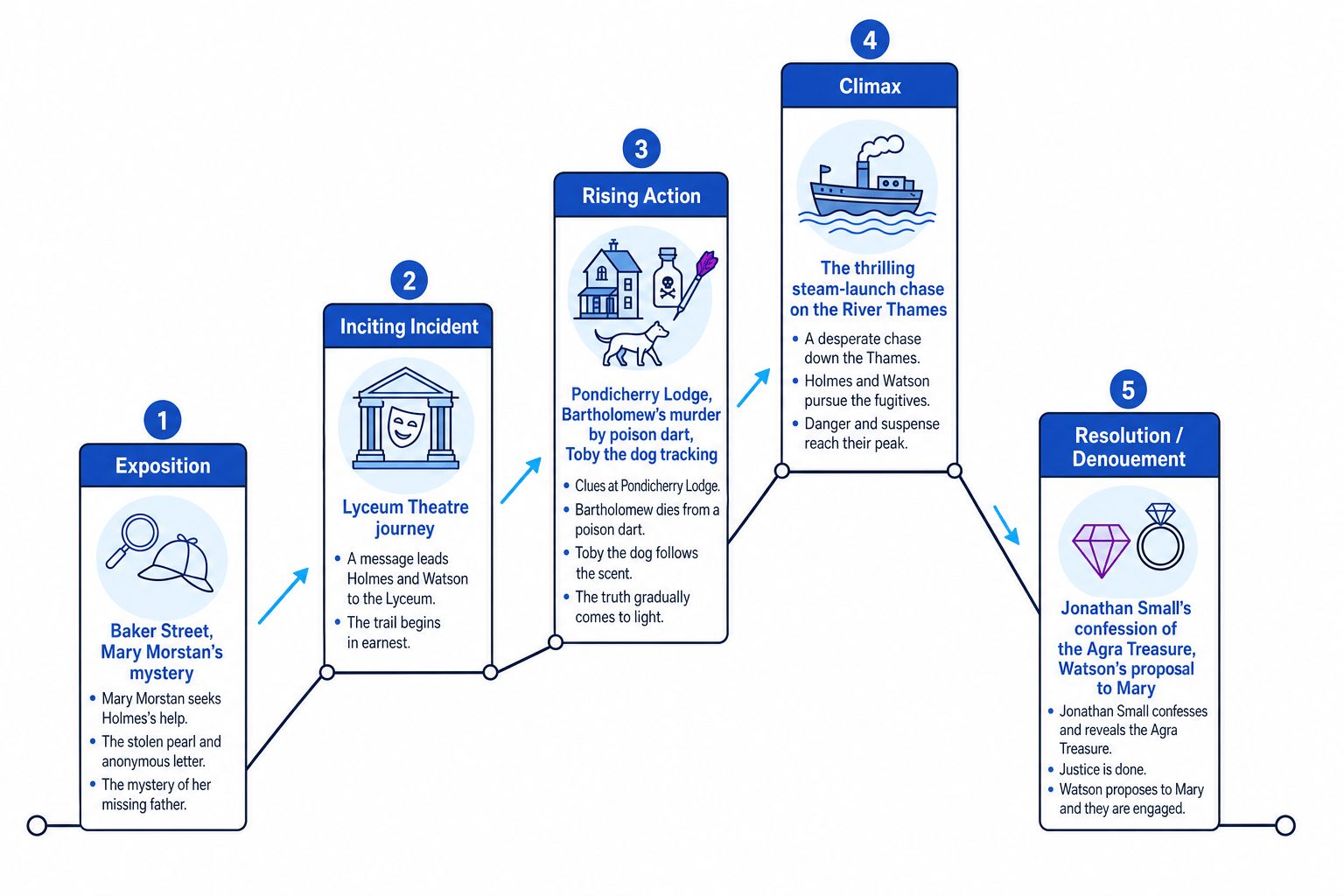
Detailed Chronological Breakdown
1. Exposition: 221B Baker Street (Chapters 1–2)
The novella opens in the domestic interior of 221B Baker Street. Doyle immediately establishes a contrast between Dr. Watson's conventional morality and Sherlock Holmes's eccentric, hyper-rational mind.
- The "Seven-Per-Cent" Solution: Holmes, desperate for mental stimulation in the absence of a case, injects himself with cocaine. Watson objects on medical and moral grounds.
- The Arrival of Mary Morstan: Mary arrives with a structured, three-part problem:
- Her father, Captain Arthur Morstan, disappeared mysteriously ten years ago (1878) after returning from India.
- For the last six years, she has received a "very large and lustrous pearl" in the post on the same day every year.
- Today, she received a letter telling her she is "a wronged woman" and asking her to meet an unknown benefactor at the Lyceum Theatre.
A Mathematical Mind vs. Emotional Humanism
Doyle uses Chapter 1 to establish the dynamic between his two main characters. Holmes views Mary's case purely as an intellectual puzzle—he calls her "a unit, a factor" and warns Watson never to let personal qualities bias judgment. Watson, conversely, is instantly attracted to Mary, viewing her with romantic empathy.
2. The Inciting Incident: The Journey into London (Chapters 3–4)
Watson, Holmes, and Mary travel by carriage to the Lyceum Theatre. Doyle uses this journey to transition from the safety of Baker Street into a gothic, threatening London.
- The Pathetic Fallacy of the London Fog: Doyle describes the city as covered in a "dense drizzly fog" with "mud-coloured clouds." This symbolizes the moral and physical confusion of the imperial metropolis.
- Thaddeus Sholto: The trio is guided to a suburban house containing Thaddeus Sholto, a nervous, eccentric man living in an oasis of Eastern luxury. He reveals that his father, Major Sholto (Captain Morstan’s former colleague in the Andaman Islands), died in fear of a "one-legged man."
- The Deathbed Confession: Before his death, Major Sholto confessed that he and Captain Morstan had found a massive treasure in India. During a dispute over how to divide it, Morstan suffered a fatal heart attack. Sholto hid the body and kept the treasure. On his deathbed, Sholto tried to reveal the treasure's location to his twin sons (Thaddeus and Bartholomew), but panicked and died when he saw a terrifying face pressed against the window.
- The Inheritance: Bartholomew has recently found the treasure hidden in the attic of their family home, Pondicherry Lodge. Thaddeus, feeling guilty, wants to give Mary her share.
Confusing the Sholto Twins
Students often mix up Thaddeus and Bartholomew Sholto.
- Thaddeus is the artistic, hypochondriac twin who seeks out Mary to give her her fair share of the inheritance. He is sympathetic.
- Bartholomew is the greedy, combative twin who locks himself in Pondicherry Lodge and refuses to share the treasure. He is the one who is murdered.
3. Rising Action: The Tragedy of Pondicherry Lodge (Chapters 5–9)
The characters travel to Norwood, where Bartholomew has locked himself inside Pondicherry Lodge.
- The Locked-Room Mystery: They find Bartholomew dead in his armchair. His face is frozen in a "horrible smile"—a symptom of tetanus caused by a poisoned wood-thorn found in his scalp. The Agra Treasure is gone.
- The Footprints on the Ceiling: Holmes examines the crime scene. He discovers two sets of footprints: one from a wooden peg-leg, and another from a small, bare-footed accomplice who climbed through a hole in the roof.
- The Sign of Four: Next to the body is a scrap of paper reading "The Sign of Four"—the same phrase written on a map found in Captain Morstan's luggage.
- The Pursuit with Toby: Holmes enlists the help of Toby, a half-spaniel, half-lurcher dog, to track the scent of creosote (used by the intruders) from Norwood to the River Thames. The trail leads to a boatyard, where they learn that the peg-legged man (Jonathan Small) and his wild companion have hired a fast steam-launch named the Aurora.
4. The Climax: The Thames Chase (Chapter 10)
After a period of waiting—during which Holmes utilizes the "Baker Street Irregulars" (a group of street children) and goes undercover disguised as an old sailor—the chase reaches its peak on the River Thames.
- The High-Speed Chase: Holmes, Watson, and police inspectors pursue the Aurora in a police launch.
- The Death of Tonga: As they close in, the "small, black" islander, Tonga, attempts to shoot Holmes with a poisoned dart. Holmes and Watson fire simultaneously, killing Tonga, who falls into the dark waters of the Thames.
- The Capture: The steam-launch is run aground, and Jonathan Small is captured.
Themes of Empire and the Foreign
Note how Tonga is depicted as an animalistic, savage caricature ("abhorrent," "bestial"). Doyle uses this depiction to reflect late-Victorian anxieties about colonial territories and the "civilizing" mission of the British Empire. Tonga represents the untamed danger of the colonies invading domestic London.
5. Resolution & Denouement: The Backstory (Chapters 11–12)
The novel ends not with a celebration of wealth, but with a series of anti-climaxes that restore moral order.
- The Empty Chest: Watson takes the iron treasure box to Mary Morstan, only to discover that it is completely empty. Small had thrown the treasure into the Thames during the chase, declaring that no one else should have what had ruined his life.
- The Romantic Resolution: Relieved that Mary is not a wealthy heiress (which would have made his courtship seem opportunistic due to class differences), Watson confesses his love. Mary accepts his proposal.
- The Frame Narrative: In custody at Baker Street, Jonathan Small tells his story. He explains how he lost his leg to a crocodile in India, became a guard at the Agra fort, and conspired with three Sikh soldiers (forming the original "Sign of Four") to steal the treasure of a wealthy rajah. They were captured and sent to the penal colony on the Andaman Islands, where they struck a deal with Major Sholto and Captain Morstan to escape in exchange for the treasure. Sholto betrayed them, leading to Small’s quest for vengeance.
- The Final Image: Watson announces his engagement to Mary. Holmes, indifferent to domestic romance, reaches for his cocaine bottle once again.
Analyzing Structural Shifts
In the GCSE English Literature exam, you are assessed on your ability to analyze form and structure (AO2). It is not enough to simply list what happens in the plot; you must analyze how Doyle manipulates the structure to achieve specific effects.
Let's look at how to construct a high-scoring analytical response focusing on Doyle's structural choices, specifically his use of the frame narrative in Chapter 12.
Analyzing the structural shift in Chapter 12
Analyze how Doyle structures the end of the novella to shift the reader’s understanding of justice and empire.
-
Identify the structural device and its placement: Note that Doyle delays Jonathan Small's backstory until the very last chapter, after the detective plot has been resolved. This is a classic "frame narrative" shift.
-
Select precise textual evidence: Identify quotations that contrast the foggy, orderly streets of London with the chaotic, violent landscape of colonial India. Small describes the Indian Rebellion of 1857: "it was a fight of the black against the white," and describes his pact as an oath signed in "blood."
-
Analyze the literary method and its effect: Explain that by shifting the narrative perspective from Watson's objective, civilized British voice to Small’s desperate, working-class monologue, Doyle humanizes the antagonist. The first-person flashback exposes the original sin of greed and betrayal (by Major Sholto) that initiated the cycle of violence.
-
Link to the broader context (AO3): Explain that this structural shift forces the Victorian reader to realize that the crime in London was not an isolated incident of foreign malice, but a direct consequence of British colonial greed and military violence abroad. The empire's sins have "come home to roost" in the heart of London.
Do not summarize the plot in your essay!
The most common mistake GCSE students make is writing a chronological summary of the book (e.g., "First Holmes takes drugs, then Mary arrives, then they go to Norwood..."). Examiners call this "retelling the story" and it limits you to lower marks. Instead, start your paragraphs with an analytical point about a theme or character, and use plot events as evidence to support your argument.
In the exam
When writing about the plot of The Sign of Four, keep these strategy tips in mind:
- Connect Beginning and End: Always contrast the opening of the novel with the ending. The cycle of Holmes's boredom →\rightarrow→ stimulation →\rightarrow→ boredom shows that while the mystery is solved, Holmes's restless mind remains unchanged.
- Track the Pacing: Explain how Doyle transitions from slow-paced, atmospheric, cerebral chapters in Baker Street to fast-paced, physical action on the Thames. This matches the movement from "deduction" to "induction."
- Use the "Agra Treasure" as a Structural Motif: Show how the treasure acts as a catalyst for every major plot point. Every character who seeks it or possesses it is corrupted, punished, or made miserable (Major Sholto, Bartholomew, Jonathan Small), while those who reject it (Watson, Mary) find happiness.
Check yourself
Answer these questions mentally to ensure you have mastered the plot structure:
- Why does Arthur Conan Doyle begin and end the novel with Sherlock Holmes's drug use? What does this structural symmetry tell us about his character?
- How does the setting of Pondicherry Lodge mirror the themes of decay, isolation, and greed?
- What is the structural significance of the empty treasure chest at the end of the novel? How does it resolve the class barriers between Watson and Mary Morstan?
