In the GCSE English Literature exam, you will be assessed on your ability to show how Arthur Conan Doyle uses characters as literary constructs to explore Victorian ideas, anxieties, and values. Characters in The Sign of Four are not just lifelike people; they are carefully designed symbols that represent different aspects of 19th-century society.
What you'll learn
- How Conan Doyle uses the duality between Sherlock Holmes and Dr. John Watson to balance science and emotion.
- How female and foreign characters reflect Victorian ideals, prejudices, and fears of the "other."
- How to analyze language, form, and context to write high-scoring exam essays.
The Dynamic Duo: Holmes and Watson
At the heart of the novella is the relationship between Sherlock Holmes and Dr. John Watson. Conan Doyle uses them to represent two different ways of looking at the world: the purely logical and scientific, versus the emotional and moral.
Sherlock Holmes: The Analytical Machine
Holmes represents the late-Victorian fascination with scientific progress, rationalism, and order. He is a detective who prides himself on his cold, unemotional approach to life.
Duality
Duality is the contrast between two opposing ideas, traits, or forces. In literature, writers often use duality within a single character or between a pair of characters to highlight conflicting human experiences or societal anxieties.
Conan Doyle establishes Holmes’s unique character through:
- His scientific detachment: Holmes famously declares, "Detection is, or ought to be, an exact science, and should be treated in the same cold and unemotional manner." He rejects feeling because he believes it biases his judgement.
- His drug use: When Holmes does not have a case, his mind stagnates. He turns to a "three-percent solution" of cocaine to escape the "dull routine of existence." This introduces a dark, gothic duality to his character. He is both a brilliant defender of Victorian law and order, and a transgressive drug user operating on the margins of polite society.
Dr. John Watson: The Human Foil
If Holmes is the "brain," Watson is the "heart." Watson serves as the narrator, which is a crucial structural choice by Conan Doyle.
Foil
A foil is a character who contrasts sharply with another character (usually the protagonist) in order to highlight and emphasize their particular qualities and traits.
Watson's character functions in several key ways:
- The Bridge to the Reader: Because Watson is an ordinary, middle-class Victorian gentleman, the reader identifies with him. He feels awe, fear, and romance, making Holmes's extraordinary intellect seem even more spectacular by contrast.
- The Voice of Emotion and Morality: While Holmes views Mary Morstan's case as a "mere unit" or a "problem," Watson is instantly drawn to her humanity and beauty. He represents the chivalrous Victorian romantic ideal.
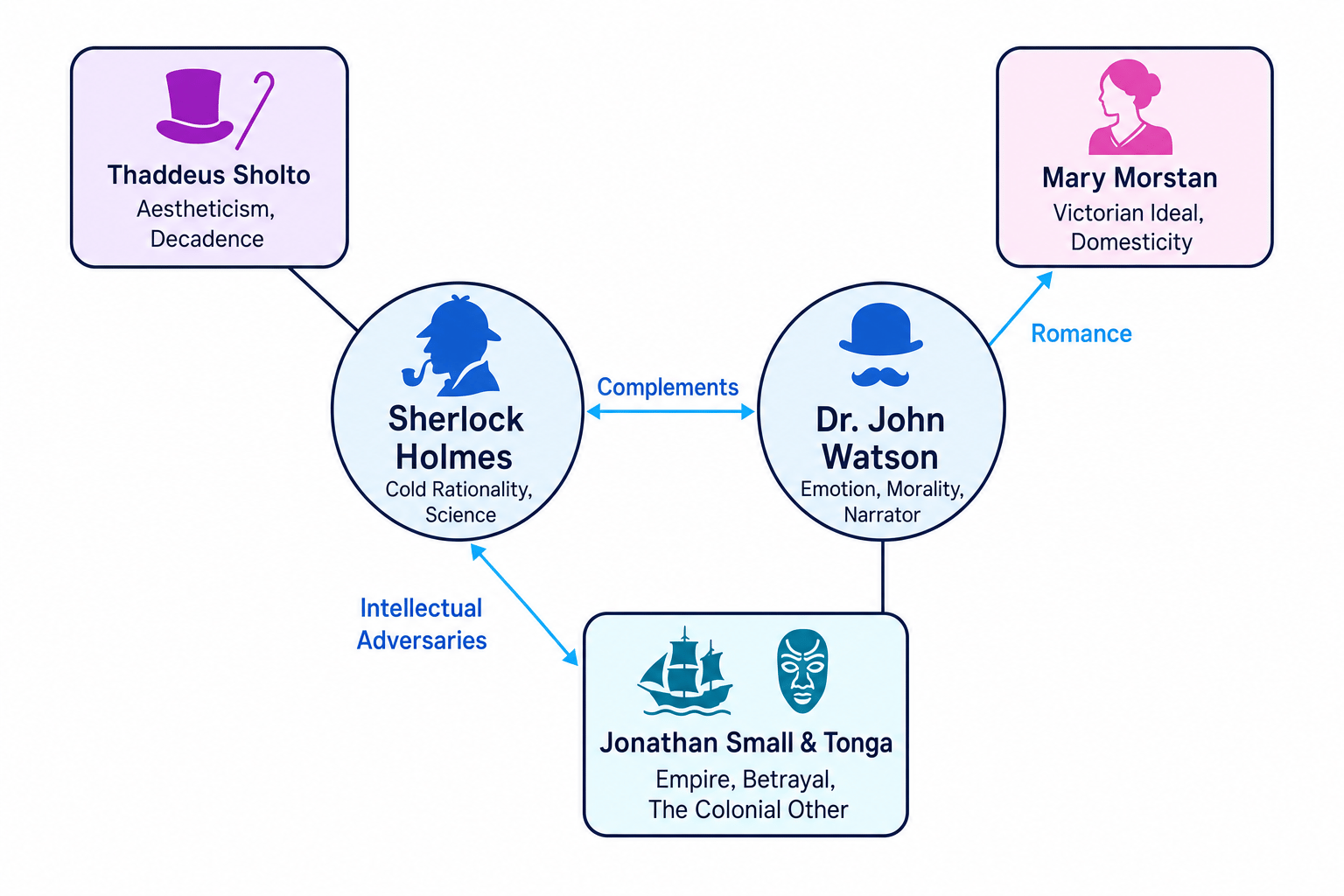
The Balance of Reason and Emotion
Conan Doyle uses the partnership of Holmes and Watson to suggest that a successful society needs both cold scientific logic (Holmes) and moral, emotional humanity (Watson). One cannot function successfully without the other.
Mary Morstan: The Victorian Ideal
Mary Morstan is introduced in Chapter 2 as the catalyst for the entire plot. Her character is constructed to represent the idealized Victorian woman.
To the Victorian reader, the ideal woman was domestic, pure, passive, and in need of male protection. Watson's description of Mary reinforces these traits:
- Her appearance: She is dressed in quiet, grey tones ("sombre vestments"), suggesting modesty and thrift.
- Her emotional restraint: Watson notes her "sweet and amiable" expression and her "self-control." Even when distressed, she maintains her composure, which was highly valued in Victorian high society.
- Her lack of greed: When the Agra treasure is lost, Mary is relieved rather than devastated. This highlights her spiritual purity and lack of materialism, contrasting sharply with the destructive greed of the male characters (like Major Sholto and Bartholomew Sholto).
Look for structural shifts
Notice how Mary's character virtually disappears from the action once the chase begins. Under Victorian gender conventions, women were excluded from the dangerous "public" spheres of detective work and violence, remaining instead in the safe, domestic "private" sphere.
Thaddeus Sholto: The Decadent Aesthete
Thaddeus Sholto is one of the most eccentric characters in the novella. He represents the Aesthetic Movement (often called Decadence) of the late 19th century.
Aestheticism
Aestheticism was an art movement in the late 19th century that championed "art for art's sake." Aesthetes valued beauty, sensory pleasure, and art above morality, utility, or scientific logic.
Conan Doyle uses Thaddeus's bizarre home and appearance to create contrast:
- His appearance: He is described as a "baldish gentleman" with a "nervous, twitching" manner and a "high, piping voice." He represents physical degeneration, a major fear in late-Victorian Britain.
- His home: Hidden in a drab, working-class London suburb, his room is a rich, exotic oasis filled with "oriental" luxuries, incense, and fine art.
- His function: Thaddeus represents a self-indulgent lifestyle that contrasts sharply with Holmes’s active, scientific discipline and Watson's straightforward morality. He shows how Eastern riches have "corrupted" or made weak the British men who inherit them.
Jonathan Small and Tonga: The Imperial Threat
Through the characters of Jonathan Small and Tonga, Conan Doyle explores Victorian anxieties about the British Empire, colonial greed, and foreign influences.
Jonathan Small: The Corrupted British Soldier
Small is the wooden-legged man who seeks vengeance for the stolen Agra treasure. He is a complex character:
- Victim of Greed: Small is not a cartoon villain; he was a normal soldier whose morality was completely corrupted by the promise of Eastern wealth ("the golden scales").
- The Danger of Empire: Small represents the idea that Britain's imperial activities in India are coming back to haunt the home nation. His return to London with a wooden leg and a thirst for revenge brings the violence of the colonies directly into the peaceful heart of London.
Tonga: The Colonial "Other"
Tonga is Jonathan Small’s companion from the Andaman Islands. He is presented in a highly xenophobic, animalistic way, reflecting the deep-seated prejudices of Victorian society.
Othering
Othering is the act of treating a group of people as intrinsically different from, and inferior to, oneself. Writers in the colonial era often "othered" native populations by describing them as savage, animalistic, or subhuman.
Conan Doyle uses Tonga to embody the fear of the "savage":
- Animalistic imagery: Watson describes Tonga as a "savage, distorted creature" and notes his "bestial" features. He is compared to a "bloodhound" and a "venomous thing."
- Social Darwinism: In the late 19th century, people misused Charles Darwin's theories of evolution to argue that non-white races were less evolved than Europeans. Tonga represents this pseudo-scientific fear of the "primitive" conquering the "civilized."
Ignoring the Victorian context
Do not judge Conan Doyle's racist presentation of Tonga by modern standards without analyzing why he wrote him this way. In your exam, explain that Conan Doyle was playing into the fears and pseudo-scientific beliefs (like phrenology and Social Darwinism) of his contemporary Victorian audience to generate suspense and horror.
Worked Example: Analyzing Characterization
Let's walk through how to write a high-level analytical paragraph about a character.
Analyzing the presentation of Tonga
Analyze how Conan Doyle uses the character of Tonga to explore Victorian anxieties about the exotic and the foreign.
- State your analytical point clearly, focusing on the writer's purpose: Conan Doyle uses the character of Tonga as a monstrous physical embodiment of Victorian imperial anxiety, representing the feared threat that the "uncivilized" colonial world poses to the metropolitan heart of the British Empire.
- Introduce a short, precise quotation and identify the literary method used: During the climactic boat chase on the Thames, Watson describes Tonga using animalistic imagery, noting his "savage, distorted creature" appearance and his "never... seen features so deeply marked with all beastliness and cruelty."
- Analyze the language and literary devices in detail (AO2): The noun "beastliness" and the adjective "distorted" strip Tonga of his humanity, reducing him to a primitive animal. By comparing him to a beast, Conan Doyle evokes the Victorian fear of evolutionary regression. The noun "cruelty" suggests an innate malice, contrasting with the civilized, rational law enforcement represented by Holmes and the police.
- Connect your analysis to historical and social context (AO3): This dehumanizing depiction directly reflects the late-Victorian belief in Social Darwinism and physiognomy—the pseudo-science which claimed a person's character could be read through their physical features. By presenting Tonga as a literal monster, Conan Doyle appeals to his readers' anxieties about racial "degeneration" and the potential dangers of colonial expansion.
In the exam
When writing about characters in The Sign of Four, keep these strategic steps in mind:
- Remember they are constructs: Never talk about Holmes or Watson as if they are real people. Always use the writer's name: "Conan Doyle constructs Holmes to represent..." or "Conan Doyle uses Watson as a structural device to..."
- Integrate context naturally (AO3): Do not write a separate paragraph of history facts. Instead, weave context directly into your character analysis. For example, connect Mary Morstan to the "Angel in the House" Victorian ideal of womanhood, or Tonga to imperial anxieties.
- Analyze language, form, and structure (AO2): Look at how characters are introduced. Contrast their physical appearances, their dialogue, and their environments. Look at how Watson's first-person narration shapes our view of Holmes's coldness or Mary's virtue.
Check yourself
- Why is it structurally important that Watson, rather than Holmes, narrates the novel?
- In what ways does Thaddeus Sholto represent the "Aesthetic Movement," and how does this contrast with Sherlock Holmes?
- What does the fate of Jonathan Small and the loss of the Agra treasure suggest about Conan Doyle's view of colonial wealth?
