Published in 1890, Arthur Conan Doyle’s The Sign of Four is the second novel featuring the legendary detective Sherlock Holmes and his loyal companion, Dr John Watson. Set against the backdrop of late-Victorian London at the height of the British Empire, the novella is much more than a simple detective puzzle. It is a complex narrative that explores Victorian anxieties about foreign invasion, the moral corruption associated with colonial wealth, and the emerging power of scientific rationalism.
What you'll learn
By the end of this overview, you will understand:
- How Doyle blends detective fiction with Victorian Gothic elements to create a tense, atmospheric mystery.
- The structural journey of the novella, mapping its key narrative movements from Baker Street to the River Thames.
- The core thematic tensions between rationalism and emotion, and between civilised England and the exoticised Empire.
The Genre: Blending Science and Sensationalism
To analyse The Sign of Four successfully, you must understand the literary genres Doyle weaves together. The novella is primarily a piece of detective fiction, a genre Doyle helped codify, but it also heavily draws upon the conventions of the Victorian Gothic.
Detective Fiction
Detective fiction is a subgenre of crime and mystery fiction in which an investigator (either professional or amateur) studies a crime, tracks down clues, and solves the mystery through logical deduction.
At the heart of Doyle's detective fiction is the character of Sherlock Holmes, who champions the scientific method: observation, deduction, and analytical reasoning. In 1890, this focus on forensic science, fingerprinting, and footprint analysis was cutting-edge and deeply comforting to a Victorian public anxious about rising urban crime rates.
However, Doyle juxtaposes this cold, logical science with the sensationalism of the Victorian Gothic.
Victorian Gothic
Victorian Gothic is a literary style characterised by a tense, eerie atmosphere, psychological horror, exotic or foreign threats, and a sense of the uncanny (where the familiar becomes strange and frightening).
In The Sign of Four, the Gothic manifests in:
- The dense, yellow, choking London fogs ("lurid brown" and "mud-coloured" streets) that obscure moral and physical clarity.
- The locked-room murder of Bartholomew Sholto at Pondicherry Lodge, complete with a terrifying, grinning corpse and a poisoned dart.
- The presentation of Tonga, the Andaman Islander, as a monstrous, animalistic threat to civilised London.
The Structural Arc of the Novella
Structurally, The Sign of Four is built on a framework of tension, release, and explanation. Doyle uses a highly deliberate narrative arc that takes the reader from the domestic safety of Baker Street, out into the dark, threatening world of crime, and back to domestic safety again.
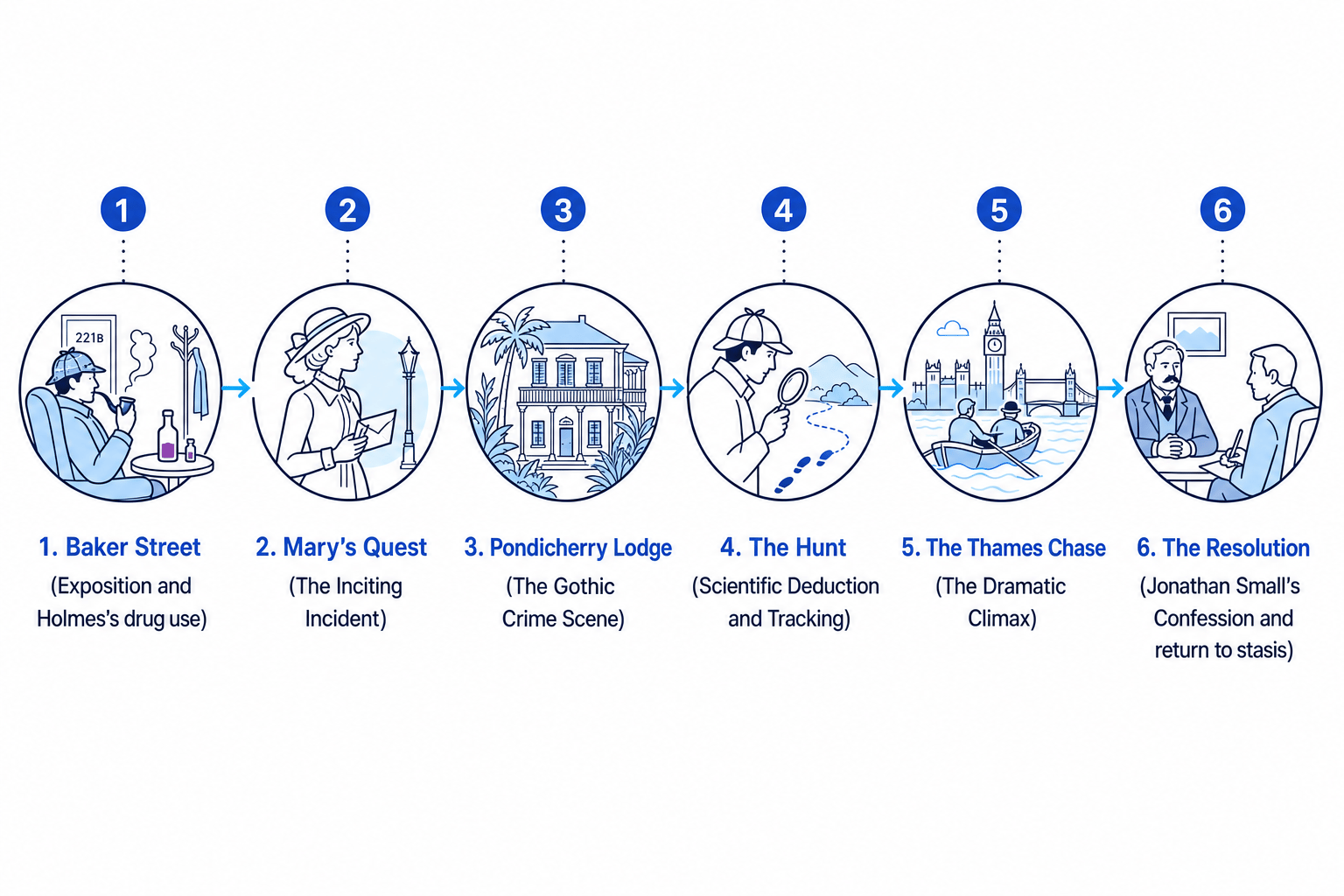
1. The Baseline: Baker Street
The novella opens in the domestic, highly intellectualised space of 221B Baker Street. We are introduced to Sherlock Holmes in a state of restless inactivity, consuming a "seven-per-cent solution" of cocaine to escape what he calls the "dull routine of existence". This establishes Holmes's core conflict: his brilliant mind requires constant stimulation, or it turns upon itself.
2. The Catalyst: Mary Morstan's Arrival
Mary Morstan enters as the classic "damsel in distress," presenting a dual mystery: the mysterious disappearance of her father ten years prior, and the annual arrival of rare pearls from an anonymous benefactor. Her arrival acts as the inciting incident, moving Holmes from lethargy to intense intellectual focus.
3. The Gothic Crime: Pondicherry Lodge
The narrative shifts to Norwood, a dark, suburban space where the characters find Bartholomew Sholto dead in a locked room. Doyle uses this setting to evoke Victorian anxieties about hidden family secrets and the corrupting nature of foreign plunder (the Agra Treasure).
4. The Scientific Hunt: Tracking the Murderers
Holmes and Watson track the suspects using Toby the dog and forensic deduction. This section showcases Holmes's supreme analytical skills, contrasting them with the bumbling, conventional methods of Athelney Jones and the official police force.
5. The Climax: The Thames Chase
The tension peaks in an adrenaline-fueled boat chase down the River Thames. The steam-launch Aurora becomes a symbol of modern industrial progress chasing down the ancient, chaotic forces of the East (represented by Tonga and Jonathan Small).
6. The Resolution: Small’s Confession and Stasis
With the capture of Jonathan Small and the death of Tonga, the mystery is solved. Small’s lengthy confession provides the backstory of the Indian Mutiny of 1857, explaining the origins of the Agra Treasure. The novel ends in stasis: the treasure is lost at the bottom of the Thames, Mary and Watson are engaged, and Holmes returns to his cocaine bottle, completing the cyclical structure.
The Narrative Cycle
The structure of The Sign of Four is cyclical. It begins and ends with Holmes, Watson, and the cocaine bottle in Baker Street. This cycle suggests that while individual crimes can be solved and order temporarily restored, the underlying anxieties of the Victorian world—and Holmes's own inner demons—remain unresolved.
Core Thematic Tensions
When writing about The Sign of Four, your analysis should always connect Doyle’s language and structural choices to his broader themes. The novella is built on several sharp thematic contrasts.
Rationalism vs. Emotion (Holmes vs. Watson)
Doyle deliberately designs Watson as a foil to Holmes.
- Holmes represents pure, unfeeling rationalism. He argues that "love is an emotional thing, and whatever is emotional is opposed to that true cold reason which I place above all things." He treats Mary Morstan's case as a purely intellectual "clinical problem."
- Watson represents emotion, romance, and Victorian chivalry. He is immediately drawn to Mary's "sweet" nature and struggles throughout the novel with his feelings, fearing that proposing to her while she is a potential heiress would make him look like a fortune-hunter.
Imperialism and Victorian Anxiety
Written during the late-Victorian era, the novel reflects deep-seated anxieties about the British Empire.
- The Agra Treasure acts as a symbol of colonial greed and corruption. Every character who seeks to possess it—Major Sholto, Captain Morstan, Bartholomew Sholto, and the Four—is morally corrupted, ruined, or killed by it.
- The "Other" and Foreign Invasion: The character of Tonga represents the Victorian fear of the colonial "other." He is described in deeply xenophobic, animalistic terms ("savage," "distorted," "bestial"), reflecting the contemporary fear that the violence used to maintain the Empire abroad would eventually "infect" and invade the domestic safety of London.
Ignoring the Imperial Context
Many students write about The Sign of Four as if it is just a simple, fun adventure story. To gain high marks for context (AO3), you must demonstrate how the text is a product of its time. You must show how Doyle uses the gothic elements and foreign characters to reflect the real-world anxieties of Victorian readers who were terrified of colonial rebellion and urban decay.
Analyzing Doyle's Literary Methods
To score highly on AO2 (analysis of language, form, and structure), you must be able to write detailed, analytical paragraphs that dissect how Doyle uses language to construct his characters and themes.
Let's look at how to construct an analytical paragraph examining the presentation of Holmes in Chapter 1.
Analysing the Contrast Between Holmes and Watson
Analyze how Doyle uses language in Chapter 1 to establish the contrast between Sherlock Holmes's rationalism and John Watson's emotional humanity.
-
Formulate a precise thesis statement (AO1/AO3): Begin with a clear point that links Doyle's characterisation to his broader thematic purposes.
Drafting your point: "In the opening chapter, Doyle immediately establishes a sharp contrast between Holmes's cold, scientific detachment and Watson’s human warmth, reflecting Victorian debates surrounding the limits of pure rationalism."
-
Integrate precise evidence and identify literary methods (AO2): Select a short, memorable quotation and name the literary device (such as metaphor, foil, or dialogue).
Selecting evidence: Use Holmes’s claim: "I am a brain, Watson. The rest of me is a mere appendix."
Integrating and identifying methods: "Doyle uses a striking medical metaphor when Holmes asserts, 'I am a brain, Watson. The rest of me is a mere appendix.' By reducing his physical body to a 'mere appendix'—an evolutionary remnant with no function—Holmes conceptualises himself as a purely intellectual entity."
-
Analyse the effect on the reader and link to context (AO2/AO3): Explain why Doyle chose this language and how it relates to Victorian context.
Developing the analysis: "This extreme self-reduction shocks the reader and highlights Holmes's rejection of ordinary human emotions and physical desires. To Holmes, the human body is merely a biological vehicle for his supreme intellect. This reflects the late-Victorian fascination with scientific specialization and the fear that progress might lead to a cold, post-human future devoid of empathy—a viewpoint Watson continually challenges with his warm, emotional narrative voice."
The Dual Nature of Holmes
Do not view Holmes as a one-dimensional machine. Doyle deliberately presents him as a complex, contradictory figure. He is a gentleman scientist who upholds British law, yet he routinely breaks the law to solve cases and relies on illegal drugs when his intellect is unchallenged. This duality makes him a deeply fascinating character to write about in your exam.
In the exam
- Focus on the Question's Key Terms: When you open your exam paper, highlight the keywords in the prompt (e.g., 'fear', 'wealth', 'friendship', 'setting'). Every paragraph you write must directly answer that prompt, rather than just retelling the plot.
- Anchor Your Analysis in Context (AO3): Never "tack on" historical facts at the end of a paragraph. Instead, weave them into your language analysis. For example, connect Doyle’s description of the dark, labyrinthine London streets directly to Victorian anxieties about urban poverty and crime.
- Trace the Narrative Journey: Remember that characters and themes develop over the course of the novel. Contrast the chaotic, dark settings of Pondicherry Lodge and the Thames with the orderly, intellectual sanctuary of Baker Street to show how Doyle uses structure to mirror the battle between chaos and order.
Check yourself
- Why does Sherlock Holmes use a "seven-per-cent solution" of cocaine in Chapter 1, and what does this tell us about his personality?
- How does the Agra Treasure act as a symbol of colonial corruption throughout the novella?
- In what ways does Doyle use the character of Tonga to exploit the imperial anxieties of his Victorian readership?
