

In the AQA GCSE English Literature exam, you will not just be asked to retell the plot of the stories in the Telling Tales anthology. Instead, the examiner wants you to show how different writers use characters, settings, and symbols to explore big, universal ideas. These big ideas are called themes.
What you'll learn
- How to identify and track central themes across different stories in the anthology
- How to use precise literary terminology to analyse how writers build these themes
- How to structure a high-scoring comparative plan that links two stories under a shared thematic umbrella
Understanding Theme in Short Stories
Before we look at the specific themes in Telling Tales, we need to understand how theme works in a short story compared to a full-length novel or play.
Because short stories are highly condensed, writers do not have hundreds of pages to develop their ideas. Every word, character interaction, and description must work double-time to convey the central message.
Theme
A theme is an underlying, universal idea, message, or argument that a writer explores throughout a literary text. It is not just a topic (like "family"), but what the writer is saying about that topic (such as "family relationships are often strained by silence and unspoken grief").
To build these themes in a limited space, short-story writers frequently rely on motifs.
Motif
A motif is a recurring image, object, word, or phrase that helps to develop and reinforce the central theme of a text.
For example, in Graham Swift's Chemistry, the toy boat is a motif that represents the delicate balance and eventual sinking of the family unit.
Major Thematic Connections in Telling Tales
To score highly in your exam, you need to look at the anthology as a interconnected web of ideas. Rather than treating each story as an isolated island, you should practice grouping them by their shared thematic concerns.
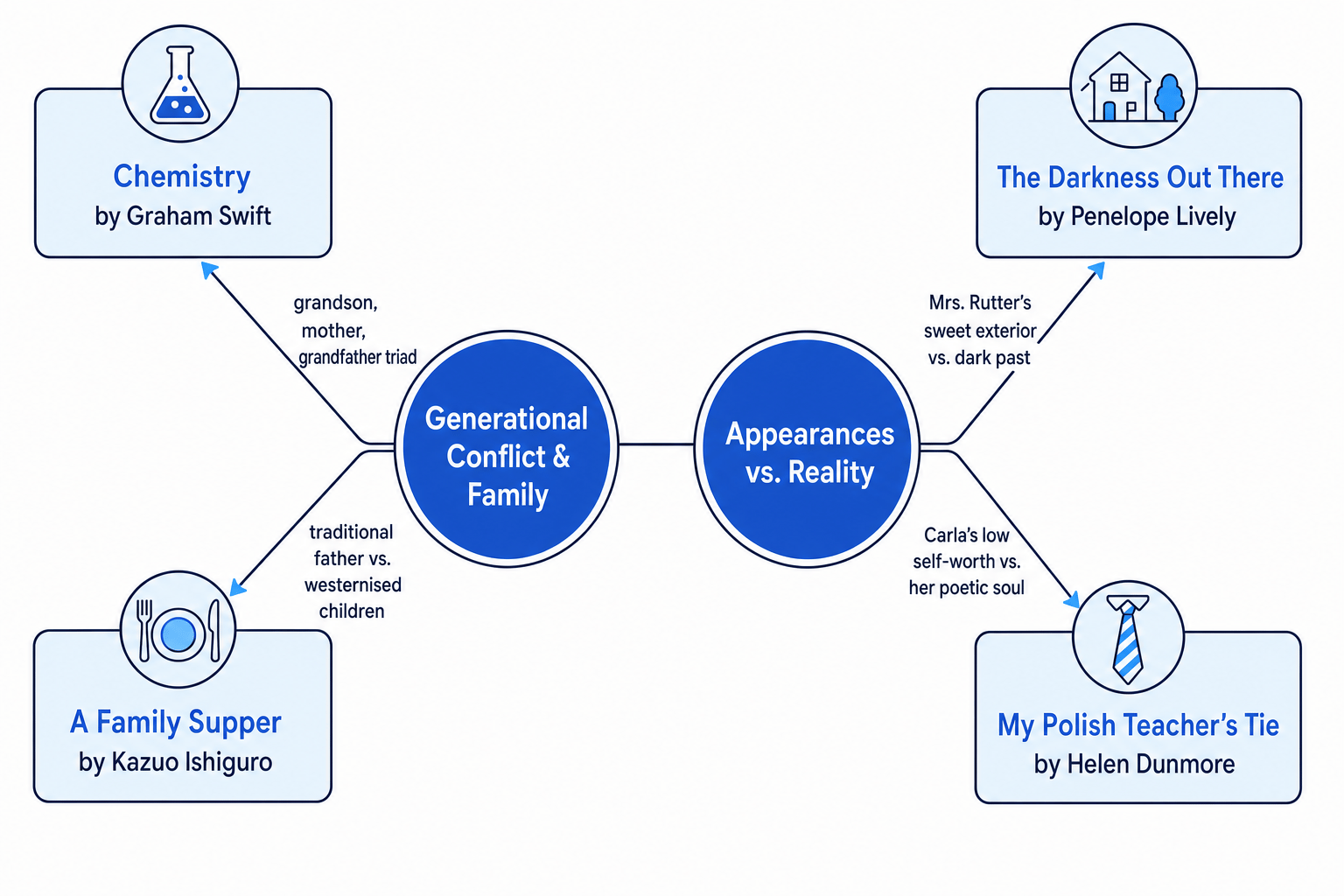
1. Generational Conflict and Family Dynamics
Many of the stories in the collection explore the complex, often painful relationships between parents, children, and grandparents. Writers often focus on the tension between older generations trying to preserve tradition and younger generations seeking independence or struggle to adapt to change.
- In Chemistry (Graham Swift): The narrator, his mother, and his grandfather exist in a fragile, "seamless" three-way harmony that is shattered by the arrival of Ralph, a new partner who represents a different, harsher world. Swift uses the physical spaces of the house and the garden pond to show how the characters are pushed to the margins of their own family.
- In A Family Supper (Kazuo Ishiguro): The tension is quiet but immense. Set in Japan, the story explores the generational divide between a traditional, rigid father and his Westernised, adult children who have returned from America. The father's quiet focus on the poisonous fugu fish and his memories of his wife's death create a tense atmosphere of unspoken resentment and cultural estrangement.
Comparing Family Relationships
When comparing family dynamics, look at how the writers use silence or unspoken thoughts. In both Chemistry and A Family Supper, the characters struggle to communicate their grief and love directly, leading to a profound sense of isolation.
2. Appearances vs. Reality
Several writers in the anthology warn us that the world is rarely as simple or safe as it appears on the surface. They explore the gap between social facades and internal truths.
- In The Darkness Out There (Penelope Lively): This is a classic "coming-of-age" story where the young protagonist, Sandra, undergoes a loss of innocence. The setting of Chadd's Ford and the character of Mrs Rutter initially appear picturesque and harmless—Mrs Rutter is described as looking like "a picture in a book". However, the revelation of Mrs Rutter’s cruel past (allowing a dying German pilot to perish slowly in a field during WWII) shatters Sandra's naive worldview.
- In My Polish Teacher's Tie (Helen Dunmore): The school community judges people entirely on their external status. The narrator, Carla, is treated as a "half-person" by the other teachers because she is part of the catering staff. When Stefan, the Polish teacher, arrives wearing a vibrant but "wrong" tie with "red and gold threads," he represents an authentic, artistic reality that challenges the superficial, status-obsessed school hierarchy.
3. Isolation and Belonging
Feeling like an outsider—whether due to class, race, nationality, or personal circumstances—is a recurring emotional state throughout these stories.
- In Invisible Mass of the Back Row (Claudette Williams): The protagonist, Hortense, experiences deep cultural and social isolation when she moves from the warm, vibrant community of Jamaica to a cold, grey English schoolroom. Williams uses the physical metaphor of the "back row" of the classroom to represent how immigrant children are marginalised and made invisible by the education system.
- In My Polish Teacher's Tie (Helen Dunmore): Carla experiences a different form of isolation: class-based invisibility. She hides her intellect and her half-Polish heritage to blend into the background, believing she is "not a real teacher". Her connection with Stefan breaks this isolation, showing that true belonging is found through shared humanity, not social labels.
Analysing Themes: Step-by-Step Planning
When you are asked to write about a theme in the exam, your essay must go beyond simply identifying quotes. You must explain how the writer uses their craft to convey their message (AO2) and why they wrote it in that way, considering the social or historical context (AO3).
Here is how you can build a comparative plan around a theme.
Comparing the presentation of generational conflict
Plan an essay comparing how Graham Swift in Chemistry and Kazuo Ishiguro in A Family Supper present generational conflict and family tension.
-
Establish a shared thematic core (the thesis statement): Begin by identifying the common ground between both texts. Write a sentence explaining that while Swift presents family breakdown through the physical, destructive intrusion of an outsider (Ralph), Ishiguro presents it through internal cultural alienation and emotional distance.
-
Contrast the symbolic methods used by the writers (AO2): Select one key symbol from each text that represents the family tension. For Chemistry, select the toy boat on the pond, which the grandfather helps build but which eventually "sank... as if it had been waiting for that cue," symbolizing the inevitable collapse of their three-generation unit. For A Family Supper, select the toxic fugu fish or the dark "stony well" in the garden, which symbolizes hidden dangers, death, and the father's unspoken power over his children's lives.
-
Compare how narrative perspective shapes the reader's view (AO2): Analyse the voice. Chemistry is told through the subjective, emotional first-person perspective of a child struggling to accept change. A Family Supper is written in an understated, minimalist first-person voice by an adult son, where what is left out of the dialogue is far more important than what is actually said. This stylistic difference highlights the difference between a child's active resistance and an adult's weary resignation.
-
Integrate the social and cultural contexts (AO3): Link the family dynamics to wider societal shifts. In Chemistry, associate the conflict with post-war British domestic shifts and the struggle to integrate new partners into established families. In A Family Supper, link the tension to post-WWII Japan, where the older generation felt dishonoured by military defeat and the younger generation increasingly embraced Western individualism and rejected traditional filial piety.
The 'Device Spotting' Trap
Do not just list literary devices (e.g., "The writer uses a metaphor in this quote"). AQA examiners call this "device spotting." Instead, always link the method directly to the theme. Use the formula: Method →\rightarrow→ Meaning →\rightarrow→ Effect on Reader. For example: "Swift uses the physical symbol of the sinking toy boat (Method) to represent the fragile nature of the family unit (Meaning), prompting the reader to feel a sense of inevitable tragedy (Effect)."
Strategic Vocabulary for Theme Essays
To write a sophisticated, academic essay, avoid using simple words like "shows" or "presents" repeatedly. Instead, use analytical verbs that describe the writer’s choices.
| Weak Verb | Powerful Analytical Alternative | Example in Action |
|---|---|---|
| Shows | Illuminates / Manifests / Evokes | "Lively illuminates the dark capacity for human cruelty hidden behind a cosy rural facade..." |
| Changes | Subverts / Transforms / Destabilizes | "The arrival of Ralph destabilizes the delicate domestic chemistry of the household..." |
| Proves | Exemplifies / Underpins / Reinforces | "The metaphor of the 'back row' underpins the protagonist's profound cultural alienation..." |
In the exam
- Answer the specific question: Do not write a pre-prepared essay. If the question asks about secrecy, focus your thematic links entirely on what the writers are saying about secrets, not just general family dynamics.
- Track the structure of the stories: Discuss how the theme develops from the beginning, through the climax, to the resolution. In short stories, the ending often contains a sudden shift in perspective (a "revelation")—such as Sandra's realization at the end of The Darkness Out There that "there is a darkness out there... and it is part of us."
- Embed short, sharp quotations: Because the exam is closed-book, memorise brief 2–4 word phrases (like "half-person", "picture in a book", or "seamless") that you can easily weave into the flow of your own sentences.
Check yourself
- Which two stories from the Telling Tales anthology would you pair together to write an essay about the theme of social class and status?
- What does the motif of the "bird of paradise" tie represent in My Polish Teacher's Tie, and which theme does it support?
- How does the ending of The Darkness Out There transform our understanding of the story's title?
