In the GCSE English Literature exam, you will not just be asked to retell the story of A Christmas Carol. Instead, you must explore why Charles Dickens wrote it. Dickens did not write this novella merely to entertain; he wrote it to provoke social change. The themes are the ideas, messages, and warnings that Dickens wanted his Victorian readers—and us—to think about.
What you'll learn
- How Dickens uses his characters and settings as symbols to explore deep social issues.
- The critical themes of Social Responsibility, Redemption, and The Spirit of Christmas.
- How to link language analysis (AO2) directly to Victorian context (AO3) in your exam answers.
Understanding Dickens's Purpose
Before looking at individual themes, we must understand the type of book Dickens wrote. A Christmas Carol is a didactic text.
Didactic
A didactic piece of literature is designed or intended to teach a lesson, particularly a moral or social one.
Dickens also structured his story as an allegory.
Allegory
An allegory is a story that can be interpreted to reveal a hidden, deeper moral, spiritual, or political meaning. The characters and events are not just themselves; they stand for larger ideas.
Scrooge is not just a grumpy old man; he represents the cold-hearted greed of wealthy Victorian capitalism. Tiny Tim represents the vulnerability of the Victorian poor, who were entirely dependent on the charity of others to survive.
Theme 1: Social Responsibility and the Poor
In 1843, Victorian London was a city of stark contrasts. The Industrial Revolution had made a small number of people incredibly wealthy, while the vast majority lived in extreme poverty, filth, and overcrowding. Dickens believed that the wealthy had a moral duty to help those less fortunate, a concept known as social responsibility.
Malthusian Theory vs. Christian Charity
In Stave 1, Scrooge is visited by two Portly Gentlemen collecting money for the poor. Scrooge refuses to donate, asking if the "Prisons" and "Union workhouses" are still open. When the gentlemen point out that many would rather die than go there, Scrooge replies:
"If they would rather die, they had better do it, and decrease the surplus population."
This is a direct reference to the Malthusian theory, named after the economist Thomas Malthus. Malthus argued that the human population would always grow faster than the food supply, and that poverty, disease, and famine were inevitable, natural ways to keep the population in check. He believed that helping the poor only encouraged them to have more children, making the problem worse.
Dickens's Attack on Malthusianism
By putting Malthus's cold, mathematical language ("surplus population") into the mouth of the monstrous, unfeeling Scrooge, Dickens is directly attacking this ideology. He wants his readers to see that treating human beings as mere numbers on a balance sheet is immoral and un-Christian.
Ignorance and Want
In Stave 3, the Ghost of Christmas Present reveals two horrific, animal-like children hidden beneath his robes:
"They were a boy and girl. Yellow, meagre, ragged, scowling, wolfish; but prostrate, too, in their humility."
The Ghost introduces them as Ignorance (the boy) and Want (the girl).
- Want represents physical poverty—the lack of food, warm clothing, and shelter.
- Ignorance represents the lack of education. Dickens believed that denying education to the poor trapped them in a cycle of crime and poverty.
The Ghost warns Scrooge: "most of all beware this boy, for on his brow I see written which is Doom, unless the writing be erased." Dickens is warning the wealthy classes that if they continue to ignore the education and welfare of poor children, society will eventually collapse into violent revolution ("Doom").
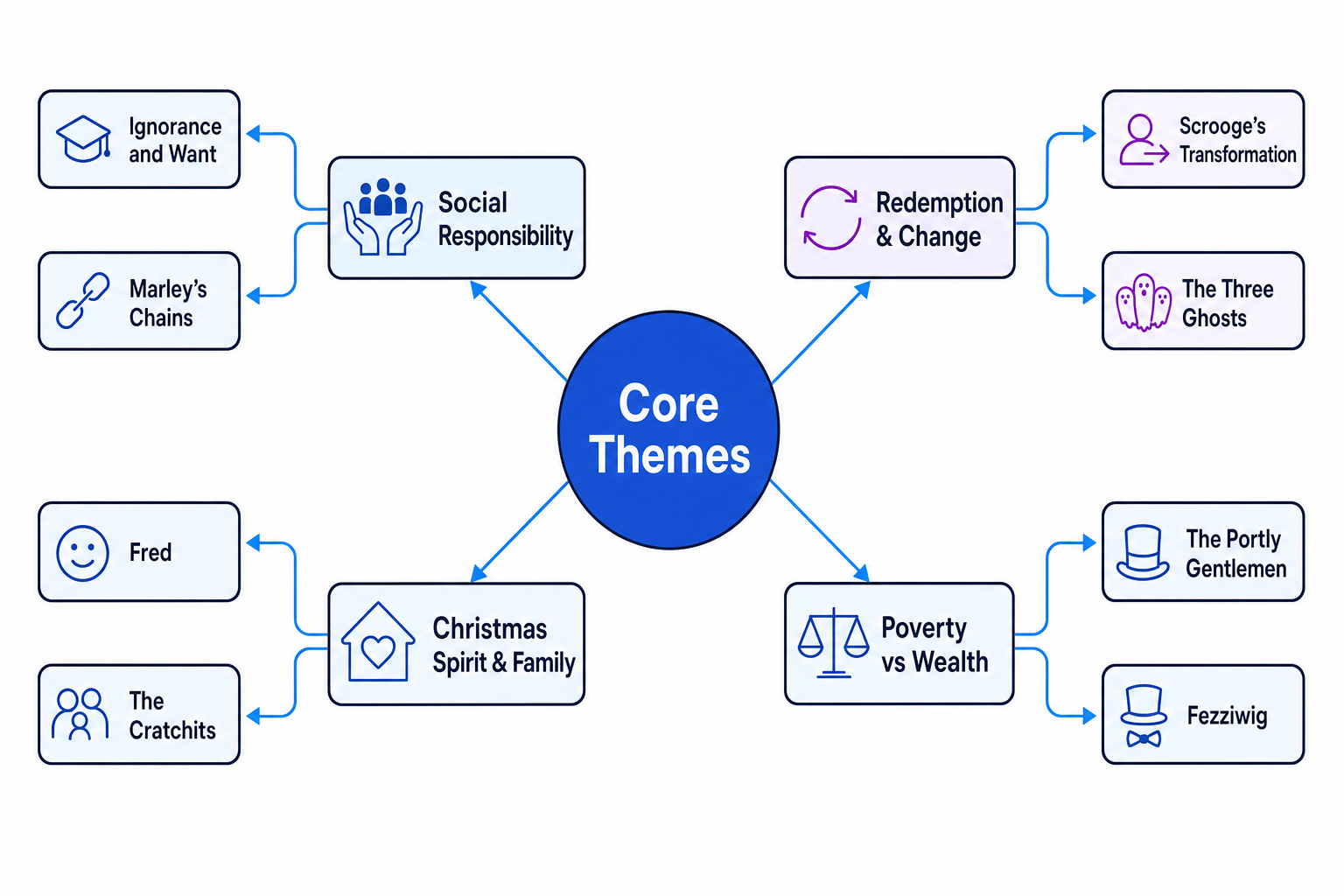
Theme 2: Redemption and Transformation
To "redeem" something means to save it from sin, error, or evil. A Christmas Carol is ultimately a story of hope because it shows that even the most deeply corrupted human being can achieve redemption.
Scrooge’s Cold Heart (Stave 1)
At the start of the novella, Scrooge is described using imagery of coldness and rigidity:
"External heat and cold had little influence on Scrooge. No warmth could warm, no wintry weather chill him."
Dickens uses a semantic field of winter and ice ("cold," "frosty," "iced," "shivered") to show how Scrooge has completely isolated himself from human warmth and sympathy. He is described as "hard and sharp as flint, from which no steel had ever struck out generous fire."
Scrooge’s Rebirth (Stave 5)
By the end of the novella, Scrooge’s coldness has melted away. This transformation is highlighted through a dramatic shift in his language and behaviour. He says:
"I am as light as a feather, I am as happy as an angel, I am as merry as a schoolboy. I am as giddy as a drunken man."
Analysing the Similes
Notice the string of joyful similes Dickens uses here. "Light as a feather" contrasts with the heavy, clanking chains Marley’s Ghost had to drag. "Happy as an angel" directly contrasts with his earlier devil-like, cold isolation. He has undergone a spiritual rebirth.
Theme 3: Christmas Spirit, Family, and Generosity
For Dickens, the "Christmas spirit" was not just a religious holiday, but a philosophy of life. He believed that at Christmas, people should put aside their selfish desires and view each other as "fellow-travellers to the grave, and not another race of creatures bound on other journeys."
The Contrasting Households
Dickens uses three contrasting households to show how happiness is not tied to financial wealth, but to emotional warmth and family connection:
- Scrooge’s Office/House: Cold, dark, and silent. Scrooge eats his gruel alone in the dark to save money. His physical environment reflects his spiritual poverty.
- The Cratchit Household: Physically cold (they have a tiny fire) and financially poor, but rich in love, warmth, and gratitude. The family works as a team, and they value each other's presence above everything else.
- Fred’s House: Bright, loud, filled with laughter, games, and music. Fred is Scrooge's nephew and represents the ideal, generous, middle-class Victorian man who values family connection over financial gain.
Analysing the Theme of Social Responsibility
When writing your essay, you must show the examiner how Dickens uses language and structure (AO2) to deliver his social message (AO3). Here is a guide on how to walk through a thematic analysis step-by-step.
Analysing a passage for the theme of Social Responsibility
- Identify the thematic focal point in the text. Let us look at the moment Marley’s Ghost visits Scrooge in Stave 1. Marley is weighed down by a chain made of "cash-boxes, keys, padlocks, ledgers, deeds, and heavy purses wrought in steel."
- Analyse the writer's methods (AO2). Dickens uses a metaphorical chain made of items from the financial sector. These physical items symbolize the business and greed that Marley prioritized in life. The adjective "heavy" and the verb "wrought" emphasize how difficult and agonizing this self-inflicted burden is. Marley confesses: "I wear the chain I forged in life... I made it link by link."
- Link the method to Dickens's social message and context (AO3). Through Marley’s confession, Dickens is issuing a stark warning to the wealthy capitalists of Victorian England. If they live selfish lives, focused entirely on money and neglecting their social responsibility, they will face eternal spiritual damnation. Marley's exclamation "Mankind was my business!" serves as the moral core of the play: our true "business" on Earth is not financial profit, but charity, mercy, and benevolence.
Feature spotting without effect
Do not just write: "Dickens uses a metaphor when Marley talks about his chain." This is "feature spotting" and does not get you high marks. You must explain how the metaphor works and why Dickens chose those specific items (cash-boxes, ledgers) to convey his theme of social responsibility.
The 'Scrooge was just mean' trap
Avoid writing about Scrooge as if he were a real, living person who was simply bad-tempered. Always refer to him as a literary construct created by Dickens to represent a wider social class and mindset.
In the exam
- Focus on the Writer’s Craft: Always use the writer's name ("Dickens constructs...", "Dickens uses...", "Dickens emphasizes..."). This reminds the examiner that you are analyzing a piece of deliberate art, not reading a history book.
- Integrate Context Seamlessly: Never write a "history paragraph" at the end of your essay. Instead, weave the context directly into your language analysis (e.g., "When Scrooge demands 'Are there no prisons?', Dickens is directly criticising the Poor Law Amendment Act of 1834...").
- Trace the Character Arc: When discussing themes like Redemption or Social Responsibility, always mention how the theme develops from Stave 1 through to Stave 5. Contrast Scrooge’s initial state with his final transformation to show you understand the structure of the entire novella.
Check yourself
- Why does Dickens choose to make Ignorance a boy and Want a girl, and why is Ignorance the more dangerous of the two?
- How does the description of Scrooge's physical environment in Stave 1 reflect his moral and spiritual state?
- What does Marley's chain represent, and how does it link to the theme of social responsibility?
