In A Christmas Carol, Charles Dickens does not simply write realistic portraits of Victorian Londoners. Instead, he uses his characters as symbols to deliver a powerful message about poverty, greed, and social responsibility.
What you'll learn
- How to analyze characters as deliberate literary constructs rather than real people.
- The role of "foils" in highlighting Scrooge's moral flaws and potential for change.
- How supernatural figures act as catalysts for psychological and societal transformation.
Character as an Allegorical Construct
To achieve top marks in your GCSE English Literature exam, you must move away from talking about characters as if they are real people. You must view them through the lens of the writer’s craft.
Construct
A construct is a character created deliberately by an author to represent a specific set of ideas, values, or social groups, rather than simply to exist as a realistic individual.
Dickens wrote A Christmas Carol as an allegory.
Allegory
An allegory is a story with a hidden narrative level where characters, settings, and events stand for broader moral, political, or religious meanings.
By understanding that Scrooge represents the selfish attitudes of the wealthy Victorian middle class, and that the Cratchits represent the suffering yet deserving poor, you can elevate your essay from simple plot summary to high-level analysis.
Ebenezer Scrooge: The Path to Redemption
At the beginning of the novella, Scrooge is the archetype of greed and cold-hearted isolation. Dickens uses vivid, sensory language to establish his misanthropy. He is described as "hard and sharp as flint" and "solitary as an oyster."
Scrooge's Transformation
Scrooge's journey is a secular conversion narrative. He moves from cold, isolated individualism ("solitary as an oyster") to warm, socially responsible collectivism ("as good a friend... as the good old city knew"). His redemption proves to Dickens's Victorian audience that no one is beyond saving, and that social reform begins with personal transformation.
To emphasize Scrooge's coldness, Dickens utilizes pathetic fallacy—a literary device where the writer attributes human emotions to nature or the environment:
"The cold within him froze his old features... he carried his own low temperature always about with him."
Scrooge’s icy interior is so profound that physical weather has no effect on him. This coldness represents his lack of human empathy. He actively rejects community, family, and charity, declaring that the poor should die and "decrease the surplus population." This line directly mirrors the harsh social theories of Thomas Malthus, a Victorian economist who argued that population growth would outstrip food supply and that poverty was inevitable. Dickens uses Scrooge to satirize and condemn these heartless "Malthusian" views.
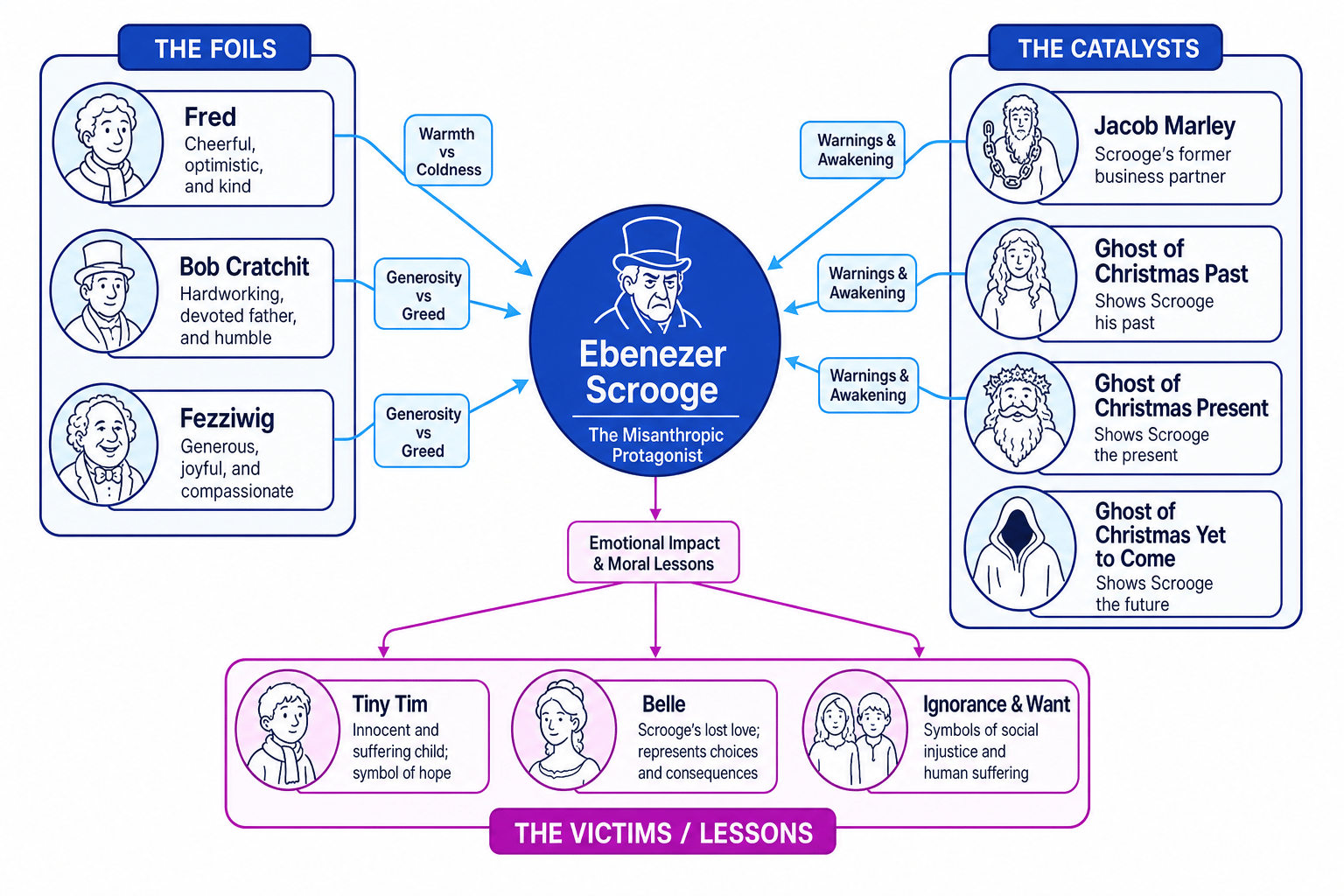
The Foils: Contrasting Scrooge
To make Scrooge’s flaws stand out, Dickens surrounds him with characters who act as structural contrasts.
Foil
A foil is a character who contrasts sharply with another character (usually the protagonist) to highlight and emphasize particular qualities of that character.
Fred: The Embodiment of Christmas Spirit
Scrooge’s nephew, Fred, enters Stave 1 "all in a glow," a direct contrast to Scrooge’s internal "low temperature."
- Warmth vs. Cold: Fred's physical warmth reflects his emotional warmth and capacity for joy.
- Unconditional Love: Despite Scrooge's bitter rejection ("Bah! Humbug!"), Fred returns every year to invite him to dinner. He represents unconditional familial love and the true, charitable spirit of Christmas.
Bob Cratchit and Tiny Tim: The Deserving Poor
Bob Cratchit is Scrooge’s clerk. He is physically cold because Scrooge refuses to let him put coal on the fire, yet he remains warm in spirit.
- The Power of Family: The Cratchits have very little material wealth, yet they are rich in love, mutual respect, and gratitude.
- Tiny Tim as a Catalyst: Tiny Tim, Bob's disabled son, represents the most vulnerable members of Victorian society. He is innocent, devout, and helpless. By showing Scrooge that Tiny Tim will die if the future remains unaltered, the Ghost of Christmas Present forces Scrooge to confront the real, human cost of his financial greed.
Fezziwig: The Benign Capitalist
In Stave 2, we meet Fezziwig, Scrooge’s former employer. Fezziwig is wealthy, but he uses his money to bring joy to his workers.
- Contrast of Authority: Fezziwig throws a grand Christmas party for his apprentices, proving that power over others can be used for kindness.
- The Power to Bless or Curse: Watching this scene, Scrooge realizes that Fezziwig's power to make his clerks happy or unhappy "is quite as great as if it cost a fortune." This sparks Scrooge's first moment of real regret regarding his treatment of Bob Cratchit.
The 'Poor are Perfect' Trap
Do not write that Dickens presents the Cratchits as a realistic portrait of a working-class family. Dickens idealized them. He purposely left out the grimmer, desperate aspects of extreme poverty (such as crime or domestic tension) to present them as the "deserving poor." This made them sympathetic to his wealthy, middle-class readers who might otherwise have judged or feared them.
The Ghosts: Supernatural Catalysts
The four spirits act as psychological catalysts. Each target a different aspect of Scrooge's moral blindness.
Catalyst
A catalyst is an agent that provokes or speeds up a significant change or action. In literature, a catalyst character forces the protagonist to undergo internal development.
1. Jacob Marley's Ghost
Marley is Scrooge's double. He wears a chain forged of "cash-boxes, keys, padlocks, ledgers, deeds, and heavy purses." This chain is a physical manifestation of his greed. Marley’s function is to warn Scrooge of his impending eternal damnation and to introduce the Christian concept of social responsibility: "Mankind was my business. The common welfare was my business."
2. The Ghost of Christmas Past
A strange, flickering figure that resembles both an old man and a child, representing the elusive nature of memory. It forces Scrooge to look back at his own innocence, his lonely childhood, and the moment he chose money over love (his breakup with Belle). This ghost reawakens Scrooge's capacity for empathy by reminding him of what it felt like to feel pain and joy.
3. The Ghost of Christmas Present
A jolly giant sitting on a throne of food, representing abundance, generosity, and celebration. He shows Scrooge the joy of Christmas in the poorest homes. However, this spirit also carries a dark warning. Beneath his robes hide two wretched children: Ignorance and Want.
- Ignorance represents the lack of education among the poor.
- Want represents their physical starvation and poverty.
- The Spirit warns Scrooge to "beware them both, but most of all beware this boy [Ignorance], for on his brow I see written Doom." Dickens believed that a society that ignores the education and welfare of its children is doomed to collapse into violence and ruin.
4. The Ghost of Christmas Yet to Come
A silent, shrouded figure resembling the Grim Reaper. This spirit represents the unknown future and the certainty of death. By refusing to speak, the ghost forces Scrooge to actively interpret his own fate. Scrooge must witness the callous indifference of the business world to his own death and the deep grief of the Cratchit family over Tiny Tim's death. This terror drives his final, complete reformation.
The Ghost of Christmas Yet to Come's Silence
Do not say the final ghost "tells" or "teaches" Scrooge about his death. The ghost is completely silent and only points. Scrooge has to do the cognitive work himself to realize that the unloved, dead man everyone is mocking is actually him. This structural choice by Dickens shows that Scrooge's redemption must come from his own internal awakening, not just external instruction.
Worked Example: Analyzing Characterization
When writing about characters, you must link the writer's methods directly to their thematic purpose and historical context. Let's look at how to analyze Dickens's introduction of Scrooge in Stave 1.
Analyzing Scrooge's Initial Description
Analyze how Dickens presents Scrooge’s character at the start of the novella.
-
Step 1: Identify the character construct and state your main argument. Drafting: Dickens introduces Scrooge as a caricature of Victorian greed to critique the cold-heartedness of Malthusian economic theories. He uses physical isolation to symbolize Scrooge's spiritual decay.
-
Step 2: Embed a precise quotation and identify the literary method used. Drafting: This is demonstrated through the famous simile "solitary as an oyster." The adjective "solitary" highlights his self-imposed exile from human society and his rejection of Christian fellowship.
-
Step 3: Analyze the deeper layers of the method (zooming in on words) and connect it to Dickens's social message. Drafting: While the "oyster" image emphasizes a hard, calcified, and unyielding exterior, it also contains a crucial foreshadowing of his redemption: oysters contain pearls. By choosing this specific natural imagery, Dickens implies that beneath Scrooge's cold, abrasive outer shell lies something of great value—his latent humanity—which can be rescued and polished. This mirrors Dickens’s broader social message that even the most deeply cynical members of the wealthy elite are capable of moral awakening and social responsibility.
The Pearl in the Oyster
Using the "pearl" interpretation of the oyster simile is an excellent way to show the examiner you are thinking deeply about structural development. It transitions your essay smoothly from Scrooge's initial presentation in Stave 1 to his eventual redemption in Stave 5.
In the exam
- Never treat characters as real people. Always refer to them as constructs. Instead of writing "Scrooge is mean," write "Dickens constructs Scrooge as a caricature of avarice to critique..."
- Contrast is key. If you get a question on Scrooge, make sure to write about his foils (Fred, Bob Cratchit, or Fezziwig) to show how Dickens uses structural contrasts to highlight Scrooge's moral journey.
- Link to context naturally. Do not dump historical facts (like the 1834 Poor Law or Malthusian theory) in a separate paragraph. Weave them directly into your analysis of character actions and dialogue.
Check yourself
- Why does Dickens describe Scrooge using pathetic fallacy (cold weather imagery) in Stave 1?
- How does the character of Fezziwig challenge Scrooge’s belief that his treatment of Bob Cratchit is purely "business"?
- What do the allegorical children, Ignorance and Want, represent, and why does the Ghost of Christmas Present say "Ignorance" is the most dangerous?
