

What you'll learn
- How to explain how a story is told, not just what happens.
- How writers in Telling Tales use viewpoint, voice, structure, setting, symbols and gaps.
- How to turn narrative-method spotting into GCSE analysis.
- How to compare narrative methods across different stories in the anthology.
Why narrative methods matter
Telling Tales is a short-story anthology, so narrative method is especially important. Short stories do not have much space: writers often create meaning through compression, where a small number of scenes, objects or conversations suggest much bigger conflicts.
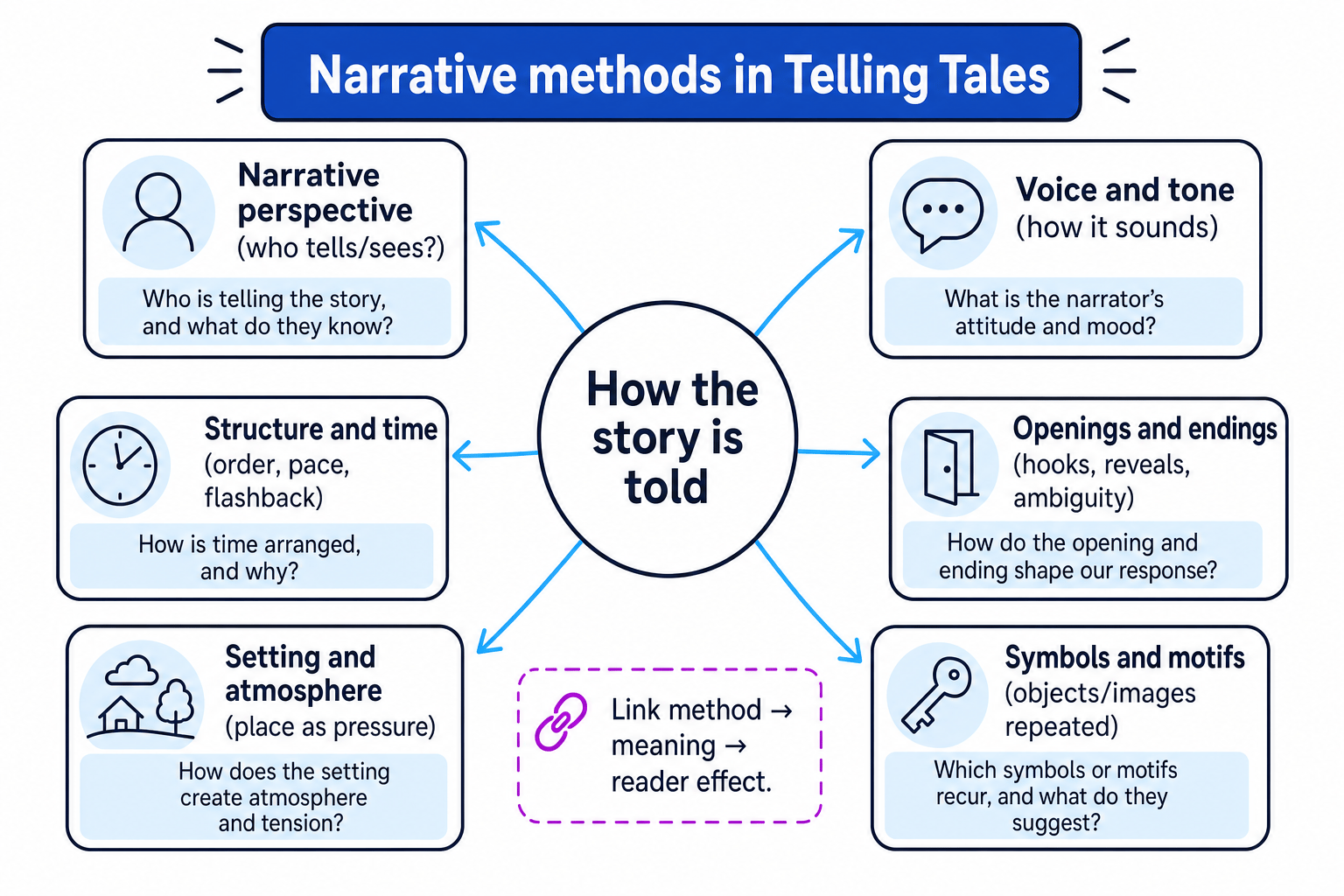
Narrative method
A narrative method is any choice a writer makes about how a story is told. This includes the narrator, viewpoint, order of events, pace, openings and endings, dialogue, setting, symbols and the information the reader is given or denied.
This is mainly AO2 work: you are analysing the writer’s methods. But you still need AO1: a clear argument, supported by accurate references and short quotations.
Story vs narrative
Before you analyse method, separate two things:
- Story: the events themselves — what happens.
- Narrative: the way those events are presented to the reader.
Two stories can contain similar events — family tension, secrets, violence, childhood memories — but feel completely different because of the narrative method.
Separating events from telling in A Family Supper
-
In Kazuo Ishiguro’s “A Family Supper”, the basic story involves a son returning home after his mother’s death and having supper with his father and sister.
-
The narrative does not begin with the reunion itself. It opens with factual information: “Fugu is a fish caught off the Pacific shores of Japan”, followed by the revelation that the narrator’s “mother died through eating one.”
-
This order matters. By placing death and poisonous food before the family meal, Ishiguro makes an ordinary supper feel threatening before it even begins.
The key question
Do not stop at “what happens?” Ask: why has the writer chosen to tell it in this way, at this moment, through this voice?
Narrative perspective: who controls what we see?
The narrator is the voice telling the story. Narrative perspective means the position from which the story is told.
A first-person narrator uses “I” or “we”. This can feel intimate, but it is also limited: we only know what that narrator knows, remembers or chooses to reveal.
A third-person narrator uses “he”, “she” or “they”. This can seem more detached, but it may still be limited to one character’s thoughts.
Focalisation means the character or consciousness through which events are filtered. For example, a story may be written in the third person but still stay close to a child’s fears or misunderstandings.
Unreliable narrator
An unreliable narrator is a narrator whose version of events is questionable because they are biased, confused, self-deceiving or deliberately withholding information. Not every limited narrator is unreliable.
In Telling Tales, perspective often creates mystery. First-person narrators in stories such as “A Family Supper”, “Chemistry” and “When the Wasps Drowned” make the reader feel close to events, but also trapped inside a partial version of them.
Analysing limited first-person narration
-
In “A Family Supper”, the narrator tells the story calmly and retrospectively, looking back on a family meal after his mother’s death.
-
Because he is a first-person narrator, we do not get direct access to the father’s true motives. His father’s behaviour must be interpreted through the narrator’s observations.
-
This limited perspective creates ambiguity: the reader is unsure whether the father is merely stern and grieving, or whether the meal might carry a darker threat.
Calling every narrator unreliable
Avoid writing “the narrator is unreliable” just because the story is in first person. First-person narration is always limited, but it is only unreliable if there is a clear reason to doubt the narrator’s understanding or honesty.
Voice and tone: how the telling sounds
Voice means the distinctive sound or personality of the narration. Tone means the narrator’s attitude or mood — for example, calm, anxious, bitter, childish, detached or nostalgic.
Tone can be unsettling when it does not match the events. Ishiguro’s calm tone in “A Family Supper” is disturbing because it discusses death, poison and family tension without melodrama.
In child-centred stories such as Clare Wigfall’s “When the Wasps Drowned”, a young or naive viewpoint can make adult events feel more disturbing. The reader may understand the seriousness of what is happening before the child fully does.
Useful method verbs
Instead of always saying “the writer shows”, try verbs such as withholds, delays, filters, foreshadows, contrasts, compresses, frames, reveals and juxtaposes.
Structure and time
Structure is the arrangement of a text: the order of events, the beginning and ending, shifts in time, pace and paragraphing.
A story can be:
- Chronological: told in time order.
- Non-linear: not told in time order.
- Retrospective: narrated after the events have happened.
- Built around flashback, where the narrative moves back to earlier events.
- Built around foreshadowing, where early details hint at later danger or revelation.
- Built around withholding, where important information is delayed.
Short stories often depend on a delayed reveal. The reader is encouraged to revise their understanding when new information appears.
Tracking withholding and reveal in The Darkness Out There
-
In Penelope Lively’s “The Darkness Out There”, the setting initially appears ordinary and safe: young people visit an elderly woman in a rural community.
-
Lively then withholds the darker truth about Mrs Rutter’s past. The narrative allows the reader to share the young characters’ assumptions before those assumptions are challenged.
-
When Mrs Rutter’s wartime cruelty is revealed, the title’s “darkness” becomes moral as well as physical. The structure turns a familiar setting into something disturbing.
Openings and endings
An opening often teaches you how to read the story. It may introduce a threat, a memory, a mystery, a symbol or a voice.
An ending can be closed or open. A closed ending resolves the main questions. An open ending leaves important uncertainty, forcing the reader to keep thinking.
Many Telling Tales stories use open or unsettling endings. In “A Family Supper”, uncertainty remains around the meal and the father’s intentions. In “When the Wasps Drowned”, the children’s discovery leaves the reader thinking about guilt, silence and innocence.
Short-story endings
A short-story ending does not always “solve” the story. Often, it changes the reader’s understanding of everything that came before.
Setting and atmosphere
Setting means where and when a story takes place. Atmosphere means the mood created by details of place, weather, sound and description.
Pathetic fallacy is when weather or nature reflects mood. For example, rain, darkness or oppressive heat may echo fear, grief or tension.
In D. H. Lawrence’s “Odour of Chrysanthemums”, the industrial setting shapes the whole story. The opening description of the locomotive “clanking, stumbling” makes the mining landscape seem harsh and mechanical. The sound pattern helps create a world where human life feels pressured by industry.
Turning setting into pressure
-
Lawrence does not present the mining village as a neutral background. The machinery is active and intrusive, with the locomotive “clanking, stumbling” through the scene.
-
The personified verbs make the industrial world feel almost alive, but not comforting. It seems heavy, awkward and threatening.
-
This prepares the reader for the emotional pressure inside the Bates household: the setting outside mirrors the strain, exhaustion and danger within the family.
Symbols and motifs
Symbol and motif
A symbol is a concrete object, place or detail that suggests a wider abstract idea. A motif is a repeated image, object or pattern that builds meaning across a story.
Titles often point you towards important symbols. “Compass and Torch” suggests guidance, protection and the fragile bond between father and son. “Chemistry” suggests relationships as reactions: unstable, changing and potentially dangerous. “Odour of Chrysanthemums” makes a smell into a repeated reminder of marriage, birth, disappointment and death.
Reading chrysanthemums as a motif
-
In “Odour of Chrysanthemums”, chrysanthemums are not just decorative flowers. Elizabeth associates them with major family moments, including “when I married him” and “when you were born.”
-
Because the flowers recur around marriage, birth and death, they gather emotional weight. They become connected with the whole history of Elizabeth’s relationship with Walter.
-
The motif makes the ending more painful: something beautiful and domestic is linked with disappointment, grief and the limits of understanding another person.
Symbol-hunting
Do not claim that every object is automatically symbolic. A strong symbol is usually repeated, placed in a title, described in detail, or clearly linked to a major idea.
Dialogue, silence and gaps
Dialogue is direct speech between characters. In short stories, dialogue often matters because of what characters avoid saying.
Subtext means the hidden meaning beneath speech. A character might talk about food, weather or practical tasks while the real issue is grief, fear, power or shame.
In “Compass and Torch”, practical objects and actions can express feelings that the father and son struggle to say directly. In “My Polish Teacher’s Tie”, voice, letters and identity matter because communication becomes a way of exploring belonging.
Reading what is not said in Compass and Torch
-
Elizabeth Baines places emotional tension inside a simple situation: a father and son on a trip involving practical items such as a compass and torch.
-
These objects suggest what the relationship lacks and needs: direction, guidance, safety and trust.
-
The method is indirect. Instead of making characters explain their feelings openly, Baines lets objects and silences carry the emotional meaning.
Bringing methods together
In the exam, the best answers do not list methods separately. They connect them.
A strong analytical sentence might move like this:
point → evidence → method → effect → link to the question
For example:
Ishiguro makes the family meal in “A Family Supper” feel threatening by opening with the dangerous delicacy fugu. The factual sentence “Fugu is a fish caught off the Pacific shores of Japan” sounds calm and controlled, but the later reference to the narrator’s mother dying from eating it foreshadows danger. This structural choice means the reader approaches the supper suspiciously, so ordinary family conversation becomes tense and ambiguous.
Notice that the paragraph does not just name “foreshadowing”. It explains how the method shapes the reader’s response.
Comparing narrative methods
When comparing two Telling Tales stories, compare the effect first, then the method.
For example, you might compare how two stories make ordinary settings disturbing:
- “A Family Supper” uses first-person narration, withholding and foreshadowing.
- “The Darkness Out There” uses contrast between an apparently safe setting and a shocking confession.
- Both stories suggest that danger can exist beneath ordinary surfaces.
Comparison sentence frame
Try: Both writers create a sense of hidden danger, but while [writer] uses [method], [writer] uses [different method] to create [effect].
In the exam
-
Start with a clear idea about the writer’s method, not a plot summary: for example, “Ishiguro uses limited first-person narration to create uncertainty.”
-
Use short, accurate references. Titles such as “Compass and Torch” or “Odour of Chrysanthemums” can support symbol analysis, but include brief internal quotations where you can.
-
Always complete the chain: method → meaning → reader effect → link to the question. Do not leave the examiner to work out why the method matters.
Check yourself
- Can you explain the difference between story and narrative using one Telling Tales example?
- Which story in the anthology uses withholding or delayed revelation most effectively?
- Can you choose one symbol or motif and explain how it develops meaning across a story?
