What you'll learn
- How Dickens uses language to present Scrooge, poverty, memory and change.
- How the form of a Christmas ghost story shapes the reader’s expectations.
- How the five-stave structure guides Scrooge from isolation to responsibility.
- How to write about methods in a way that earns credit for analysis, not just device-spotting.
The basics: what do language, form and structure mean?
In the AQA exam, you are rewarded for explaining how Dickens creates meaning, not just what happens in the story. That means you need to connect a method to an effect on the reader and to Dickens’s bigger message.
Language, form and structure
- Language means Dickens’s word choices: imagery, verbs, adjectives, dialogue, contrasts, repeated words and patterns of sound.
- Form means the type and overall shape of the text: A Christmas Carol is a novella — a short prose fiction — that also uses the conventions of a ghost story and a moral tale.
- Structure means how the text is organised: the order of events, shifts in time, contrasts between scenes, repeated ideas, openings and endings.
The main method to remember
Dickens makes Scrooge’s moral change feel dramatic by combining frightening ghost-story techniques with a carefully organised journey through the Past, Present and Future.
Form: a Christmas ghost story with a moral purpose
Dickens calls the novella A Christmas Carol, not just “a story”. A carol is a Christmas song, and he calls the chapters staves. A stave is a set of lines on which music is written. This makes the whole text feel like a carefully arranged moral “song”, moving from darkness and discord towards harmony.
The novella is also a morality tale — a story designed to teach a lesson about right and wrong. Scrooge’s journey is not just personal: Dickens uses it to challenge selfish attitudes towards the poor.
Ghost-story form
The opening line, “Marley was dead: to begin with”, immediately establishes the supernatural. The blunt statement makes Marley’s later appearance impossible to dismiss. If Marley is definitely dead, then his ghost must matter.
Dickens uses ghost-story features such as darkness, bells, chains, strange noises and spirits. But the ghosts are not just there to scare. They force Scrooge to see moral truths he has avoided.
Analysing the ghost-story opening
- The sentence “Marley was dead: to begin with” places death at the very start, so the reader enters a world where mortality and the afterlife matter.
- The plain, factual tone makes the supernatural more convincing: Dickens insists Marley’s death is certain before Marley returns as a ghost.
- This prepares us for Marley’s warning, “I wear the chain I forged in life”, where the ghost-story image of chains becomes a moral symbol of selfish choices.
- The effect is that the reader sees the supernatural not as random horror, but as a way of revealing consequences.
Structure: the five staves as a moral journey
The structure moves Scrooge through time: present → past → present → future → present. This is not accidental. Each ghost teaches a different kind of lesson.
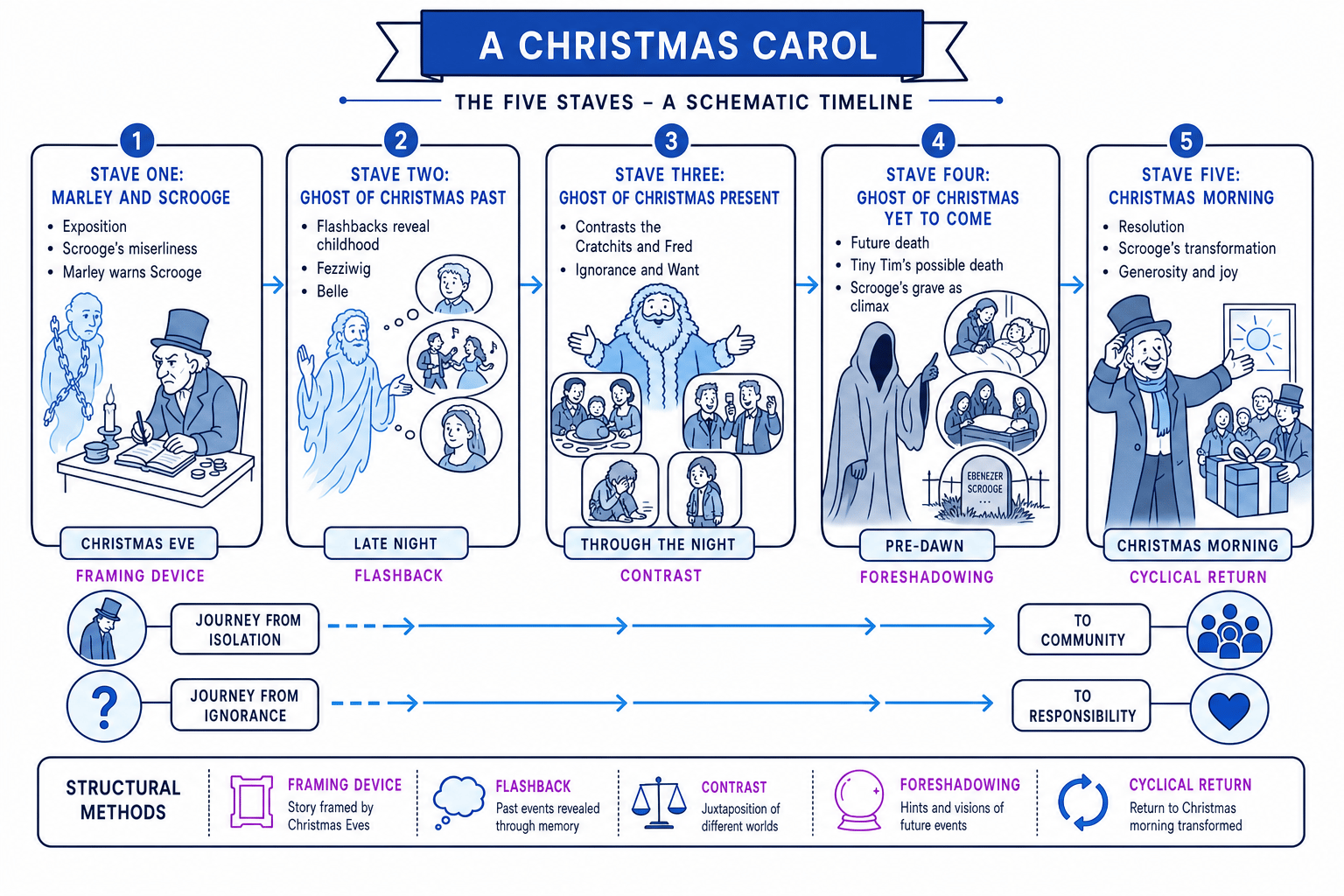
Stave One: exposition and warning
Exposition means the opening part of a story where key characters, setting and problems are introduced. In Stave One, Dickens presents Scrooge as isolated and hard-hearted: “solitary as an oyster” and “Hard and sharp as flint”.
Marley’s Ghost acts as a framing device: his warning sets up the visits of the three spirits and gives the story a clear moral direction.
Staves Two to Four: time travel and transformation
A flashback is a shift to events from the past. The Ghost of Christmas Past shows Scrooge scenes from childhood and young adulthood, helping the reader understand how he became emotionally closed off.
A contrast is when Dickens places different people, places or ideas side by side to highlight differences. The Ghost of Christmas Present contrasts Scrooge’s cold loneliness with the warmth of the Cratchits and Fred.
Foreshadowing means hinting at what may happen later. The Ghost of Christmas Yet to Come shows a possible future: Scrooge’s lonely death and Tiny Tim’s possible death. This creates urgency because Scrooge sees where his current choices may lead.
The future is conditional
Stave Four shows what may happen if Scrooge refuses to change. It is not fixed fate. That matters because Dickens wants readers to believe moral reform is possible.
Stave Five: cyclical return, but with change
A cyclical structure returns to a similar point from the beginning, but with an important difference. Stave Five returns to Christmas morning, but Scrooge is transformed. The weather becomes “clear, bright, jovial”, and Scrooge declares he is “as light as a feather”.
The structure therefore proves the moral lesson: change must become action. Scrooge does not only feel sorry; he gives, apologises and joins the community.
Tracing the echo of surplus population
- In Stave One, Scrooge says the poor should die and “decrease the surplus population”. The phrase makes people sound like numbers, not human beings.
- In Stave Three, the Ghost of Christmas Present repeats the phrase when discussing Tiny Tim. This structural echo forces Scrooge to hear his own cruelty applied to a child the reader has come to care about.
- The meaning of the phrase changes because the context changes: in Stave One it sounds like cold theory; in Stave Three it becomes emotionally shocking.
- Dickens uses this repetition to expose the cruelty of Scrooge’s worldview and push him towards responsibility.
Language: imagery, contrast and symbolism
Dickens’s language is vivid because he wants readers to feel moral ideas, not just understand them.
Similes and metaphors
A simile compares one thing to another using “like” or “as”. A metaphor describes something as if it literally is something else.
Scrooge is “solitary as an oyster”. At first, this makes him seem shut away and hard to reach. But an oyster can also contain a pearl, so the image quietly suggests hidden value or the possibility of change.
Analysing Scrooge as an oyster
- The simile compares Scrooge to an oyster, an animal enclosed inside a hard shell, suggesting emotional isolation and self-protection.
- The surrounding words “secret” and “self-contained” reinforce this idea, creating a pattern of language about being shut off from others.
- However, oysters can contain pearls, so the image is not simply negative. Dickens hints that Scrooge may have buried goodness inside him.
- This makes his later transformation more believable: Dickens presents him as morally damaged, not completely irredeemable.
Coldness and warmth
Dickens repeatedly links Scrooge with cold. The narrator says, “No warmth could warm, no wintry weather chill him.” This language makes Scrooge seem emotionally unnatural: he is colder than the weather around him.
By contrast, warmth is linked to generosity, family and community. Even the Cratchits, who are poor, create emotional warmth through love and togetherness.
Pathetic fallacy
Pathetic fallacy is when weather or surroundings reflect mood or atmosphere. In A Christmas Carol, fog, darkness and cold often reflect Scrooge’s moral blindness, while the bright Christmas morning reflects renewal.
Personification
Personification gives human qualities to something non-human. Dickens often makes the weather seem active and aggressive. The cold “nipped” Scrooge’s nose and “stiffened” his gait. This makes the atmosphere feel hostile, as if Scrooge’s inner coldness has infected the world around him.
Symbols and motifs
A symbol is something concrete that represents a bigger idea. A motif is a repeated image, object or idea that builds meaning across the text.
| Method | Short quotation | Effect |
|---|---|---|
| Symbolism of chains | “I wear the chain I forged in life” | Marley’s chain represents the moral consequences of selfish actions. |
| Motif of light | “bright clear jet of light” | The Ghost of Christmas Past’s light suggests memory, truth and painful self-knowledge. |
| Symbolism of children | “Ignorance” and “Want” | The children turn social problems into shocking human figures, making poverty impossible to ignore. |
Feature spotting
Avoid writing, “Dickens uses a simile” and stopping there. Always explain what the method makes the reader think or feel, and how it develops Dickens’s message.
Narrative voice: warmth, humour and judgement
The story is told by a third-person narrator, meaning the narrator refers to characters as “he”, “she” or “they”. The narrator is also often intrusive, meaning he comments directly and playfully, guiding the reader’s response.
For example, the narrator jokes about the phrase “dead as a door-nail”. This humour makes the voice feel friendly and conversational. But the narrator can also be sharply judgemental, calling Scrooge a “covetous old sinner”. Covetous means greedily wanting wealth or possessions.
This mix of humour and moral seriousness is important. Dickens wants to entertain the reader, but also challenge them.
Writing about methods successfully
A strong paragraph does not list techniques. It builds an argument.
You can use this pattern:
Point → Evidence → Method → Effect → Link
For example: Dickens presents Scrooge as emotionally isolated through the simile “solitary as an oyster”. The image suggests he has shut himself away from human connection, like an oyster sealed inside its shell. However, because oysters can contain pearls, Dickens also hints that Scrooge has the potential for goodness. This makes his later transformation feel possible and supports Dickens’s message that even the selfish can change.
Closed-book quotation choices
Learn short, flexible quotations: “solitary as an oyster”, “decrease the surplus population”, “I wear the chain”, “Ignorance” and “Want”, “as light as a feather”. Short quotations are easier to remember and analyse closely.
In the exam
- Start from the question’s focus, then choose a method that helps answer it: language, form or structure.
- Zoom in on short quotations and analyse individual words or patterns, not long copied chunks.
- Keep linking methods to Dickens’s moral purpose: transformation, social responsibility, generosity and the possibility of redemption.
Check yourself
- How does the five-stave structure help show Scrooge’s change?
- What is the effect of describing Scrooge as “solitary as an oyster”?
- How does Dickens use repetition to make “decrease the surplus population” more shocking later?
