

Because your GCSE English Literature exam is closed-book, you cannot take the Telling Tales anthology into the exam room with you. This means you need a highly strategic approach to selecting, memorising, and analysing quotations.
Rather than memorising entire paragraphs, you will find it far more effective to learn short, powerful, and versatile phrases that we call micro-quotes.
This guide will teach you how to choose these high-yield quotes, break them down using precise literary terminology, and weave them seamlessly into an insightful essay.
What you'll learn
- How to select "Swiss Army Knife" quotations that can be used for multiple exam questions.
- Techniques to unpack the hidden layers of language, structure, and form (AO2) within short stories.
- How to link specific quotes to the writers' wider social, historical, and cultural contexts (AO3).
The Strategy: Choosing and Exploding Quotes
Not all quotes are created equal. A common trap is memorising long sentences that only describe a plot event. Instead, you should look for quotes rich in literary techniques and thematic meaning.
Micro-quote
A micro-quote is a highly condensed, word-level reference (typically 1 to 5 words) that contains rich literary devices, symbols, or thematic significance.
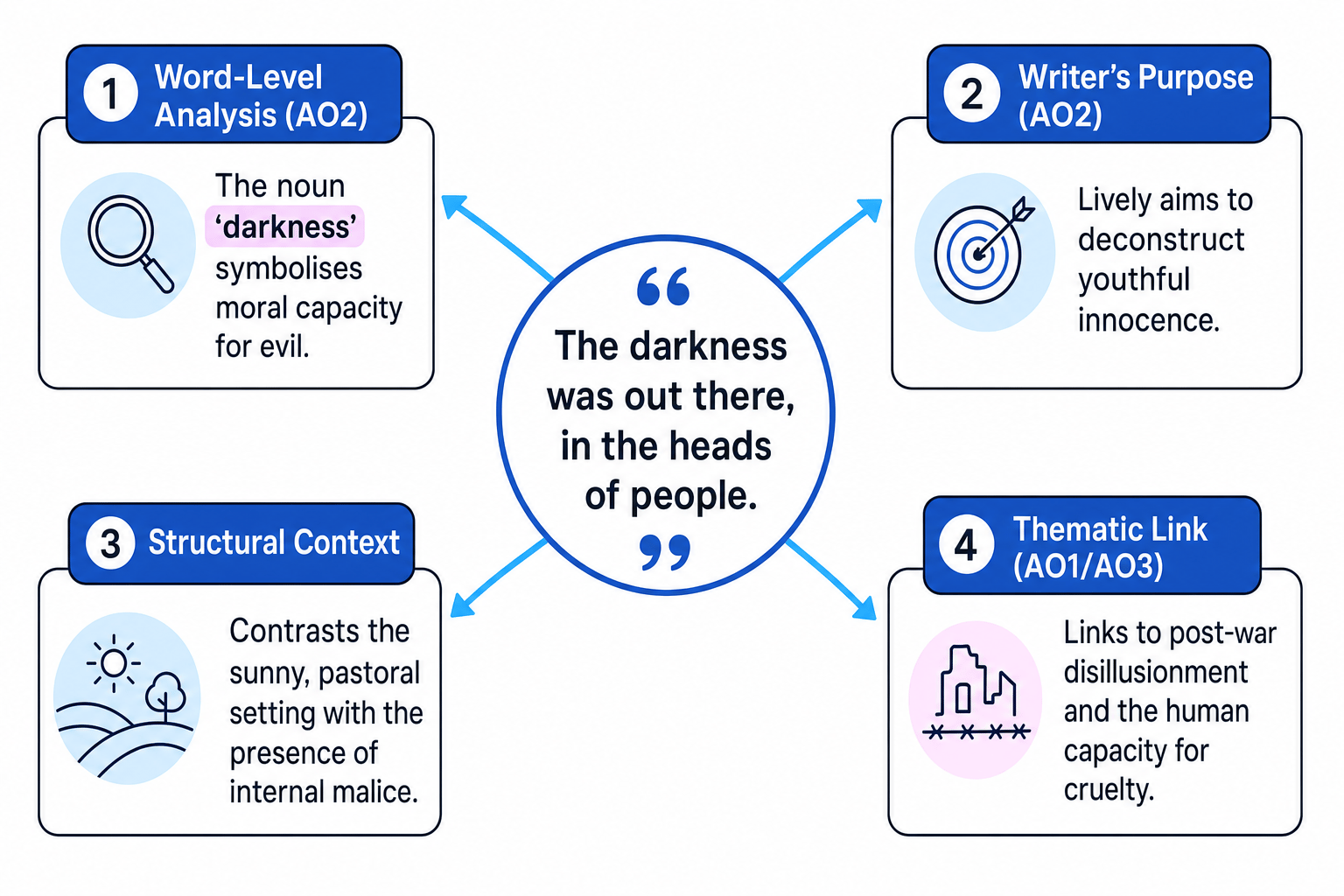
When you "explode" a quote, you pull it apart to look at word-level choices, structural placement, and how it reflects the historical or social context in which the story was written.
Quality over quantity
For any short story in the Telling Tales anthology, you only need to memorise 3 to 4 versatile micro-quotes. If you choose quotes that link to characters, themes, and structure all at once, you will be prepared for any question the exam board asks.
Key Quotes: "The Darkness Out There" by Penelope Lively
Lively’s story explores the transition from childhood innocence to adult disillusionment, focusing on Sandra’s realisation that true evil is not a fairy-tale concept but exists within ordinary human minds.
Quote 1: "The darkness was out there, in the heads of people."
- Context: This realization occurs at the very end of the story after Mrs Rutter cheerfully describes leaving a dying German pilot to perish during World War II.
- Methods: Metaphor, abstract noun ("darkness"), structural pivot.
- Analysis: The "darkness" ceases to be the physical threat of the woods (which Sandra feared at the start) and becomes a metaphor for human cruelty and moral blindness. By placing this at the climax, Lively structures the story as a loss-of-innocence narrative (bildungsroman).
- Context (AO3): Reflects post-war disillusionment and the dismantling of the simplistic wartime "good vs. evil" narrative.
Quote 2: "She was a nice girl... she had her standards."
- Context: Used early in the story to describe Sandra’s self-perception, and later ironically echoed in relation to Mrs Rutter.
- Methods: Irony, free indirect discourse, repetition.
- Analysis: The colloquial phrase "nice girl" and "standards" highlights Sandra’s initial superficial judgement of people based on appearance and societal expectations. The subsequent revelation of Mrs Rutter's cruelty completely deconstructs this superficial definition of "niceness".
Feature spotting without effect
Do not simply point out a technique and move on (e.g., "Lively uses a metaphor when she writes 'the darkness'."). You must explain why the writer chose that method and how it changes the reader's understanding of the character or theme.
Key Quotes: "Chemistry" by Graham Swift
Swift’s story explores grief, the fragility of family relationships, and the tension between scientific logic and emotional, almost supernatural, human bonds.
Quote 1: "We were like three people inside a bubble."
- Context: The narrator describes the close, isolated relationship he shared with his mother and grandfather before Ralph's arrival.
- Methods: Simile, symbol, imagery of fragility.
- Analysis: The "bubble" represents comfort and safety, but also extreme isolation and vulnerability. Swift's use of this simile foreshadows how easily their domestic peace can be shattered by an external force (Ralph).
- Context (AO3): Reflects the psychological vulnerability of a post-war family unit dealing with grief, clinging to private isolation to cope with loss.
Quote 2: "People decay... standard, blank, dead."
- Context: The narrator observes the chemical changes in the pond and reflects on the inevitable decay of physical bodies and relationships.
- Methods: Triadic structure (rule of three), negative adjectives, harsh scientific register.
- Analysis: The monosyllabic adjectives "blank, dead" contrast sharply with the emotional warmth of family memory. Swift highlights the narrator’s attempt to process grief through scientific detachment, a coping mechanism that ultimately fails to heal his emotional pain.
Key Quotes: "My Polish Teacher's Tie" by Helen Dunmore
Dunmore's story addresses themes of identity, social class, xenophobia, and the unexpected human connections that cut through institutional coldness.
Quote 1: "I am Carla Carter, and I wear a uniform."
- Context: Carla introduces herself at the start of the story, defining her identity through her low-status job as a school caterer.
- Methods: Alliteration ("Carla Carter"), metaphor of the "uniform", declarative syntax.
- Analysis: The uniform is a structural symbol of social invisibility. The harsh, simple sentence structure reflects how Carla has internalised the school hierarchy, reducing her entire identity to her working-class job.
Quote 2: "His English was very formal, very correct, like an old-fashioned suit."
- Context: Carla describes Stefan’s written and spoken English.
- Methods: Simile, repetition of "very", visual imagery.
- Analysis: The comparison of his language to "an old-fashioned suit" conveys respectability, dignity, and a lack of modern pretense. It contrasts sharply with the dismissive attitude of the headmaster and other teachers, highlighting Stefan's genuine desire to connect.
- Context (AO3): Addresses late-20th-century British attitudes towards Eastern European immigrants, challenging the xenophobic assumption that a lack of colloquial English correlates with a lack of intellect or culture.
Unpacking a Complex Quotation
Let's look at how to build an analytical, high-scoring paragraph from a single key quote. We will use a passage from Kazuo Ishiguro’s "A Family Supper".
Analysing language and subtext in A Family Supper
- State the core point linked to the prompt:
- Draft: Ishiguro uses the threat of the fugu fish to represent the unspoken, destructive tension and unspoken grief within the family.
- Introduce the quotation seamlessly:
- Draft: This is established early in the story when the father describes the lethal nature of the fish: "The fugu fish has a poison which is lethal... it is a common delicacy in Japan."
- Identify the primary literary methods:
- Draft: Ishiguro uses the fugu fish as a central motif and a metaphor for domestic danger, relying on a deceptively simple, flat narrative tone.
- Analyse the specific word choices and their effects:
- Draft: The word "delicacy" contrasts sharply with the adjective "lethal". This juxtaposition mirrors the family dinner itself: on the surface, it is a polite, traditional "delicacy," but underneath, it is fraught with emotional danger, unspoken resentment, and the ghost of the mother's suicide.
- Connect the analysis to the historical or cultural context (AO3):
- Draft: Through this chilling metaphor, Ishiguro critiques the rigid, traditional Japanese expectations of family honor and duty, suggesting that the pressure to conform to these ideals can act as a quiet, domestic poison that slowly destroys relationships from within.
Key Quotes: "The Signalman" by Charles Dickens
Though technically a Victorian ghost story, "The Signalman" is included in the anthology to explore themes of isolation, technology, and the overwhelming weight of duty.
Quote 1: "He directed his eyes go towards the red light... as if something were missing."
- Context: The narrator first observes the Signalman staring intently at the danger light.
- Methods: Foreshadowing, color symbolism ("red light"), uncanny atmosphere.
- Analysis: The "red light" is a traditional symbol of danger and blood, but structurally, it acts as an ominous beacon of inescapable fate. The Signalman’s look "as if something were missing" hints at his psychological fragmentation and his inability to reconcile his logical duties with supernatural premonitions.
- Context (AO3): Explores mid-19th-century anxieties surrounding the rapid expansion of the industrial railway system. Technology is depicted as an unnatural force that isolates human beings and subjects them to terrifying, mechanistic pressures.
<tip title="The "Spillover" Technique">
When memorising quotes, try to learn words that can "spill over" into different paragraphs. For instance, the word "darkness" from Lively's story can be used when discussing the setting, the character of Mrs Rutter, Sandra’s transition to adulthood, or the historical context of WWII.
In the exam
- Weave, don't drop: Never "drop" a quote into a paragraph as a standalone sentence (e.g. This is shown in the quote: "We were like three people inside a bubble."). Instead, weave it into your own sentence: The family’s fragile domestic isolation is highlighted when Swift describes them as "three people inside a bubble".
- Zoom in on single words: After presenting your quote, isolate a single word (a noun, verb, or adjective) and analyse its specific connotations. This guarantees you are meeting the AO2 criteria for deep language analysis.
- Link structure to meaning: Always comment on where the quote occurs in the story. Does it happen during the exposition, at a sudden structural pivot, or during the final resolution? Short stories rely heavily on pacing and sudden twists; showing you understand this will impress the examiner.
Check yourself
- Can you identify three distinct themes that could be analyzed using the quote: "The darkness was out there, in the heads of people"?
- Why is a short phrase like "like an old-fashioned suit" easier to analyze in depth than a full sentence of description?
- How does the context of industrialization change our understanding of the "red light" motif in The Signalman?
