Because your AQA GCSE English Literature exam is closed-book, you do not need to memorise long blocks of text. Instead, your goal is to master a small bank of highly versatile, short, and impactful quotations.
In this guide, you will learn how to select these "multi-tool" quotations, how to "explode" them for deep linguistic and structural analysis, and how to link them directly to Charles Dickens's social and historical context.
What you'll learn
- How to select and memorise highly versatile "multi-tool" quotations.
- The "Quote Explosion" technique for unpacking multiple layers of meaning.
- Key quotations for Scrooge's character arc, the supernatural, and social responsibility.
- How to construct a high-scoring analytical paragraph using embedded quotes.
The Anatomy of a "Multi-Tool" Quotation
Many students make the mistake of trying to memorise fifty different quotations for A Christmas Carol. In the high-pressure environment of the exam, this often leads to half-remembered, inaccurate quotes or superficial analysis.
Instead, top-tier students focus on a carefully curated selection of highly versatile quotations.
Multi-Tool Quotation
A multi-tool quotation is a short, highly dense phrase from the text that can be used to address multiple different essay questions, such as character studies (e.g., Scrooge, the Ghosts), key themes (e.g., redemption, isolation, poverty), or social context (e.g., Victorian inequality).
By focusing on a small selection of versatile quotes, you can learn them perfectly and practice unpacking them in extreme detail.
Quality Over Quantity
AQA examiners reward micro-analysis—zooming in on single words, punctuation, and linguistic devices—far more than they reward long, block-quoted summaries of the plot. Three short, deeply analysed quotes will always beat six long, poorly analysed ones.
The "Quote Explosion" Technique
To get top marks for your analysis of language and structure, you must go beyond "device spotting." Pointing out that Dickens uses a simile is not enough; you must explain how that simile creates meaning and why Dickens chose it.
The Quote Explosion technique requires you to break a quotation down into three distinct levels of analysis:
- Linguistic Methods: Identify the grammatical parts of speech (nouns, verbs, adjectives) and literary devices (metaphors, similes, personification, sibilance).
- Connotations and Layers of Meaning: Explode specific words to uncover their deeper associations.
- Writer's Intent and Context: Connect the language choices to Dickens's social message. What was he trying to change in Victorian society?
Connotation
A connotation is an idea, feeling, or emotional association that a word invokes in addition to its literal, primary dictionary definition (its denotation).
Let's look at how this works in practice with one of the most famous descriptions of Scrooge from Stave 1:
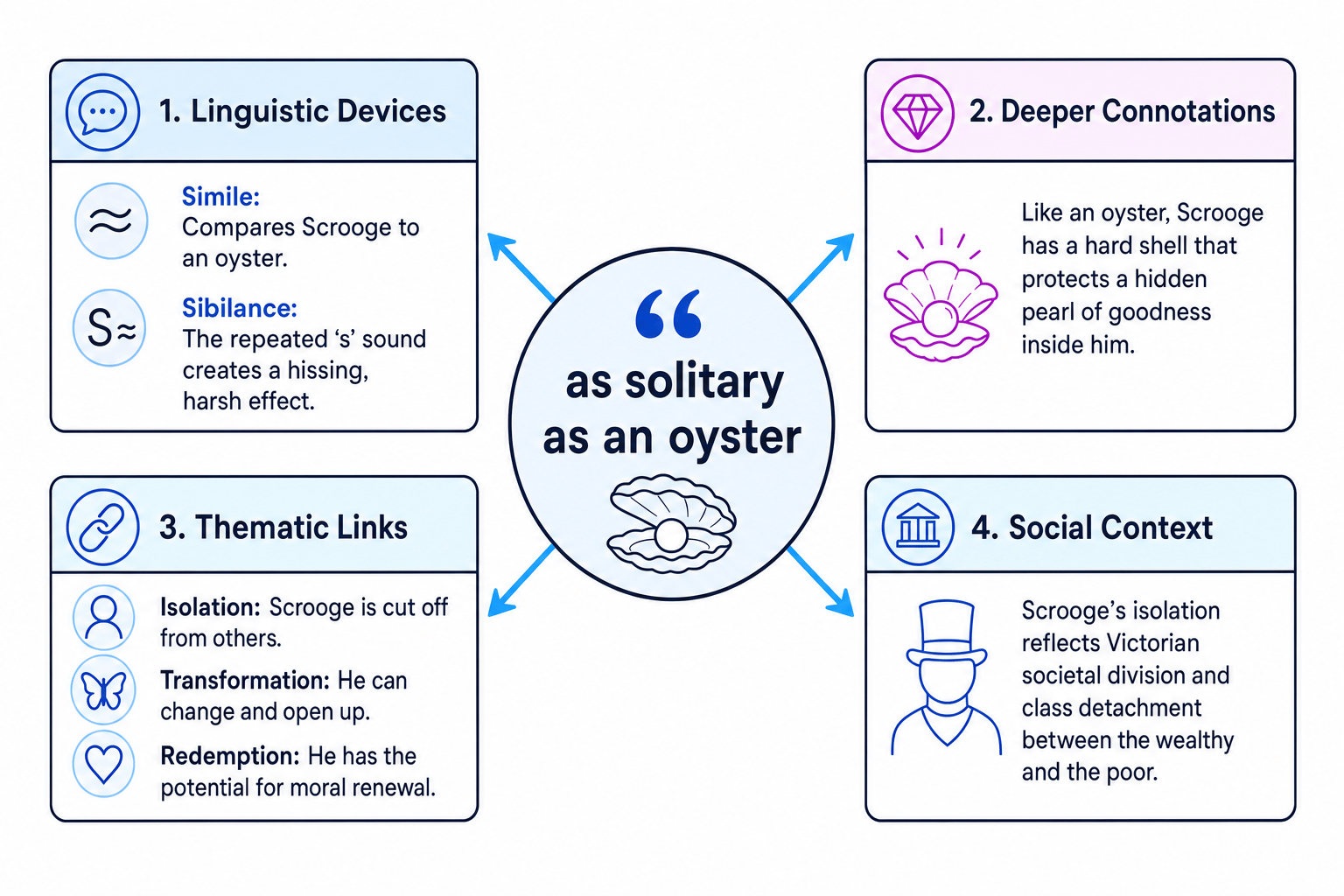
As this diagram shows, a single five-word quotation can yield a wealth of deep analysis when you look beneath the surface.
Essential Quotations to Master
Here is a targeted selection of key quotations across the novella's five staves, selected for their high utility in the exam.
1. Scrooge's Initial Character (Stave 1)
"A squeezing, wrenching, grasping, scraping, clutching, covetous old sinner!"
- The Methods: Dickens uses an asyndetic list (a list of words connected without conjunctions like 'and') of six dynamic, active gerunds (verbs ending in '-ing'), ending with the harsh, descriptive noun "sinner."
- The Explosion: The verbs are all associated with hands and physical restriction. "Squeezing" and "clutching" suggest Scrooge holds onto his money tightly and refuses to let any wealth flow back into society. The hard, plosive consonants (the 'g' and 'c' sounds) make the words sound aggressive and violent when read aloud.
- The Context: By calling Scrooge a "sinner," Dickens frames Scrooge’s greed not just as a social flaw, but as a moral and religious failing—something that would resonate deeply with his highly Christian Victorian audience.
2. Scrooge and the Environment (Stave 1)
"External heat and cold had little influence on Scrooge."
- The Methods: Dickens uses pathetic fallacy throughout Stave 1 to reflect Scrooge's internal psychological state through the freezing, foggy London weather.
- The Explosion: The word "influence" suggests that Scrooge is totally closed off from the outside world. He is completely impervious to his environment; his coldness is internal and absolute.
- The Context: This reflects the emotional detachment of the wealthy Victorian upper class, who deliberately chose to remain "cold" and indifferent to the suffering of the poor around them.
Pathetic Fallacy
Pathetic fallacy is a literary device where the writer attributes human emotions, traits, or states of mind to nature, the weather, or inanimate surroundings.
3. The Threat to Society (Stave 3)
"This boy is Ignorance. This girl is Want. Beware them both..."
- The Methods: The Ghost of Christmas Present presents two wretched children hidden beneath his robes. Dickens uses allegory and personification to turn abstract social problems into physical characters.
- The Explosion: "Ignorance" represents the lack of education given to poor children, while "Want" represents their physical starvation and deprivation. The Ghost warns that "Ignorance" is the more dangerous of the two, because societal neglect of education leads to crime, ruin, and ultimately the collapse of civilisation ("Doom").
- The Context: Dickens was a passionate advocate for the education of the poor. He believed that failing to educate the working classes would lead to social revolution, a major fear in Victorian England.
Worked Example: Unpacking Scrooge's Transformation
When writing about Scrooge's transformation, the most effective technique is to compare a quotation from Stave 1 directly with a contrasting quotation from Stave 5. This allows you to demonstrate your understanding of the novel's structure.
Analysing Scrooge's redemption through comparative quotation analysis
Question: Explore how Dickens presents Scrooge’s change of character in A Christmas Carol.
Quotes selected:
- Stave 1: "as solitary as an oyster"
- Stave 5: "I am as light as a feather, I am as happy as an angel"
Here is how to build this comparative analysis step-by-step:
-
Establish the point of comparison and introduce the first quote: Start by asserting how Scrooge begins his journey, embedding the Stave 1 simile naturally into your sentence to show his self-imposed isolation.
Example: "At the start of the novella, Dickens establishes Scrooge's absolute isolation through the simile 'as solitary as an oyster'."
-
Explode the Stave 1 quote by analyzing its specific methods and connotations: Zoom in on the word "oyster." Explain how this image functions on multiple levels, noting both its negative exterior and its positive hidden interior.
Example: "While the noun 'oyster' initially connotes a hard, rough, and impenetrable exterior that shuts itself off from the world, it also carries the crucial subtext of containing a pearl within. Through this clever choice of imagery, Dickens foreshadows that despite Scrooge's cold, defensive shell, there is a valuable, beautiful core of humanity waiting to be unlocked by the spirits."
-
Introduce the contrasting Stave 5 quote and analyze its structural shift: Contrast the initial cold, heavy imagery with the light, spiritual similes of Scrooge's redemption in Stave 5, pointing out the shift in tone and meaning.
Example: "By Stave 5, this heavy, closed-off imagery is completely transformed into weightless, open joy as Scrooge exclaims, 'I am as light as a feather, I am as happy as an angel.' The simile 'as light as a feather' directly contrasts with the heavy chains of greed worn by Marley’s Ghost, symbolizing that Scrooge has cast off his spiritual burden."
-
Connect the transformation to Dickens's social and moral message (AO3): Conclude the analysis by explaining why Dickens structured Scrooge's transformation in this way, linking it to Christian redemption and social responsibility.
Example: "Furthermore, the comparison to an 'angel' highlights his moral rebirth. By moving Scrooge from the beastly, subterranean imagery of an 'oyster' to the celestial purity of an 'angel,' Dickens demonstrates to his Victorian readers that complete moral redemption is possible for anyone who chooses to embrace social charity and Christian love."
Device Spotting
Avoid writing sentences like: "Dickens uses a simile when he says 'as solitary as an oyster'. This makes the reader picture an oyster."
This is "device spotting." It identifies the technique but does absolutely no analytical work. Instead, always ask yourself: "Why this specific word?" What does an oyster do? It protects itself, lives in the dark, is hard to open, but contains a pearl. That is where your marks are found.
How to Memorise Quotes for a Closed-Book Exam
Since you cannot take the book into the exam room, you must have your quote bank committed to memory. Use these highly effective revision strategies:
The 'Look, Cover, Write, Check' Technique
Write down your chosen key quotes on flashcards. On the back, write the key linguistic methods and three analytical bullet points.
To memorise, try writing the quote from memory, then "explode" it on a blank sheet of paper without looking at your notes. Doing this regularly builds muscle memory for the exam.
In the exam
- Embed your quotes: Never drop a quotation in as a standalone sentence (e.g., "Scrooge was very lonely. 'As solitary as an oyster.' This shows..."). Instead, weave it naturally into your own prose: "Dickens highlights Scrooge's self-imposed isolation by describing him as 'as solitary as an oyster'."
- Use single-word analysis: After quoting a short phrase, select one key word from it and zoom in on its specific connotations. Use phrases like: "The writer's choice of the noun 'oyster' is particularly significant because..."
- Link to the broader structure: Always try to show how a quote in one part of the novella contrasts with or echoes a quote from another part. This proves to the examiner that you understand the text as a cohesive, whole work of art.
Check yourself
- Can you explain the double meaning behind the "oyster" simile in Stave 1, and how it foreshadows the end of the novella?
- Which key quotation from Stave 3 best illustrates Dickens's warnings about the Victorian educational system?
- Why is it more effective to memorise fifteen short, highly versatile "multi-tool" quotations than fifty long ones?
