

What you'll learn
- How to plan a clear answer for Telling Tales without trying to memorise whole essays.
- How to turn a question into a strong line of argument.
- How to organise paragraphs around theme, method and effect.
- How to adapt plans for different stories in the anthology.
Why essay plans matter for Telling Tales
Telling Tales is an anthology, which means it is a collection of short stories by different writers. In the exam, you need to show that you understand the story or stories named in the question, and that you can write a focused, analytical response.
You do not need to retell the plot. A good plan helps you avoid drifting into summary.
Essay plan
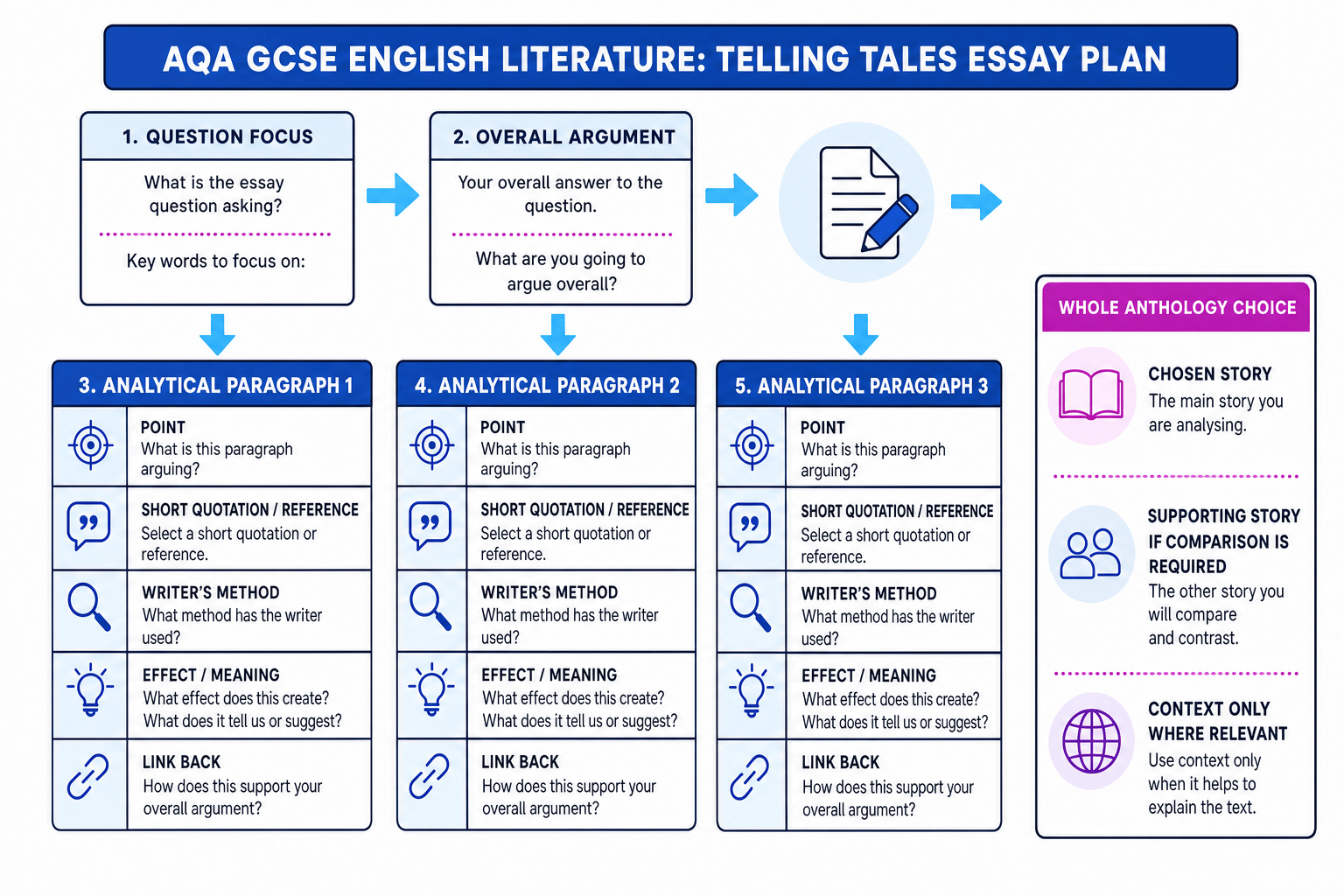
An essay plan is a quick outline of your argument before you write. It usually includes your main answer to the question, the paragraphs you will write, the evidence you will use, and the writer’s methods you will analyse.
The goal
Your plan should answer: What is my overall argument, and how will each paragraph prove it?
Start with the question, not the story
It is tempting to think, “I know this story — I’ll write everything I remember.” Try not to. The examiner rewards a focused answer.
Most questions will direct you towards a theme, character relationship, conflict, setting, or writer’s method.
Theme
A theme is a big idea explored by a text, such as family conflict, secrecy, guilt, childhood, power, prejudice, isolation or appearance versus reality.
When you read the question, ask:
- What idea am I being asked about?
- Which character, relationship or moment is most relevant?
- Is the question asking me to compare with another story?
- What does the writer want the reader to think or feel?
Turning a question into a plan
Suppose the question focuses on family relationships in A Family Supper.
-
Decide the main idea: Ishiguro presents family relationships as tense and uncertain, especially because important feelings are left unspoken.
-
Choose three paragraph angles: the disturbing opening about fugu and death, the awkward conversations between the narrator and his father, and the ambiguous supper at the end.
-
Match each angle to method: Ishiguro uses first-person narration, dialogue, symbolism and ambiguity to make the reader feel unsure about what the family truly means to each other.
-
Link every paragraph back to the question: each paragraph should explain how family is shown as emotionally distant, not simply describe what happens at dinner.
Build a line of argument
Line of argument
A line of argument is the clear opinion that runs through your whole essay. It is your answer to the question, developed paragraph by paragraph.
A weak line of argument sounds like this:
The story shows family relationships in different ways.
That is true, but too vague.
A stronger line of argument sounds like this:
Ishiguro presents family relationships as outwardly polite but emotionally dangerous, using silence and ambiguity to make the reader question what is really happening beneath the surface.
This is stronger because it includes:
- a clear view
- the writer’s name
- methods: silence and ambiguity
- an effect on the reader
Thesis sentence shortcut
Use this shape: The writer presents [idea] as [adjective/adjective], using [method] to make the reader [effect].
Paragraphs: point, evidence, method, effect, link
Each main paragraph should do one job. Do not try to include every idea at once.
Method
A method is a choice made by the writer. It can include language, structure, form, symbolism, setting, dialogue, narrative viewpoint, contrast, foreshadowing or ambiguity.
A strong GCSE paragraph usually follows this pattern:
- Point — your idea about the question.
- Evidence — a short quotation or precise reference.
- Method — the writer’s technique.
- Effect — what this suggests and how the reader responds.
- Link — connect back to the question.
For example, in Odour of Chrysanthemums, Elizabeth’s reflection that she and Walter had “met in the dark” is useful because it is short, memorable and analytical. You can connect it to marriage, misunderstanding, emotional separation and regret.
Planning one analytical paragraph
Focus: marriage in Odour of Chrysanthemums
-
Make the point: Lawrence presents Elizabeth’s marriage as emotionally divided, not just unhappy.
-
Select evidence: Elizabeth realises that she and Walter had “met in the dark”, a short phrase that captures their failure to truly know each other.
-
Analyse the method: the metaphor of “dark” suggests ignorance, emotional blindness and lack of understanding.
-
Develop the effect: the reader sees Elizabeth’s grief as complicated; Walter’s death does not simply create sadness, but forces her to recognise the distance that already existed in the marriage.
-
Link to the question: this makes the relationship tragic because the real separation happened long before Walter died.
Choosing evidence: short quotations are best
Because the exam is closed book, you should rely on short, accurate quotations. You do not need long chunks.
Good evidence can be:
- a short quotation: “met in the dark”
- a repeated image: chrysanthemums in Lawrence’s story
- a title: The Darkness Out There
- a precise moment: the final supper in A Family Supper
- a structural contrast: childish expectations versus adult reality in Compass and Torch
Retelling instead of analysing
A common mistake is writing the story’s events in order: “First this happens, then this happens…” Instead, organise your plan by ideas. Each paragraph should prove something about the question.
Planning for comparison
Because Telling Tales is an anthology, some tasks may ask you to write about one story and link it to another. If comparison is required, do not write two separate mini-essays.
Comparison
Comparison means explaining meaningful similarities and differences between texts. It is not just saying “both stories are about family”.
A good comparison paragraph might use this shape:
- Story 1 presents the theme in one way.
- Story 2 presents a similar or contrasting version.
- The difference matters because the writers are exploring different messages.
For example, family tension appears in several stories:
- A Family Supper presents family tension through silence, politeness and ambiguity.
- Chemistry presents family conflict through a child’s viewpoint and divided loyalties.
- Compass and Torch presents family breakdown through a father-son relationship shaped by separation.
- Korea explores father-son tension through suspicion, money and emigration.
Selecting a story to compare
Focus: parents and children
-
Start with the main story: if the question names Compass and Torch, your first plan should focus on the boy’s relationship with his father and the emotional pressure of the camping trip.
-
Choose a second story with a meaningful connection: Chemistry works well because it also shows a child caught inside adult conflict.
-
Decide the comparison: both stories present children as vulnerable to adult decisions, but Compass and Torch focuses on longing and disappointment, while Chemistry can be read as more openly hostile and divided.
-
Plan linked paragraphs: instead of writing all of Compass and Torch and then all of Chemistry, compare them by idea — childhood perspective, parental failure, and the symbolic objects or settings connected to each relationship.
Useful essay-plan templates
Template 1: theme question
Use this for questions on ideas such as family, secrecy, fear, prejudice, guilt or isolation.
Introduction
- Give your overall argument.
- Name the writer and the theme.
- If comparing, name both stories and your main similarity or difference.
Paragraph 1: first key moment
- What does this moment reveal about the theme?
- Which method does the writer use?
- What does the reader learn?
Paragraph 2: development
- How does the theme become more complex?
- Is there contrast, foreshadowing, symbolism or dialogue?
- Does the reader’s view change?
Paragraph 3: ending or turning point
- How does the ending reshape the theme?
- Is the ending clear, ironic, tragic, ambiguous or unsettling?
Conclusion
- Return to your argument.
- Sum up the writer’s message, not the plot.
Template 2: character or relationship question
Use this for questions on a parent, child, marriage, friendship or older generation.
Plan around change:
- How the relationship is first presented.
- What creates conflict or tension.
- How the ending changes the reader’s understanding.
This works especially well for stories where the reader gradually discovers hidden truth, such as The Darkness Out There or A Family Supper.
Template 3: method question
Use this if the question asks “How does the writer create tension?” or “How does the writer present setting?”
Plan around techniques:
- Narrative viewpoint — who tells or filters the story?
- Setting and atmosphere — where does the story take place, and what mood is created?
- Structure — what is revealed, delayed or left unresolved?
Ambiguity
Ambiguity means deliberate uncertainty. A writer creates ambiguity when more than one interpretation is possible.
Ishiguro often uses ambiguity in A Family Supper: the reader is never allowed to feel completely certain about the father, the meal, or the emotional danger in the house.
Mini plans for common Telling Tales ideas
These are not full essays to memorise. Treat them as flexible starting points.
Family conflict
Possible stories: A Family Supper, Chemistry, Compass and Torch, Korea, Odour of Chrysanthemums
Possible argument:
The anthology often presents family as a place where love and danger exist together; writers use silence, symbolism and limited viewpoints to show how difficult family relationships can be.
Paragraph ideas:
- Family tension may be hidden under politeness or routine.
- Children often notice more than adults realise.
- Endings often leave relationships unresolved rather than neatly repaired.
Hidden darkness
Possible stories: The Darkness Out There, A Family Supper, Odour of Chrysanthemums
Possible argument:
Several writers expose darkness beneath ordinary surfaces, making the reader question appearances and moral certainty.
Paragraph ideas:
- Pleasant settings can hide violence or cruelty.
- Respectable characters may be morally disturbing.
- The ending often forces the reader to reinterpret earlier details.
Childhood and growing up
Possible stories: Compass and Torch, Chemistry, The Darkness Out There, The Invisible Mass of the Back Row
Possible argument:
The anthology often presents growing up as a painful process of discovery, where young people learn that adults and society are less safe or fair than they first seemed.
Paragraph ideas:
- Child narrators or young perspectives create vulnerability.
- Adult behaviour is often confusing or disappointing.
- A moment of revelation changes how the young character sees the world.
Do not force context
Context should support your interpretation, not replace it. For example, when writing about Odour of Chrysanthemums, you might mention gender roles or working-class mining communities, but only if it helps explain Lawrence’s presentation of marriage and power.
Writing the introduction from your plan
Keep your introduction short. You do not need biography or a general history paragraph.
A strong introduction does three things:
- answers the question directly
- names the writer or stories
- gives a clear argument
Example:
In The Darkness Out There, Lively presents evil as disturbingly ordinary. Through the contrast between the attractive countryside and Mrs Rutter’s cruel wartime memory, Lively suggests that darkness is not only found in frightening places, but inside apparently respectable people.
Notice that this introduction does not retell the plot. It sets up an argument.
Conclusions: return to the writer’s message
A conclusion should not simply say, “In conclusion, this theme is important.” Instead, zoom out to the writer’s purpose.
Try:
Overall, the story suggests that childhood innocence is fragile because adult behaviour can be selfish, secretive or morally confusing.
Or:
By ending ambiguously, Ishiguro leaves the reader trapped in the same uncertainty as the narrator, which makes the family relationship feel even more unsettling.
Plan backwards from the ending
Short stories often rely on a twist, revelation or final ambiguity. When planning, ask: How does the ending change our understanding of the beginning? That question often gives you your best argument.
In the exam
-
Spend about five minutes planning: decide your argument, three paragraph ideas, and the evidence you will use.
-
Keep quotations short and accurate; if you cannot remember the exact wording, use a precise textual reference instead of inventing a quote.
-
Analyse the writer’s methods in every paragraph, then link back to the question so your answer stays focused.
Check yourself
- Can you turn a theme like “family conflict” into a clear line of argument?
- Can you name three writer’s methods that are useful for short stories?
- Can you plan three paragraphs without retelling the plot in order?
