Planning is the single most important step in writing a high-scoring GCSE English Literature essay. In the exam, you have 45 minutes to write your response to A Christmas Carol. Spending 5 to 7 minutes of that time planning is not a waste; it is the secret to achieving a coherent, well-argued, and deeply analytical essay.
Without a plan, essays often become "shopping lists" of random plot points or unstructured paragraph dumps of quotes. A planned essay, however, shows the examiner that you have a clear thesis and a logical argument that tracks Charles Dickens’s structural choices from Stave 1 to Stave 5.
What you'll learn:
- How to deconstruct an exam question and construct a powerful thesis statement.
- The "Three-Stage Journey" planning method tailored to a Victorian novella.
- How to balance AO1 (argument/evidence), AO2 (writer's methods), and AO3 (social/historical context) in your plan.
The Prerequisites of a Great Essay Plan
Before you put pen to paper, you must understand what the examiner is looking for. In AQA GCSE English Literature Paper 1, Section B, you are assessed on three main areas:
- Your personal response and argument (AO1): Do you answer the question directly with a clear line of argument, supported by well-selected quotes?
- Analysis of language, form, and structure (AO2): Do you explore how Dickens uses techniques like pathetic fallacy, symbolism, and structural shifts to create meaning?
- Understanding of context and intent (AO3): Do you connect Dickens's authorial choices to the realities of Victorian London, the Poor Laws, and his desire for social reform?
To hit all three objectives, your plan must be built around a core thesis statement and structured chronologically to mirror the novella’s narrative arc.
Thesis Statement
A thesis statement is a one- or two-sentence summary of your main argument. It directly answers the exam question and introduces the core theme or authorial purpose you will explore. It acts as the "anchor" for your entire essay.
Allegory
An allegory is a story with a hidden moral, political, or social meaning. A Christmas Carol is a moral allegory designed to teach Victorian readers the importance of Christian charity, social responsibility, and human connection over industrial greed.
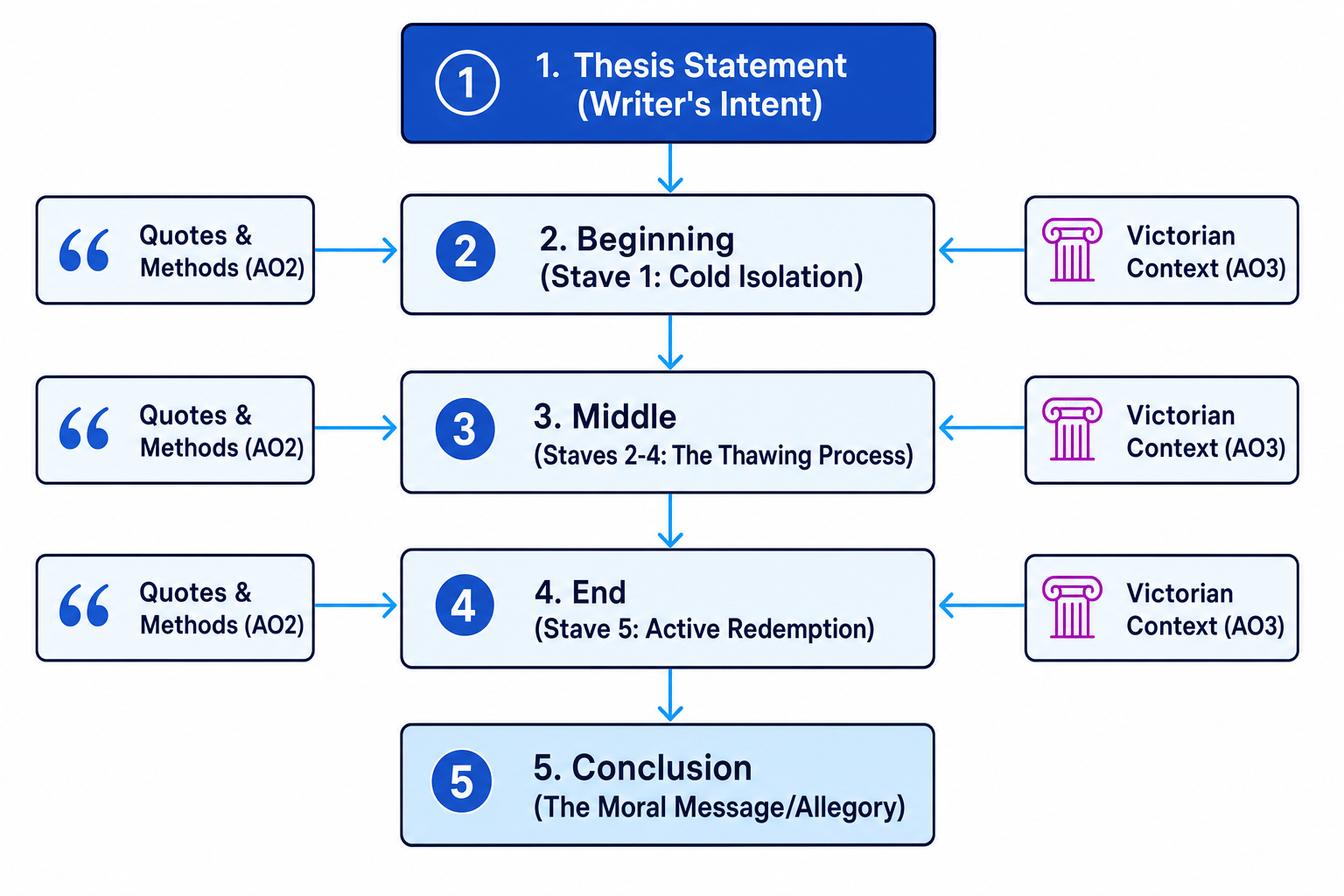
Because A Christmas Carol is structured as an allegory centered on transformation, your essay plans should almost always trace Scrooge's journey from cold isolation to warm, active redemption. This ensures you analyze Dickens's structural choices (AO2) alongside his moral message (AO3).
The "Three-Stage Journey" Planning Method
The most effective way to structure an essay on A Christmas Carol is to track the chronological progression of the text. Dickens deliberately structures the novella into five "Staves" (musical stanzas in a Christmas carol) to mimic a song of joy and redemption.
Your essay should mirror this structure using three main body paragraphs that trace Scrooge's psychological transformation:
- Stage 1: The Problem (Stave 1): Analyze Scrooge's initial state of moral corruption. Identify how Dickens uses language and atmosphere to represent the broader societal issues of Victorian industrialism and greed.
- Stage 2: The Intervention/Thawing (Staves 2, 3, and 4): Explore Scrooge’s exposure to past, present, and future realities. Analyze how the Spirits act as catalysts for his emotional awakening, shifting him from ignorance to empathy.
- Stage 3: The Resolution (Stave 5): Analyze Scrooge’s ultimate transformation. How does his reformed character serve as Dickens's blueprint for a harmonious, socially responsible society?
Track the Transformation
Never write an essay that looks at Scrooge statically. Dickens is showing a process of redemption. Every paragraph of your essay must evaluate where Scrooge is on his spiritual journey and how Dickens uses that stage to educate the reader.
Planning a Theme-Based Question
Let’s apply this method to a concrete example. Below is a step-by-step guide to planning an essay on a major theme.
Developing an essay plan on social responsibility
Exam Prompt: Explore how Dickens presents the importance of social responsibility in A Christmas Carol.
-
Deconstruct the prompt and draft a thesis statement. Identify the keywords: "social responsibility" and "presents". Your thesis must state why Dickens thought social responsibility was crucial and how he used the novella to convey this message.
- Draft Thesis: Dickens presents social responsibility not merely as an optional moral duty, but as an urgent Christian necessity required to combat the cruel, dehumanizing effects of Victorian industrial greed. Through Scrooge's metaphorical journey from cold isolation to active philanthropy, Dickens urges his middle-class readers to reject Malthusian economic theories and embrace collective responsibility for the vulnerable.
-
Plan Body Paragraph 1 (The Problem - Stave 1). Focus on the denial of social responsibility.
- Focus: Scrooge as a symbol of Malthusian capitalist greed and social detachment.
- Evidence (AO1): "Squeezing, wrenching, grasping, scraping, clutching, covetous old sinner!" and "If they would rather die... they had better do it, and decrease the surplus population."
- Analysis of Methods (AO2): The syndetic list of aggressive verbs establishes Scrooge’s active hoarding of wealth. His coldness is reinforced through the pathetic fallacy of the biting fog.
- Context (AO3): Scrooge's dialogue directly echoes Thomas Malthus’s economic theories and the harsh ideology behind the 1834 Poor Law Amendment Act, which sought to make poverty as uncomfortable as possible to deter "idleness."
-
Plan Body Paragraph 2 (The Awakening - Staves 3 and 4). Focus on the consequences of ignoring social responsibility.
- Focus: The Spirits exposing Scrooge to the human cost of his negligence and the dangerous social decay it causes.
- Evidence (AO1): The Cratchit family (Tiny Tim's fragile state) and the monstrous children, Ignorance and Want: "This boy is Ignorance. This girl is Want. Beware them both...".
- Analysis of Methods (AO2): Dickens uses the allegorical figures of Ignorance and Want, described with zoomorphic adjectives ("apelike", "shrivelled"), to symbolize the horrific systemic results of societal neglect.
- Context (AO3): Dickens was a passionate supporter of Ragged Schools and believed that failing to educate poor children ("Ignorance") would lead to societal collapse and revolution ("Doom").
-
Plan Body Paragraph 3 (The Redemption - Stave 5). Focus on the active embrace of social responsibility.
- Focus: Scrooge’s transformation into a socially responsible citizen, showing that redemption is possible for anyone.
- Evidence (AO1): "I am as light as a feather, I am as happy as an angel" and Scrooge becoming a "second father" to Tiny Tim.
- Analysis of Methods (AO2): Similes of lightness and purity contrast sharply with the heavy chains of Marley’s Ghost in Stave 1. The structural resolution shows that saving others (Tiny Tim) is what ultimately saves Scrooge.
- Context (AO3): Dickens advocates for Christian charity and humanitarian capitalism, showing that the wealthy can reform society by voluntarily redistributing their wealth and treating their workers with dignity (re-establishing the paternalistic bonds of Fezziwig's era).
The Didactic Pivot
Remember that Dickens is a highly didactic writer (meaning he writes with the clear intention to teach a moral lesson). Whenever you analyze a method, ask yourself: What is the specific lesson Dickens is trying to teach his contemporary Victorian audience here?
Common Planning Pitfalls to Avoid
Many students lose easy marks because of simple structural mistakes made during the planning phase.
The 'Shopping List' Plan
Avoid plans that are just a list of random quotes you remember. If you plan your quotes before your arguments, you will end up forcing quotes into paragraphs where they do not fit, leading to a disjointed essay. Always plan your argument (your topic sentences) first, then select the best evidence to support it.
Feature Spotting without Effect
Writing "analyze metaphor" or "talk about personification" in your plan without noting why Dickens used that method is a trap. If your plan just says "Simile: solitary as an oyster," make sure you note down the effect: reveals Scrooge’s hard exterior but hints at the hidden pearl of goodness inside.
In the exam
Follow these five structural steps to ensure your plan sets you up for a Grade 9 essay:
- Spend the first 2 minutes analyzing the prompt. Circle the key theme or character, and scribble down 2 or 3 big ideas that immediately come to mind.
- Write your thesis statement at the very top of your planning space. This ensures every paragraph you plan next directly supports your central argument.
- Divide your plan into three distinct stages. Use the chronological "Beginning, Middle, and End" structure of the novella to show you understand its narrative form.
- Bullet-point 1–2 precise quotes per paragraph. Ensure you note at least one literary method (e.g., metaphor, motif, pathetic fallacy) for each quote.
- Jot down one specific piece of Victorian context for each paragraph. Ensure this context is directly tied to Dickens’s didactic intent (e.g., linking Stave 1 Scrooge to the 1834 Poor Law, or Stave 3 Ignorance and Want to Victorian child labor and Ragged Schools).
Check yourself
- Can you explain the difference between a plot-driven essay plan and an argument-driven essay plan?
- How does structuring your essay chronologically (from Stave 1 to Stave 5) help you meet the AO2 criteria for structure?
- Pick a past exam question on the character of Marley’s Ghost. What would your thesis statement be, and how would you break his role down into three chronological steps of Scrooge's redemption journey?
