In your GCSE English Literature exam, you won't just be asked to retell the story of A Christmas Carol. Instead, you must analyze how Charles Dickens uses specific structural turning points—which we call key moments—to deliver his powerful message about social responsibility, redemption, and Christian charity.
This guide will help you understand the core structure of the novella, explore five pivotal moments that you must know inside out, and master the technique of linking these moments to Dickens's wider social purpose.
What you'll learn:
- How Dickens structures Scrooge's transformation across five musical "Staves"
- How to analyze five critical moments for language, structure, and context
- How to write a high-scoring analytical paragraph on a key moment
1. The Structure of a Carol: The Five Staves
Before looking at individual scenes, it is vital to understand how Dickens structures the novella as a whole. Rather than using conventional "chapters," Dickens calls his sections Staves.
Stave
A stave is a set of five horizontal lines on which musical notes are written. By calling his chapters "Staves," Dickens structures his story like a musical carol—a song designed to be shared, sung in community, and spread joy.
Dickens uses this structural choice to reinforce his didactic purpose. He wants his reader to hear his message of social reform collectively, much like congregation members listening to a festive song.
The Trajectory of Transformation
Every key moment in the novel is a deliberate step in Scrooge's psychological and spiritual rehabilitation. The spirits do not just show Scrooge random events; they systematically break down his emotional defenses.
The diagram below illustrates how Scrooge’s emotional journey rises and falls across the five staves, moving from cold isolation to a warm, redemptive climax.
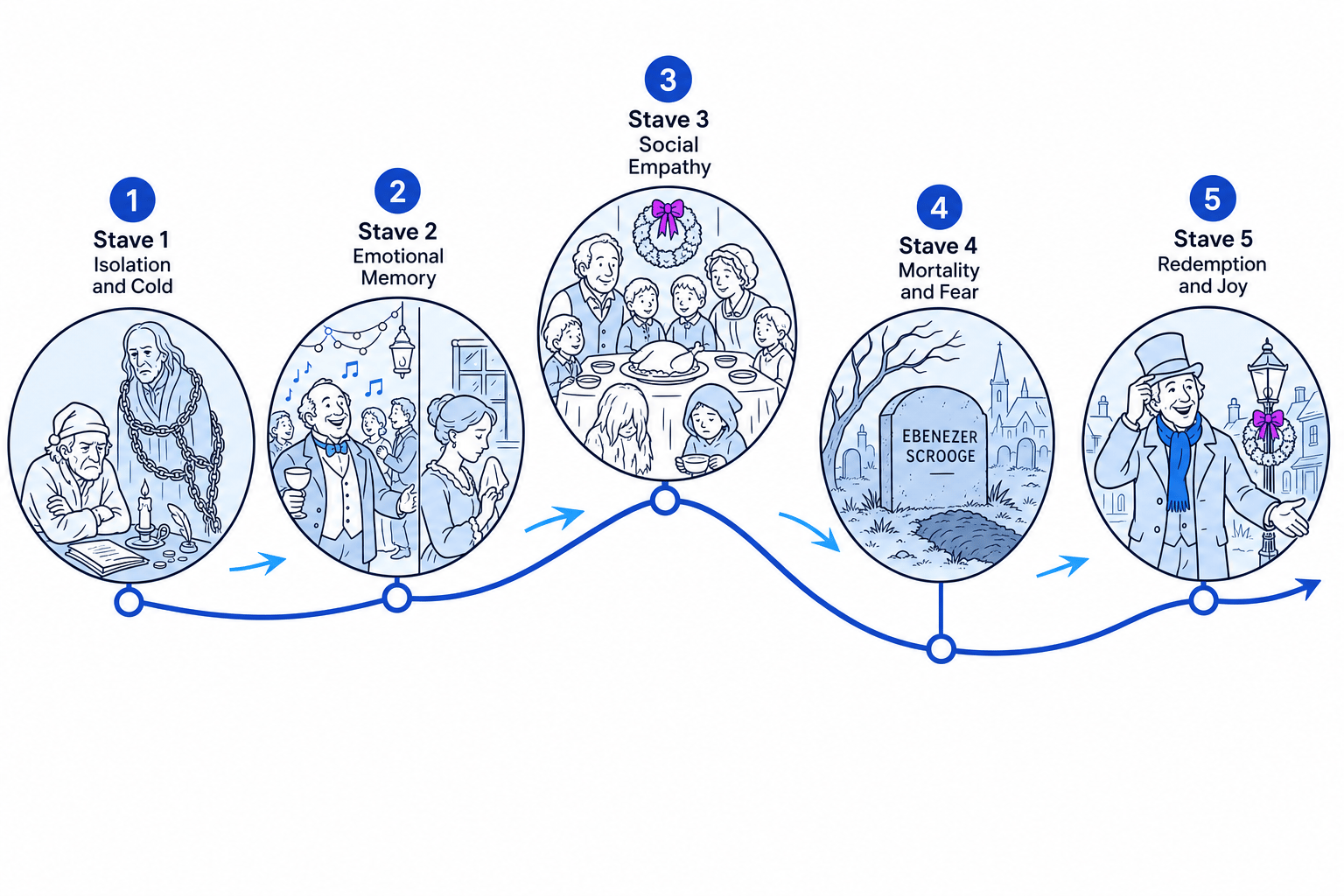
2. Five Key Moments You Must Know
To succeed in your closed-book exam, you need to memorize short, flexible quotations from these five pivotal moments. Let's look at each moment, the methods Dickens uses, and why they matter.
Moment 1: Stave 1 — Marley's Chains and the Warning
This is the inciting incident of the novella. Marley’s Ghost visits Scrooge to warn him of his impending doom if he does not change his ways.
- The Quote: "I wear the chain I forged in life... I made it link by link, and yard by yard."
- The Method: Dickens uses a powerful metaphor of physical bondage to represent spiritual and moral guilt. The chain is made of "cash-boxes, keys, padlocks, ledgers, deeds, and heavy purses"—all symbols of Scrooge's avarice (greed).
- The Context: In Victorian Britain, industrialization and capitalism led many wealthy merchants to prioritize wealth over human relationships. Marley represents the spiritual consequence of this neglect.
Moment 2: Stave 2 — Belle's Release of Scrooge
During his journey with the Ghost of Christmas Past, Scrooge is forced to witness the moment his fiancée, Belle, breaks off their engagement.
- The Quote: "Another idol has displaced me... a golden one."
- The Method: Belle uses the religious noun "idol" to describe Scrooge’s obsession with money. This suggests that Scrooge has committed a form of spiritual blasphemy, worshipping gold rather than God or love.
- The Context: Dickens critiqued the harsh utilitarian mindset of the era, which viewed human beings and relationships solely in terms of their financial productivity and value.
Structure is a method!
Don't just write about language. Point out that Dickens structures the ghostly visits so Scrooge must first confront his personal past before he can understand his social responsibilities in the present.
Moment 3: Stave 3 — Ignorance and Want
At the end of his journey with the Ghost of Christmas Present, two wretched, animalistic children are revealed from beneath the Spirit’s robes.
- The Quote: "They are Man's... This boy is Ignorance. This girl is Want. Beware them both..."
- The Method: Dickens uses allegory and personification to turn abstract societal failures into physical, terrifying children. He uses graphic, zoomorphic adjectives to describe them as "yellow, meagre, ragged, scowling, wolfish."
- The Context: This is Dickens's most direct political critique. "Ignorance" represents the lack of education for the poor, while "Want" represents poverty. Dickens believed that education was the key to breaking the cycle of poverty and crime in Victorian England.
Moment 4: Stave 4 — The Gravestone and Climax
The Ghost of Christmas Yet to Come leads Scrooge to a neglected, weed-choked churchyard, where he is forced to read his own name on a headstone.
- The Quote: "Am I that man who lay upon the bed?"
- The Method: This is the dramatic climax of the novella. Dickens uses the haunting, silent figure of the Spirit to force Scrooge to draw his own terrifying conclusions, creating intense suspense.
- The Context: Victorians were deeply preoccupied with a "good death"—dying surrounded by family and being remembered well. The contrast between Scrooge's lonely, looted deathbed and Tiny Tim's mourned, peaceful passing highlights the moral consequences of how one lives.
Moment 5: Stave 5 — Scrooge's Rebirth and Redemption
On Christmas Morning, Scrooge wakes up to find he is still alive and has time to alter his fate.
- The Quote: "I am as light as a feather, I am as happy as an angel, I am as merry as a school-boy."
- The Method: Dickens uses a rapid-fire series of similes to convey Scrooge’s complete spiritual lightness. This contrasts starkly with the heavy, leaden imagery of Marley's chains and Scrooge’s "frosty" description in Stave 1 ("hard and sharp as flint").
- The Context: The Christian concept of repentance and resurrection is woven throughout Stave 5. Scrooge is "reborn" into a new life of active charity, reflecting Dickens’s belief that society could also be redeemed if it chose to care for its weakest members.
Confusing the Spirits' roles
Make sure you do not mix up the lessons Scrooge learns from each spirit.
- Past: Reawakens his personal emotions (grief, regret, joy).
- Present: Teaches him empathy for others and exposes social injustice (the Cratchits, Ignorance and Want).
- Yet to Come: Instills the fear of moral judgment and eternal damnation.
3. How to Analyze a Key Moment in the Exam
When writing about a key moment in your AQA exam, you must balance AO1 (answering the question and using quotes), AO2 (analyzing Dickens's methods), and AO3 (linking ideas to Victorian context).
Let's walk through how to construct a high-scoring analytical paragraph on Moment 3: Ignorance and Want.
Analyzing the Ignorance and Want Scene
How does Dickens use the figures of Ignorance and Want to present his ideas about social responsibility?
- Formulate a precise thesis point (AO1): Start by identifying how the key moment acts as a warning to Victorian society about the consequences of neglecting the poor.
Drafting: "Dickens structures the end of Stave 3 around the terrifying climax of 'Ignorance and Want' to warn the wealthy classes that failing to educate and support poor children will lead to societal ruin." - Integrate short, precise quotations (AO1) and identify the method (AO2): Choose specific, high-impact words rather than block-quoting long sentences.
Drafting: "Dickens personifies these societal evils as two wretched children, describing them as 'shrivelled' and 'wolfish' creatures who cling to the Ghost's robes." - Perform close-word analysis of language and form (AO2): Zoom in on key words. Discuss what they imply and how they affect the reader.
Drafting: "The animalistic adjective 'wolfish' is particularly striking. By comparing the children to predators, Dickens warns that if society treats the impoverished like beasts, they will eventually turn wild and destructive. This zoomorphism strips the children of their innocence, showing how poverty dehumanizes the vulnerable." - Weave in targeted historical and social context (AO3): Explain why Dickens made these choices based on his own beliefs and the era he lived in. Ensure you avoid a "history dump"—every piece of context must explain the text.
Drafting: "This directly reflects Dickens's own horror at the treatment of the poor in Victorian London, particularly his support for the Ragged Schools Union, which provided free education to destitute children. Through the Spirit’s warning that 'on his brow I see that written which is Doom,' Dickens issues a prophetic warning to the ruling classes: neglecting the education ('Ignorance') of the poor will lead to a violent revolution."
In the exam
- Read the extract, but plan the whole essay: The AQA question asks you to focus on the printed extract and the novel as a whole. Use the extract as a springboard, but make sure at least half of your essay focuses on other key moments across the 5 Staves.
- Track Scrooge's change: Whatever the question theme is (e.g., family, charity, isolation, greed), structure your essay chronologically around Scrooge's transformation. Show how he behaves at the start (Stave 1), how a key moment shifts his perspective (Staves 2-4), and how he acts differently at the end (Stave 5).
- Acknowledge Dickens's didactic purpose: Always ask yourself why Dickens wrote a specific scene. He was a social reformer writing for a middle-class Victorian audience; every key moment is designed to shock, shame, or inspire his readers into taking action.
Check yourself
- Why did Dickens structure the novel into "Staves" rather than chapters, and what does this suggest about his intended audience?
- Which key moment serves as the turning point where Scrooge first shows genuine remorse for his past treatment of others?
- How does the description of Scrooge's physical appearance in Stave 1 contrast with the similes used to describe him in Stave 5?
