

What you'll learn
- What “context” means for Telling Tales as a short-story anthology.
- How to link context to writer’s choices, not bolt it on separately.
- The main types of context that help with stories in the anthology.
- How to use context briefly and effectively in an AQA exam paragraph.
What context means
In GCSE English Literature, context is not just “facts about history”. It is anything outside the words of the story that helps explain why the writer presents characters, settings, conflicts or ideas in a particular way.
Context
Context means the circumstances around a text — such as the time, place, society, culture, writer’s background, genre and original audience — that help shape its meanings.
For Telling Tales, context matters because the anthology contains short stories from different writers, periods, cultures and social worlds. You cannot learn “one context” for the whole anthology. Instead, you need to ask: what pressures are shaping this particular story?
Think of context as a bridge between the world outside the story and the writer’s choices inside the story.
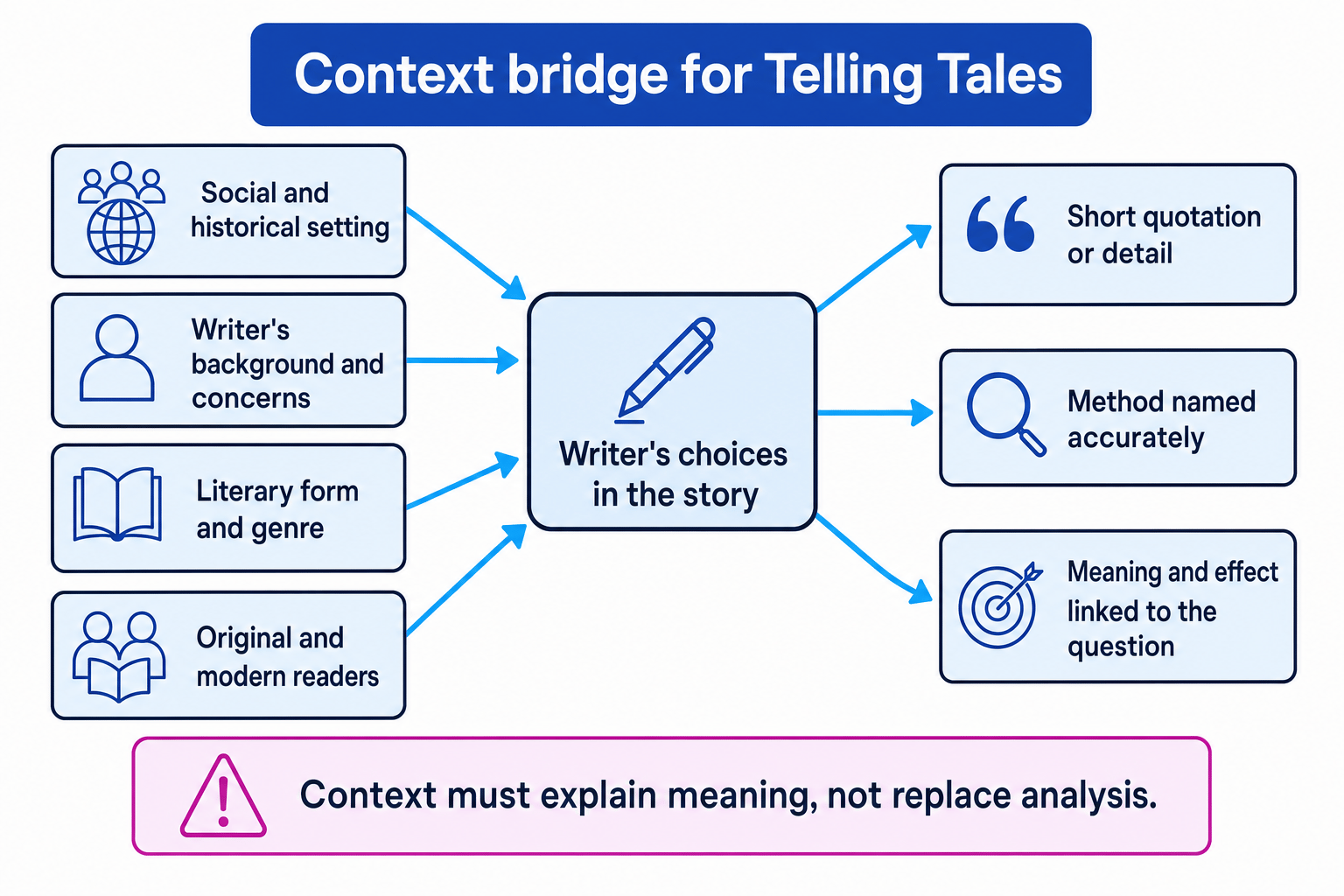
Context is a bridge, not a detour
The best context explains why a detail in the story matters. It should connect to a quotation, method, character, setting or narrative choice.
Context and the assessment
For AQA, context is assessed through the relationship between the text and the world it comes from. In simple terms, the examiner wants to see that you understand how a story is shaped by its society, history, culture or literary form.
This does not mean writing a mini biography of the author. It means making comments like:
- how wartime memories shape attitudes in “The Darkness Out There”
- how gender and class expectations affect relationships in “Odour of Chrysanthemums”
- how migration, language and identity matter in “My Polish Teacher’s Tie”
- how family duty and repression influence “A Family Supper”
- how childhood innocence is disturbed in “When the Wasps Drowned”
Types of context you can use
Historical context
Historical context
Historical context means the events, conditions and time period surrounding a text, such as war, economic hardship, migration or social change.
In Telling Tales, historical context often helps you understand why characters behave in ways that may seem harsh, secretive or emotionally restrained.
For example, in “The Darkness Out There”, Penelope Lively draws on the aftermath of the Second World War. Mrs Rutter’s memory of leaving a German airman to die exposes how war can leave behind hatred and moral damage. The phrase “only a German” reduces the man to his nationality, suggesting how prejudice can make cruelty seem acceptable.
Using wartime context in analysis
-
Connect the context to the story’s moral problem: the Second World War created grief and hostility, but Lively is interested in what happens when those feelings become dehumanising.
-
Link the context to a precise detail: Mrs Rutter’s phrase “only a German” makes the airman seem less than fully human, using a dismissive qualifier and a national label.
-
Explain the writer’s purpose: Lively challenges the comforting assumption that ordinary, respectable people are naturally good; the war context reveals how cruelty can hide inside familiar rural English life.
Social context
Social context
Social context means the expectations, values and power structures of a society, such as class, gender roles, family duties, education or work.
Many stories in Telling Tales explore people trapped by social expectations.
In “Odour of Chrysanthemums”, D. H. Lawrence presents a mining community where work is dangerous and domestic life is tense. The context of industrial working-class life matters because Walter’s job is not just background detail: it shapes the family’s poverty, exhaustion and emotional distance.
In “Chemistry”, Graham Swift presents a modern family under pressure, with divorce, remarriage and jealousy affecting the child narrator’s view of adults. Here, context is not about a huge historical event; it is about changing family structures and the emotional instability they can create.
Cultural context
Cultural context
Cultural context means the beliefs, customs, traditions, values and identity markers that influence characters and readers.
Cultural context is especially useful when writing about stories involving identity, belonging and family expectation.
In “A Family Supper”, Kazuo Ishiguro presents a Japanese family meal surrounded by silence, formality and unease. The opening focus on fugu — “Fugu poisoning is hideously painful” — immediately links food, danger and family memory. Context helps you see that the meal is not simply dinner: it becomes a tense ritual where grief, duty and unspoken guilt are present.
Do not stereotype culture
Avoid saying things like “Japanese people are all…” or “in that culture everyone…” Instead, write about what this writer presents in this story, using cautious phrases such as “Ishiguro suggests”, “the story presents”, or “the family seems shaped by”.
Authorial context
Authorial context
Authorial context means relevant details about the writer’s life, background, interests or typical concerns that help explain their choices.
Use authorial context carefully. It can be useful to know, for example, that Kazuo Ishiguro often writes about memory, repression and what characters cannot openly say. But you should not reduce a story to the writer’s biography.
A strong sentence might be:
Ishiguro’s interest in repression can be seen in the narrator’s controlled, understated voice, which makes the family’s silence feel more threatening than direct confrontation.
That works because it links authorial context to narrative method.
Literary context: the short-story form
Literary context
Literary context means the genre, form and writing traditions a text belongs to, such as short fiction, realism, gothic writing or modernist narration.
Because Telling Tales is an anthology of short stories, literary context is very important. A short story is a brief prose narrative that usually focuses on a small number of characters, a limited time frame and one central tension, revelation or turning point.
Short stories often use:
- compression: a lot of meaning packed into a few details
- ellipsis: gaps or things left unsaid
- symbolism: objects or settings carrying deeper meaning
- twists or revelations: a moment that changes how we understand events
- ambiguous endings: endings that leave readers uncertain
For example, “When the Wasps Drowned” uses childhood perspective and a disturbing discovery to create unease. The short-story form allows Clare Wigfall to focus tightly on one summer incident, making the lack of full explanation feel unsettling rather than incomplete.
The short-story context shortcut
Ask: Why has the writer chosen to reveal only this much? In short stories, what is hidden, delayed or left unresolved is often as important as what is directly explained.
Common context patterns in Telling Tales
You do not need to memorise a separate essay of background for every story. Instead, learn flexible context patterns that you can adapt.
| Context pattern | What it helps you discuss | Stories where it can be useful |
|---|---|---|
| War and its aftermath | grief, prejudice, moral damage, memory | “The Darkness Out There” |
| Industrial work and class | poverty, danger, restricted lives, domestic strain | “Odour of Chrysanthemums” |
| Migration and language | belonging, identity, cultural pride, prejudice | “My Polish Teacher’s Tie” |
| Family change | jealousy, loyalty, remarriage, generational conflict | “Chemistry”, “A Family Supper” |
| Childhood and innocence | discovery, fear, adult secrets, moral awakening | “When the Wasps Drowned”, “The Darkness Out There” |
| Gender expectations | marriage, motherhood, female respectability, limited power | “Odour of Chrysanthemums”, “Flight” |
| Silence and repression | what characters cannot say openly | “A Family Supper”, “Chemistry” |
How to write context well
The safest structure is:
point → evidence → method → context → effect → link
You should still analyse language, form and structure. Context strengthens the analysis; it does not replace it.
The history paragraph
A common mistake is writing a whole paragraph about the Second World War, mining, migration or Japanese culture without analysing the story. If there is no quotation or method, it is not really literature analysis.
A weak context sentence says:
The story was written after the war, so people hated Germans.
A stronger one says:
By making Mrs Rutter dismiss the dying airman as “only a German”, Lively shows how wartime prejudice can survive in ordinary speech, forcing the reader to question the idea that evil is always obvious or dramatic.
The stronger version works because it connects:
- context: wartime prejudice
- evidence: “only a German”
- method: dismissive phrasing
- effect: challenges the reader’s judgement
Comparing context across stories
In a Telling Tales essay, you may need to write about a named story and another story from the anthology. Context can help you choose your second story.
If the question is about family, you might compare:
- “Chemistry”: modern family breakdown, jealousy and the child’s limited viewpoint
- “A Family Supper”: family duty, silence, grief and repression
If the question is about childhood, you might compare:
- “The Darkness Out There”: young people discovering adult cruelty
- “When the Wasps Drowned”: children encountering death, secrecy and danger
If the question is about power, you might compare:
- “Odour of Chrysanthemums”: gender and class pressures in a mining community
- “My Polish Teacher’s Tie”: language, education and assumptions about social status
The key is to compare how contexts shape the writers’ choices, not just to say the stories come from different times or places.
In the exam
-
Use context only when it helps explain a specific quotation, method or character choice.
-
Keep context precise: one sharp sentence linked to the question is better than a long background paragraph.
-
Compare contexts thoughtfully: ask how different social worlds create different pressures on characters.
-
Avoid stereotypes and sweeping claims; write about what the writer presents in the story.
Check yourself
-
Can you explain the difference between historical, social, cultural and literary context?
-
Can you turn one context fact into analysis of a quotation or narrative method?
-
Which two stories would you compare for a question about family, childhood or power?
