When studying Charles Dickens’s A Christmas Carol, it is easy to view the story simply as a festive fairy tale about a grumpy old man who learns to love Christmas. However, Dickens wrote this novella with a far more urgent, radical purpose. It was a direct response to the social, economic, and moral crises of Victorian Britain.
In your GCSE English Literature exam, assessment objective AO3 requires you to analyze the relationship between the text and the context in which it was written. This means understanding how Dickens's world directly shaped his characters, his themes, and his literary choices.
What you'll learn
- How Victorian social systems, such as the 1834 Poor Law, shaped the lives of the poorest citizens and Scrooge’s cold ideology.
- The influence of Malthusian theory on Scrooge’s characterization and Dickens's critique of the wealthy elite.
- Dickens’s personal history and how his childhood trauma motivated his lifelong crusade for social justice.
- How to integrate context seamlessly into your essays to elevate your analysis from simple recall to sophisticated literary criticism.
Understanding Context (AO3) as an Analytical Tool
Before looking at the specific historical details of 1843, we must establish what context actually is in a literature exam. Many students make the mistake of "history-dumping"—writing a paragraph of historical facts that has nothing to do with Dickens's language or structural choices.
To gain high marks, you must treat context as the writer's motivation. Why did Dickens choose a specific metaphor? How does a particular setting reflect Victorian anxieties?
Context is Dickens's 'Why'
Never treat context as a history lesson bolted onto the end of a paragraph. Context is the driving force behind the text. Every historical detail you mention must explain why Dickens wrote what he wrote, and how it affects his reader.
The Social and Economic Landscape of Victorian London
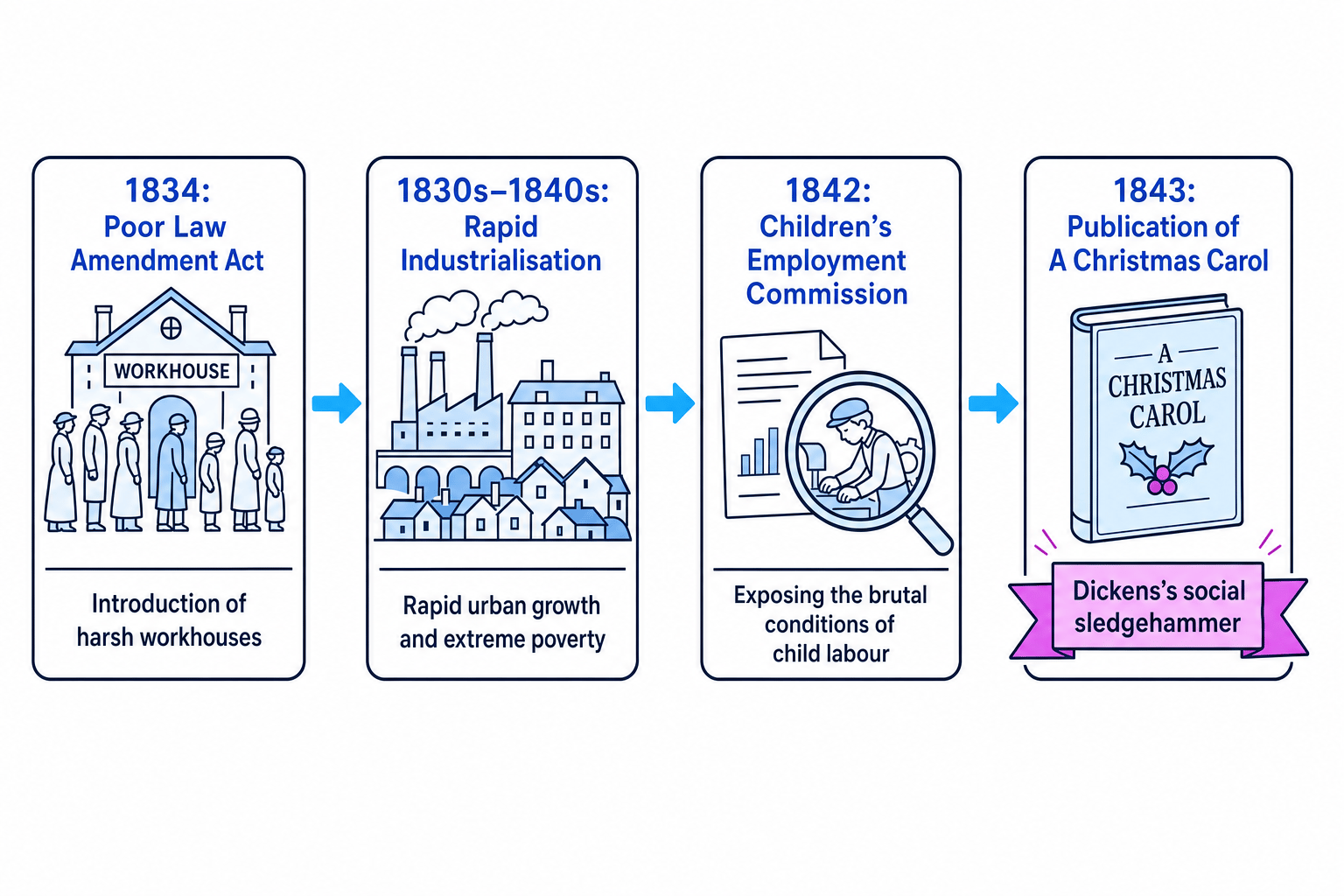
To understand Scrooge's attitude toward the poor, we must look at the world Dickens lived in. In the 1840s, Britain was undergoing rapid change, leaving behind its rural past to become an industrial superpower.
The Industrial Revolution and Urban Poverty
The rise of factories drew thousands of families from the countryside into major cities like London. This sudden explosion in population led to extreme overcrowding, raw sewage in the streets, rampant disease (such as cholera), and deep economic division.
While the capitalist middle class grew incredibly wealthy, the working class faced brutal conditions. There was no social security, no free healthcare, and no limit on working hours. If you could not work, you starved.
The Poor Law Amendment Act of 1834
In 1834, the British government passed a law designed to reduce the cost of helping the poor. Before this act, parishes provided "outdoor relief" (money, food, or clothing) to poor people in their homes. The new law abolished this, stating that if able-bodied people wanted help, they had to move into a workhouse.
Workhouse
A Victorian state institution where those unable to support themselves were offered basic accommodation and food in exchange for grueling physical labor. Conditions were deliberately made harsher than the lowest standard of living outside, to deter "lazy" people from seeking help.
Families were routinely torn apart in the workhouses; husbands, wives, and children were separated, forced to wear uniforms, and fed a starvation diet of gruel.
When Scrooge asks the charity collectors in Stave 1, "Are there no prisons?... And the Union workhouses?" he is directly voicing the cold, unsympathetic attitude of the Victorian ruling class who believed poverty was a moral failing rather than a systemic tragedy.
Thomas Malthus and the "Surplus Population"
Dickens was deeply angry at the theories of Thomas Malthus, an influential political economist of the era. Malthus argued that the human population would always grow faster than the food supply. He believed that poverty, war, and disease were inevitable, natural checks to keep the population in balance.
Malthusian Theory
The economic belief that population growth will inevitably outpace resource production. Proponents argued that charity to the poor was counterproductive because it simply encouraged them to have more children, compounding the scarcity of food.
Malthus argued that the poor should not be helped, as this only allowed them to survive and reproduce, worsening the overall problem.
Dickens directly targets this theory in Stave 1. When the charity collectors explain that many would rather die than go to the workhouses, Scrooge responds:
"If they would rather die, they had better do it, and decrease the surplus population."
By putting Malthus's exact concept of "surplus population" into the mouth of his grotesque protagonist, Dickens forces his wealthy readers to confront the cruelty of their own economic beliefs.
Scrooge represents an ideology
Remember that Scrooge is not just an individual miser; he is an allegorical caricature of Malthusian economics and the cold laissez-faire capitalism of the 19th-century ruling class.
Dickens's Personal Context and the "Sledgehammer"
Dickens did not observe Victorian poverty from a distance; he lived it. This personal history fueled his deep empathy for characters like Bob Cratchit and Tiny Tim.
Personal Trauma: Marshalsea and the Blacking Factory
When Dickens was just twelve years old, his father was sent to Marshalsea Debtors' Prison because of unpaid bills. Under Victorian law, the entire family (except Charles) had to join the father in prison.
To pay off the family debt, young Charles was pulled out of school and sent to work ten hours a day at Warren's Blacking Factory, pasting labels onto pots of shoe polish. He worked in a cold, rat-infested warehouse by the River Thames.
This experience left permanent psychological scars on Dickens. He felt abandoned, humiliated, and terrified of falling back into poverty. When Scrooge watches his younger self left alone at school in Stave 2, or when we see the filthy, neglected streets of London in Stave 4, Dickens is drawing directly from his own childhood memories of isolation and urban decay.
The 1843 Children's Employment Commission Report
In early 1843, Dickens read a government report detailing the horrific exploitation of children working in Britain's mines and factories. The report described children as young as five working in total darkness, losing limbs in heavy machinery, and suffering severe physical abuse.
Initially, Dickens planned to write a cheap political pamphlet titled An Appeal to the People of England on behalf of the Poor Man’s Child. However, he quickly realized that a dry political essay would be ignored by the upper classes. Instead, he decided to write a fictional story that would capture people's hearts and minds. He wrote to a friend that the story would strike a "sledgehammer blow" on behalf of the poor.
We see this sledgehammer blow most clearly at the end of Stave 3 with the introduction of Ignorance and Want.
Ignorance and Want are symbolic monsters
The two children hiding under the Ghost of Christmas Present's robes represent the twin evils of Victorian society. Want represents physical poverty (starvation, lack of shelter), while Ignorance represents the lack of education. Dickens warns that Ignorance is the more dangerous of the two, because a society that refuses to educate its poorest children will ultimately face its own violent doom ("on his brow I see written which is Doom").
How to Integrate Context: A Worked Example
To achieve a Grade 7, 8, or 9, you must write analytical paragraphs that seamlessly blend Evidence (AO1), Methods (AO2), and Context (AO3). Let's look at how to construct an essay paragraph that successfully does this.
The 'History Paragraph'
Avoid dedicating an entire paragraph to a history lesson. A paragraph that reads: "In Victorian times, poor people went to the workhouse. They had to eat gruel. This shows Scrooge was mean because he liked workhouses," does not show literary analysis. It splits history from language, earning very low marks.
Integrating Malthusian theory into literary analysis
Here is a step-by-step guide to writing a high-level analytical paragraph using the PETAL/PEEL structure, focusing on Scrooge's Stave 1 exchange with the charity collectors.
-
Step 1: Make a clear point (AO1)
Start by linking Scrooge's attitude directly to Dickens’s social critique.
Drafting: Dickens uses Scrooge's cold indifference in Stave 1 to expose the callous attitudes of the Victorian wealthy elite toward those suffering in poverty.
-
Step 2: Introduce evidence and name the writer's methods (AO1 & AO2)
Embed a short, precise quotation and identify how Dickens uses language to construct meaning.
Drafting: When asked to donate money to the poor, Scrooge dismisses the charity collectors by stating that if the poor would rather die than go to the workhouses, they should do so and "decrease the surplus population." The noun phrase "surplus population" uses a cold, mathematical register that strips the poor of their humanity, reducing living human beings to mere statistics.
-
Step 3: Integrate historical context (AO3)
Explain the real-world ideas Dickens is critiquing with this language.
Drafting: This language is a direct allusion to the economic theories of Thomas Malthus, who argued that population growth must be checked by famine and disease, and that helping the poor was counterproductive. By putting this heartless Malthusian rhetoric into Scrooge's mouth, Dickens holds a mirror up to his contemporary Victorian readers who used such theories to justify their lack of charity and their support for the cruel 1834 Poor Law.
-
Step 4: Analyze the effect on the reader and the writer's purpose (AO2 & AO3)
Explain how the context and language work together to deliver Dickens's moral message.
Drafting: Consequently, Dickens demonizes this capitalist ideology. By showing Scrooge’s subsequent, terrifying transformation under the guidance of the Spirits, Dickens warns his middle-class readers that they must abandon their detached, intellectualized cruelty and embrace social responsibility before they face their own spiritual damnation.
In the exam
When writing your exam essay on A Christmas Carol, keep these three strategic tips in mind to maximize your AO3 marks:
- Start with the writer: Use active verbs that show Dickens making deliberate choices (e.g., "Dickens constructs...", "Dickens weaponizes...", "Dickens satirizes..."). This forces you to analyze his purpose rather than treating the characters as real historical figures.
- Anchor context to quotes: Never introduce a piece of historical context without tying it directly to a specific word or phrase from your quotation. If you mention workhouses, link it directly to Scrooge's use of the noun "workhouses". If you mention Malthus, link it to the phrase "surplus population".
- Trace the shift: Remember that Scrooge's transformation is a structural critique of Victorian society. In Stave 1, he embodies cold, institutional Malthusianism. By Stave 5, his direct charity to the Cratchits and his donation to the portly gentlemen represent Dickens's ideal of Christian benevolence and active social reform. Your context marks will rise if you show how Dickens's context applies to the end of the novel as well as the beginning.
Check yourself
- How did the Poor Law Amendment Act of 1834 seek to solve the problem of poverty in Victorian Britain, and where do we see its influence in Stave 1?
- Who was Thomas Malthus, and how does Scrooge’s dialogue in the opening chapter reflect Malthusian economic philosophy?
- What was Dickens’s personal experience of poverty as a child, and how did this shape his depiction of the Cratchit family and the children Ignorance and Want?
