

When studying the stories in the Telling Tales anthology, it is easy to get swept up in the narrative and treat the characters as if they are real people. However, to achieve top marks in your GCSE English Literature exam, you must shift your perspective.
Writers do not create real people; they create carefully designed representations to communicate specific ideas about society, human nature, and history.
What you'll learn:
- How to treat characters as literary constructs designed by the writer to convey big ideas.
- How to identify and analyze the methods writers use to build and contrast characters in short stories.
- How to link characterization directly to context (AO3) and theme.
1. Characters as Constructs
The most important leap you can make in your essays is to refer to a character as a construct.
Construct
A construct is a character created deliberately by an author to represent a specific social group, psychological state, or abstract thematic idea. They are a tool used to deliver the text's deeper message.
When writing your essay, instead of asking "Why does Sandra do this?" you should ask, "Why has Penelope Lively constructed Sandra to act this way?" This small shift in language immediately elevates your analysis from basic plot summary to sophisticated, critical appreciation.
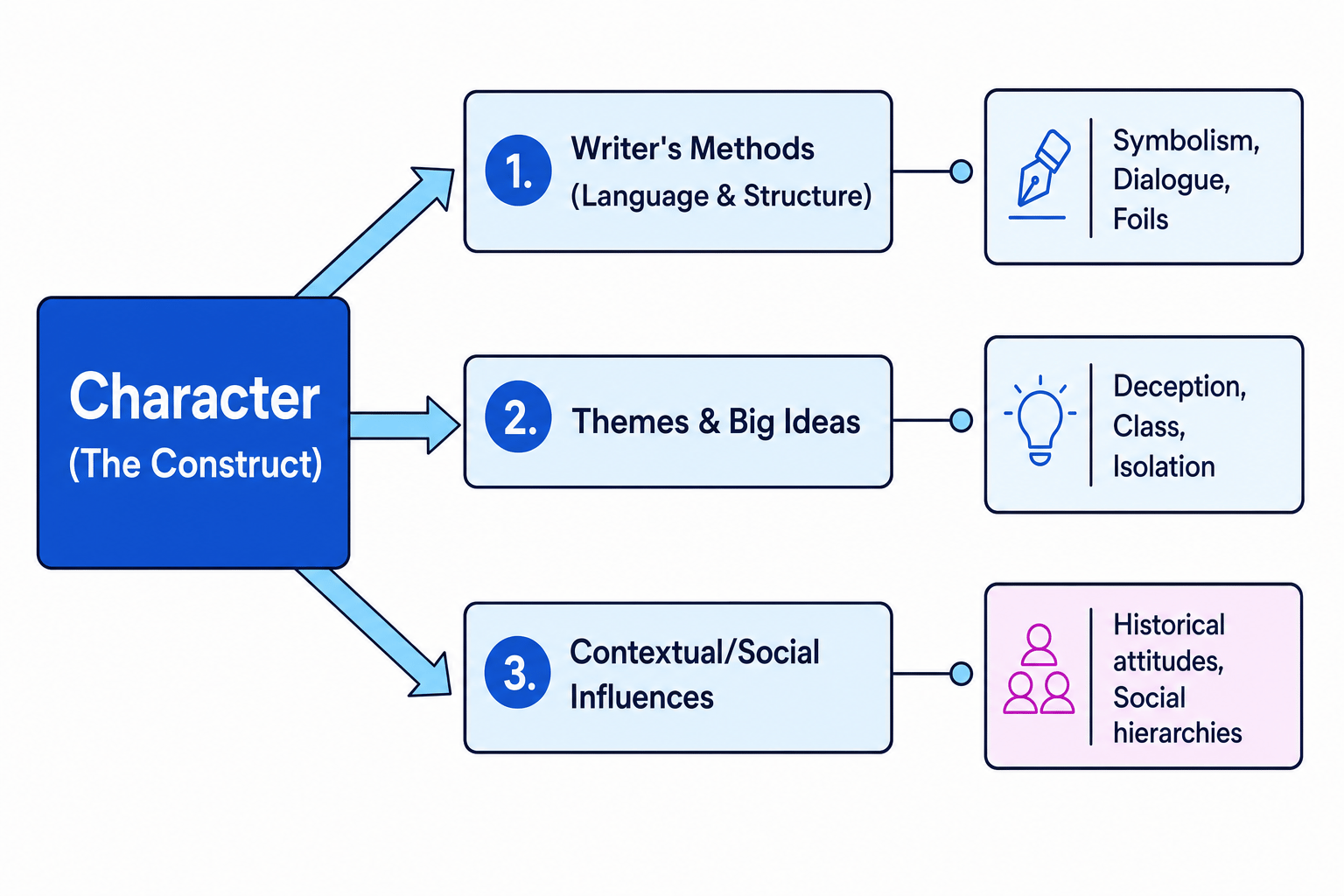
Characters are vehicles for ideas
Every character in Telling Tales is a vehicle carrying a larger message. For example, in My Polish Teacher's Tie, Carla Carter is not just a school tea lady; she is a construct representing the psychological constraints of the British class system and the vulnerability of the working class.
The 'Real Person' Pitfall
Never write about characters as if they have lives outside the margins of the page. Avoid phrasing like: "If Carla had gone to university, she would have..." or "Mrs Rutter must have had a sad childhood to make her so bitter." Focus only on what the writer chose to put on the page and why they put it there.
2. Methods of Characterization in Short Stories
Because short stories have a highly restricted word count, writers cannot afford lengthy, multi-chapter character introductions. They must establish their characters rapidly and economically. They do this through three primary techniques:
Physical Appearance and Symbolic Objects
Writers often use a physical detail or an object to reveal a character's inner state or social standing.
- The Mother's hair in Chemistry: Her physical transformation and her hair symbolise her shifting allegiances between her father and her new partner, Ralph.
- Stefan’s tie in My Polish Teacher's Tie: The tie, described as "red... with bold, bright birds on it," represents Stefan's artistic individuality and his refusal to be silenced or dimmed by his impoverished circumstances. It contrasts sharply with the drab, uniform expectations of the school.
Dialogue and Voice
How a character speaks tells the reader about their background, confidence, and role in the story.
- In My Polish Teacher's Tie, Carla speaks in short, self-deprecating sentences at first: "I wear a uniform. I am the tea lady." The simple syntax reflects her low self-esteem and how she has internalized her low social status.
The Use of Foils
A writer will often place two contrasting characters side by side to emphasize the traits of both.
Foil
A foil is a character who contrasts sharply with another character, usually the protagonist, in order to highlight particular qualities, themes, or moral differences between them.
In Chemistry, Ralph acts as a direct foil to the Grandfather:
- The Grandfather is "a maker of things," associated with "chemistry" (which represents precise, quiet, respectful creation and memory).
- Ralph is a loud, intrusive "destroyer," associated with "alchemy" (which represents a chaotic, selfish attempt to force change and exploit others).
Look for structural pairings
Whenever you see a pair of characters in a short story, ask: What is the contrast here, and what idea is the writer trying to highlight by putting them together?
3. Step-by-Step Analysis: Character as a Construct
To write a high-scoring analytical paragraph, you must follow a clear pathway: identify the character's function, provide precise evidence, name the writer's methods, and link it to the wider context and theme.
Let's look at how to build an analytical paragraph focusing on Mrs Rutter from Penelope Lively’s The Darkness Out There.
Analyzing Mrs Rutter as a literary construct
Analyze how Penelope Lively constructs the character of Mrs Rutter to explore the nature of evil.
- State the character's thematic function (AO1): Formulate a point that treats Mrs Rutter as a construct designed to challenge the young protagonist’s (and the reader’s) superficial judgments.
- Drafting: Lively constructs Mrs Rutter as a deceptively benign maternal figure to expose how true human malice often hides behind a mask of ordinary, cozy domesticity.
- Introduce and embed a precise quotation (AO1): Find a quote showing how she is initially presented, contrasted with her shocking confession about the dying German soldier.
- Drafting: At first, Mrs Rutter is associated with domestic warmth, "crooning" to her kettle. However, this image is shattered when she describes leaving the injured pilot to die: "it was a dry night, nice and warm... we walked away."
- Analyze the writer's language and structural methods (AO2): Look closely at the contrast, word choices, and tone.
- Drafting: Lively uses a stark juxtaposition of tone. The colloquial, casual adjectives "nice and warm" are chillingly applied to the night a young man was left to die in agony. The verb "walked away" demonstrates a callous, systematic lack of empathy, entirely subverting the reader's expectation of the "sweet old lady" archetype.
- Link to context and the writer's broader message (AO3): Explain what Lively wants the reader to realize about society and human nature.
- Drafting: Through this shocking subversion, Lively addresses post-WWII generational trauma and prejudice. By showing that Mrs Rutter’s cruelty is born of wartime resentment, Lively warns her readers that "the darkness" is not a distant, historical foreign threat, but something that resides within seemingly ordinary members of our own communities.
4. Connecting Character to Context (AO3)
You cannot separate a character from the social and historical context in which their story is set. The writer constructs them because of these contextual factors.
| Character & Story | Contextual Influences | What the Construct Reveals |
|---|---|---|
| Stefan (My Polish Teacher's Tie) | The expansion of the European Union and the migration of Eastern European workers to the UK in the late 20th century. | He represents the overlooked intelligence and cultural richness of migrant workers, challenging British insularity and xenophobia. |
| The Narrator’s Mother (Chemistry) | Mid-to-late 20th-century family structures and the social pressures of widowhood and financial dependency. | She represents the vulnerability of women caught between traditional duty to the older generation (the Grandfather) and the desire for new companionship (Ralph). |
| Mrs Rutter (The Darkness Out There) | The lingering bitterness, trauma, and moral compromise left behind in Britain after the Second World War. | She represents how wartime trauma can erode morality and breed a quiet, domestic cruelty that persists in peacetime. |
In the exam
When writing about characters in the Telling Tales exam:
- Use the writer's name constantly: Keep reminding the examiner that the character is an artistic creation. Instead of writing "Carla feels isolated," write "Dunmore highlights Carla's isolation to..."
- Focus on the beginning, middle, and end: Characters in short stories often undergo rapid transformations or trigger sudden realizations (epiphanies) in others. Track their trajectory. For example, how does Sandra’s view of Mrs Rutter shift from pity to absolute horror?
- Use precise terminology: Don't just list events. Name the methods—foil, juxtaposition, symbolic motif, colloquial dialogue, third-person limited narrative perspective—and explain how they shape our understanding of the character.
- Anchor everything in context (AO3): Ask yourself why the writer wrote this story at that specific point in history. What were they trying to change or expose in their contemporary society?
Check yourself
- Why is it a mistake to write about what a character does "outside" of the text?
- What is a "foil" in character construction, and can you name a pairing from the anthology that uses this technique?
- How does D.H. Lawrence use physical description in Odour of Chrysanthemums or Graham Swift in Chemistry to reflect a character's internal feelings?
