Understanding the structure of A Christmas Carol is essential for scoring highly in your GCSE English Literature exam. Charles Dickens does not just tell a story; he carefully crafts a structural journey of transformation. By mastering what happens in each section, you will be able to trace Scrooge's psychological shift and explain how Dickens uses structure to deliver his powerful social message.
What you'll learn:
- Why Dickens structured the novella into staves rather than chapters.
- The key plot events of all five staves and how they connect.
- How to analyze Scrooge’s gradual emotional and moral transformation.
- How to link structural shifts to Dickens's social and historical context.
The Architectural Design: Why "Staves"?
Before we dive into the plot details, we must look at how the book is constructed. Dickens does not use "chapters." Instead, he calls his chapters staves.
Stave
A stave (or staff) is a set of five parallel lines on which sheet music is written. In literature, Dickens uses the term metaphorically to link his story to a "carol"—a traditional song sung at Christmas to bring communities together.
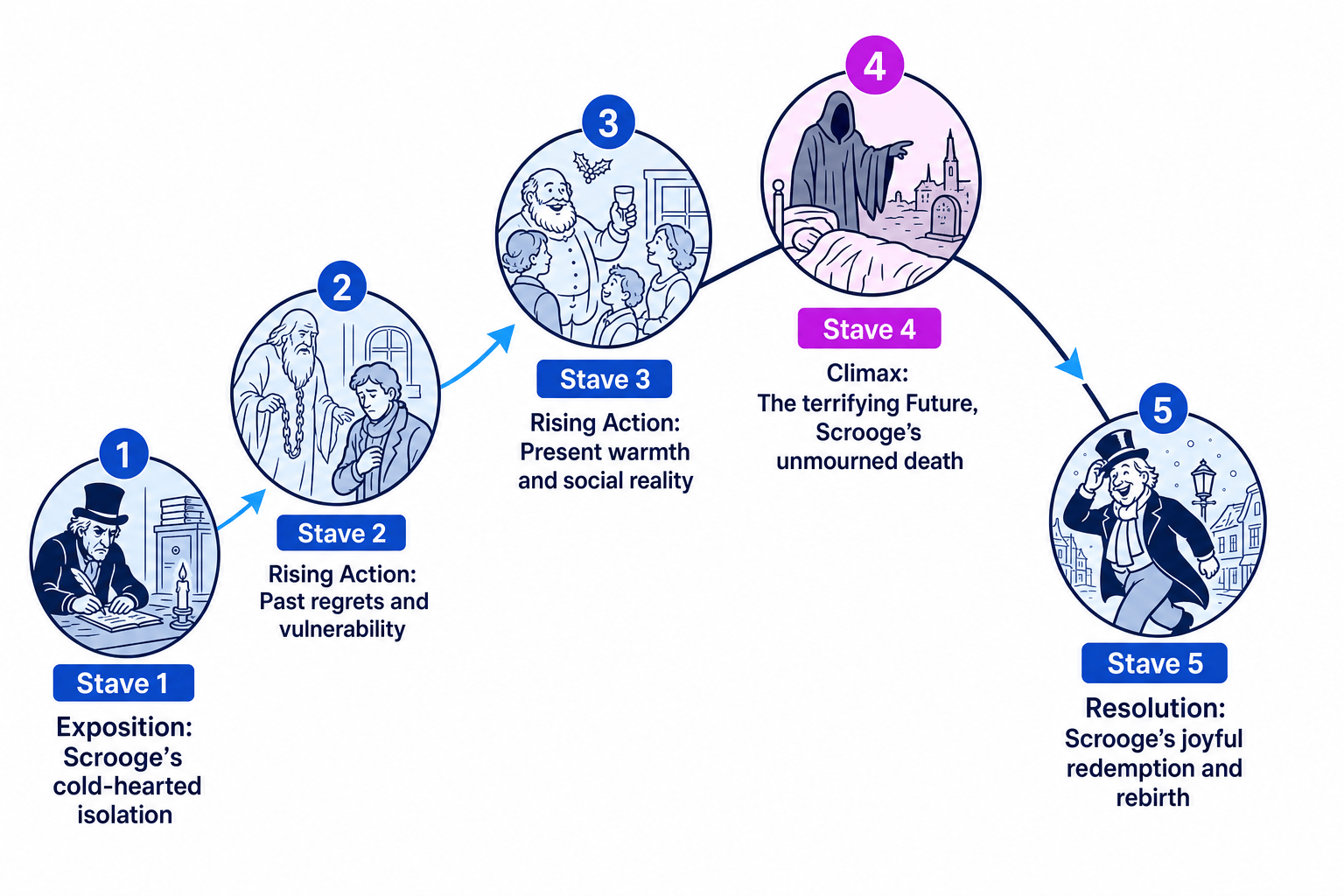
By dividing his story into five staves, Dickens reminds us that the text is designed to be shared, heard, and celebrated collectively, much like a musical song. Structurally, these five staves mirror a traditional five-act play:
- Stave 1: Exposition (The setup of the problem)
- Stave 2: Rising Action (The journey into the past)
- Stave 3: Rising Action (The examination of the present)
- Stave 4: Climax (The terrifying confrontation with the future)
- Stave 5: Resolution (The joyful conclusion and transformation)
Stave 1: Marley’s Ghost (Exposition)
Stave 1 introduces us to Ebenezer Scrooge on a freezing, foggy Christmas Eve in London. Dickens establishes Scrooge's cold heart using vivid sensory language and pathetic fallacy (where the weather reflects a character's internal state).
Key Plot Events:
- The Warning Signs: We are told immediately that Scrooge's business partner, Jacob Marley, is dead—"dead as a door-nail."
- Cold Isolation: Scrooge is depicted working in his freezing counting-house. He refuses to give his clerk, Bob Cratchit, enough coal to stay warm.
- Three Visitors:
- His cheerful nephew, Fred, arrives to invite him to Christmas dinner; Scrooge dismisses him with "Bah! Humbug!".
- Two portly gentlemen arrive asking for charitable donations for the poor. Scrooge rejects them, famously asking if the "prisons" and "workhouses" are still open, suggesting that the poor should die and "decrease the surplus population."
- A young carol singer tries to sing at his door, but Scrooge frightens him away.
- The Haunting: At home, Scrooge's door knocker transforms into the face of Jacob Marley.
- Marley's Message: Marley’s Ghost appears, draped in heavy chains made of cash boxes, keys, ledgers, and purses. Marley warns Scrooge that he forged this chain in life through his greed and neglect of others. He tells Scrooge he will be haunted by Three Spirits to save him from the same fate.
The Theme of Ignorance
In Stave 1, Scrooge represents the cold apathy of the Victorian wealthy. His refusal to help the poor reflects the popular (and harsh) economic theories of Thomas Malthus, who believed that poverty was inevitable and that charity only encouraged the poor to have more children.
Stave 2: The First of the Three Spirits (The Past)
The first spirit, the Ghost of Christmas Past, visits Scrooge at one o'clock in the morning. This spirit represents memory and the passage of time, appearing as a childlike yet old figure with a beam of light shining from its head.
Key Plot Events:
- Childhood Solitude: The spirit takes Scrooge back to his old boarding school. We see Scrooge as a "solitary child, neglected by his friends," left alone at Christmas. Scrooge weeps with pity for his younger self.
- Family Ties: We meet Scrooge’s beloved younger sister, Fan, who came to bring him home. The spirit gently reminds Scrooge that Fan died but left behind a son: Scrooge's nephew, Fred.
- Fezziwig’s Generosity: Scrooge is shown his apprenticeship under the joyful Mr. Fezziwig. Fezziwig throws a magnificent Christmas party for his employees. Scrooge realizes that a boss has the power to make workers "happy or unhappy" without spending a fortune.
- The Turning Point: Scrooge sees his former fiancée, Belle. She releases him from their engagement because a "Golden Idol" (money) has replaced her in his heart.
- The Pain of Regret: Scrooge is forced to watch Belle years later, happily married with a loving family. Overcome by grief and self-loathing, Scrooge extinguishes the spirit's light with its cap to block out the painful memories.
Look for the cracks
Stave 2 is crucial because it shows us that Scrooge was not always a monster. His greed was a defense mechanism built after a lonely childhood. This is the beginning of his psychological thawing.
Stave 3: The Second of the Three Spirits (The Present)
Scrooge wakes to find his room transformed into a lush, green grove filled with a feast. He meets the giant, joyful Ghost of Christmas Present, who represents Christmas cheer, abundance, and empathy.
Key Plot Events:
- The Cratchit Family: The spirit takes Scrooge to the humble home of his clerk, Bob Cratchit. Scrooge sees their poverty but also their immense love and warmth. He meets Tiny Tim, Bob's crippled son. When Scrooge asks if Tiny Tim will live, the Spirit mockingly throws Scrooge's own words back at him: "If he be like to die, he had better do it, and decrease the surplus population."
- Fred's Party: They visit Fred's home, where Fred and his guests are playing games. Despite Scrooge's cruelty, Fred expresses pity for his uncle, toast-drinking to his health.
- The Harsh Reality: The spirit takes Scrooge to remote places—a bleak moor, a lighthouse, and a ship at sea—showing that even in the harshest conditions, people find joy together on Christmas.
- Ignorance and Want: From beneath its robes, the spirit reveals two horrific, starved children named Ignorance and Want. The spirit warns Scrooge to beware them both, but "most of all beware this boy [Ignorance]," symbolizing the rich turning a blind eye to the plight of the uneducated poor.
Stave 4: The Last of the Spirits (The Future)
The final spirit, the Ghost of Christmas Yet to Come, is a silent, hooded figure resembling the Grim Reaper. This spirit represents the dark, inevitable future if Scrooge does not alter his path.
Key Plot Events:
- A Heartless Death: Scrooge is taken to the London streets, where businessmen casually joke about the death of a wealthy, disliked man.
- The Plunderers: In a filthy slum pawn shop, Scrooge watches three people sell the dead man's stolen belongings—including the very sheets and blankets from his deathbed.
- The Contrast: Scrooge asks to see some tenderness connected with a death. The spirit shows him the Cratchit household, grieving the heartbreaking death of Tiny Tim.
- The Climax: Finally, the spirit leads Scrooge to a neglected, weed-choked churchyard. The spirit points to a headstone. Scrooge rubs away the snow to read his own name: EBENEZER SCROOGE.
- The Vow: Terrified and weeping, Scrooge grabs the spirit's hand, promising that he will "honour Christmas in [his] heart" and live in the Past, Present, and Future.
Confusing Scrooge's realization
A common mistake students make is assuming Scrooge knows he is the dead man throughout Stave 4. He actually does not realize (or subconsciously refuses to accept) that the unmourned dead man is him until he reads his name on the gravestone at the very end of the stave. This makes the climax highly dramatic and shocking for him.
Stave 5: The End of It (Resolution)
Scrooge wakes up in his own bed. He discovers with overwhelming joy that he has been given a second chance, and that all three spirits visited him in a single night.
Key Plot Events:
- Overwhelming Joy: Scrooge is giddy and laughing. He describes himself as "light as a feather" and "happy as an angel."
- Practical Charity: He sends a boy to buy the giant prize turkey and has it delivered anonymously to Bob Cratchit’s house.
- Redeeming Past Sins: On the street, Scrooge meets one of the portly gentlemen who asked for charity in Stave 1. He whispers an enormous sum of money into his ear, back-paying years of neglected charity.
- Rejoining Family: Scrooge musters the courage to visit Fred’s house, asking to join their Christmas dinner. He is welcomed with open arms.
- A New Father: The next morning, Scrooge catches Bob Cratchit arriving late to work. Pretending to be his old angry self, Scrooge surprises Bob by raising his salary and promising to help his struggling family.
- The Legacy: Dickens tells us that Scrooge became a "second father" to Tiny Tim (who did not die) and was known as the best man in London for keeping Christmas well.
Worked Example: Tracing Character Transformation
In your GCSE exam, you will often be asked to analyze how Scrooge changes, or how Dickens presents a theme across the whole text. To do this successfully, you must link specific plot events to Scrooge's structural shift.
Tracing Scrooge's emotional thawing from Stave 1 to Stave 2
Analyze how Dickens uses structure to show Scrooge's transformation between Stave 1 and Stave 2.
- Identify the starting point (Stave 1): Focus on Scrooge’s coldness. He is described as "hard and sharp as flint" and "solitary as an oyster." He actively rejects human connection, locking himself away from the cold weather that matches his cold heart.
- Identify the structural catalyst (Stave 2): Look at the arrival of the Ghost of Christmas Past. The spirit takes Scrooge back to his childhood, forcing him to face his own vulnerability. The transition from the frozen present of London to the warm, emotional memories of his youth is the key structural shift.
- Analyze the emotional reaction: Contrast Scrooge's behavior. In Stave 1, he dismisses the young carol singer. In Stave 2, after seeing himself as a lonely boy at school, he says, "There was a boy singing a Christmas Carol at my door last night. I should like to have given him something: that's all."
- Link to Dickens's purpose (AO3): Explain why Dickens structured it this way. By showing Scrooge's lonely childhood immediately after his cruel adult behavior, Dickens makes the reader feel sympathy for him. He suggests that cold adults are often made, not born, and that remembering our own vulnerability is the first step toward empathy.
In the exam
- Name the Stave: When referencing a quote or event, always state which stave it comes from. This demonstrates a precise, structural understanding of the narrative arc (AO1).
- Track the Change: Do not treat Scrooge as static. Contrast his Stave 1 persona with his Stave 5 persona to show a dynamic understanding of his redemption.
- Analyze the Spirits’ Methods: Remember that each spirit is a structural tool used by Dickens to target a specific part of Scrooge's psyche (Past = regret/feeling; Present = social responsibility; Future = mortality/fear).
Check yourself
- Why did Dickens choose to divide the novel into "staves" instead of standard "chapters"?
- At what point in the novel does the structural climax occur, and why is this the turning point for Scrooge?
- Name two specific characters from Scrooge’s past (Stave 2) who contrast directly with his cold, miserly behavior in Stave 1.
