

To score highly in your GCSE English Literature exam, you cannot treat Lord of the Flies simply as an exciting adventure story. William Golding wrote this novel as an allegory—a story with a double meaning, where characters, settings, and objects represent wider political, moral, and historical ideas.
By masterfully weaving symbolism and structure together, Golding tracks the rapid erosion of democratic civilization and the rise of primal savagery.
What you'll learn:
- How to track the decay of key symbols (the conch, Piggy's glasses, the fire) as the boys' society crumbles.
- How Golding structures the novel to mirror a descent into primal darkness.
- How to write a sophisticated analytical response linking a character's actions to structural shifts on the island.
The Power of Symbolism
Before analyzing how these symbols change, we must define what we are looking for.
Symbolism
Symbolism is a literary method where an author uses a physical object, person, or situation to represent a deeper, abstract idea or concept.
In Lord of the Flies, Golding does not use symbols as static decorations. Instead, their physical condition directly mirrors the psychological and moral state of the boys.
1. The Conch Shell (Order, Democracy, and Law)
Found by Ralph and Piggy in Chapter 1, the conch is a delicate, cream-colored shell. It becomes the ultimate symbol of democratic order and free speech.
- The Rule of the Conch: Whoever holds the conch has the right to speak. It establishes a civilized parliamentary system.
- The Decline: As Jack’s tribal savagery grows, the conch’s authority fades. Jack sneers that the conch "doesn't count at this end of the island" (Chapter 9).
- The Destruction: When Roger releases the boulder in Chapter 11, "the conch exploded into a thousand white fragments and ceased to exist." Its absolute destruction marked the death of rational democracy.
2. Piggy’s Spectacles (Science, Intellect, and Truth)
Piggy’s glasses represent the power of science, logic, and rational human intellect. They are also the only physical means the boys have to create fire.
- The Initial Use: The glasses are used to harvest the sun’s rays, symbolizing how scientific intellect can serve humanity.
- The Cracking: In Chapter 4, Jack strikes Piggy and breaks one lens. This symbolizes the partial fracturing of common sense and the initial rise of violence over reason.
- The Theft: In Chapter 10, Jack's tribe steals the glasses. Jack becomes the "chief" who controls technology (fire), using it not for rescue, but for survival and violence.
3. The Signal Fire (Hope of Rescue and Civilized Connection)
The fire is the boys' link to the outside world.
- Civilized duty: Keeping the fire burning requires organization, discipline, and collaboration.
- Primal distraction: When the boys let the fire go out to hunt pigs, they are choosing immediate gratification and primal instincts over long-term rescue and survival.
4. The Lord of the Flies (Humanity's Inherent Evil)
The "Lord of the Flies" is a translation of the Hebrew word Beelzebub, a name frequently associated with the devil. Physically, it is a rotting sow's head skewered on a stick by Jack’s tribe.
- The Meeting: In Chapter 8, Simon hallucinates that the head is speaking to him, warning him: "I'm part of you."
- The Meaning: It symbolizes the primal, savage nature that lies dormant inside every human being, waiting for the constraints of civilization to slip away.
The Dynamics of Symbols
Never discuss Golding's symbols as static objects. The conch, the glasses, and the fire are dynamic; their physical degradation across the novel directly mirrors the psychological degradation of the boys.
Narrative Structure: The Descent into Darkness
Narrative Structure
Narrative structure refers to the framework of a story—how the plot is organized, sequenced, and paced to build tension and convey meaning to the reader.
Golding structures the novel as a gradual, inevitable descent. The narrative trajectory moves systematically from light to dark, and from order to chaos.
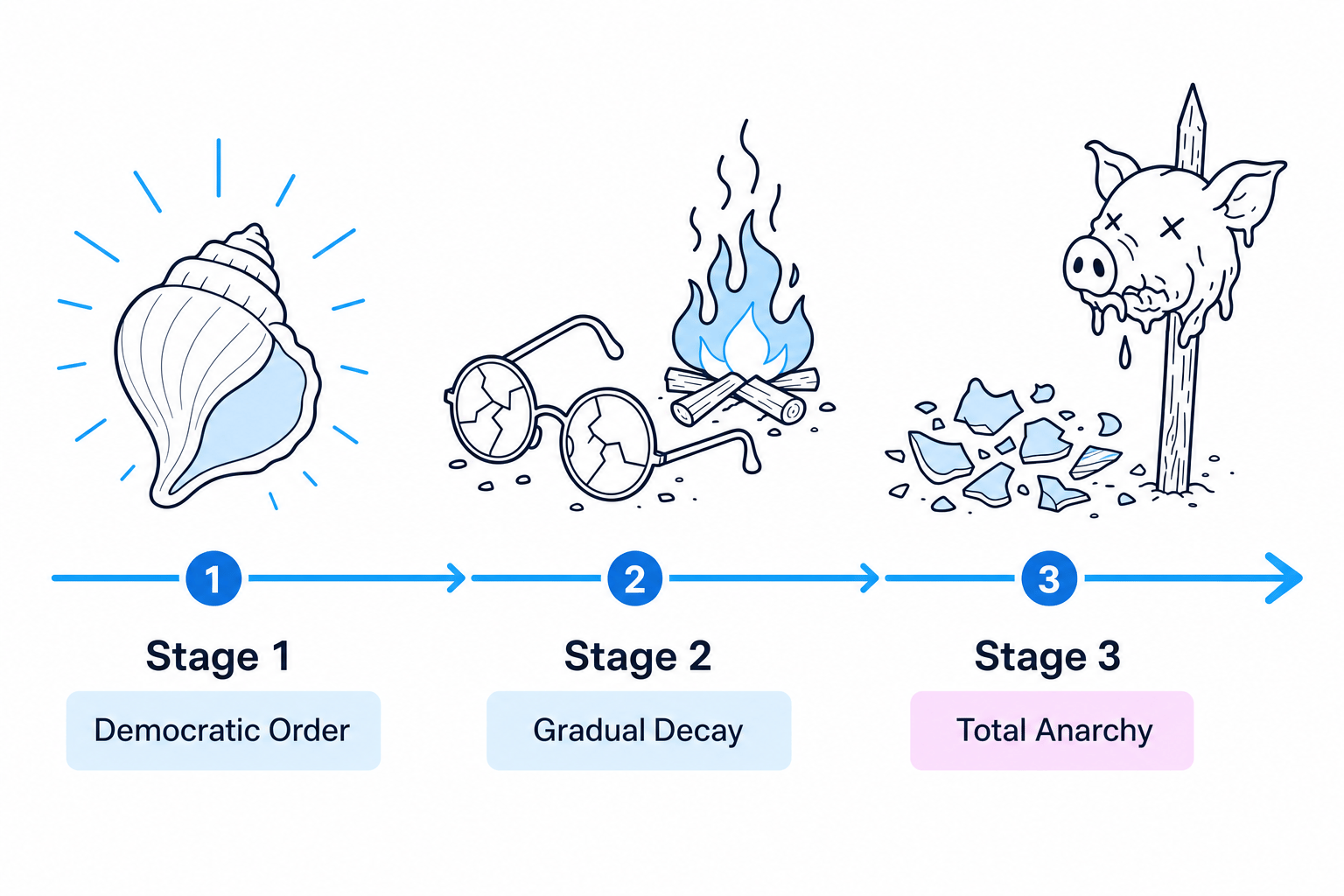
This structure can be divided into three key movements:
Phase 1: The Democratic Rise (Chapters 1–3)
The novel opens with the boys building a democratic society. They elect a leader (Ralph), build shelters, and establish rules using the conch. Golding establishes this civilized structure first so that the reader feels the tragic weight of its eventual loss.
Phase 2: The Splitting of the Microcosm (Chapters 4–8)
The island is a microcosm (a miniature version) of the adult world, which is currently undergoing a nuclear war.
The Microcosm Metaphor
Remember that the boys' descent on the island mirrors the adult world's self-destruction in the nuclear war happening off-stage. Golding is suggesting that adult "civilization" is just as fragile as the boys' society.
In this phase, two distinct tribes emerge:
- Ralph's tribe: Built on democratic values, shelter-building, and keeping the signal fire alive.
- Jack's tribe: Built on hunting, immediate gratification, primal rituals, and fear of "the Beast."
Phase 3: Absolute Savage Anarchy (Chapters 9–12)
Once Simon is murdered in Chapter 9, the moral threshold is crossed. This is the climax of their descent into darkness. The structure shifts from tension and debate to raw, animalistic pursuit:
- Simon's Death (Chapter 9): The killing of the spiritual, intuitive boy.
- Piggy's Death (Chapter 11): The killing of the rational, logical boy, alongside the shattering of the conch.
- The Hunt for Ralph (Chapter 12): The final attempt to eliminate the democratic alternative.
The Cynical Rescue: A Structural Twist
The novel ends with a deus ex machina (an unexpected power saving a hopeless situation)—the arrival of the British Naval Officer.
While Ralph weeps for "the end of innocence," the structural twist is profoundly cynical: the officer rescues the boys from their private war, only to take them back to his battleship to continue fighting a global war. The cycle of human savagery is not broken; it is merely scaled up.
Missing the Adult Mirror
Students often write that the Naval Officer represents a happy ending because "law and order return." In reality, Golding structures this ending to show that the adult world is just as savage as Jack's tribe. The officer is wearing a uniform and carrying a revolver; he is merely a "civilized" hunter.
Worked Example: Analyzing a Symbolic Transition
Let's look at how to construct a high-scoring analytical paragraph (AO2/AO3) focusing on how Golding uses a shift in structure and symbolism to convey his message.
Analyzing a symbolic transition
Task: Analyze how Golding uses the destruction of the conch in Chapter 11 to convey his ideas about civilization and savagery.
-
Formulate your thesis point (What): State clearly how the moment links to Golding's wider structural goals.
Drafting: In Chapter 11, Golding uses the physical destruction of the conch to structurally signal the complete collapse of democratic order and the triumph of savagery.
-
Embed your quote and name the method (How): Select a precise, memorable quote and name the specific literary technique (symbolism, structural placement, word class).
Drafting: During the confrontation at Castle Rock, Roger unleashes a boulder which strikes Piggy: "the conch exploded into a thousand white fragments and ceased to exist." Golding uses the active verb "exploded" to emphasize the sudden, violent end to the rules of the island.
-
Analyze the language and connotations (Why): Explain the deeper symbolic resonance of specific words.
Drafting: The color "white" carries connotations of purity, peace, and innocence. By reducing the conch to "a thousand... fragments," Golding suggests that democracy is fragile and easily shattered when confronted with unchecked, brutal force. The phrase "ceased to exist" has a chillingly absolute tone, emphasizing that once civil order is broken, it cannot be put back together.
-
Link to context/thematic purpose (Author's Message): Connect your analysis to Golding's intentions (AO3) and his view of human nature.
Drafting: Golding, having witnessed the horrors of World War II, believed that human nature was inherently flawed. Through this structural climax, he warns his post-war readers that the thin veneer of civilization is incredibly fragile, and without constant work to maintain it, humanity will inevitably lapse into primitive cruelty.
In the exam
- Avoid "device spotting": Don't just point out a symbol (e.g., "The conch represents democracy"). You must explain how the symbol changes and why that change matters to the overarching plot.
- Contrast the start and the end: High-scoring essays look at structural contrasts. Compare how a symbol is treated in Chapter 1 versus how it is treated in Chapter 11 or 12 to show you understand the novel's journey.
- Use structural terminology: Incorporate terms like climax, foreshadowing, microcosm, structural shift, and resolution to show the examiner you are analyzing form and structure (AO2).
Check yourself
- Why is the conch's color (white) symbolically significant, and how does this contrast with the black caps of the choirboys?
- How does the physical state of Piggy's glasses mirror the declining mental sanity of the boys?
- Explain how the rescue of the boys by a naval officer in Chapter 12 is structurally ironic.
