

Because the GCSE English Literature exam is closed-book, you must memorise key quotations to support your arguments under timed conditions. Rather than memorising entire paragraphs, your goal should be to master a small bank of short, versatile, "high-yield" quotations.
A high-yield quotation is short (usually 2 to 6 words), easy to embed naturally in your writing, and packed with literary devices, thematic depth, and links to historical context.
What you'll learn
- How to select and "explode" high-yield quotations for maximum marks.
- The critical quotations that track the descent from civilisation to savagery.
- How to link language choices directly to William Golding's authorial intent and 1950s context.
The Art of "Exploding" a Quotation
To achieve top marks, you must avoid simply dropping a quote into your essay and moving on. Instead, you need to analyse its mechanics. This is known as "exploding" a quote: examining the writer's deliberate choices, identifying their techniques, and explaining how these choices construct meaning.
Authorial Intent
The reasons why a writer makes specific choices in their work. Instead of treating characters as real people, consider them as constructs designed by Golding to convey a message about human nature, society, or politics.
When analysing a quotation, always consider three layers:
- The Literal Meaning (AO1): What is happening in the narrative when this is said?
- The Micro-Analysis (AO2): What specific language, structural, or grammatical techniques is Golding using? Zoom in on individual words (verbs, adjectives, nouns) and their connotations.
- The Macro-Concept (AO3): How does this quote reflect Golding’s wider themes (e.g., the thin veneer of civilisation, original sin) and the historical context of post-WWII Europe?
The Power of Short Quotes
In a closed-book exam, short quotes of 3–6 words are your best weapon. They are easier to remember, simpler to embed smoothly into your sentences, and force you to zoom in on specific language choices.
Worked Example: Exploding a Quote
Let’s look at how to unpack a pivotal structural moment in the novel: the destruction of the conch and Piggy's death.
Analysing the destruction of the conch
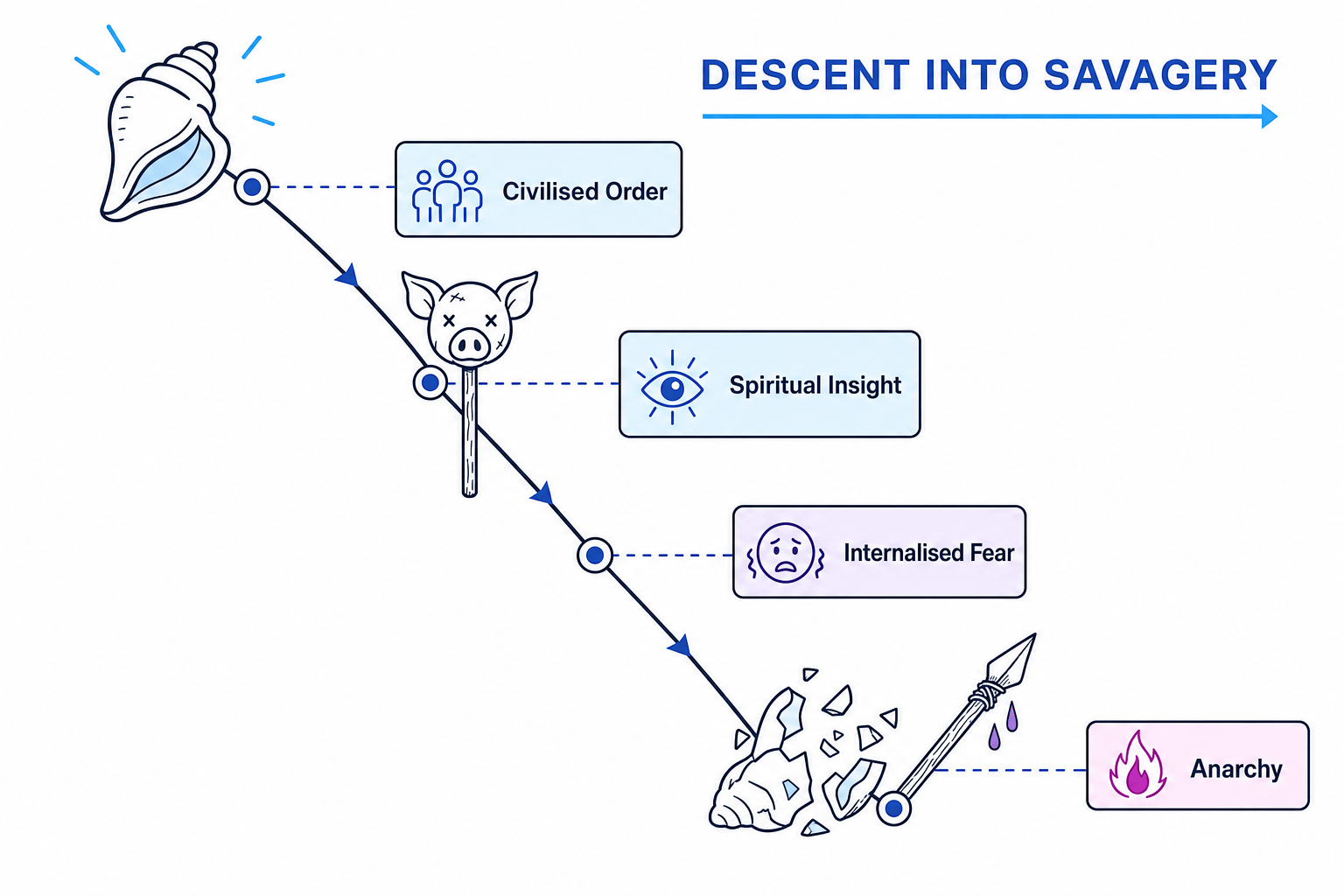
Quotation: "The conch exploded into a thousand white fragments and ceased to exist." (Chapter 11)
- Establish the narrative and thematic context (AO1): Place the quote in the novel's trajectory. This event occurs at Castle Rock immediately after Roger releases the boulder, killing Piggy. It represents the absolute climax of the conflict between Ralph's democratic order and Jack's tyrannical savagery.
- Examine the language and structural methods (AO2): Identify the key techniques and word choices.
- The verb "exploded" suggests a violent, irreversible release of energy, indicating that the breakdown of order on the island is not gradual or gentle, but sudden and destructive.
- The phrase "a thousand white fragments" uses hyperbole to emphasise the utter devastation of their societal structure. The adjective "white" carries connotations of purity, truth, and peace, which are now shattered into meaningless pieces.
- The absolute phrase "ceased to exist" carries a tone of stark finality. Golding uses this to signal that democratic dialogue is no longer possible on the island.
- Connect to authorial intent and context (AO3): Relate these details to Golding's wider message. Golding, having witnessed the horrors of World War II as a Royal Navy officer, uses the total destruction of the conch to argue that human systems of law and order are fragile constructs. Once the moral boundaries of civilisation are broken, they cannot easily be repaired.
Key Quotations: Civilisation vs. Savagery
At the start of the novel, the boys attempt to recreate British democratic systems. However, this structure quickly decays.
Quote 1: Jack's Early Nationalism
"We've got to have rules and obey them. After all, we're not savages. We're English, and the English are best at everything." (Jack, Chapter 2)
- Methods: Dramatic irony, nationalism, jingoistic language.
- Analysis: This quote is highly ironic given Jack's rapid descent into become the tribal "Chief" who leads the hunt for Ralph. Golding exposes the hypocrisy of British imperialist pride. The phrase "the English are best at everything" directly reflects the Victorian-era belief in cultural superiority (a trope common in adventure books like The Coral Island). Golding undercuts this by showing that savagery is not a trait of "primitive" cultures, but an inherent human condition that exists beneath the surface of even the most "civilised" English boys.
Confusing Jack's Motivation
Do not write that Jack loves rules because he is a good citizen. Jack loves rules because they give him a mechanism to punish others. His interest is not in order, but in authority and power.
Quote 2: The Breakdown of Rationality
"The barrier in between, showing both sides, was vanished." (Narrator, Chapter 7)
- Methods: Symbolism of the sea, metaphor, structural positioning.
- Analysis: This line describes Ralph looking out at the vast, cold ocean. The "barrier" represents the dividing line between their isolated, chaotic island life and the safe, structured adult world they left behind. By stating this barrier has "vanished," Golding indicates a psychological shift: the boys are losing their connection to their past lives, their memories of home are fading, and the comforting illusion of rescue is dissolving.
Key Quotations: The Beast and Innate Evil
Golding uses the symbol of "the Beast" to explore the dark capacity for evil present inside every human being.
Quote 3: Simon's Intuition
"Maybe there is a beast... maybe it's only us." (Simon, Chapter 5)
- Methods: Modality ("maybe"), hesitant syntax, foreshadowing.
- Analysis: Simon is the novel's visionary, a Christ-figure who possesses intuitive spiritual knowledge. Unlike the other boys, who look for a physical monster in the air or sea, Simon recognises that the true "Beast" is the capacity for cruelty inside human nature. The repeated, hesitant adverb "maybe" reflects both the difficulty of articulating this profound truth to a hostile audience and the fragile nature of rational thought on the island.
Linking Simon to Context
Simon's insight aligns closely with Golding's own post-WWII philosophy. Golding famously wrote that his experiences in the war taught him that "man produces evil as a bee produces honey." Simon is the vehicle Golding uses to deliver this bleak moral realization to the reader.
Quote 4: The Lord of the Flies Speaks
"You knew, didn't you? I'm part of you? Close, close, close! I'm the reason why it's no go? Why things are what they are?" (The Lord of the Flies, Chapter 8)
- Methods: Colloquial language, rhetorical questions, personification, repetition of "close".
- Analysis: The pig’s head on a stick—the literal "Lord of the Flies" (a translation of the Hebrew Beelzebub, a name for the devil)—speaks to Simon during a fit brought on by his epilepsy. The colloquial phrase "no go" represents the simple, childish frustration of their failed society, contrasting sharply with the terrifying spiritual truth being revealed. The repetition of "close" creates a claustrophobic, inescapable atmosphere, reinforcing the idea that original sin and evil cannot be run away from because they are carried inside us.
Key Quotations: The Loss of Innocence
As the novel draws to a close, the arrival of the naval officer saves Ralph's life but highlights the tragic loss of the boys' moral innocence.
Quote 5: The Darkness of Man's Heart
"Ralph wept for the end of innocence, the darkness of man's heart, and the fall through the air of the true, wise friend called Piggy." (Narrator, Chapter 12)
- Methods: Rule of three (tricolon), elegiac tone, metaphor.
- Analysis: This final emotional release serves as the novel's tragic resolution. Ralph does not cry out of relief at being rescued; instead, he weeps because his experiences have permanently shattered his optimistic view of humanity.
- The abstract noun phrase "the end of innocence" signals the psychological transition from childhood to adulthood.
- The metaphor "the darkness of man's heart" summarizes Golding's central theme: the human soul is inherently flawed.
- The tribute to Piggy as a "true, wise friend" serves as a final, melancholic acknowledgment of the rationalism and loyalty that the boys systematically hunted down and destroyed.
The Irony of the Rescue
Be careful not to view the arrival of the naval officer as a simple "happy ending." The officer represents the adult world, yet he is wearing a uniform and commands a warship. The boys are being rescued from their small war on the island only to be returned to a massive, devastating nuclear war in the adult world. The rescue is deeply ironic.
In the exam
To make the most of your quotations in your AQA paper, use these three strategies:
- Integrate your quotes smoothly: Avoid writing "This is shown in the quote: 'the darkness of man's heart'." Instead, weave the words directly into your own sentences: Ralph's tears reflect his devastating realization of "the darkness of man's heart" and the fragility of human goodness.
- Focus on micro-analysis: Never quote a long sentence if you only plan to talk about one word. Select a short phrase, then explicitly name its word class or literary technique (e.g., "the verb 'exploded' suggests...").
- Always link back to Golding's intent: Use active analytical verbs like demonstrates, exposes, criticises, undercuts, or warns. Frame your analysis around what Golding is warning his post-war readers about.
Check yourself
- Why is Jack's insistence on having rules in Chapter 2 an example of dramatic irony?
- How does the phrase "ceased to exist" in Chapter 11 emphasise the symbolic weight of the conch's destruction?
- What does the name "Lord of the Flies" mean, and how does this translation link to Golding's presentation of the Beast?
