

In your GCSE English Literature exam, you will be assessed on your ability to write a cohesive, analytical essay about a key theme or character in Princess & The Hustler. Understanding how Chinonyerem Odimba uses drama to explore deep social, political, and personal ideas is essential for achieving top marks.
This guide breaks down the core themes of the play, links them to Odimba's dramatic methods, and connects them directly to the historical context of 1963 Bristol.
What you'll learn
- How to analyze the conflict between Eurocentric beauty standards and Black identity.
- How the historical context of the Bristol Bus Boycott drives the play's dramatic tension.
- How Odimba uses family dynamics and domestic symbols to explore wider socio-political struggles.
The Landscape of the Play: Key Themes
At its heart, Princess & The Hustler is a domestic drama that plays out against the backdrop of a major national civil rights moment. Rather than separating the personal from the political, Odimba shows how national events crash directly into the living room of a working-class Black British family.
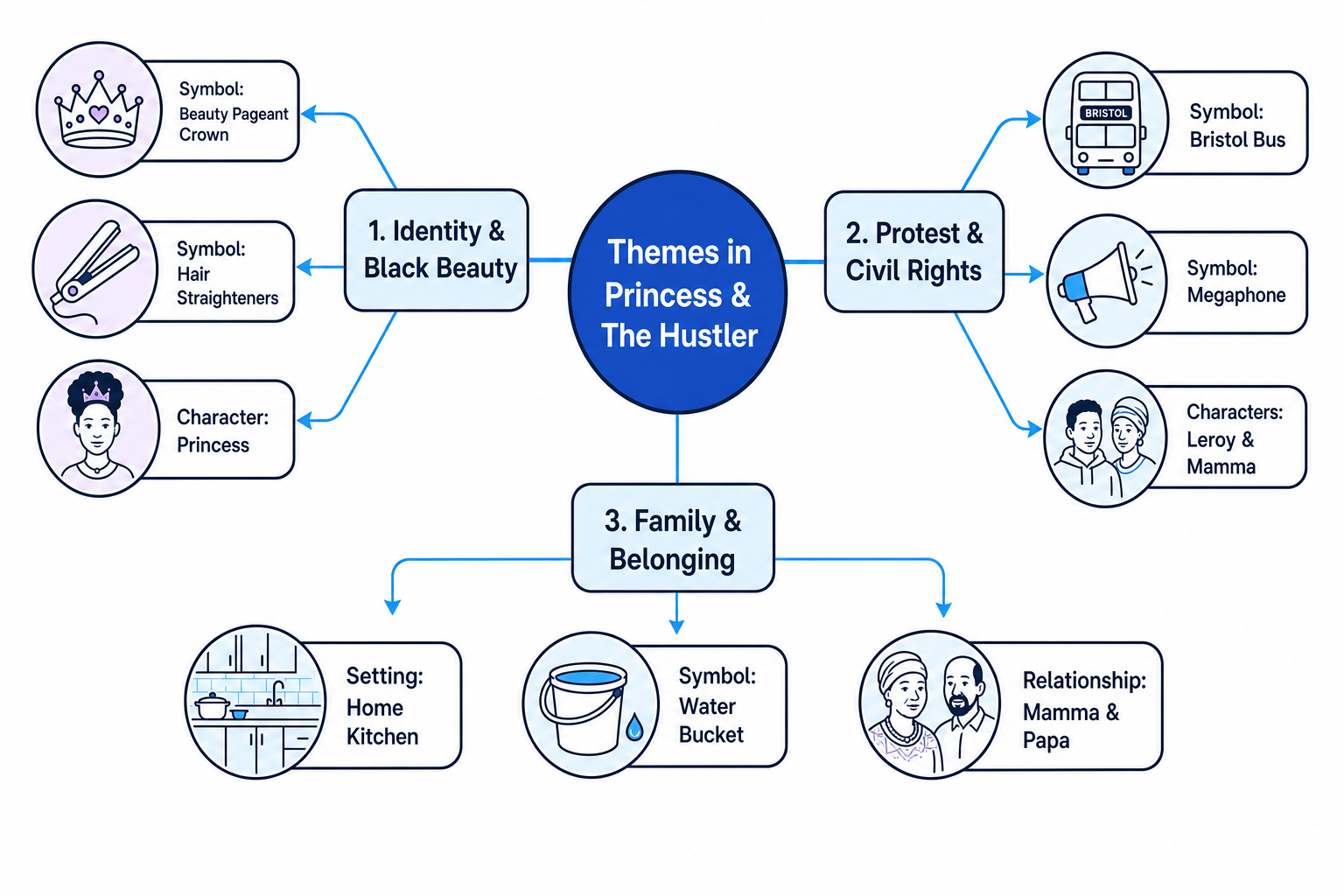
Theme 1: Identity and Black Beauty
The play is set in 1963, a time when Black people in Britain faced pervasive racism, and mass media almost exclusively celebrated white, Eurocentric features. Through the protagonist, ten-year-old Princess, Odimba explores how young Black children internalize these damaging societal messages.
Princess’s Conflict: The Pageant and the Doll
Princess is obsessed with the Weston-super-Mare beauty pageant. She equates being "beautiful" and "a princess" with having white skin and blonde hair. This is symbolized by her relationship with her doll and her desire to look like the girls she sees on television.
Odimba uses Princess's child-like perspective to expose the insidious nature of institutional prejudice. Princess does not understand the political forces around her, but she experiences their psychological effects.
Colorism
Colorism is a form of prejudice or discrimination in which people with lighter skin tones are treated more favorably than those with darker skin tones. It can occur both across different racial groups and within the same racial community.
The Symbolism of the Crown
The "crown" represents multiple things in the play:
- The Pageant Crown: Initially, a symbol of conformity to white standards of beauty and social validation.
- The Natural Crown: By the end of the play, the crown becomes a symbol of natural Black hair, self-love, and cultural pride.
When Mamma (Phyllis) and Princess's grandmother help Princess see the beauty in her natural, dark skin and coiled hair, the play shifts. The physical act of styling hair on stage becomes a sacred, political act of reclaiming identity.
Beauty as a Battleground
In Princess & The Hustler, beauty is not superficial; it is highly political. Reclaiming Black beauty is presented as a crucial first step toward self-liberation and resisting racial oppression.
Theme 2: Protest and Civil Rights
The historical backdrop of the play is the Bristol Bus Boycott of 1963. This was a real-world protest led by West Indian immigrants against the Bristol Omnibus Company, which refused to employ Black or Asian bus crews.
Active vs. Passive Protest
Odimba uses the family unit to dramatize different responses to racial injustice:
- Leroy (The Hustler): Represents the activist, radical stance. He is willing to risk his livelihood, his marriage, and his physical safety to stand on the front lines of the boycott. He believes that change only comes through direct, visible confrontation.
- Mamma (Phyllis): Represents a pragmatic, survivalist stance. As a mother carrying the domestic burden, her priority is keeping her family safe, fed, and housed in a hostile host country. To Phyllis, Leroy's activism looks like reckless self-indulgence that threatens their survival.
Dramatic Foil
A dramatic foil is a character who contrasts with another character (usually the protagonist or another major figure) to highlight particular qualities of the other character.
Phyllis and Leroy act as dramatic foils for one another. Their arguments about the boycott reveal the complex internal debates within the Windrush generation: is it better to "keep your head down" to survive, or to stand up and fight for systemic change?
Context Integration (AO3)
Never treat historical context like a history lesson dropped into your essay. Always link the Bristol Bus Boycott directly to the characters' psychological states. For example, explain how Phyllis’s fear of eviction is a direct result of the "No Irish, No Blacks, No Dogs" housing discrimination of 1960s Britain.
Theme 3: Family, Gender, and Domesticity
While the men in the play often focus on the public sphere of politics and "hustling," the women carry the physical and emotional weight of maintaining the home.
The Symbolic Burden of Water
One of the most powerful recurring symbols in the play is the bucket of water. Because their rented home lacks modern indoor plumbing, Phyllis must constantly carry heavy buckets of water up and down the stairs to wash her children and keep the house clean.
This physical struggle symbolizes:
- The systemic inequality and poor housing conditions endured by Caribbean immigrants.
- The exhausting, unglamorous labor of Black women, who keep their families afloat while the men are out engaging in public protests or business ventures.
- The cleansing of trauma and the struggle to maintain dignity in a society that treats Black families as "dirty" or unwelcome.
Worked Example
Analyzing how Odimba uses symbolism to present the theme of racial identity
Below is a step-by-step process of constructing a high-scoring analytical paragraph showing how Odimba uses the character of Princess and key symbols to explore identity.
-
Deconstruct the prompt and formulate a clear point: Begin with a thesis-driven topic sentence that links a character's journey to the playwright's overarching message about identity.
Drafting: "Odimba uses Princess's childhood innocence and her obsession with the beauty pageant to symbolize the damaging impact of Eurocentric beauty standards on young Black girls in 1960s Britain."
-
Integrate precise textual evidence (the quote): Introduce a short, memorable quotation naturally within your sentence structure, detailing the dramatic context.
Drafting: "This is made clear early in the play when Princess declares her desire to be 'light' and win the pageant, asserting, 'I want to be a princess, a real one' with 'golden hair'."
-
Analyze the writer's methods (AO2): Identify specific literary or dramatic devices (such as symbolism, contrast, or dialogue) and explain how they construct meaning.
Drafting: "Odimba uses the adjective 'real' to create a powerful sense of dramatic irony; the young child has been socialized to believe that her own natural Black features make her 'unreal' or invalid. The symbol of the 'golden hair' represents the unattainable standard of white femininity that Princess feels she must emulate to receive love and recognition."
-
Connect the analysis to historical or social context (AO3): Explain why the writer chose to highlight this issue at this specific point in British history.
Drafting: "This internal conflict reflects the wider post-Windrush immigrant experience, where assimilation was often viewed as a survival mechanism, and mainstream British media reinforced the idea that Blackness was synonymous with exclusion."
-
Conclude by linking back to the playwright's purpose: Summarize how this specific moment contributes to the play’s final message.
Drafting: "Through this symbolic struggle, Odimba highlights that the fight for civil rights was not just fought on buses and streets, but inside the minds of young Black children reclaiming their self-worth."
The 'Device Spotting' Trap
Do not just label a device and move on (e.g., "Odimba uses a metaphor here."). If you spot a symbol, like the water bucket or the crown, you must explain why it matters to the characters and how it affects the audience. Analysis should always follow the format: Method →\rightarrow→ Meaning →\rightarrow→ Effect on Audience.
In the exam
- Focus on the Question: Underline the key thematic word in the essay prompt (e.g., protest, family, prejudice). Every paragraph you write must explicitly link back to this word.
- Track the Dramatic Arc: Themes are not static; they change. Show how a theme develops from the exposition (the start) through the climax to the resolution (the end). For example, analyze how Princess's view of her own identity transforms from self-rejection to self-celebration.
- Remember it is a Play: Always refer to Odimba as "the playwright" or "the writer." Describe how actions, props, and set designs (like the kitchen setting or the physical act of combing hair) convey themes to a live audience.
Check yourself
- Can you explain how the physical setting of the family home reflects the thematic tension between domestic survival and public political protest?
- Why is the Bristol Bus Boycott structurally important to the personal conflicts occurring between Phyllis and Leroy?
- What does Princess's final decision regarding the beauty pageant reveal about her character development and Odimba's message regarding Black beauty?
