What you'll learn
- How Shakespeare develops the main themes in Much Ado About Nothing.
- How themes overlap: love connects to deception, honour, gender and language.
- How to use short, memorable quotations in a closed-book AQA exam.
- How to turn a theme into a clear argument, not just a topic.
Starting point: what is a theme?
Theme
A theme is a repeated big idea in a text. In an essay, you should not just name the theme, such as “love”; you should make an argument about what Shakespeare suggests about it, such as: Shakespeare presents love as strongest when it is based on trust rather than appearances.
A writer’s method is a deliberate choice made by the writer. In Shakespeare, this includes language — the words and images characters use — form — the type of text, here a stage comedy — and structure — the order of events, such as deception leading to crisis and then reconciliation.
Much Ado About Nothing is a comedy, meaning a dramatic form that usually moves from confusion and conflict towards marriage, forgiveness and social harmony. However, Shakespeare makes the comedy darker by showing how quickly jokes, rumours and “noting” can damage someone’s life.
Use this map to see how the main themes connect. Notice that the themes are not separate boxes in an essay: the best answers link them together.
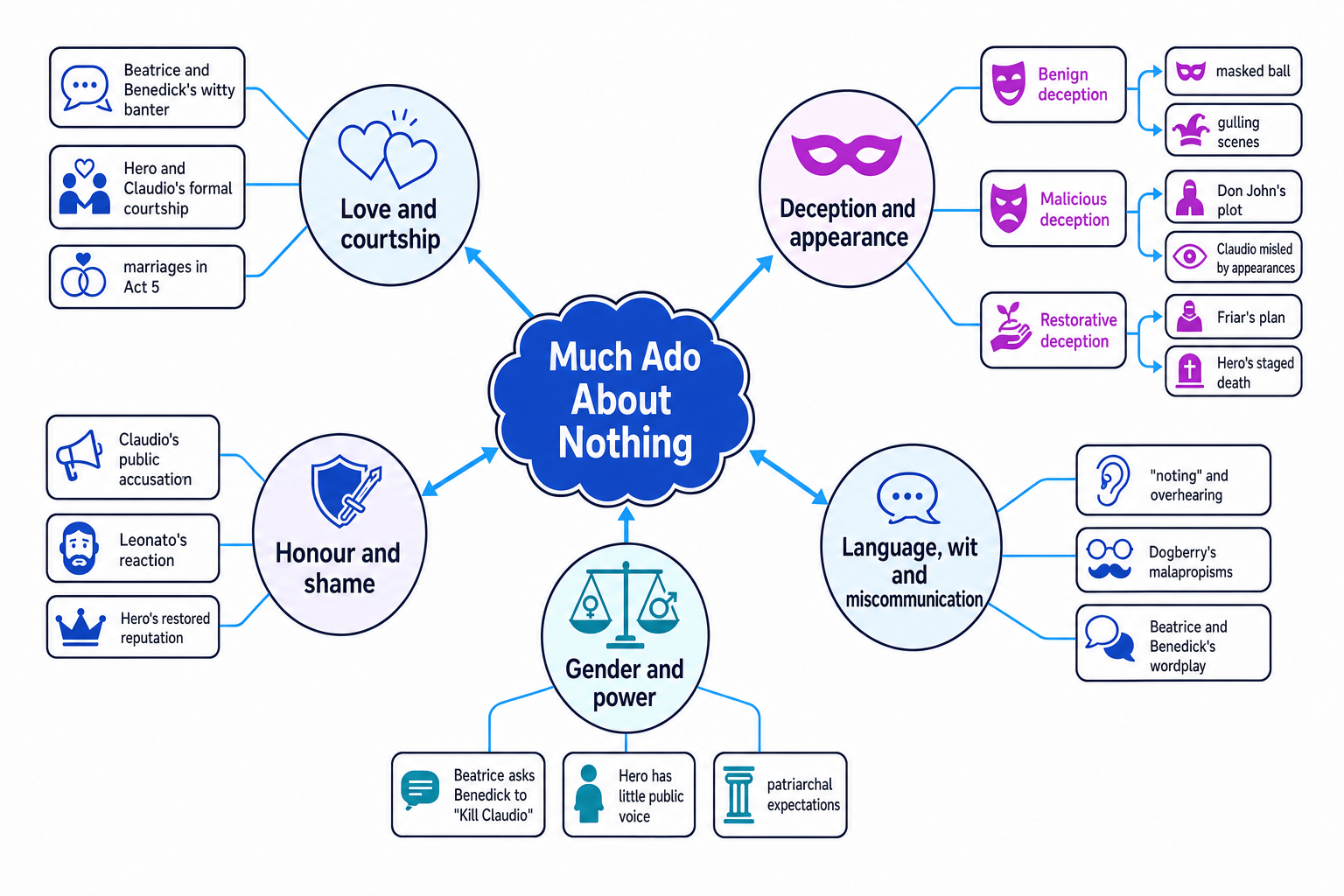
Love and courtship
Courtship means the process of seeking or choosing a romantic partner, especially before marriage. Shakespeare presents two contrasting kinds of courtship.
Hero and Claudio’s relationship is formal and public. Claudio falls for Hero quickly, but he also believes Don John’s deception quickly. Their love depends heavily on reputation and appearance.
Beatrice and Benedick’s relationship is different. They begin with witty insults and verbal competition. Beatrice says, “I had rather hear my dog bark at a crow than a man swear he loves me” in Act 1 Scene 1. Her hyperbole — deliberate exaggeration — makes her sound comic and independent, but it also suggests she distrusts men’s romantic promises.
Reading Beatrice's scepticism
-
Start with the quotation: “I had rather hear my dog bark at a crow than a man swear he loves me.” Beatrice does not simply reject one man; she mocks the whole idea of men “swearing” love.
-
Analyse the method: the comic animal image of a “dog” barking at a “crow” makes romance sound irritating and ridiculous. The hyperbole shows Beatrice using humour as protection.
-
Link to the theme: Shakespeare presents love as something Beatrice resists until it becomes honest and equal. Her later relationship with Benedick feels stronger because it grows from knowledge of each other, not just appearance.
By Act 4 Scene 1, Benedick can say, “I do love nothing in the world so well as you.” The simple emotional confession contrasts with his earlier witty performance. Structurally, Shakespeare moves their love from mockery to loyalty.
Deception, appearance and “noting”
A pun is wordplay using different meanings or sounds of a word. The title Much Ado About Nothing plays on “nothing” and “noting” — observing, overhearing and judging. A motif is a repeated idea or image; “noting” becomes a motif because so much of the plot depends on watching, overhearing and misreading.
Deception in the play is morally mixed. Some deception is comic and helpful: the gulling scenes trick Beatrice and Benedick into admitting love. Some deception is malicious: Don John tricks Claudio into believing Hero is unfaithful. Some deception is restorative: Friar Francis stages Hero’s “death” to reveal truth and repair her reputation.
Dramatic irony
Dramatic irony happens when the audience knows more than one or more characters on stage. In Much Ado About Nothing, the audience understands Don John’s plot, so Claudio’s certainty about Hero looks dangerously foolish.
Comparing helpful and harmful deception
-
Hero says, “Some Cupid kills with arrows, some with traps” in Act 3 Scene 1. The metaphor — describing one thing as another — presents love as a trap, but this trap is designed to help Beatrice recognise her feelings.
-
Don John says, “I am a plain-dealing villain” in Act 1 Scene 3. The phrase sounds honest, but he uses appearances to manipulate others, making his “plain-dealing” deeply ironic.
-
The comparison gives you an argument: Shakespeare does not present all deception as equally bad. He judges deception by motive and consequence — it can reveal truth, but it can also destroy trust.
Deception is morally ambiguous
In this play, deception is not automatically evil. Shakespeare contrasts playful tricks, villainous plots and restorative lies to ask whether appearances can ever lead people towards truth.
Honour, shame and reputation
Honour means public reputation and social respect. In Messina, a woman’s honour is strongly linked to chastity, meaning sexual purity before marriage. This is important context: Claudio does not just accuse Hero privately; he shames her publicly at the wedding.
In Act 4 Scene 1, Claudio rejects Hero with the brutal metaphor, “Give not this rotten orange to your friend.” He treats Hero like spoiled property being passed between men. The image suggests she looked attractive on the outside but was corrupt inside — which is exactly the false appearance Don John has created.
Leonato’s response is also shocking. He says, “Death is the fairest cover for her shame” in Act 4 Scene 1. This shows how reputation can matter more than compassion in a patriarchal society.
Patriarchy
A patriarchal society is one where men hold most legal, social and family power. In the play, fathers, husbands and male friends largely control women’s public reputations.
Linking honour to gender
-
Focus on Claudio’s phrase “rotten orange”. The metaphor reduces Hero to an object that can be accepted or rejected by men.
-
Connect this to context: in a patriarchal culture, a woman’s reputation affects her family’s honour and her marriage prospects, so the public accusation is socially devastating.
-
Use dramatic irony: because the audience knows Hero is innocent, Shakespeare exposes the cruelty of a society that trusts male accusation more than female truth.
Calling Claudio simply evil
It is stronger to argue that Claudio behaves cruelly because he values public honour and male approval over trust. That lets you analyse Shakespeare’s society as well as the character.
Gender and power
Shakespeare gives Beatrice a powerful voice, but he also shows the limits placed on her because she is a woman. After Hero is shamed, Beatrice cries, “O that I were a man!” in Act 4 Scene 1. The exclamation shows frustration: she wants the social power to challenge Claudio directly.
Her command “Kill Claudio” is an imperative, meaning a command verb. It tests Benedick’s love, but it also challenges the male honour system. Beatrice cannot fight Claudio herself, so she pushes Benedick to turn private love into public action.
Hero, by contrast, has very little public voice in the church scene. This contrast matters: Beatrice speaks fiercely, while Hero is spoken about and judged.
Gender shapes who gets believed
The play shows that women can be intelligent, loyal and truthful, but their voices are often controlled or doubted by men with social power.
Language, wit and miscommunication
Language is not just decorative in this play; it drives the plot. Beatrice and Benedick use wit as a shield and as a form of attraction. When Beatrice says to Benedick, “nobody marks you” in Act 1 Scene 1, she attacks his pride while also playing with the idea of being noticed or “marked”.
Dogberry creates comedy through malapropisms, which are mistaken words that sound similar to the intended word. For example, he says “comparisons are odorous” in Act 3 Scene 5, when he means “odious”. His language is ridiculous, but he and the Watch accidentally uncover the truth that the nobles miss.
Writing about comic language
Do not stop at “this is funny”. Explain what the comedy reveals: Shakespeare often lets foolish characters expose truths that clever, high-status characters fail to see.
Remember the core argument
The themes work together like this: love needs trust, but trust is easily damaged by appearances; honour culture makes that damage public and cruel; gender decides whose voice is believed; language can both hide and reveal truth.
In the exam
-
Start with a clear thematic argument, such as: “Shakespeare presents deception as dangerous when it serves pride, but useful when it reveals truth.”
-
Use short quotations you can remember accurately: “rotten orange”, “Kill Claudio”, “plain-dealing villain”, “Some Cupid kills with arrows”.
-
Always connect method to meaning: name the metaphor, imperative or dramatic irony, then explain what it shows about the theme.
-
Track change across the play: beginning, crisis and ending. Shakespeare’s comedy moves from witty conflict to social disorder and finally to reconciliation.
-
On the Shakespeare question, leave time to check spelling, punctuation and sentence clarity, because written accuracy is assessed.
Check yourself
- How does Shakespeare contrast Beatrice and Benedick’s love with Hero and Claudio’s?
- In what ways can deception be helpful as well as harmful in the play?
- Why is the church scene so important for the themes of honour, gender and reputation?
