

In your AQA GCSE English Literature exam, AO3 (Context) accounts for a significant portion of your marks for the modern drama question.
For Princess & The Hustler, context is not just "background information"—it is the engine that drives the plot, shapes the characters' identities, and dictates their conflicts. Chinonyerem Odimba’s 2019 play is set in a very specific historical moment: Bristol in 1963. To write a top-tier essay, you must understand how the political struggles of this era mirror the personal struggles of the Smith family.
What you'll learn
- How the 1963 Bristol Bus Boycott serves as the political backdrop and catalyst for the play's action.
- How the experiences of the Windrush Generation shape the generational divides, dreams, and hardships of the Smith family.
- How Eurocentric beauty standards in 1960s Britain influence Princess’s search for self-love and identity.
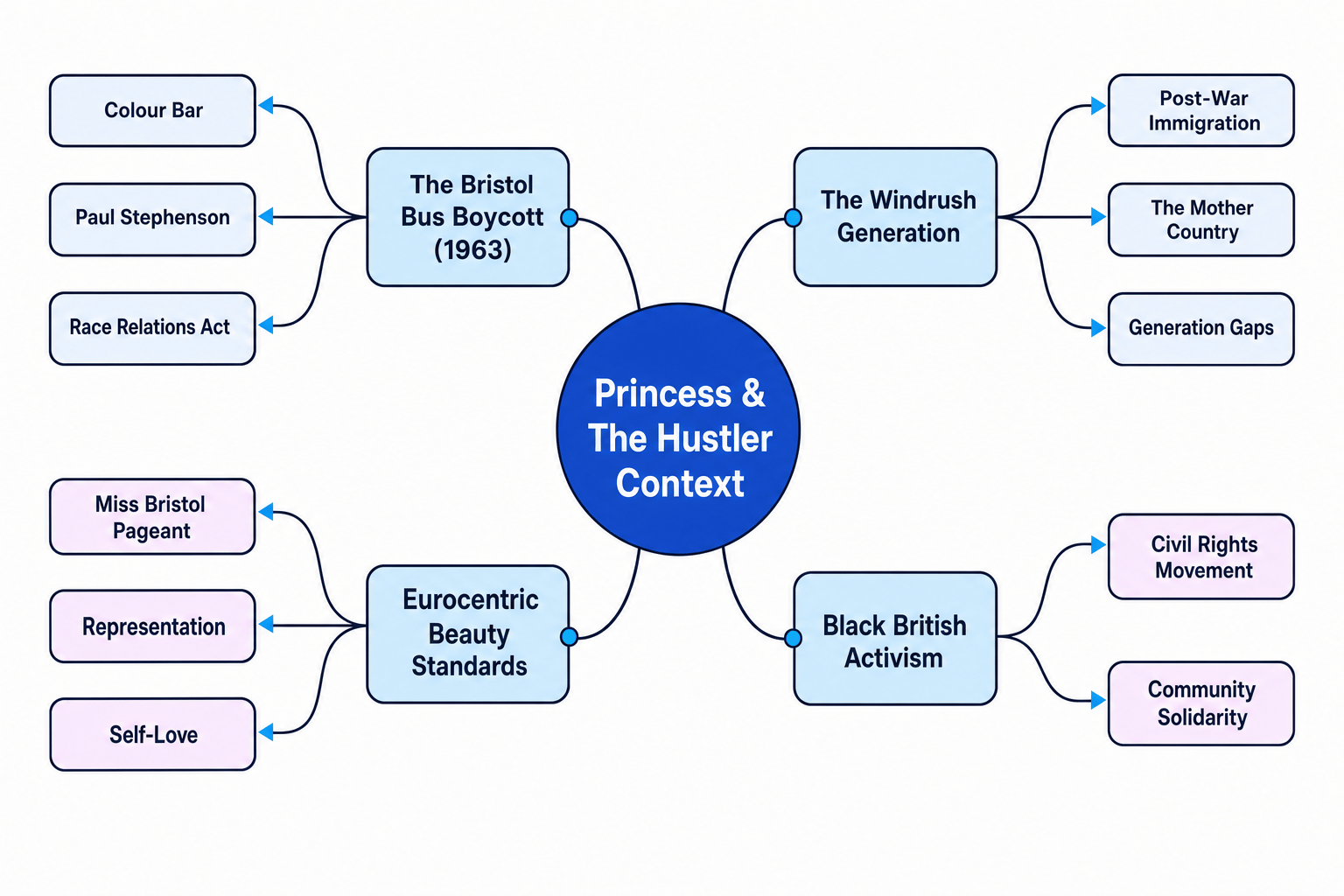
The Bristol Bus Boycott (1963)
At the heart of Princess & The Hustler is the Bristol Bus Boycott, a pivotal moment in British civil rights history.
Boycott
A boycott is a punitive ban on relations with a product, organization, or country as a way of protesting against its policies.
Colour Bar
The colour bar was a social and legal system of racial discrimination and segregation prevalent in 20th-century Britain, where Black and Asian people were barred from certain jobs, housing, and social spaces.
The Historical Event
In 1963, the Bristol Omnibus Company refused to employ Black or Asian bus crews, enforcing a strict, unofficial "colour bar". This was legal at the time, as Britain did not yet have laws against racial discrimination in employment.
Led by youth worker Paul Stephenson and the West Indian Development Association, Bristol's Caribbean community organized a boycott of the company's buses. Inspired directly by Rosa Parks and the US Civil Rights Movement, the boycott began in April 1963. It lasted for four months, drawing national attention to systemic racism in Britain.
The boycott successfully ended on 28 August 1963—the very same day Martin Luther King Jr. delivered his famous "I Have a Dream" speech in Washington, D.C. This victory was a major catalyst for the creation of the Race Relations Act of 1965, which finally outlawed public discrimination in the UK.
How Odimba Uses This in the Play
The boycott is not just a historical event happening off-stage; it divides the Smith household.
- Bruce (the "Hustler") becomes deeply involved in the activism. For him, the boycott is a chance to stand up and demand the dignity he has been denied.
- Mavis (Mamma) is terrified of the consequences. She fears that drawing attention to themselves will result in violence, job losses, or deportation.
- Princess is caught in the middle, trying to understand why her brother is fighting and why her mother is so afraid.
Microcosm of a Macro-political Struggle
Odimba uses the domestic space of the Smith family home as a microcosm (a miniature world) to represent the wider political conflicts of 1963 Britain. The family's kitchen table discussions mirror the debates happening across the entire nation.
The Windrush Generation and the "Mother Country"
To understand why the characters act and feel the way they do, you must understand their history as immigrants.
Windrush Generation
The Windrush Generation refers to the people arriving in the UK from Caribbean countries between 1948 and 1971. The name comes from the ship HMT Empire Windrush, which brought one of the first large groups in 1948.
The Dream vs. The Reality
Following World War II, the British government actively invited citizens from the British Empire (including the Caribbean) to move to the UK to help rebuild the war-torn country.
Many Caribbean people grew up receiving a colonial British education. They were taught that Britain was the "Mother Country"—a place of wealth, safety, and opportunity where they would be welcomed as British citizens.
However, upon arrival, they faced intense hostility. They were met with:
- Systemic housing discrimination (often summarized by the infamous signs: "No Irish, No Blacks, No Dogs").
- Employment barriers, where highly qualified professionals were forced to take low-paid, manual labor jobs.
- Everyday racism and physical violence.
The Impact on the Smith Family
This history explains the psychological weight carried by the characters:
- Mavis carries the exhaustion of trying to survive in a hostile environment. She clings to respectability and hard work as armor against racism.
- Hustler (Bruce's father) is defined by his inability to find stable, dignified work. His "hustling" is a direct survival mechanism because the legitimate British job market is closed to him due to his race.
- Lorna represents the younger, British-born generation who feel a disconnect between their parents' Caribbean roots and their own lives growing up in Bristol.
The 'Mother Country' Illusion
Think of the "Mother Country" myth as a cruel trick. Imagine being invited to a family reunion by a relative who claims to love you, only to arrive and find they won't let you sit at the table, make you do all the chores, and force you to sleep in the cold. This sense of betrayal is exactly what the Windrush immigrants felt.
Eurocentric Beauty Standards and the Pageant
While the boys are fighting the bus company, Princess is fighting her own battle: she wants to enter the "Miss Bristol" beauty pageant.
Eurocentric Beauty Standards
Eurocentric beauty standards are beliefs that prioritize European physical traits—such as fair skin, straight hair, and slim features—as the universal standard of beauty, while devaluing the features of other racial groups.
Beauty Pageants in the 1960s
In 1963, beauty pageants like "Miss World" and local pageants like "Miss Bristol" were highly popularized cultural events, watched by millions on television. However, these pageants strictly celebrated white, Eurocentric physical traits.
A dark-skinned Black girl like Princess entering a local beauty pageant in 1963 was not just a childhood fantasy—it was a radical, political act. It challenged the dominant cultural narrative that Black women were invisible, undesirable, or unworthy of being celebrated.
Princess’s Journey to Self-Love
Princess’s obsession with the pageant is her way of seeking validation in a world that tells her she doesn't belong.
- At the start, she tries to copy white beauty standards (using flour on her face to look lighter, or obsessing over straight hair).
- By the end of the play, her journey mirrors the rise of the "Black is Beautiful" movement of the late 1960s. She learns to embrace her natural hair and dark skin, realizing that she does not need a white system's permission to be beautiful.
Dismissing the Pageant as 'Trivial'
Do not make the mistake of writing off Princess’s pageant plotline as a silly, childish subplot. Odimba uses the pageant to show how racism affects a child's psychological development. It is just as politically significant as the bus boycott because it represents the fight for internal, mental liberation.
Worked Example: Integrating Context and Analysis
In the exam, you must never simply write down historical facts. You must link context directly to Odimba’s language and dramatic methods (AO2) and your overall argument (AO1).
Here is how to build a high-scoring analytical paragraph step by step.
Analysing the impact of the colour bar on the Smith family
Question: Explore how Odimba presents the struggles of the Smith family in Princess & The Hustler.
- Step 1 — Formulate a thesis-driven point linking a character’s struggle to historical context.
Drafting: Odimba presents the psychological toll of the British "colour bar" through Hustler’s inability to secure stable, dignified employment, forcing him to rely on unlawful means to support his family. - Step 2 — Embed a precise, memorable quotation.
Drafting: Hustler defends his lifestyle to Mavis by asserting his pride, claiming, "I am a man, Mavis. I have to find a way to be that." - Step 3 — Analyse Odimba's language and dramatic methods (AO2).
Drafting: The noun "man" carries immense weight in this dialogue, signifying not just gender, but adult dignity, independence, and agency. Odimba’s use of short, declarative sentences emphasizes Hustler's desperation; he is stripped of his identity by a racially hostile society that infantiles and excludes Black men. - Step 4 — Synthesise the analysis with the specific historical context (AO3).
Drafting: This highlights the harsh reality of the Windrush experience in 1963 Bristol. Despite being invited to rebuild the "Mother Country," immigrants faced systemic employment discrimination. By showing Hustler’s desperation to "be a man," Odimba exposes how the post-war British colour bar did not just cause financial poverty, but actively eroded the dignity of Black fathers.
The 2019 Perspective
Always remember that Odimba wrote this play in 2019, looking back at 1963. She is writing for a modern audience who already knows the outcome of the civil rights movement. This allows her to use dramatic irony—we know the boycott will succeed and change British history forever, even when the characters on stage are filled with doubt and fear.
In the exam
- Never use "history-dumping": Only bring up the Bristol Bus Boycott, Paul Stephenson, or the Windrush Generation if you can tie them directly to a character's dialogue, stage directions, or a key scene.
- Use precise historical terminology: Use terms like colour bar, Mother Country myth, Windrush Generation, and Eurocentric beauty standards rather than just saying "the racism back then."
- Focus on the playwright's intent: Use verbs like Odimba exposes, Odimba challenges, Odimba parallelizes, or Odimba dramatizes to show that you recognize the play as a constructed piece of art designed to deliver a message about society.
Check yourself
- Why did the organizers of the Bristol Bus Boycott choose to use a boycott rather than other forms of protest, and who inspired them?
- How does Mavis's fear of the protests reflect the broader social anxieties of the Windrush Generation in 1963 Britain?
- In what ways does Princess's desire to enter the "Miss Bristol" pageant reflect her internal struggle with Eurocentric beauty standards?
