

What you'll learn
- How a strong Princess & The Hustler essay is built from a clear argument, not just a list of points.
- How to use short textual references, stagecraft, context and writer’s methods together.
- How to shape model paragraphs that meet GCSE English Literature expectations.
- How to avoid common mistakes when writing about a modern drama text.
What makes a “model essay”?
A model essay is not something to memorise word-for-word. It is a guide to how excellent responses are shaped: clear argument, precise evidence, method analysis, and relevant context.
For Princess & The Hustler, your best essays should show that you understand Odimba’s play as both a family drama and a political drama. The private world of Princess’s family is connected to the public world of 1960s Bristol, racism, beauty standards, protest and Black British identity.
Thesis
A thesis is your overall argument about the question. It should answer the question directly and give the examiner a sense of the line of argument you will develop across the essay.
A weak essay says: “Odimba presents racism in lots of ways.”
A stronger essay says: “Odimba presents racism as both a public system, seen through the Bristol Bus Boycott, and a private pressure that shapes how Princess sees her own beauty and worth.”
That second version is better because it gives you a route through the whole essay.
Use this structure as a blueprint for building your answers.
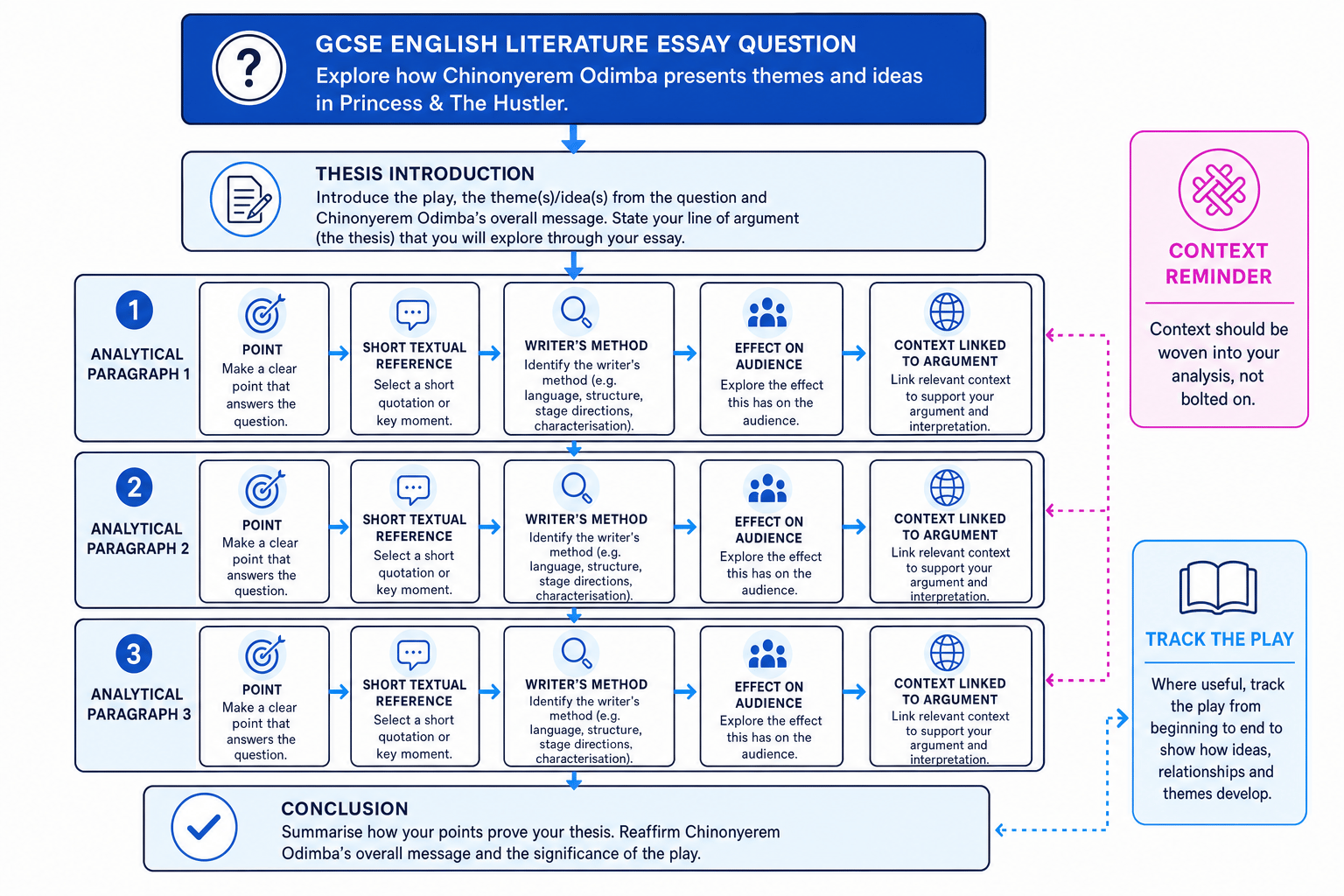
Start with the question, not the plot
In a GCSE Literature essay, you are not rewarded for retelling the story. You are rewarded for making an informed argument about how the writer presents an idea.
AO1
AO1 means making a clear, thoughtful response to the question, supported by references to the text. In practice, this means every paragraph should answer the question, not simply describe what happens.
If the question asks about identity, do not begin by writing everything you know about Princess. Begin with what Odimba suggests about identity.
For example:
- Identity is shaped by family.
- Identity is shaped by racism and social expectations.
- Identity can also become a source of pride and resistance.
Then choose moments from the play that prove those ideas.
Turning a topic into an argument
- Start with the topic: identity.
- Narrow it into Odimba’s message: identity in the play is not fixed; it is shaped by family, racism, beauty ideals and political resistance.
- Turn that message into a thesis: Odimba presents identity as something Princess must learn to value for herself, despite living in a society that often devalues Blackness.
A strong introduction
Your introduction should be short but purposeful. Aim for 2–4 sentences.
A useful pattern is:
- Name the writer and text.
- Answer the question directly.
- Mention the main ideas you will explore.
- Briefly gesture towards context if relevant.
Model introduction: identity
In Princess & The Hustler, Chinonyerem Odimba presents identity as something shaped by family, racism and resistance. Through Princess’s desire to be seen as beautiful and valued, Odimba explores the pressures placed on a young Black girl in 1960s Bristol. However, the play also suggests that identity can become empowering when characters recognise their history, community and self-worth.
This introduction works because it does not retell the plot. It sets up an argument.
Keep introductions controlled
You do not need to include quotations in the introduction. Save your precise textual references for the main paragraphs, where you can analyse them properly.
Building analytical paragraphs
Each main paragraph should do more than make a point. It should develop an idea.
A reliable structure is:
- Point: answer the question.
- Evidence/reference: use a short quotation, stage direction, character moment or title reference.
- Method: name what Odimba is doing as a playwright.
- Effect: explain what the audience understands or feels.
- Link: connect back to the question and wider meaning of the play.
AO2
AO2 means analysing the writer’s methods. In drama, this includes dialogue, stage directions, symbolism, contrast, structure, setting, entrances and exits, silence, costume, props and how characters are positioned on stage.
Because Princess & The Hustler is a play, remember to write about it as something performed, not just read.
Model paragraph: the title
The title Princess & The Hustler immediately presents identity through contrast. The noun “Princess” suggests childhood, aspiration and a desire to be recognised as special, while “Hustler” suggests survival, performance and the need to navigate a hostile world. Odimba’s use of juxtaposition places innocence beside struggle, showing that Princess’s dreams do not exist separately from the social pressures around her. For an audience, the title prepares us to see personal identity and public hardship as connected. This is especially important in the context of 1960s Bristol, where Black British people faced discrimination in housing, work and public life.
Notice that this paragraph uses the title as evidence. That is completely valid because titles are deliberate writer’s choices.
Analyse choices, not labels
Do not just name a method and move on. Explain why Odimba uses that method and how it shapes the audience’s understanding.
Using context without bolting it on
Context is important in Princess & The Hustler, especially because the play is set during the Bristol Bus Boycott of 1963. However, context should support your analysis, not replace it.
AO3
AO3 means understanding the relationship between the text and its context. For this play, useful context includes 1960s Bristol, the colour bar on buses, migration from the Caribbean, racism in post-war Britain, and Black British resistance.
A bolted-on context sentence sounds like this:
“Also, the Bristol Bus Boycott happened in 1963.”
A better version links context to meaning:
“By placing Princess’s private worries about beauty and belonging against the Bristol Bus Boycott, Odimba shows that racism affects both public institutions and intimate family life.”
Context dumping
Do not write a history paragraph that forgets the play. Every contextual point should help explain Odimba’s characters, themes or dramatic choices.
Model paragraph: private and public racism
Odimba presents racism as both public and personal. The setting of 1963 Bristol connects the family’s story to the Bristol Bus Boycott, a protest against the colour bar that prevented Black and Asian workers from being employed on buses. This historical backdrop gives the play political urgency, but Odimba also shows racism affecting Princess’s sense of self. Her desire for recognition and beauty is not simply childish vanity; it reflects a society where Black girls are often made to feel invisible or inferior. By combining domestic scenes with the wider protest movement, Odimba suggests that racism is not only found in laws or workplaces, but also in the way people learn to value themselves.
This is a strong paragraph because it blends character, theme and context. It does not treat context as a separate add-on.
Writing about structure
Structure
Structure means the way a writer organises a text. In drama, this can include the order of scenes, contrasts between public and private moments, repeated ideas, turning points, entrances, exits and how tension builds.
In Princess & The Hustler, structure matters because Odimba connects Princess’s personal journey with the wider movement towards protest and self-recognition.
You might track movement from:
- innocence to awareness
- shame or uncertainty to pride
- family conflict to wider community resistance
- private dreams to public politics
Writing about development across the play
- Identify the starting point: Princess is closely associated with dreams of beauty, recognition and being special.
- Compare this with the wider world of the play: 1960s Bristol exposes the racism that limits how Black people are seen and treated.
- Explain the development: Odimba structures the play so Princess’s personal story becomes part of a larger argument about dignity, resistance and Black identity.
Model paragraph: Princess’s development
Odimba uses Princess’s development to explore how confidence can be built through community and self-knowledge. At first, Princess’s ideas about being a “princess” are linked to external approval: she wants to be seen, admired and validated. However, as the play develops, the audience sees that true worth cannot depend on racist beauty standards or public acceptance. Odimba structures Princess’s journey alongside the growing political consciousness of the Bristol Bus Boycott, suggesting that personal pride and collective resistance are connected. This makes Princess’s story more than an individual coming-of-age narrative; it becomes a symbol of Black girls learning to claim value in a society that denies it.
Use short references
In a closed-book exam, you do not need long quotations. A brief exact phrase, a title reference, a stage direction, or a precise moment from the play can be enough if your analysis is strong.
Model paragraph: Wendell / “the Hustler”
When writing about Wendell, avoid reducing him to simply “bad” or “irresponsible”. The title’s description of him as “The Hustler” suggests performance, charm and survival. Odimba presents him as a complicated figure whose behaviour can frustrate the audience, but whose identity is also shaped by social and economic pressures. The idea of hustling implies that he must improvise and perform in order to get by. This links to the play’s wider exploration of racism: in a society where Black men face restricted opportunities, survival can involve compromise, charm and self-invention. Odimba therefore encourages the audience to judge Wendell critically but also contextually.
This kind of paragraph is useful because it gives a balanced interpretation. GCSE examiners reward thoughtful, developed responses.
Avoid one-sided character judgements
If you write “Wendell is just selfish” or “Princess is just childish”, your argument becomes too thin. Strong essays explore complexity.
How to write a conclusion
A conclusion should not repeat every point. It should return to your thesis and sharpen your overall interpretation.
A good conclusion might answer:
- What is Odimba’s overall message?
- How has the play changed the audience’s view of the issue?
- Why does this theme matter?
Model conclusion: identity and resistance
Overall, Odimba presents identity in Princess & The Hustler as both vulnerable and powerful. Princess is shaped by a world that often refuses to recognise Black beauty and dignity, but the play also shows how family, memory and protest can help rebuild self-worth. By linking one girl’s personal journey to the Bristol Bus Boycott, Odimba suggests that political resistance begins not only in public campaigns, but also in the private act of learning to value yourself.
Two useful essay shapes
Theme question
For a theme such as racism, identity, family or pride, structure your essay around different aspects of the theme.
Example shape:
- How the theme affects Princess personally.
- How the theme affects the family.
- How the theme connects to Bristol and wider society.
Character question
For a character such as Princess or Wendell, structure your essay around development.
Example shape:
- How the character is first presented.
- How Odimba complicates the audience’s view of them.
- What the character represents by the end of the play.
Listing three unrelated points
A model essay should feel like one argument developing. Try to make each paragraph build on the previous one, rather than sounding like three separate mini-answers.
In the exam
- Spend a few minutes planning a thesis and three linked points before you start writing.
- Write about Odimba as a playwright: mention stagecraft, structure, dialogue, symbolism and audience response.
- Weave context into your analysis of the play, especially when writing about racism, identity, protest and 1960s Bristol.
Check yourself
- Can you write a one-sentence thesis for a question about identity in Princess & The Hustler?
- Can you explain how the title itself creates meaning?
- Can you link the Bristol Bus Boycott to Princess’s personal journey without turning your answer into a history essay?
