Writing a top-tier essay for Much Ado About Nothing requires more than just memorising plots and quotes. You need to show the examiner that you can construct a cohesive argument, dissect Shakespeare’s dramatic techniques, and link his creative choices to the social realities of Elizabethan England.
What you'll learn
- How to structure a high-scoring analytical paragraph using the "Golden Paragraph" model.
- How to seamlessly integrate language analysis with Elizabethan context.
- How to transform a simple point into a sophisticated, Level 6 response on Beatrice and Benedick's relationship.
Understanding the Exam Criteria
Before putting pen to paper, it is vital to understand how your writing is assessed. For the Shakespeare question on Paper 1, Section A, you are marked on four Assessment Objectives (AOs).
- AO1 (Clear Argument & Textual Reference): Your ability to maintain a sharp focus on the essay prompt, use a logical structure, and embed short, accurate quotes from memory.
- AO2 (Analysis of Methods): Your examination of how Shakespeare uses dramatic devices, language, form, and structure to shape meaning.
- AO3 (Contextual Synthesis): Your understanding of the relationship between the play and the beliefs, values, and gender politics of Elizabethan and Jacobean society.
- AO4 (Spelling, Punctuation, and Grammar): Your technical accuracy, range of sentence structures, and use of sophisticated literary vocabulary.
Thesis Statement
A thesis statement is a clear, conceptually-driven argument introduced at the very beginning of your essay. It directly answers the prompt and acts as a roadmap for your entire response, showing the examiner that you have a unified perspective on the text rather than just a list of disconnected points.
Anatomy of a "Golden Paragraph"
To achieve the highest marks, your individual body paragraphs must be structured in a way that addresses all four assessment objectives simultaneously. Rather than keeping language, structure, and context separate, you should weave them together.
The diagram below outlines the five-part sequence of a highly effective analytical paragraph.
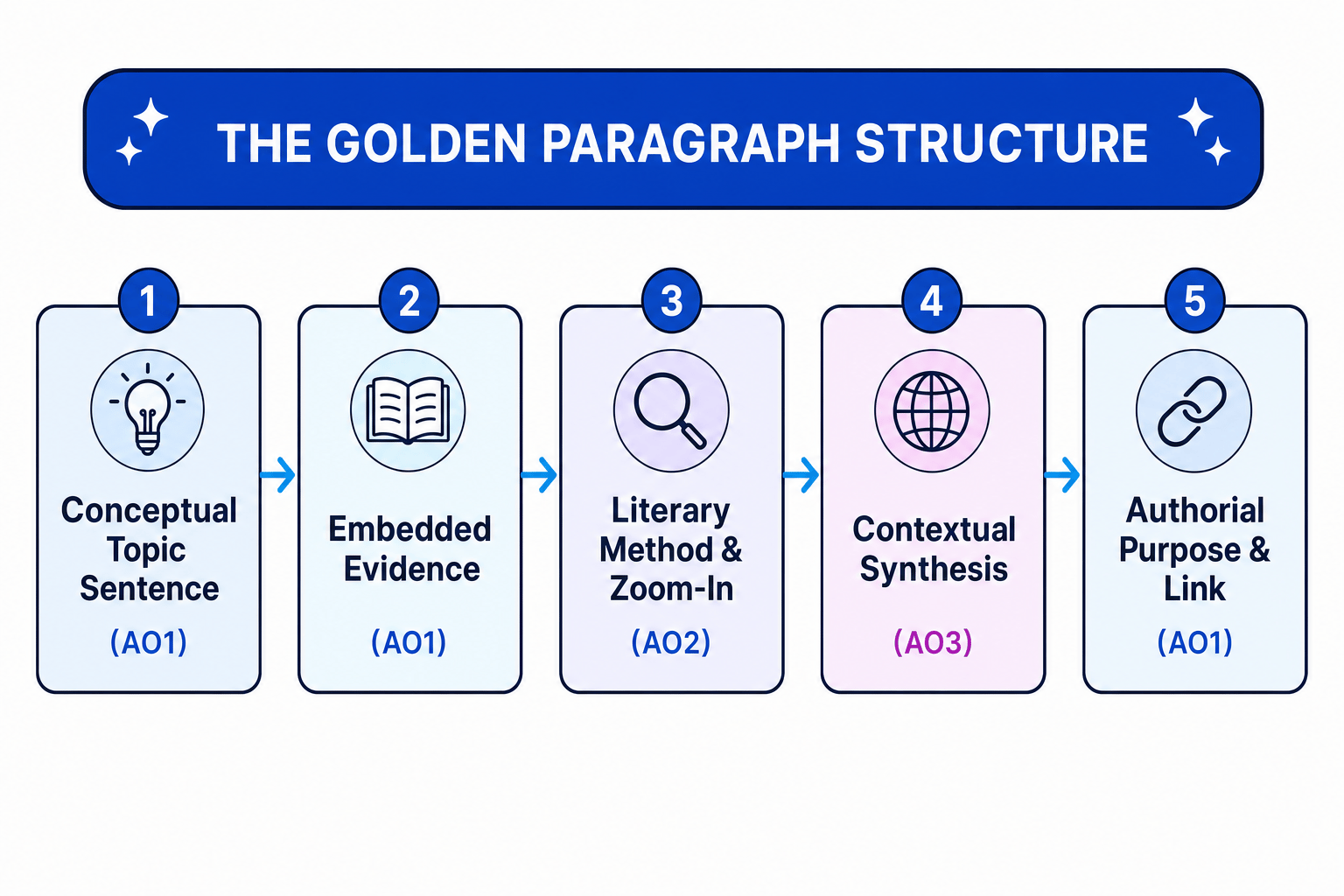
1. Conceptual Topic Sentence (AO1)
Start your paragraph with a conceptual idea rather than a plot point. Instead of writing "At the start of the play, Beatrice and Benedick argue a lot," write "Shakespeare initially establishes Beatrice and Benedick's relationship as an unconventional struggle for intellectual dominance, subverting the traditional courtly love conventions of the Elizabethan era."
2. Embedded Evidence (AO1)
Integrate your quotations directly into the flow of your sentence. Never use a quote as a standalone sentence.
Embedding Quotes
Instead of writing: Beatrice says: "I had rather hear my dog bark at a crow than a man swear he loves me." This shows she is cynical.
Try: Beatrice’s sharp cynicism is immediately apparent when she declares she would "had rather hear my dog bark at a crow" than listen to a man's declaration of love.
3. Literary Method & Zoom-In (AO2)
Identify the literary or dramatic devices Shakespeare uses. Do not just name-drop devices (a pitfall known as "feature spotting"). You must explain how the device creates meaning for the audience.
Stichomythia
Stichomythia is a dramatic technique where characters exchange rapid, single-line dialogue. Shakespeare uses this fast-paced verbal sparring to show intellectual equality and intense underlying tension between characters, particularly Beatrice and Benedick.
4. Contextual Synthesis (AO3)
Link your analysis directly to historical and social context. In Much Ado About Nothing, the main contextual drivers are the rigid expectations of patriarchal society, the concepts of male honour and female chastity, and the stylized, artificial performance of courtly love.
5. Authorial Purpose & Link (AO1)
Conclude your paragraph by reflecting on Shakespeare's broader message. Why did he write this play? What was he trying to teach or reveal to his contemporary audience about human nature, love, or social expectations?
The Golden Rule of AO3
Never "bolt on" historical facts at the end of a paragraph (e.g., "In Elizabethan times, women had no rights"). Context must explain why Shakespeare wrote a character a certain way or how a contemporary audience would have reacted to a specific scene.
Building a Level 6 Model Response
Let us look at how to construct a top-tier paragraph from scratch. We will walk through the intellectual process of building an analysis of Beatrice and Benedick's complex dynamic.
Drafting a high-scoring paragraph on Beatrice and Benedick
-
Formulate a conceptual topic sentence (AO1): Identify the core theme of their dynamic. Rather than just focusing on their "wit," conceptualize their banter as a defensive shield against the emotional vulnerability demanded by a highly patriarchal society.
Draft: "Shakespeare utilizes Beatrice and Benedick's intellectual sparring not merely as comic relief, but as a psychological defense mechanism designed to shield them from the rigid, vulnerable expectations of Elizabethan courtship."
-
Select and embed precise evidence (AO1): Identify a specific moment where this dynamic is on display. The opening scene of the play is ideal, where they engage in their first direct verbal battle.
Draft: "This is immediately evident in Act 1, Scene 1, where their interaction is described as a 'merry war' and a 'skirmish of wit,' culminating in Beatrice’s sharp assertion that she would 'rather hear my dog bark at a crow than a man swear he loves me.'"
-
Analyse the methods and zoom in on language (AO2): Examine the structural form of their dialogue and look closely at the imagery and metaphors Shakespeare employs. Notice that they speak in prose, not poetry.
Draft: "By structuring their dialogue in witty, fast-paced prose rather than the elevated blank verse typical of courtly lovers, Shakespeare highlights their rejection of conventional romantic sentiment. The oxymoronic metaphor of a 'merry war' highlights the underlying friction and mutual fascination that defines their bond. Furthermore, Beatrice’s animalistic imagery—preferring the grating sound of a 'dog bark[ing] at a crow' to a romantic vow—illustrates her deep-seated skepticism of male sincerity."
-
Synthesize the social and historical context (AO3): Connect Beatrice's fear of romance to the historical reality of what marriage meant for an Elizabethan woman: a loss of legal rights, independence, and status.
Draft: "For an Elizabethan audience, Beatrice’s vocal resistance to courtship would be perceived as highly rebellious, as patriarchal norms dictated that women remain submissive and silent. By rejecting romantic vows, Beatrice actively resists the vulnerability of a system where wives were legally subject to their husbands' absolute authority."
-
Synthesize and draft the final paragraph: Combine these steps into a cohesive, flowing paragraph, ending with a strong concluding link to Shakespeare's dramatic purpose.
Draft: "Shakespeare utilizes Beatrice and Benedick's intellectual sparring not merely as comic relief, but as a psychological defense mechanism designed to shield them from the rigid, vulnerable expectations of Elizabethan courtship. This is immediately evident in Act 1, Scene 1, where their interaction is described as a 'merry war' and a 'skirmish of wit,' culminating in Beatrice’s sharp assertion that she would 'rather hear my dog bark at a crow than a man swear he loves me.' By structuring their dialogue in witty, fast-paced prose rather than the elevated blank verse typical of courtly lovers like Hero and Claudio, Shakespeare highlights their rejection of conventional romantic sentiment. The oxymoronic metaphor of a 'merry war' highlights the underlying friction and mutual fascination that defines their bond. Furthermore, Beatrice’s animalistic imagery—preferring the grating sound of a 'dog bark[ing] at a crow' to a romantic vow—illustrates her deep-seated skepticism of male sincerity. For an Elizabethan audience, Beatrice’s vocal resistance to courtship would be perceived as highly rebellious, as patriarchal norms dictated that women remain submissive and silent. By rejecting romantic vows, Beatrice actively resists the vulnerability of a system where wives were legally subject to their husbands' absolute authority. Ultimately, Shakespeare presents their cynical banter as a protective armor, demonstrating how societal pressures can force individuals to mask genuine desire behind a facade of hostility."
Contrast as a Structural Method
One of the most powerful structural methods in the play is the contrast between the two main romantic couples: Beatrice & Benedick and Hero & Claudio.
To gain high AO2 marks, your essay should compare these couples to show how Shakespeare uses them to critique different aspects of Elizabethan love.
| Beatrice & Benedick | Hero & Claudio |
|---|---|
| Form: Speak predominantly in witty prose. | Form: Speak predominantly in romantic, elevated blank verse. |
| Dynamic: Equal intellectual partners; verbal sparring; realistic and cynical view of love. | Dynamic: Unequal patriarchal structure; Claudio idealizes Hero as a "modest young lady" and a "jewel." |
| Conflict Resolution: Built on mutual trust; Benedick challenges Claudio to a duel to defend Beatrice's family. | Conflict Resolution: Easily shattered by deceit; Claudio immediately publicly shames Hero at the altar. |
Confusing Prose and Verse
A common pitfall is ignoring the structural difference between prose (ordinary spoken language) and blank verse (unrhymed iambic pentameter). Do not assume everyone in Shakespeare speaks in poetry! Beatrice and Benedick’s use of prose is a deliberate structural choice by Shakespeare to represent their down-to-earth, realistic perspective, contrasting sharply with the artificial, poetic verse used by Claudio and Hero.
In the exam
- Spend 5 minutes planning: Do not just start writing. Read the prompt, highlight the key words, and write a brief thesis statement. Group your ideas into three clear conceptual points.
- Anchor your essay in the extract, then branch out: Start your analysis with a close look at the provided extract, and then use your transitions to link to other relevant parts of the play.
- Embed, don't dump: Keep your quotations short (under 5–6 words where possible). This makes them easier to embed seamlessly into your sentences, improving your AO4 (technical accuracy and fluency) score.
- Focus on the writer as a creator: Constantly refer to "Shakespeare" rather than just the characters. Remember that characters are constructs designed to deliver a specific message to the audience. Use phrases like "Shakespeare constructs...", "Shakespeare utilizes...", or "Shakespeare subverts..."
Check yourself
- Can you explain the difference between blank verse and prose, and why Shakespeare assigns each to specific characters in the play?
- How does the "merry war" between Beatrice and Benedick subvert traditional Elizabethan courtly love?
- What is the danger of "feature spotting," and how can you avoid it when discussing literary methods in your own essays?
