

What you'll learn
- How to build a strong essay plan for Princess & The Hustler without retelling the plot.
- How to create a clear argument that covers the whole play.
- How to plan paragraphs using moments, methods, effects and context.
- How to adapt plans for common themes such as identity, racism, family and ambition.
Why essay plans matter
An essay plan is a brief map of your answer before you write it. It helps you decide your argument, choose the best evidence, and avoid drifting into plot summary.
For Princess & The Hustler, planning is especially useful because the play connects personal experiences — Princess’s dreams, family tensions, beauty standards — with wider historical issues such as racism and the 1963 Bristol Bus Boycott.
Essay plan
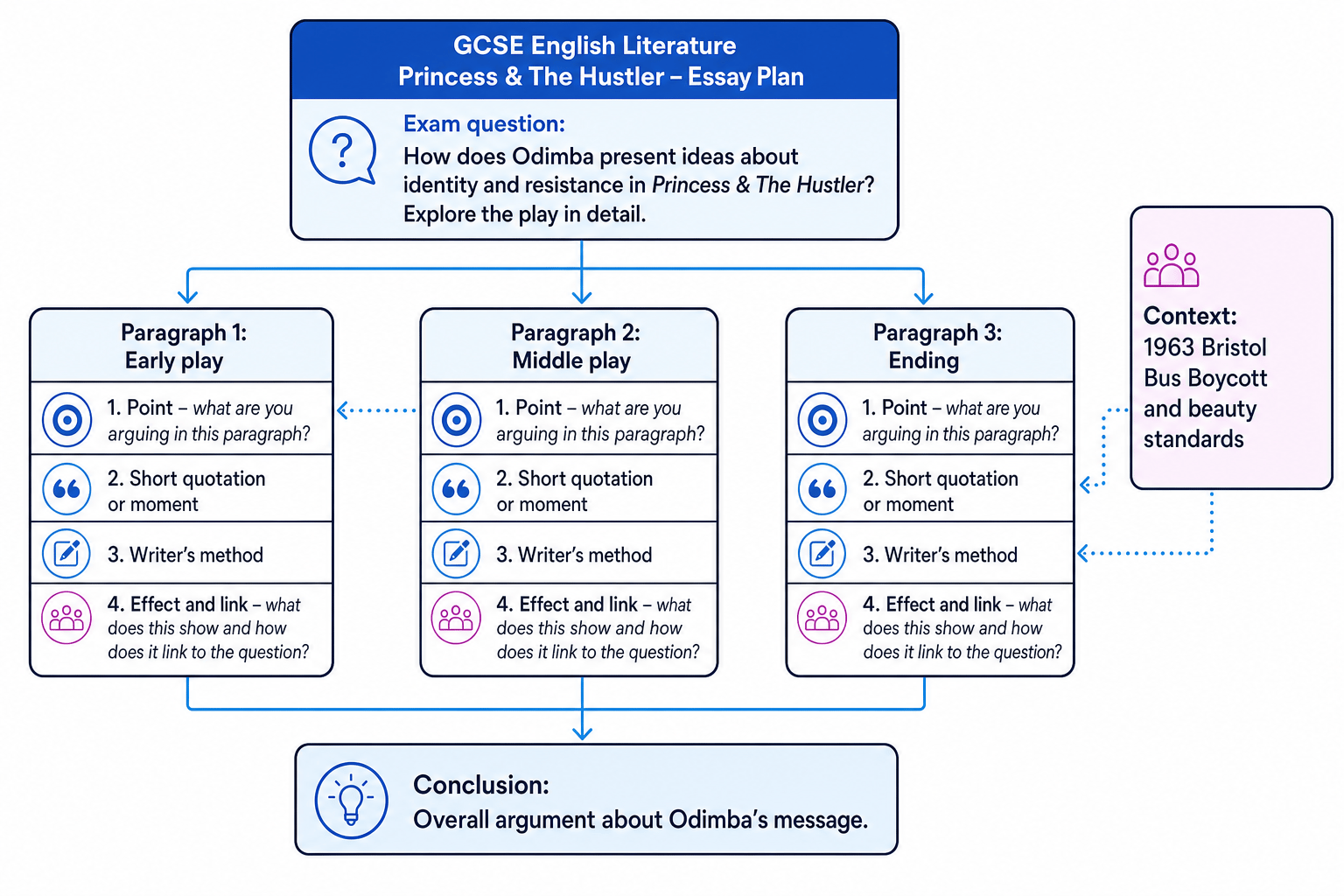
An essay plan is a structured set of notes that shows your main argument, your paragraph order, your key textual references, the writer’s methods you will analyse, and any relevant context you will connect to the question.
A good GCSE plan is not a script. It should be short enough to make quickly, but detailed enough to guide your whole answer.
The modern text question
For AQA GCSE English Literature Paper 2, Princess & The Hustler appears in the modern texts section. You answer one whole-text essay question. The exam is closed book, so you will not have the play in front of you.
You are rewarded for an informed, personal response supported by textual references, analysis of Odimba’s methods, and relevant context. You do not need to force in huge quotations. Short references to precise moments can be just as useful as long quotations, especially if you are not certain of the exact wording.
What the examiner wants
Your essay should answer the question with a clear argument about what Odimba presents and how she presents it through dramatic choices such as dialogue, characterisation, setting, structure, stage action, symbolism and contrast.
Start with the question, not the plot
The first planning step is to turn the question into an argument.
A thesis is your overall answer to the question. It should be more specific than “Odimba presents racism as bad” or “Princess is important”. It should show your interpretation.
Thesis
A thesis is the central argument of your essay: your main view about how and why the writer presents a character, theme or idea.
For example, if the question is about resistance, your thesis might be:
Odimba presents resistance as both political and personal: the public fight against racism in Bristol is mirrored by Princess’s private struggle to value herself in a society that limits Black identity and beauty.
That is stronger than simply saying:
The play shows people resisting racism.
The first version gives you a route through the whole essay.
Planning a response on resistance
-
Decide what “resistance” includes in the play: not only the organised Bristol Bus Boycott, but also personal acts of self-belief, refusal and challenge inside the family.
-
Build a whole-text thesis: Odimba connects public protest with private identity, showing that resisting racism also means resisting the ideas that make Princess doubt her own worth.
-
Choose three moments from across the play: early signs of racial and social pressure, middle scenes linked to community action or family conflict, and later moments where Princess’s understanding of herself changes.
-
Attach methods to those moments: historical setting, dramatic dialogue, contrasts between adults and children, symbolism of beauty contests, and the opposition in the title “Princess & The Hustler”.
-
Add context only where it sharpens the argument: the 1963 Bristol Bus Boycott matters because it shows racism as institutional, not just individual prejudice.
Use moments, not plot dumps
A textual reference is a precise reference to something in the play. It might be a short quotation, a stage moment, a character’s action, an entrance or exit, or a repeated idea.
Because Princess & The Hustler is a drama text, do not only think about “what happens”. Think about what an audience sees and hears.
Useful types of evidence include:
- the contrast between Princess’s childhood dreams and the adult world around her
- the beauty contest as a symbol of social pressure and aspiration
- the family home as a space where private tensions reveal wider social pressures
- the Bristol Bus Boycott context as a sign of organised community resistance
- the title contrast between “Princess” and “Hustler”
- moments where characters disagree about responsibility, ambition, racism or belonging
Retelling the story
Do not spend a paragraph explaining what happens next in the plot. Instead, choose one moment and explain how Odimba uses it to develop the question’s theme.
Plan analytical paragraphs
A strong paragraph should usually do five things:
- Make a clear point that answers the question.
- Refer to a precise moment or short quotation.
- Name a dramatic or literary method.
- Explain the effect on the audience.
- Link back to the question and Odimba’s wider message.
Method
A method is a deliberate choice made by the writer. In drama, this can include dialogue, stage directions, structure, setting, symbolism, contrast, characterisation, entrances and exits, or the use of off-stage events.
For Princess & The Hustler, methods are often more dramatic than poetic. You might analyse how Odimba stages conflict in the family home, how she uses a child’s perspective, or how the historical setting shapes the audience’s response.
Planning a paragraph on dreams and identity
-
Form the point: Odimba presents dreams as complicated because Princess’s ambitions are hopeful, but they are also shaped by narrow beauty standards.
-
Select evidence: refer to Princess’s desire to succeed in a beauty contest and connect it to the title word “Princess”, which suggests fairy-tale status, glamour and being looked at.
-
Identify method: analyse symbolism. The beauty contest can symbolise social approval, especially in a society where Black girls are not always allowed to see themselves as beautiful or powerful.
-
Explain audience effect: the audience may find Princess’s dream charming at first, but also troubling because it reveals how racism and colour prejudice can enter a child’s imagination.
-
Link outwards: connect this to the play’s wider concern with identity, showing that self-worth has to be fought for as much as political equality.
Essay plan templates for key question types
These are not full essays. They are starting plans you can adapt depending on the exact wording of the question.
Plan 1: Identity and self-worth
Possible thesis: Odimba presents identity as something shaped by family, race, gender and history, but she also shows that Princess can begin to define herself more powerfully.
| Paragraph | Focus | Methods to analyse |
|---|---|---|
| 1 | Princess’s dreams show her desire to be admired and recognised. | Symbolism of the beauty contest; child perspective; title word “Princess”. |
| 2 | The wider racist society limits how Black characters are seen and treated. | Historical setting; contrast between private home and public discrimination. |
| 3 | The play moves towards a stronger sense of self and community pride. | Structure; character development; contrast between fantasy and political reality. |
Plan 2: Racism and resistance
Possible thesis: Odimba presents racism as both everyday and institutional, but she also presents resistance as collective, courageous and emotionally necessary.
| Paragraph | Focus | Methods to analyse |
|---|---|---|
| 1 | Racism affects ordinary life, not just public politics. | Domestic setting; dialogue; tension between adults and young people. |
| 2 | The Bristol Bus Boycott shows racism as a structural problem. | Historical context; off-stage public conflict; references to employment and exclusion. |
| 3 | Resistance is shown through community action and personal confidence. | Ensemble drama; contrast; hopeful structural movement. |
Plan 3: Family relationships
Possible thesis: Odimba presents family as loving but pressured, showing how racism, money, gender expectations and disappointment shape relationships inside the home.
| Paragraph | Focus | Methods to analyse |
|---|---|---|
| 1 | Princess’s family gives her identity, humour and belonging. | Dialogue; family interactions; child’s viewpoint. |
| 2 | Conflict reveals deeper social pressures. | Dramatic tension; arguments; contrast between dreams and responsibilities. |
| 3 | Family is imperfect but still connected to survival and community. | Structure; reconciliation or partial understanding; wider social context. |
Plan 4: The Hustler and ambition
Possible thesis: Through the Hustler figure, Odimba explores charm, instability and survival, suggesting that ambition can be both a source of hope and a way of avoiding responsibility.
| Paragraph | Focus | Methods to analyse |
|---|---|---|
| 1 | The title “Princess & The Hustler” immediately sets up contrast. | Title; connotations; opposition between innocence and streetwise survival. |
| 2 | The Hustler’s behaviour creates conflict in the family. | Dialogue; characterisation; entrances and exits; dramatic disruption. |
| 3 | His role helps expose the difference between fantasy, performance and real change. | Structural contrast; symbolism; link to Princess’s developing identity. |
Safe quotation strategy
If you are unsure of an exact line, do not invent one. Use precise references to moments, character names, the title, stage action and setting, then include only the short quotations you know accurately.
Integrating context
Context means the historical, social or cultural circumstances that help us understand the text. In this play, the most important context is Bristol in 1963, especially the Bristol Bus Boycott and the racism faced by Black communities in Britain.
Context should not sit in a separate paragraph. It should explain why Odimba’s choices matter.
Using context in a racism paragraph
-
Make the analytical point first: Odimba presents racism as built into public systems, not just as individual nastiness.
-
Link the point to the play’s historical setting: Bristol in 1963 connects the family’s private experiences to the real struggle against employment discrimination in the bus company.
-
Analyse the effect: this makes the audience see that prejudice affects work, movement, confidence and family life, so the political context becomes emotionally immediate.
-
Return to the question: Odimba therefore presents resistance as necessary because racism limits both public opportunity and private self-worth.
Conclusions: finish with the writer’s message
A conclusion should not repeat your introduction word for word. It should answer: what is Odimba ultimately suggesting?
A strong conclusion might begin:
Overall, Odimba presents identity as something under pressure, but not fixed by oppression.
Or:
Ultimately, Odimba suggests that resistance begins in public protest but also continues in the private struggle to believe in your own value.
In the exam
-
Spend about five minutes planning: write your thesis, three paragraph focuses, and one method for each paragraph.
-
Cover the whole play: choose moments from the beginning, middle and end so your answer feels developed rather than narrow.
-
Keep context connected to analysis: mention the Bristol Bus Boycott or 1960s racism only when it helps explain Odimba’s message.
-
Analyse drama as drama: write about dialogue, staging, character entrances, setting, structure and audience response.
-
Prioritise accuracy: short, correct references are better than long, uncertain quotations.
Check yourself
- Can you turn a theme such as identity, racism or family into a clear thesis about Odimba’s message?
- Can you plan three paragraphs without simply retelling the plot?
- Can you name at least two dramatic methods you could analyse in Princess & The Hustler?
