

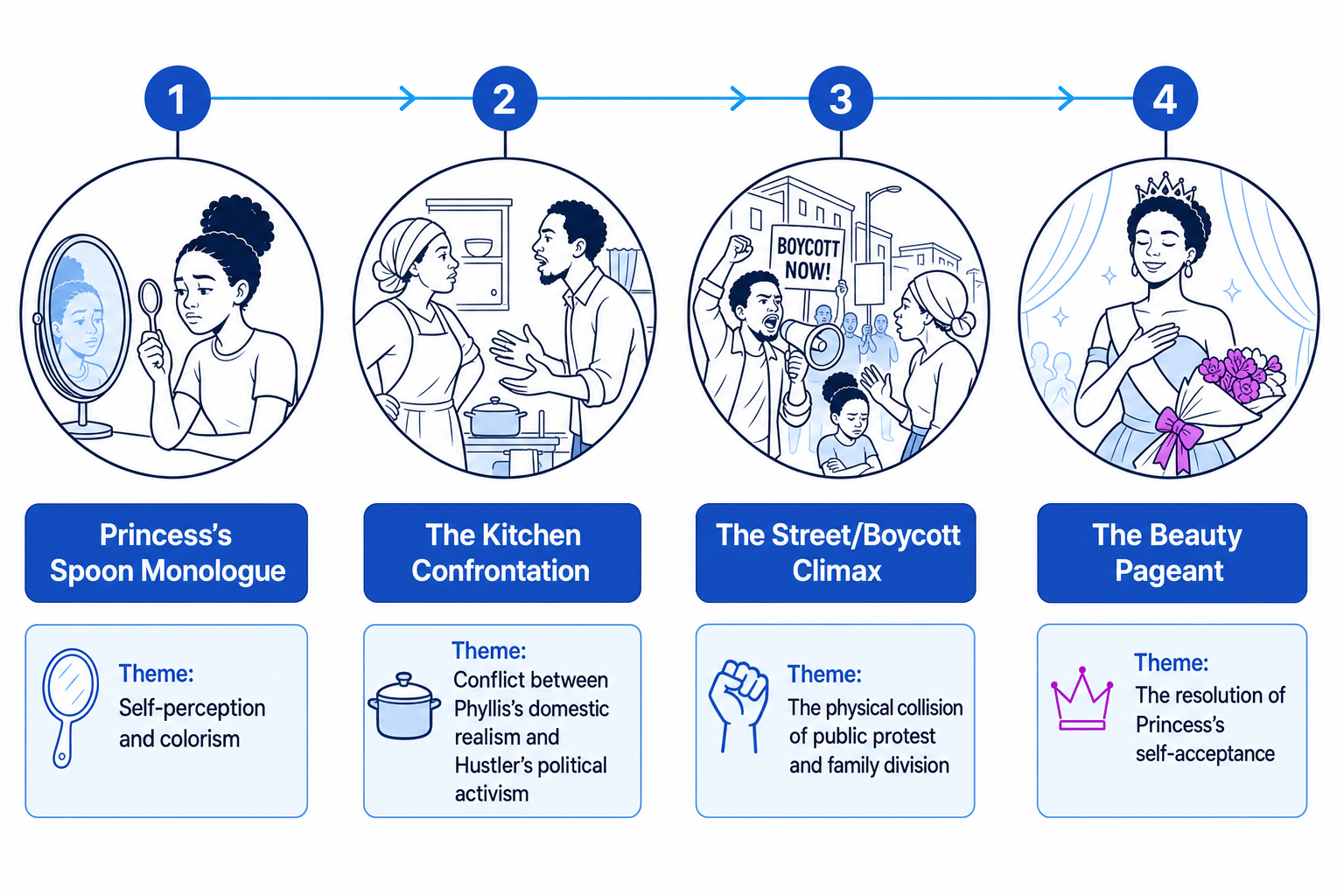
Key Scene 1: The Spoon Monologue (Act 1, Scene 1)
The play opens not with a massive public riot, but with an intimate, highly symbolic moment of self-evaluation. Ten-year-old Princess stands in front of a mirror, holding a metal spoon.
The Mirror and the Spoon as Symbols
Princess's opening monologue introduces the audience to the painful realities of colorism within the Black diaspora. She looks at her reflection in the back of a spoon and describes herself:
"I am Princess. I am black. Very black. Like the back of a spoon."
Colorism
Colorism is a form of prejudice or discrimination in which people are treated differently based on the social meanings attached to the skin color, often valuing lighter skin over darker skin tones.
Odimba uses the everyday object of a "spoon" to show how deeply embedded these ideas are in Princess's child-like imagination. A spoon is domestic, ordinary, and distorted. By looking at her reflection on the convex back of the spoon, Princess sees a distorted version of herself, highlighting her fractured self-esteem.
The Contrast of the "Pale" Princess
Princess is obsessed with beauty pageants and fairy tales. She dreams of being "pale" because the dominant, Eurocentric media of 1960s Britain has taught her that beauty and royalty are synonymous with whiteness.
This scene establishes the internal conflict that mirrors the external political battle of the Bristol Bus Boycott: before Princess can stand up to a racist society, she must first battle the internalised racism that makes her dislike her own skin.
Key Scene 2: The Kitchen Confrontation (Act 1, Scene 6)
This scene is the emotional and intellectual heart of the play. It takes place in the family kitchen—Phyllis's domain—and highlights the clash of perspectives between Hustler (the idealistic activist) and Phyllis (the protective, pragmatic mother).
Survival vs. Resistance
The conflict between Phyllis and Hustler is not about a lack of love; it is a fundamental clash of survival strategies. Phyllis believes the safest way to survive in a hostile, white-dominated society is to keep your head down and work hard. Hustler believes that true safety can only be won by standing up and fighting systemic injustice.
Hustler is deeply involved in organising the Bristol Bus Boycott. He wants to challenge the Bristol Omnibus Company’s racist ban on employing Black and Asian bus crews. Phyllis, however, is terrified of the consequences. She knows that "troublemakers" get evicted from their homes and lose their jobs.
Analysing domestic vs. political tension in Act 1
Let us walk through how to construct an analytical paragraph analyzing the dialogue in Act 1, Scene 6.
- Focus on the prompt: Analyze how Odimba presents the conflict between Phyllis and Hustler.
- Select precise evidence: Choose a quote that reflects their opposing worldviews.
- Evidence: Phyllis tells Hustler: "We have to live here, Hustler. We have to walk these streets without people looking at us like we stole something."
- Identify the writer's methods: Identify the language and dramatic techniques.
- Method: Collective pronoun ("We"), simile ("like we stole something"), domestic setting (the kitchen).
- Analyse the effects: Explain what this reveals to the audience.
- Analysis: The collective pronoun "We" highlights Phyllis's sense of shared vulnerability; she is not just worried about Hustler, but about how his public activism will paint a target on the backs of their children. The simile "like we stole something" captures the psychological toll of everyday racism in 1960s Britain—the feeling of constant, hostile surveillance and the unfair presumption of criminality. By staging this in the kitchen, Odimba contrasts Hustler's macro-political focus with the micro-realities of domestic safety.
- Connect to context (AO3): Link this to the historical reality of the Windrush generation.
- Context: This reflects the genuine anxieties of the Windrush generation in the 1960s, who faced widespread housing discrimination ("No Irish, No Blacks, No Dogs") and could easily be evicted or fired for demanding civil rights.
Key Scene 3: The Climax of the Boycott (Act 2, Scene 4)
As the Bristol Bus Boycott intensifies, the public protests spill directly into the private lives of the characters. This scene is the dramatic climax of the play's political plotline.
The Street as a Battleground
The stage directions indicate a change in tone. The warmth of the home is replaced by the sounds of chanting, megaphones, and police sirens. Leroy, Princess’s brother, gets caught up in the physical confrontation.
Odimba uses this scene to show that neutrality is impossible. Phyllis’s attempt to shield her family from the political storm fails when her own son is drawn into the fight. When Leroy returns home bruised, the physical reality of racial violence in Britain is brought directly onto the stage.
Do not simplify Phyllis
Do not write Phyllis off as "anti-protest" or "cowardly." Her resistance is silent but fierce. She fights daily against poverty, isolation, and prejudice to keep a clean, respectable home for her children. In the exam, make sure you show empathy for her pragmatic perspective.
Key Scene 4: The Pageant and Self-Acceptance (Act 2, Scene 5)
The final key scene is the beauty pageant, which serves as the resolution of the play's emotional arc. Princess, wearing her dress, finally gets her moment on stage.
Subverting the White Gaze
The beauty pageant is traditionally a space that excludes or exoticises dark-skinned Black women. However, when Princess steps forward, she does not win by conforming to white standards of beauty; instead, she wins the support and love of her family and community.
       [ Early Play: The "Back of a Spoon" ]
                         │
                         ▼
        (Internalised Colorism & Distorted Self-Image)
                         │
                         ▼
       [ Final Scene: The Pageant Stage ]
                         │
                         ▼
        (Self-Acceptance & Rejection of White Gaze)
By the end of the play, Princess no longer wants to be "pale like a princess in a book." The pageant becomes a celebration of her dark skin and her heritage. Her family gathers around her, signifying that their internal divisions (Hustler’s activism vs. Phyllis’s pragmatism) have been resolved through their collective love for Princess.
Pageant Victory
Many students mistakenly write that Princess wins the official beauty pageant. She doesn't. What matters is her personal victory—she wins the acceptance of herself and her community. Focus your analysis on her psychological growth rather than a literal trophy.
In the exam
When writing about the key scenes in Princess & The Hustler, use these steps to structure your response:
- Trace the shift: Always explain how a domestic scene (inside the house) mirrors or reacts to a public event (the Bristol Bus Boycott).
- Analyse stage directions: Odimba uses set design, lighting, and sound (chants, music, sirens) to build tension. Do not just focus on dialogue; analyse how the stage itself communicates meaning.
- Balance AO1 and AO3: Never talk about the boycott without linking it to the family's emotional journey, and never talk about the family without explaining the historical context of Windrush-era Bristol.
Check yourself
- Why does Princess look at her reflection in the back of a spoon rather than a normal mirror? What does this symbolise?
- How does the physical setting of the kitchen in Act 1, Scene 6 contrast with the public setting of the bus boycott?
- What is the difference between Hustler’s and Phyllis's definitions of "survival" in 1960s Britain?
