In your GCSE English Literature exam, you will be asked to analyse how Shakespeare presents a specific character or theme across the whole play. To write a top-tier essay, you need to know how the play’s structural arc shapes its meaning.
In Much Ado About Nothing, Shakespeare masterfully blends elements of comedy and tragedy. By studying the most critical scenes, you will understand how he moves his characters from lighthearted wit to dark betrayal, and ultimately to reconciliation.
What you'll learn
- How Shakespeare structures a Renaissance comedy and manipulates its typical conventions.
- The thematic and linguistic shifts across four pivotal scenes in the play.
- How to analyse key dramatic methods such as dramatic irony, stichomythia, and the contrast between prose and verse.
Understanding Shakespearean Comedy Structure
Before looking at specific scenes, we must understand the overarching structure of the play. Shakespearean comedies traditionally follow a three-part structural movement:
- Order: A stable social world is established, though it contains underlying tensions or rigid rules.
- Chaos (or Discord): The characters enter a state of confusion, deception, or misrule. In many comedies, this happens in a "green world" (like the forest in A Midsummer Night's Dream), but in Much Ado, it occurs within the domestic space of Leonato's home and garden.
- Restored Order: Misunderstandings are resolved, social harmony is restored, and the play concludes with marriages and dancing.
Stichomythia
Stichomythia is a dramatic technique where characters speak in rapid, single-line exchanges. It is used to show intense conflict, romantic tension, or a fast-paced battle of wits.
The dramatic arc of Much Ado About Nothing relies on these structural shifts to explore the fragility of reputation and the power of language.
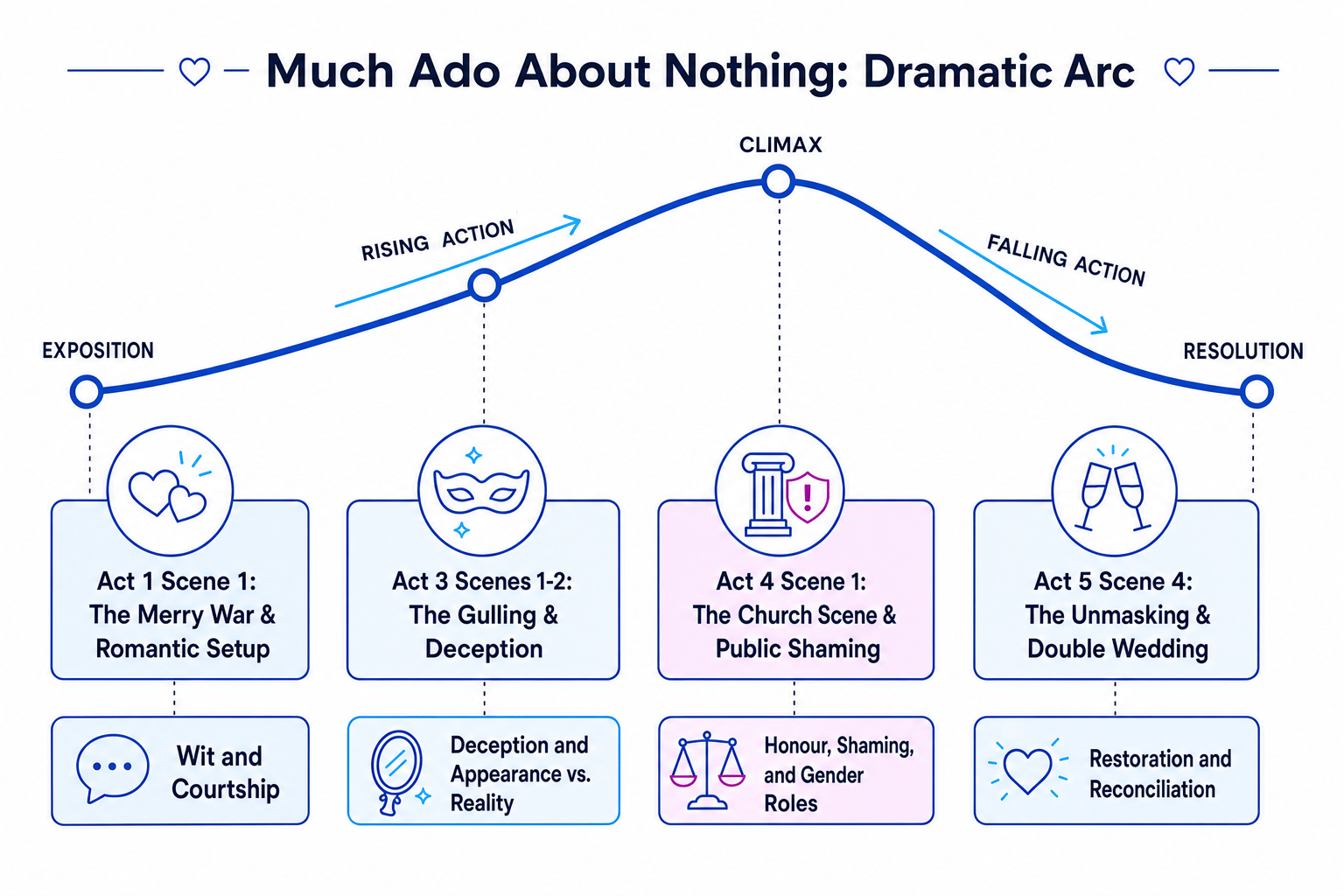
1. Act 1, Scene 1: The Merry War and Romantic Setup
The Dramatic Function
This scene functions as the exposition. It establishes the social setting of Messina, a courtly world governed by military hierarchy, honour, and sharp wit.
Key Developments and Methods
- The "Merry War": We are introduced to Beatrice and Benedick’s verbal sparring. Beatrice asks about Benedick, masking her interest in him with insults: "I pray you, is Signior Mountanto returned from the wars or no?" (calling him a show-off fencer). Their subsequent dialogue uses stichomythia to establish their intellectual equality and mutual resistance to marriage.
- Prose vs. Verse: Notice that Beatrice and Benedick speak in rapid, naturalistic prose. This reflects their skepticism of courtly romance. In contrast, when Claudio speaks of Hero, he shifts into romantic, structured blank verse (unrhymed iambic pentameter): "Silence is the perfectest herald of joy: I were but little happy, if I could say how much."
- The Seeds of Deception: Don Pedro promises to woo Hero on Claudio's behalf at the masked ball. This immediately introduces the motif of masking and "noting" (observing/misinterpreting), which drives the entire plot.
The Power of Prose vs. Verse
Shakespeare uses prose for characters who are cynical, down-to-earth, or engaged in witty banter (Beatrice and Benedick). He reserves blank verse for high-status emotional declarations, courtly love, and dramatic solemnity (Claudio, Hero, Leonato).
2. Act 3, Scenes 1 & 2: The Gulling Scenes
The Dramatic Function
These parallel scenes form the rising action. They showcase the dual nature of deception: it can be used for benevolent purposes (uniting Beatrice and Benedick) or malevolent purposes (Don John tearing Hero and Claudio apart).
Gulling
Gulling means tricking or duping someone. The "gulling scenes" refer to the parallel garden scenes where Benedick (Act 2, Scene 3) and Beatrice (Act 3, Scene 1) are tricked into believing the other is secretly in love with them.
Key Developments and Methods
-
The Orchard Setting: The physical setting of the garden or orchard is highly symbolic. Labyrinthine and full of hiding spots, it represents the deceptive nature of appearances. Hero describes Beatrice hiding "in the pleachèd bower, / Where honeysuckles, ripened by the sun, / Forbid the sun to enter."
-
Dramatic Irony: The audience watches Hero and Ursula fabricate stories about Benedick's love while Beatrice listens in secret. The comedy arises from the fact that we know more than the characters on stage.
-
Beatrice's Linguistic Shift: Upon hearing she is loved, Beatrice's language undergoes a radical transformation. She abandons her sharp, defensive prose and speaks in a highly structured, rhyming Shakespearean sonnet:
"Contempt, farewell! and maiden pride, adieu! / No glory lives behind the back of such. / And, Benedick, love on; I will requite thee"
This structural shift signals her emotional vulnerability and her willingness to shed her cynical armour.
-
The Dark Mirror (Act 3, Scene 2): Immediately following this comic deception, Don John plays his malicious trick on Claudio, claiming Hero is unfaithful. The structural placement of these scenes forces the audience to compare the two types of deceit.
Don't treat deception as purely evil
Many students write that "deception is bad" in the play. Remember that Shakespeare presents deception as a neutral tool. It is the intent of the deceiver that makes it a comic force for love (Don Pedro's plan) or a destructive force for division (Don John's plan).
3. Act 4, Scene 1: The Church Scene (The Climax)
The Dramatic Function
This is the climax of the play. Shakespeare deliberately shatters the comic tone, pushing the play to the brink of tragedy. The sacred space of the church, meant for union and order, becomes a theatre of public shaming and discord.
Key Developments and Methods
- The Public Shaming: Claudio accuses Hero at the altar, using violent, sensory language to attack her chastity. He calls her a "rotten orange" and claims "She knows the heat of a luxurious bed."
- The Patriarchy and Honour: Hero's father, Leonato, immediately believes the male accusers over his own daughter, wishing her dead to preserve his family's honour: "Do not live, Hero, do not ope thine eyes." This highlights the extreme vulnerability of women in Elizabethan society, where a woman's reputation was entirely dependent on her perceived chastity.
- The Romantic Turning Point: Left alone in the chapel, Beatrice and Benedick finally confess their genuine love. However, this romantic climax is immediately pierced by Beatrice’s shocking command: "Kill Claudio."
- The Tragedy of Gender Roles: Beatrice's rage stems from her powerlessness as a woman in a patriarchal society. She laments: "O God, that I were a man! I would eat his heart in the marketplace." Benedick must choose between his loyalty to his military brotherhood (Claudio) and his love for Beatrice. By agreeing to challenge Claudio, Benedick rejects the toxic masculine peer pressure of his soldier friends.
Analysing Claudio's language in the Church Scene
Here is how you can build an analytical paragraph examining Claudio's language in Act 4, Scene 1, linking his words to context and Shakespeare's methods.
- Point: Shakespeare uses highly contrasting imagery in the church scene to show how quickly Claudio's idealized courtly love turns into violent misogyny when his honour is threatened.
- Evidence: At the altar, Claudio rejects Hero by stating, "There, Leonato, take her back again. Give not this rotten orange to your friend; She’s but the sign and semblance of her honour."
- Analysis of Method (AO2): The metaphor of the "rotten orange" is highly sensory and insulting. Oranges were expensive, decorative fruits associated with beauty and youth; by calling her "rotten", Claudio implies she is corrupted, ruined, and worthless. The sibilance in "sign and semblance" mimics a venomous hiss, emphasizing his disgust and spitting contempt. He focuses entirely on appearances ("sign"), revealing his own superficiality.
- Contextual Link (AO3): In Elizabethan England, a bride's virginity was a financial and social transaction. An unchaste woman ruined her family's social standing. By publicly rejecting Hero as damaged goods, Claudio is defending his own reputation among his military peers, demonstrating that patriarchal honour is valued far above female life.
4. Act 5, Scene 4: The Unmasking and Resolution
The Dramatic Function
This is the resolution (or denouement). Social order is restored, the tragic misunderstandings are cleared up, and the comic convention of marriage is fulfilled.
Key Developments and Methods
-
Hero's Symbolic Resurrection: Hero is brought out masked and is revealed to Claudio, who believed she was dead. She states: "One Hero died defiled, but I do live, / And surely as I live, I am a maid." Her "death" was necessary to cleanse her reputation of the false slander.
-
The Masking Motif: The women enter wearing masks, mirroring the Act 2 masquerade. This structural repetition shows that while deception originally caused the tragedy, a benevolent deception (pretending Hero is a "second Hero") is required to cure it.
-
Beatrice and Benedick's Realism: Even at the altar, Beatrice and Benedick attempt to maintain their witty, defensive prose:
Benedick: "Do not you love me?"
Beatrice: "Why, no; no more than reason."Only when their written love sonnets (stolen from their pockets by Claudio and Hero) are produced do they finally admit their love. Their relationship remains grounded in reality, contrasting with Claudio and Hero's highly idealized, fragile romance.
-
The Final Dance: The play ends with Benedick calling for a dance: "Strike up, pipers!" In Shakespearean comedy, a dance is a vital structural symbol of harmony, unity, and the restoration of social order after chaos.
Ignoring the darker undertones of the ending
Many students argue that the ending of the play is a perfect, happy resolution. However, a top-level essay must acknowledge the lingering dark shadows: Hero marries the man who publicly humiliated her and wished her dead, and Don John's capture at the end reminds us that malice is never entirely eradicated from the world.
In the exam
If you get a question on themes like Deception, Honour, or Gender Roles, follow this structural checklist to build your argument:
- Map the Arc: Show how the theme changes from the lighthearted beginning (Act 1), through the rising action of the garden tricks (Act 3), to the dark climax of the church scene (Act 4), and finally to the resolution (Act 5).
- Contrast the Couples: Contrast Claudio and Hero’s superficial, verse-led relationship with Beatrice and Benedick’s realistic, prose-led connection.
- Use Structural Terminology: Use terms like exposition, climax, dramatic irony, and resolution to demonstrate your understanding of Shakespeare’s craft.
- Integrate Context: Always explain why characters react the way they do based on Elizabethan concepts of honour, patriarchal power, and female chastity.
Check yourself
- Why is Beatrice's shift from prose to a rhyming sonnet in Act 3, Scene 1 structurally significant?
- How does Shakespeare use the physical setting of the church in Act 4, Scene 1 to amplify the shock of Claudio’s accusations?
- In what ways does the final scene of the play challenge the idea of a completely "happy ending"?
