What you'll learn
- How to turn a Much Ado About Nothing question into a clear argument.
- How to structure three strong paragraphs for the AQA Shakespeare response.
- How to use short quotations, methods and context without “bolting them on”.
- How to adapt plans for common themes such as love, deception, honour, gender and comedy.
Why essay plans matter
In the AQA Shakespeare question, you are usually given an extract and asked to write about the extract and the play as a whole. The exam is closed book, so a good plan helps you stay calm, choose quotations quickly, and avoid retelling the plot.
Essay plan
An essay plan is a short outline of your argument before you write. It should include your overall answer, the order of your paragraphs, the quotations you will use, and the methods you will analyse.
A strong plan is not just “paragraph 1 = Beatrice, paragraph 2 = Benedick”. It needs to show a developing argument about what Shakespeare is doing and why.
Plans are arguments, not lists
The best essay plans show movement: what Shakespeare presents at the beginning, how this becomes more complicated, and what changes by the end.
Step 1: Turn the question into a thesis
A thesis is your main answer to the question. It should be a clear judgement, not a vague opening like “Shakespeare presents love in many ways”.
Thesis
A thesis is the central argument your whole essay proves. In a literature essay, it usually explains how Shakespeare presents an idea and why that presentation matters.
For Much Ado About Nothing, your thesis should often include a contrast because the play itself is full of contrasts: witty love and serious honour, comedy and cruelty, appearance and reality, freedom and social control.
Turning a question into a thesis
Question: How does Shakespeare present Beatrice as a strong female character?
-
Decide what kind of “strength” the question is asking about. Beatrice is not physically powerful; her strength is shown through wit, independence, emotional honesty and moral courage.
-
Track how Shakespeare develops this strength. At first, Beatrice uses comic language to mock marriage: “I had rather hear my dog bark at a crow than a man swear he loves me” in Act 1 Scene 1. Later, her strength becomes more serious when she challenges male injustice after Hero is shamed.
-
Form a thesis that covers the whole play: Shakespeare presents Beatrice as verbally bold and socially unconventional, but he also shows that her greatest strength is moral courage in a patriarchal world that often silences women.
Starting with plot
Avoid opening with “In the play, Beatrice argues with Benedick and then they fall in love.” That tells the story, but it does not answer how Shakespeare presents her.
Step 2: Build a line of argument
A line of argument is the thread that connects every paragraph. Each paragraph should prove part of the same main idea.
Line of argument
A line of argument is the logical route your essay takes from your thesis to your conclusion. It stops your essay becoming three disconnected points.
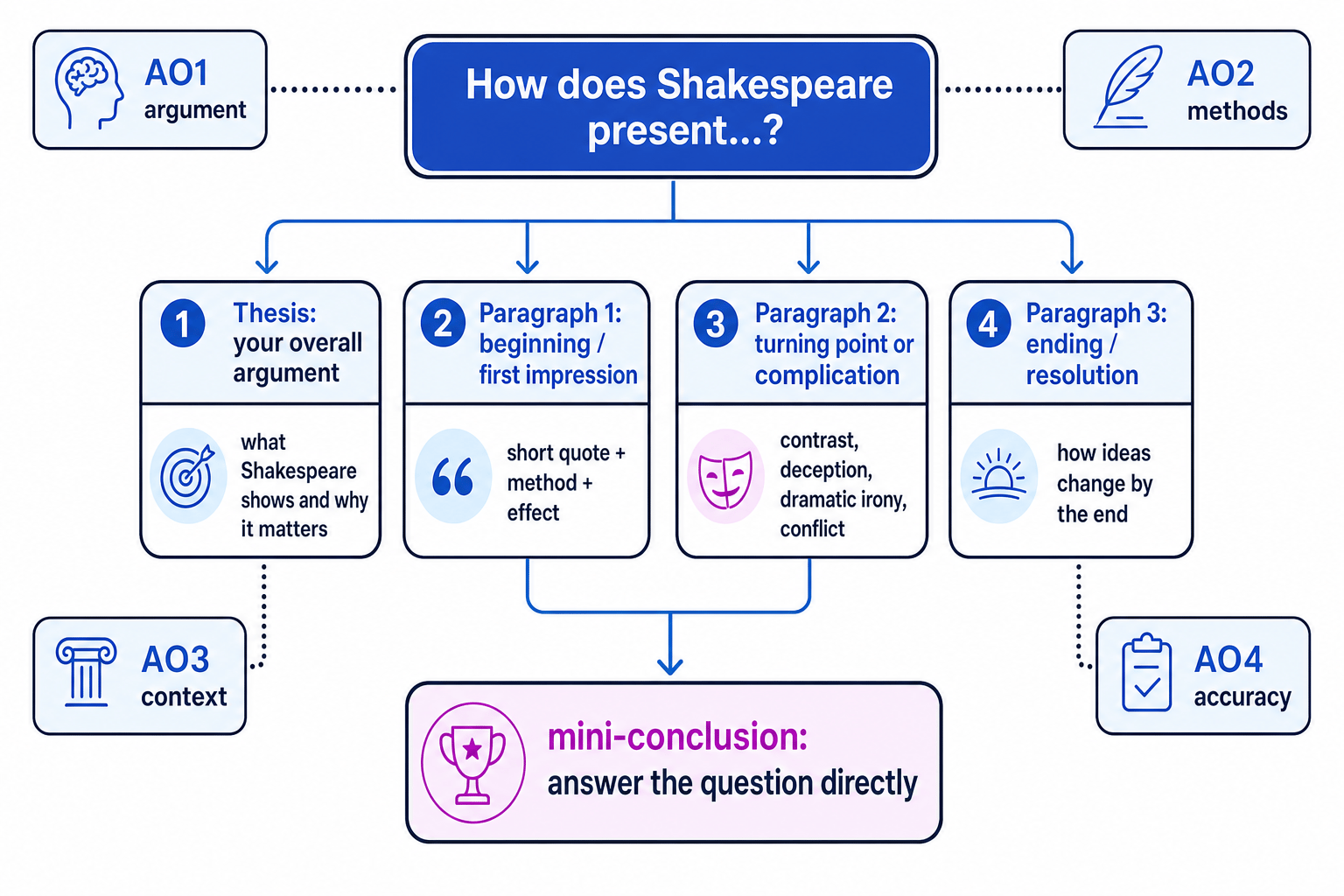
A simple GCSE structure is:
- Beginning / first impression — how Shakespeare introduces the idea.
- Middle / complication — how conflict, deception or dramatic irony makes it more complex.
- Ending / resolution — how Shakespeare leaves the audience thinking about the idea.
The diagram below shows a flexible structure you can use for most Much Ado About Nothing questions.
Structuring a deception essay
Question: How does Shakespeare present deception in Much Ado About Nothing?
-
Begin with the comic side of deception. Beatrice and Benedick are tricked into admitting love, and Hero’s line “Some Cupid kills with arrows, some with traps” in Act 3 Scene 1 makes deception sound playful and theatrical.
-
Develop the argument by contrasting this with destructive deception. Don John’s plot against Hero turns “noting” and watching into a weapon, leading Claudio to condemn Hero publicly as a “rotten orange” in Act 4 Scene 1.
-
End by showing how truth is restored, but not without discomfort. Dogberry’s foolish watch accidentally uncovers the truth, while Hero’s “One Hero died defiled, but I do live” in Act 5 Scene 4 suggests that reputation can be damaged even when innocence is proved.
Step 3: Plan paragraphs with evidence, method and effect
In literature, evidence means a short quotation or precise reference to the play. A method is a choice Shakespeare makes, such as metaphor, dramatic irony, structure, comedy, contrast, symbolism or stage action.
Method
A method is a writer’s deliberate choice of language, form or structure. You should name the method only when you can explain its effect.
A useful paragraph route is:
- Point — answer the question.
- Evidence — use a short quotation.
- Method — identify Shakespeare’s technique.
- Effect — explain what the audience understands or feels.
- Link — connect back to the question and your thesis.
Developing a planned paragraph
Question: How does Shakespeare present attitudes to women and honour?
-
Make the point precise: Shakespeare shows that women’s reputations are controlled by male judgement, especially through Claudio’s treatment of Hero.
-
Choose evidence that proves this shift. Claudio first idealises Hero as “such a jewel” in Act 1 Scene 1, but later humiliates her as a “rotten orange” in Act 4 Scene 1.
-
Analyse the method. The metaphors reduce Hero to objects: a valuable “jewel” when she seems pure, and spoiled fruit when Claudio believes she is sexually dishonourable.
-
Link to context and meaning. Shakespeare exposes a patriarchal honour culture in which a woman’s social value depends on chastity and male approval, making the wedding scene disturbing as well as dramatic.
Use tiny quotations well
A short quotation like “rotten orange”, “Kill Claudio” or “merry war” is better than a long quotation you cannot analyse closely. Zoom in on one or two words.
Adaptable essay plans for common questions
Use these as flexible skeletons. Do not memorise them word for word: adapt them to the exact wording of the question.
Plan 1: Beatrice and Benedick / love
Possible thesis: Shakespeare presents love as something that challenges pride, transforms language and exposes people’s self-deception.
- Paragraph 1 — resistance to love: Beatrice mocks romance: “I had rather hear my dog bark at a crow than a man swear he loves me” in Act 1 Scene 1. Benedick claims “I will live a bachelor”. Their exaggeration and comic insults suggest love is treated as a threat to independence.
- Paragraph 2 — gulling and transformation: The staged overhearing scenes reveal their self-deception. Hero says, “Some Cupid kills with arrows, some with traps”, presenting love as comic manipulation.
- Paragraph 3 — ending: Benedick’s “Peace! I will stop your mouth” in Act 5 Scene 4 can be read as a playful kiss, but it also raises questions about whether comedy fully preserves Beatrice’s independence.
Methods to mention: witty prose, verbal sparring, dramatic irony, parallel structure, comic resolution.
Plan 2: Hero, Claudio, honour and gender
Possible thesis: Shakespeare presents honour as a social system that protects male pride more than female truth.
- Paragraph 1 — Hero as idealised object: Claudio asks, “Can the world buy such a jewel?” in Act 1 Scene 1. The metaphor suggests admiration, but also possession and value.
- Paragraph 2 — public shaming: Claudio calls Hero a “rotten orange” in Act 4 Scene 1. The harsh metaphor shows how quickly idealisation becomes disgust when female chastity is questioned.
- Paragraph 3 — restoration: Hero says, “One Hero died defiled, but I do live” in Act 5 Scene 4. Her reputation is repaired, but the language of death shows the emotional cost of public shame.
Methods to mention: metaphor, symbolism of the wedding, public stage action, contrast between comedy and tragedy, patriarchal context.
Plan 3: Deception, appearance and “noting”
Possible thesis: Shakespeare presents deception as double-edged: it can create comic harmony, but it can also destroy trust and reputation.
- Paragraph 1 — social masks: Leonato describes Beatrice and Benedick’s “merry war” in Act 1 Scene 1. Their witty conflict hides attraction and vulnerability.
- Paragraph 2 — harmful deception: Don John’s plot turns observation into misjudgement. Claudio’s cry “Out on thee! Seeming!” in Act 4 Scene 1 shows his obsession with appearance.
- Paragraph 3 — truth revealed by fools: Dogberry’s “write me down an ass” in Act 4 Scene 2 is comic, but his accidental success exposes the failure of supposedly honourable men.
Methods to mention: dramatic irony, title pun on “nothing” / “noting”, overhearing, mistaken identity, comedy of error.
Plan 4: Comedy, conflict and order
Possible thesis: Shakespeare uses comedy not just to entertain, but to expose human pride, social absurdity and the fragility of honour.
- Paragraph 1 — witty comedy: The “merry war” between Beatrice and Benedick creates humour through sharp dialogue and mutual pride.
- Paragraph 2 — dark interruption: The wedding scene shifts towards near-tragedy as Claudio publicly shames Hero. This makes the comedy more morally serious.
- Paragraph 3 — comic restoration: Benedick concludes that “man is a giddy thing” in Act 5 Scene 4, suggesting human beings are changeable and foolish. The dance and marriages restore order, but the audience remembers the cruelty that came before.
Methods to mention: genre, contrast, structural shift, malapropism, stage action, comic ending.
How to adapt a plan to the extract
The extract is not a separate mini-essay. Use it as your starting point, then connect it to the whole play.
A good route is:
- Write about one or two details from the extract.
- Link those details to a moment earlier or later in the play.
- Explain how the whole play develops the same idea.
Forgetting the whole play
If you only analyse the extract, your answer will feel narrow. If you ignore the extract, you will not fully answer the question. Keep moving between both.
Context: small, relevant and connected
For Much Ado About Nothing, context is most useful when it explains the pressure on characters. You might refer to:
- Patriarchal society — men held legal and social authority over women.
- Female chastity and honour — a woman’s reputation affected her marriage prospects and family status.
- Comedy as a genre — Shakespearean comedy often ends with marriage, reconciliation and social order.
- Public reputation — Messina is a social world where watching, gossip and overhearing shape identity.
Do not drop context into a sentence by itself. Make it explain Shakespeare’s choices.
Context sentence starter
Try: “For Shakespeare’s audience, this would be especially disturbing because…” Then link directly to the quotation you have just analysed.
In the exam
- Spend a few minutes planning a thesis and three paragraph points before you start writing.
- Use short quotations from memory and zoom in on individual words or methods.
- Keep linking back to the question, especially at the end of each paragraph.
Check yourself
- Can you turn a theme question into a clear thesis in one sentence?
- Can you name three short quotations for love, deception or honour?
- Does each paragraph in your plan show a change from the beginning, middle or end of the play?
